
An NDSRI (nitrosamine drug substance-related impurity) is a nitrosamine impurity that shares the structure of a drug's active pharmaceutical ingredient (API), because it forms when an amine group in the API, or in an API fragment, reacts with a nitrosating agent such as nitrite. FDA sets NDSRI acceptable intake (AI) limits through the potency categories in its August 2023 guidance.
This guide covers the categories and their limits, the link to ICH M7(R2), and what FDA posted after its August 1, 2025 date. It adds a check you will not find elsewhere: Atlas searched the full text of 510 drug CGMP warning letters dated January 2021 to October 2026 for nitrosamine wording, as of November 2026.
Key facts:
- FDA's guidance "Recommended Acceptable Intake Limits for Nitrosamine Drug Substance-Related Impurities (NDSRIs)" (August 2023) sorts NDSRIs into five predicted carcinogenic potency categories with AI limits of 26.5, 100, 400, 1,500 and 1,500 ng/day.
- FDA's AI limits webpage listed 285 NDSRIs and other nitrosamines with a category-based limit in its Table 1, updated September 24, 2026, and 147 of them sit in Categories 4 or 5 at 1,500 ng/day.
- FDA recommended that firms finish NDSRI confirmatory testing and submit required application changes by August 1, 2025, and on June 23, 2025 it accepted a progress update from firms that could not finish.
- FDA's compound-specific limits are 96 ng/day for NDMA and 26.5 ng/day for NDEA.
- In the Atlas warning letter index, none of the 510 drug CGMP warning letters dated January 22, 2021 to October 14, 2026 names NDMA, NDEA, an NDSRI or any N-nitroso compound.
What is an NDSRI?
An NDSRI is a nitrosamine that carries the API's own structure, so each one is generally unique to a single drug substance. FDA's AI limits webpage explains that NDSRIs form by nitrosation of APIs or API fragments that contain secondary amine or dimethyl tertiary amine centers, often during drug product manufacture or storage through reaction with residual nitrites in excipients.
That route matters for where you look. A small-molecule nitrosamine such as NDMA usually traces back to API synthesis: the solvents, reagents and recovered materials. An NDSRI can form after the API is made, inside the tablet, from residual nitrite in an excipient.
FDA has tracked the problem since 2018, when it learned of NDMA in the angiotensin receptor blocker valsartan. FDA guidance on nitrosamines then went through three editions of "Control of Nitrosamine Impurities in Human Drugs" (September 2020, February 2021 and Revision 2 in September 2024), with the separate NDSRI limits guidance in August 2023.
NDSRI vs NDMA: what is the difference?
The difference between an NDSRI and NDMA is structure and source. NDMA (N-nitrosodimethylamine) is a small-molecule nitrosamine with no structural link to any API, found across many products. An NDSRI is a nitrosated form of one specific API, so its limit usually comes from a predicted potency category rather than from carcinogenicity data on that exact compound.
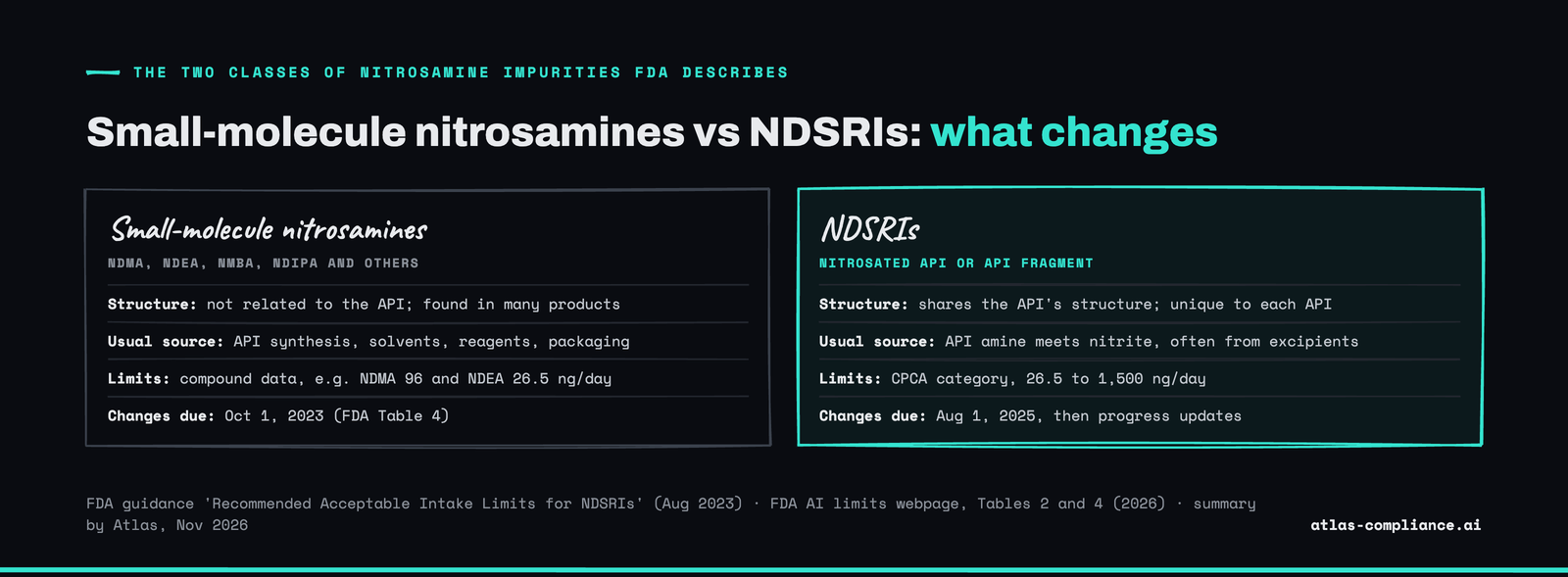
| Small-molecule nitrosamines | NDSRIs | |
|---|---|---|
| Examples | NDMA, NDEA, NMBA, NDIPA, NEIPA, NDBA | N-nitroso-fluoxetine, N-nitroso-sertraline, N-nitroso-duloxetine |
| Link to the API | None; found in many drug products | Shares the API structure; unique to each API |
| Usual source | API synthesis conditions, solvents, packaging leachates | API amine reacting with nitrite, often from excipients |
| How FDA sets the AI limit | Compound data (NDMA 96 ng/day, NDEA 26.5 ng/day) | Predicted potency category, unless FDA lists a compound-specific limit |
| Risk assessment due | March 31, 2021 | November 1, 2023 |
| Required changes due | October 1, 2023 | August 1, 2025, with progress updates after |
The dates come from Table 4 of FDA's AI limits webpage. Some NDSRIs, such as N-nitroso-fluoxetine and N-nitroso-duloxetine, have compound-specific or read-across limits in FDA's Table 2 (100 ng/day each), and that limit replaces the category limit.
What are the FDA acceptable intake limits for NDSRIs?
FDA's NDSRI acceptable intake limits run from 26.5 ng/day to 1,500 ng/day, set by one of five predicted carcinogenic potency categories in the August 2023 guidance. The Carcinogenic Potency Categorization Approach (CPCA) scores the NDSRI's structure: the hydrogen atoms on the carbons next to the N-nitroso group, plus features that raise or lower potency.
| Potency category | Recommended AI limit | Basis FDA gives |
|---|---|---|
| 1 | 26.5 ng/day | Equal to the class-specific limit based on NDEA, the most potent well-tested nitrosamine |
| 2 | 100 ng/day | Representative of NDMA (96 ng/day) and NNK (100 ng/day) |
| 3 | 400 ng/day | A 4-fold decrease in potency from Category 2 |
| 4 | 1,500 ng/day | Low predicted potency; set at the threshold of toxicological concern in ICH M7(R2) |
| 5 | 1,500 ng/day | Not predicted to be activated by alpha-hydroxylation; set at the same threshold |
Each limit is a lifetime figure that approximates one extra cancer case in 100,000 people after 70 years of daily exposure. Your specification usually needs the limit in ppm, which FDA calculates as the AI in nanograms divided by the maximum daily dose in milligrams. A Category 1 NDSRI in a product with a 100 mg maximum daily dose works out to 0.265 ppm.
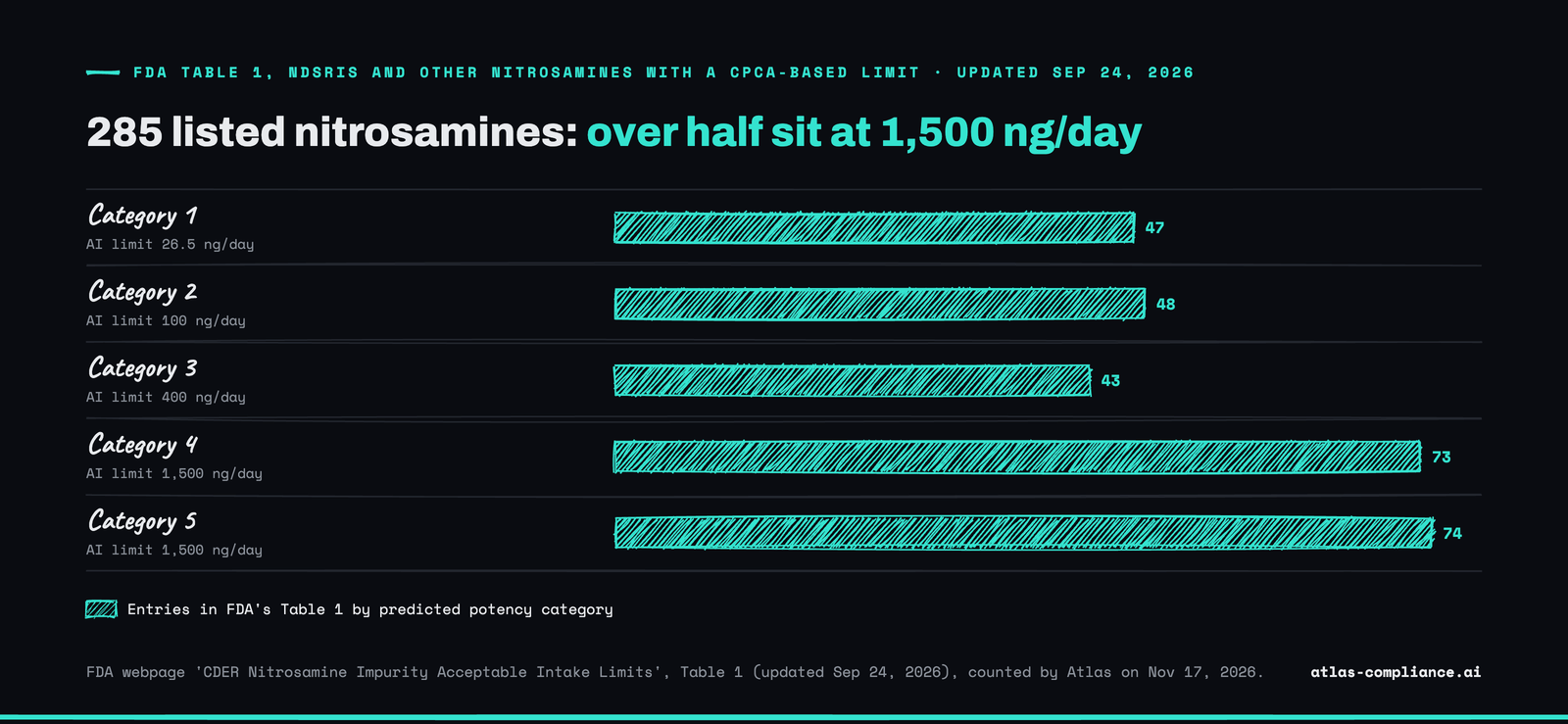
Atlas counted FDA's Table 1 on November 17, 2026. Of its 285 entries, 47 sit in Category 1, 48 in Category 2, 43 in Category 3, 73 in Category 4 and 74 in Category 5. FDA notes that a listing does not confirm the NDSRI is present in any product. It flags the API as at risk.
How does ICH M7 relate to nitrosamine limits?
ICH M7(R2) is the source of the framework that FDA's nitrosamine limits sit inside. The FDA-adopted version, "M7(R2) Assessment and Control of DNA Reactive (Mutagenic) Impurities in Pharmaceuticals to Limit Potential Carcinogenic Risk" (July 2023), places N-nitroso compounds in the cohort of concern, a group of high-potency mutagenic carcinogens that the general threshold of toxicological concern does not cover (ICH multidisciplinary guidelines).
FDA's August 2023 guidance states that the CPCA complements ICH M7(R2) and uses its structure-activity principles. The 1,500 ng/day ceiling for Categories 4 and 5 is the M7(R2) threshold of 1.5 micrograms a day. On September 24, 2026, FDA also posted a statement that M7's less-than-lifetime adjustment factors may apply to nitrosamine limits for drugs taken for shorter durations. Our ICH guidelines overview shows where M7 sits next to the Q3A and Q3B impurity guidelines.
What happened after the August 1, 2025 NDSRI deadline?
After the August 1, 2025 NDSRI deadline, FDA let firms that could not finish send a progress update instead of the full change. FDA's June 23, 2025 update to its AI limits webpage said the original timeline "is not achievable for all approved applications for at-risk products," while repeating that firms should finish confirmatory testing and submit changes by that date.
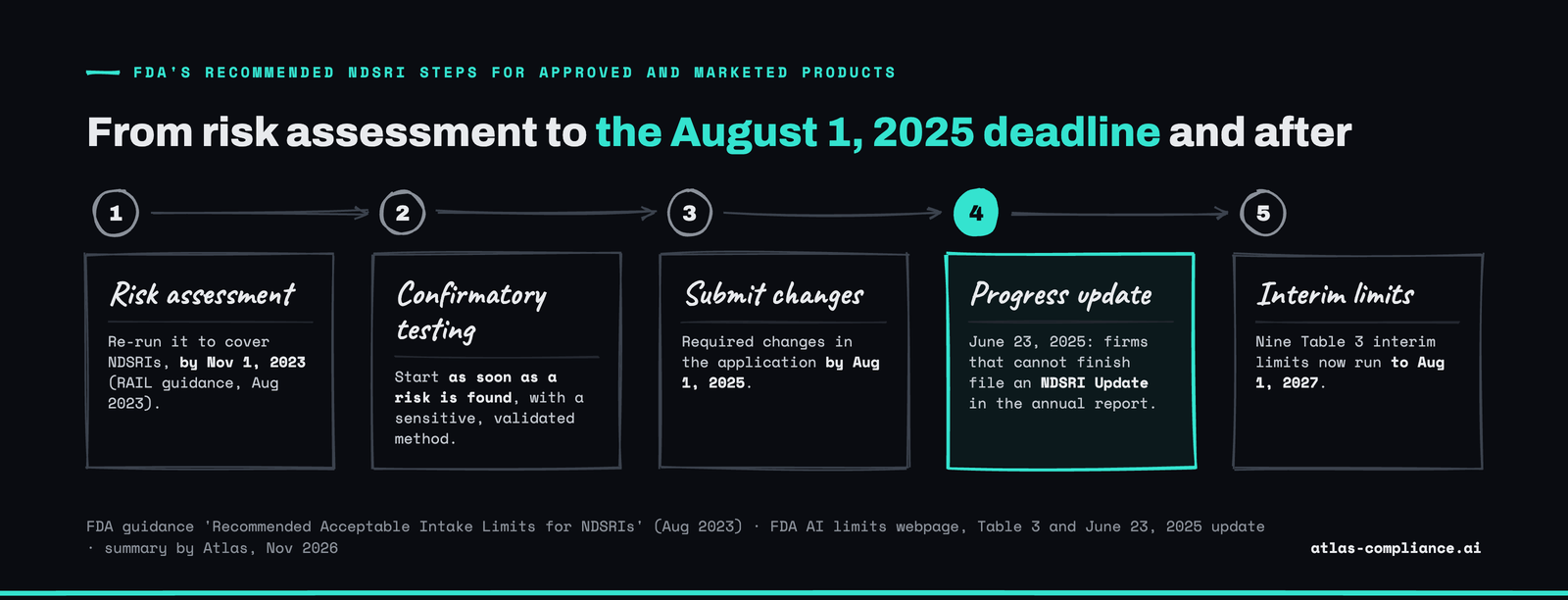
FDA asked applicants to file the update as an "NDSRI Update" in the Log of Outstanding Regulatory Business, eCTD section 1.13.14 of the annual report. The update should cover:
- Whether the NDSRI forms under targeted forced degradation.
- The NDSRIs detected and the validated test method.
- The batches tested, and when, relative to manufacture.
- Confirmatory results in ng/day or ppm.
- The root cause, if known.
- Mitigation attempts and an estimated completion date.
Manufacturers of non-application products should prepare the same update and keep it on file. FDA has posted more since the deadline. On August 18, 2025 it added information on leachable NDBA and other small-molecule nitrosamines in infusion bags. On July 29, 2025 and again on July 29, 2026 it extended the nine interim limits in Table 3, which cover products such as sertraline, fluoxetine and rifampin, first to August 1, 2026 and then to August 1, 2027. As of the webpage's September 24, 2026 revision, FDA still says it intends to share revised targeted timelines for NDSRI changes in an upcoming communication.
The change itself usually lands in your change control system, whether it is a new excipient supplier, a nitrite specification or a reformulation. Our guide to change control covers that side.
What do FDA warning letters say about nitrosamines?
FDA's nitrosamine warning letters are concentrated in 2018 and 2019, the valsartan and ARB recall years. Atlas searched the full text of 510 drug CGMP warning letters for finished pharmaceuticals and APIs, dated January 22, 2021 to October 14, 2026, for NDMA, NDEA, NDSRI, N-nitroso and nitrosamine. None of the 510 names one.
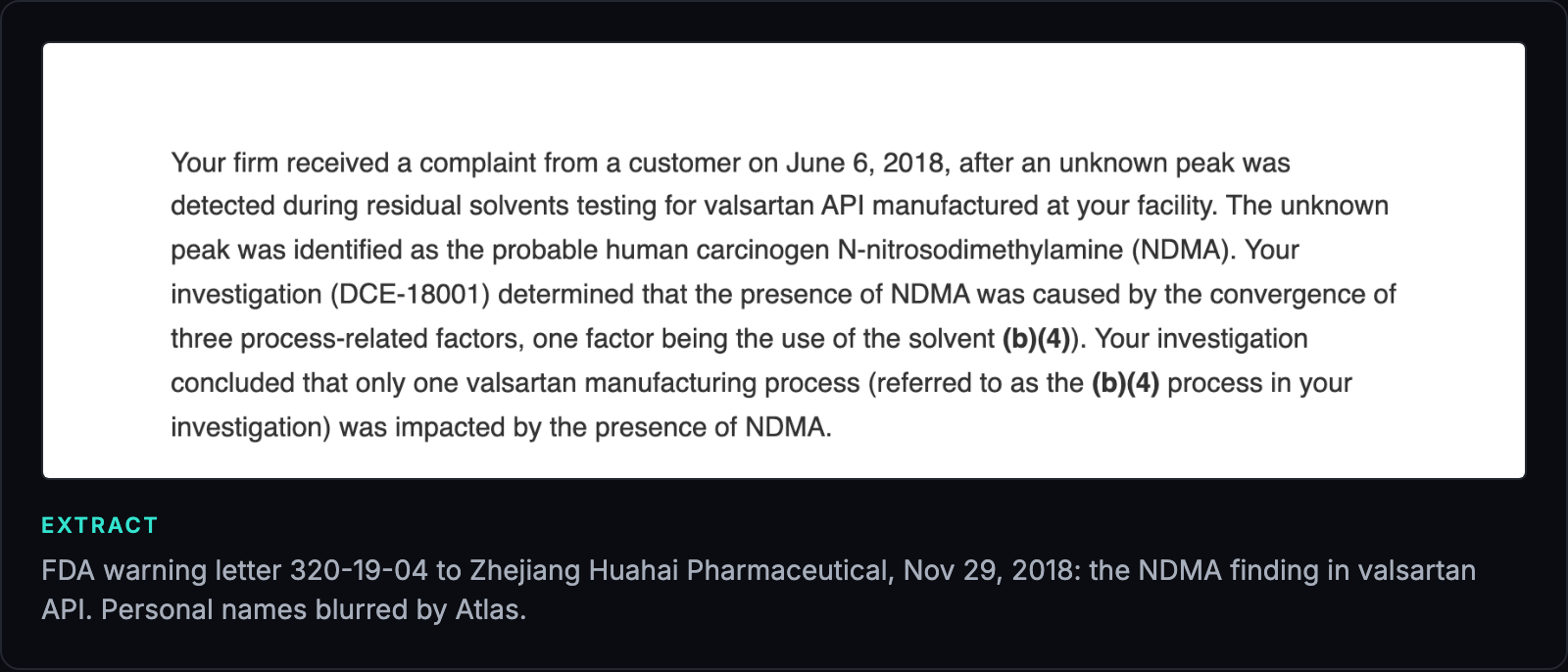
The early letters set the pattern FDA still applies. FDA warning letter 320-19-04 to Zhejiang Huahai Pharmaceutical, dated November 29, 2018, followed an inspection of its Chuannan facility in Linhai from July 23 to August 3, 2018. FDA wrote that a customer complaint on June 6, 2018 identified an unknown peak in residual solvent testing as NDMA, and that the firm's investigation was inadequate because FDA found NDMA in batches from a second process. The letter also faulted a November 2011 process change approved without assessing whether mutagenic impurities could form, and noted Import Alert 66-40 from September 28, 2018.
| Warning letter | Date | Facility in Atlas | Nitrosamine finding | Atlas record |
|---|---|---|---|---|
| 320-19-04 | Nov 29, 2018 | Zhejiang Huahai, Chuannan, Linhai | NDMA in valsartan API; investigation and change control | 7 inspections, 3 Form 483s |
| 320-20-03 | Oct 8, 2019 | Torrent, Indrad | Losartan batches recalled for nitrosamine impurities | 10 inspections, 8 Form 483s |
| 320-20-06 | Nov 5, 2019 | Unit 8, Vizianagaram (recorded as Matrix Pharmacorp) | NDMA and NDEA cross-contamination controls | 10 inspections, 3 Form 483s |
Atlas facility records are from the August 15, 2026 release. The Torrent and Unit 8 letters are covered in our Torrent inspection history and Mylan and Viatris India history. FDA closed the Unit 8 letter on July 27, 2023.
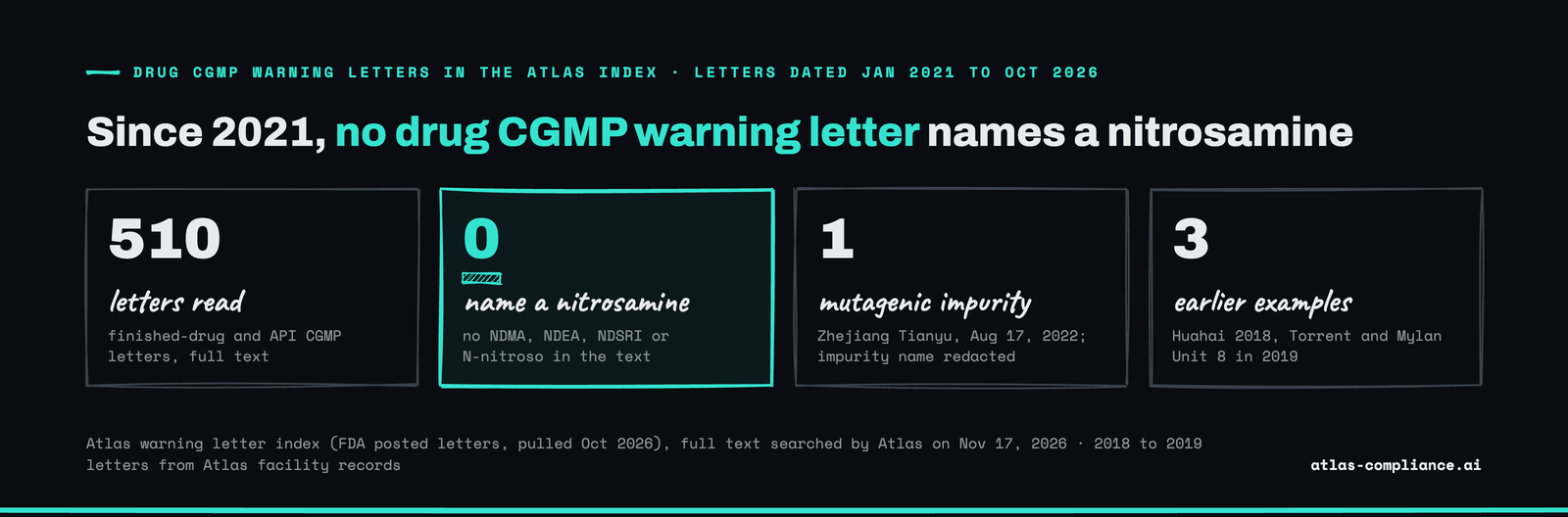
One letter in the 510 comes close. FDA's August 17, 2022 letter to Zhejiang Tianyu Pharmaceutical, after a February 28 to March 4, 2022 inspection, cites a failure to evaluate a potential mutagenic impurity in an API that a customer complaint and an EDQM deficiency letter raised in July 2021. FDA redacted the impurity's name, so the letter cannot be counted as a nitrosamine letter.
Zhejiang Huahai's later letter shows how a facility's record moves on. The Xunqiao, Linhai facility received a June 6, 2025 letter after a January 2025 inspection that cited 21 CFR 211.67(a), 211.42(c)(10) and 211.100(a), with no nitrosamine finding. Its Atlas record holds 12 inspections and 6 Form 483s, the latest closing April 24, 2026.
Investigators can still record a nitrosamine finding on a Form 483. It lands under the standard Part 211 headings, such as 211.160 for laboratory controls or 211.192 for investigations, and the citation records in the FDA Form 483 database do not name the impurity. If your next inspection follows an NDSRI change, check which Part 211 sections your likely investigator has cited at peer API and generic facilities.
 Atlas
See what the FDA knows about your next investigator.
30 minutes with the founder. No pitch deck.
How do you build an NDSRI control strategy?
You build an NDSRI control strategy by following FDA's three steps: assess the risk, run confirmatory testing where a risk exists, and file the changes that bring each NDSRI at or below its AI limit. For a drug product, the work usually runs in this order:
- Screen the API for secondary amines and dimethyl tertiary amines, and check FDA's Table 1 and Table 2 for its listed NDSRIs.
- Map nitrite sources: excipient nitrite levels by supplier and lot, and packaging.
- Run targeted forced degradation to show whether the NDSRI forms.
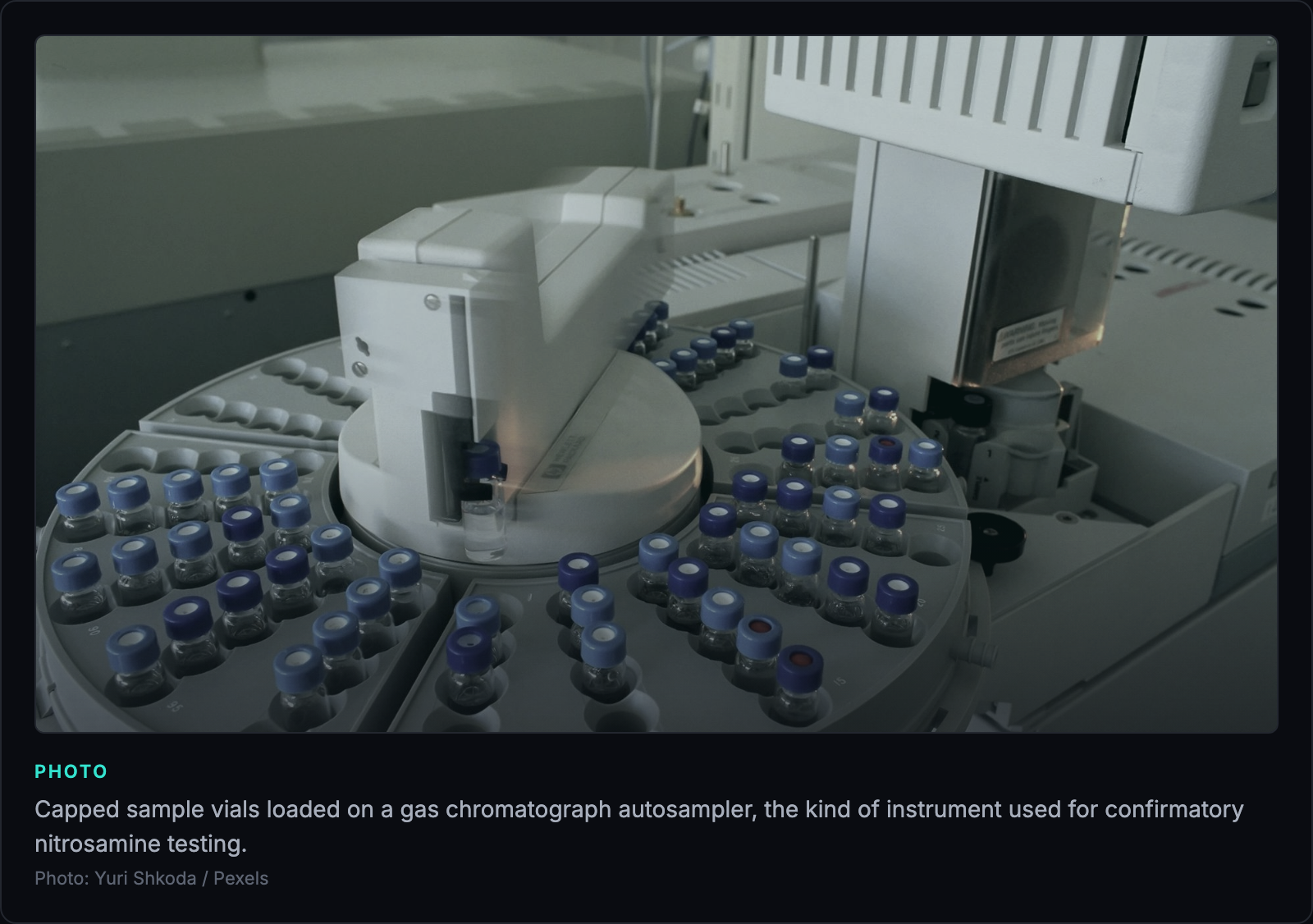
- Test batches with a sensitive, validated method, including aged stability samples.
- Set the control: a specification, a change of excipient supplier or process, or a reformulation.
- File the change or, if it is not done, the NDSRI Update in the annual report.
The testing ties into routine CGMP duties. 21 CFR 211.160(b) requires scientifically sound specifications and test procedures (eCFR, 21 CFR 211.160), and an NDSRI limit added to a specification then becomes part of release testing under 211.165. FDA's webpage lists FDA-developed methods for specific products, such as LC-ESI-HRMS methods for N-nitroso-propranolol and N-nitroso-bumetanide, which users must validate before relying on the data. The 21 CFR Part 211 guide maps the laboratory and investigation sections an inspector will read alongside your nitrosamine file.
FDA publishes new warning letters every week, and the digest below sends the drug CGMP letters, impurity findings included, as they post.
AtlasFDA Inspection Intelligence Digest
We track every 483, EIR, and warning letter the moment it happens. Get the signals before they hit the FDA website.
Frequently asked questions
NDSRIs form when a nitrosating agent, most often nitrite under acidic conditions, reacts with a secondary amine or dimethyl tertiary amine in the API or an API fragment. In drug products, FDA points to residual nitrites in excipients as a common source. Formation can continue during storage, so a batch that passes at release can rise on stability, which is why aged samples belong in confirmatory testing.

Written by
Bhavish Agarwal
Founder, Atlas
Bhavish Agarwal is the founder of Atlas and previously worked at Google and Microsoft. He has spent the past several years building regulatory data infrastructure for the pharmaceutical industry.