
ICH Q14 is the ICH guideline that describes science and risk based approaches for developing analytical procedures for drug substances and drug products and for managing changes to those procedures over the product lifecycle. ICH adopted Q14 at Step 4 on November 1, 2023, on the same day as the revised validation guideline ICH Q2(R2), and FDA announced both as final guidance in the Federal Register on March 7, 2024.
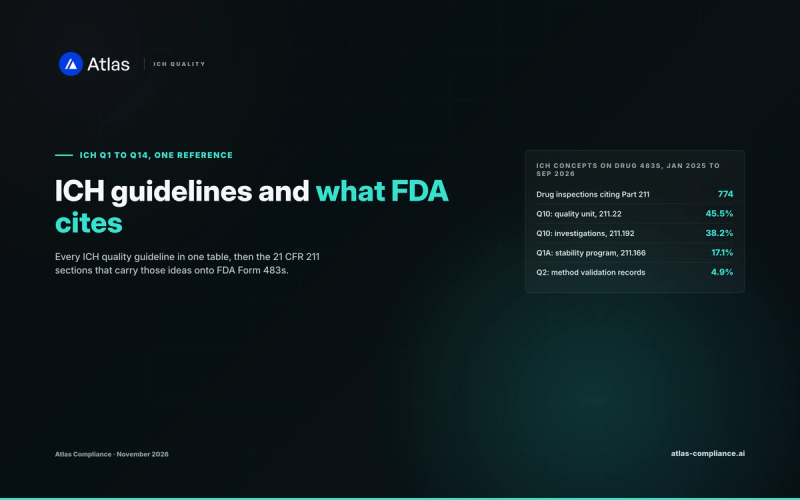
This guide covers both documents, then adds what other pages on Q14 leave out: how often FDA investigators cited laboratory method sections of 21 CFR Part 211 at 774 drug inspections from January 2025 to September 2026, from the FDA citation records in the Atlas data files (pulled October 21, 2026).
Key facts:
- ICH Q14 and ICH Q2(R2) both reached Step 4 on November 1, 2023; ICH issued an error correction to Q2(R2) tables on November 30, 2023.
- FDA's notice of availability (89 FR 16582, March 7, 2024, docket FDA-2022-D-1503) replaced the draft guidances of August 29, 2022.
- Q14 applies to analytical procedures for release and stability testing of commercial drug substances and products, and phase-appropriately to procedures used in clinical development.
- Q14 describes a minimal approach and an enhanced approach, and section 2 states that the minimal approach remains acceptable.
- FDA investigators cited 21 CFR 211.160(b) at 197 of 774 drug inspections (25.5%), and 43.1% of those inspections ended Official Action Indicated (OAI).
- Method validation under 211.165(e) appeared at 24 inspections and method suitability under 211.194(a)(2) at 14; 14 of the 24 test method inspections ended OAI.
What does ICH Q14 cover?
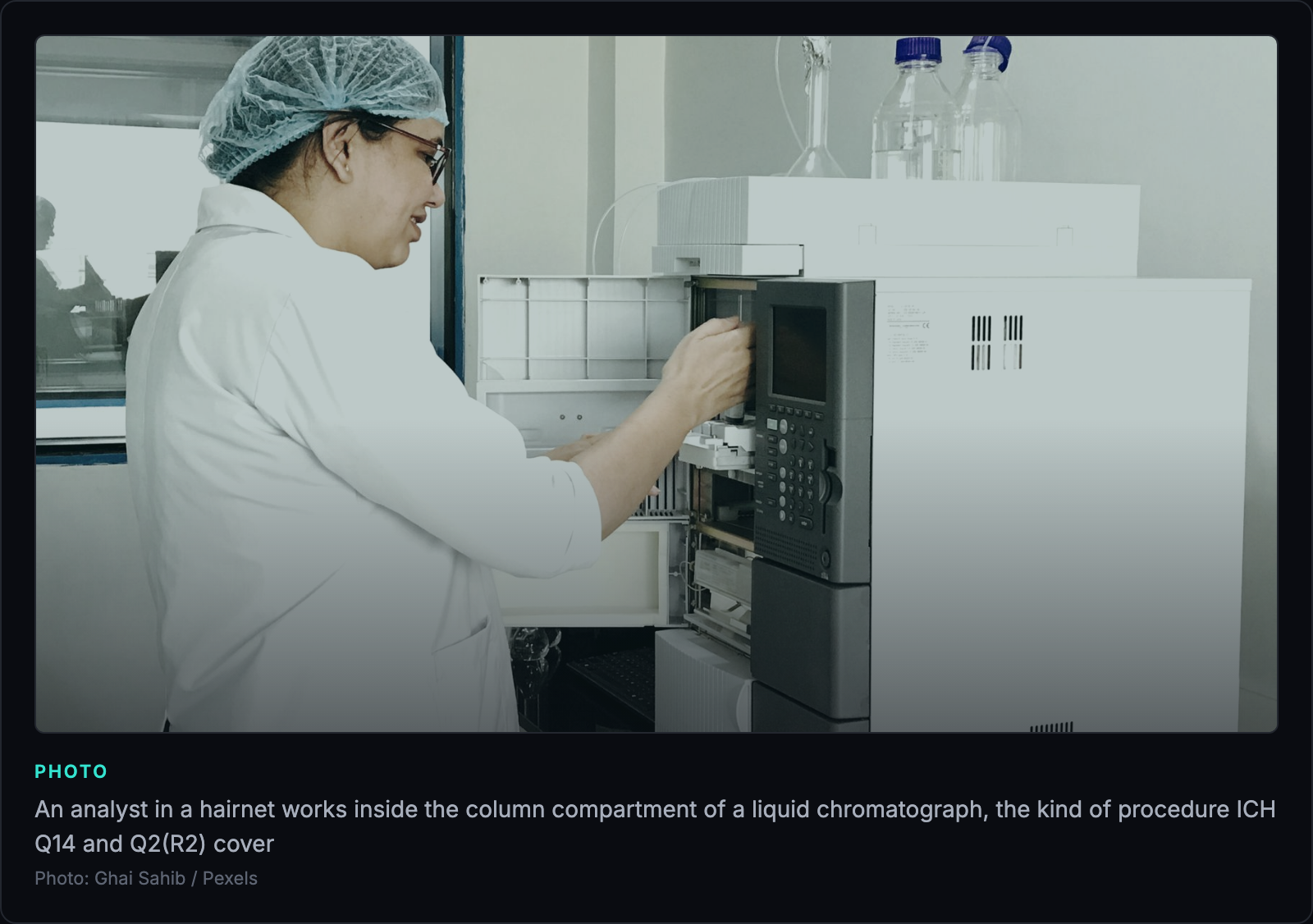
ICH Q14 covers the development of analytical procedures, their control strategy, and the management of post-approval changes to them, for procedures used in release and stability testing of commercial drug substances and drug products. The ICH Q14 guideline states in section 1.1 that it complements ICH Q2, which covers validation.
The guideline has 13 chapters:
| Chapter | Title | What it sets out |
|---|---|---|
| 1 | Introduction | Objective and scope |
| 2 | General considerations | Minimal vs enhanced approaches; the procedure lifecycle |
| 3 | Analytical target profile | Intended purpose and performance criteria |
| 4 | Knowledge and risk management | Prior knowledge; ICH Q9 tools to rank parameters |
| 5 | Robustness and parameter ranges | Deliberate variation studies; PARs and MODRs |
| 6 | Analytical procedure control strategy | System suitability, sample suitability, established conditions (6.1) |
| 7 | Lifecycle management and post-approval changes | ICH Q12 tools, reporting categories, bridging studies |
| 8 | Multivariate analytical procedures | Model building, validation and maintenance |
| 9 | Real time release testing | Additional considerations for RTRT |
| 10 | Submission of procedure information | What goes into the CTD for each approach |
| 11 | Glossary | Definitions, including ATP, MODR and PAR |
| 12 | References | Linked ICH guidelines |
| 13 | Annex | Two worked examples and a multivariate model lifecycle |
Annex A works through a stereoisomer impurity procedure for a small molecule drug substance and a potency assay for an anti-TNF-alpha monoclonal antibody. Our ICH guidelines overview places Q14 among the other Q-series documents.
How do ICH Q14 and Q2(R2) work together?
ICH Q14 and ICH Q2(R2) split the analytical procedure lifecycle: Q14 covers development, the control strategy and change management, and Q2(R2) covers the validation study that shows the procedure is fit for its intended purpose. Section 2 of Q2(R2) lets suitable data from Q14 development studies count as validation data, and Q14 section 5.1 says a robustness evaluation done during development need not be repeated in validation.
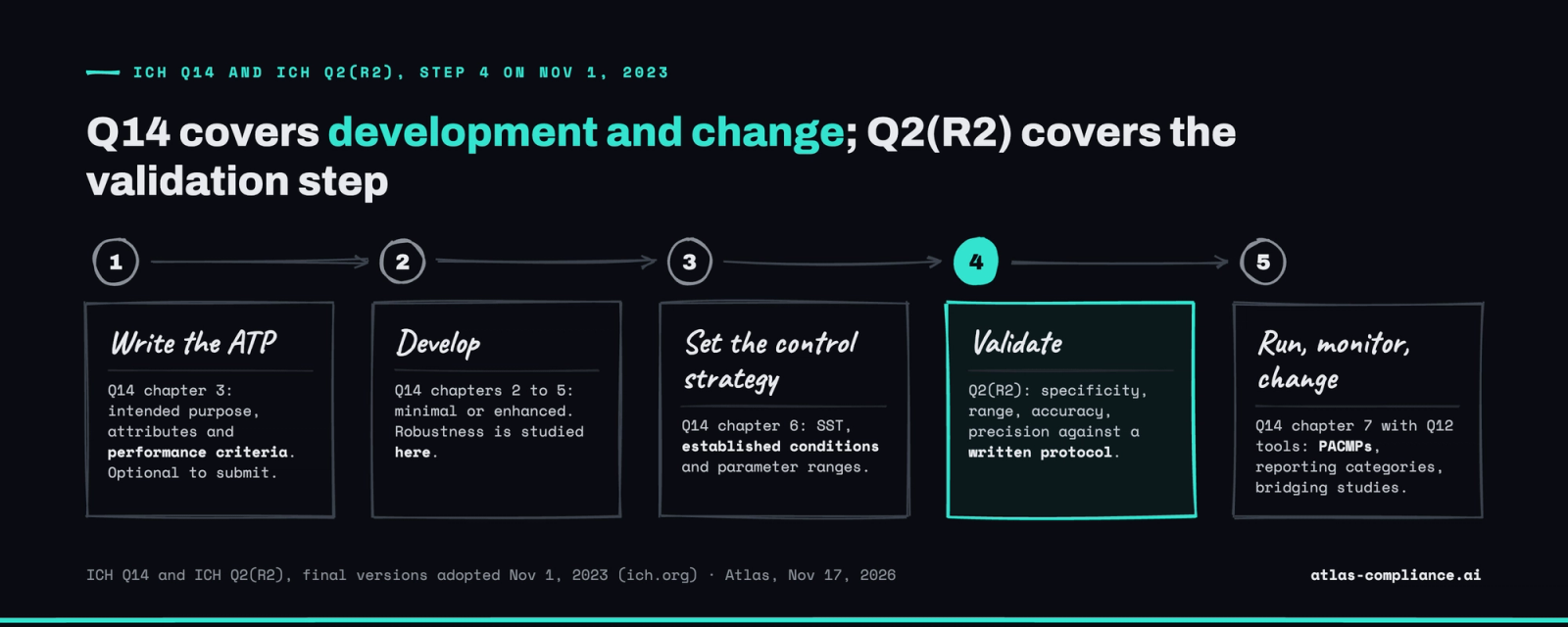
Both documents share one scope sentence: release and stability testing of commercial products, with other control strategy procedures covered on a risk basis. The FDA notice of March 7, 2024 says the final Q14 clarified the minimal versus enhanced approach, the analytical target profile and established conditions, and that the final Q2(R2) resolved issues on range, response, reference materials, biologics, replicates and dissolution. As with every ICH guidance FDA adopts, the notice states the guidances are not binding and an alternative approach is acceptable if it meets the statutes and regulations.
Minimal vs enhanced approach: what is the difference?
The difference between the minimal and the enhanced approach in ICH Q14 is how much procedure understanding the applicant builds and documents. The minimal approach identifies the attributes to test, selects the technology, studies performance and documents the procedure. The enhanced approach adds an ATP, a risk assessment, multivariate experiments and parameter ranges, which can earn more flexibility for post-approval changes.
| Element (Q14 section) | Minimal approach | Enhanced approach |
|---|---|---|
| Starting point (2.1, 3) | Attributes the product needs tested | ATP with performance criteria, written first |
| Parameter selection (4.2) | Experience and fixed conditions | Prior knowledge plus a formal or informal risk assessment, such as an Ishikawa diagram |
| Experiments (5) | Specificity, accuracy, precision, robustness | Uni- or multivariate studies, often design of experiments |
| Operating conditions (5.2) | Fixed set points | Proven acceptable ranges (PARs) or a method operable design region (MODR) |
| Established conditions (6.1) | May be extensive, with fixed parameters | Fewer, focused on performance |
| Changes (7) | Reported under regional rules | Moves inside an approved range stay in the PQS |
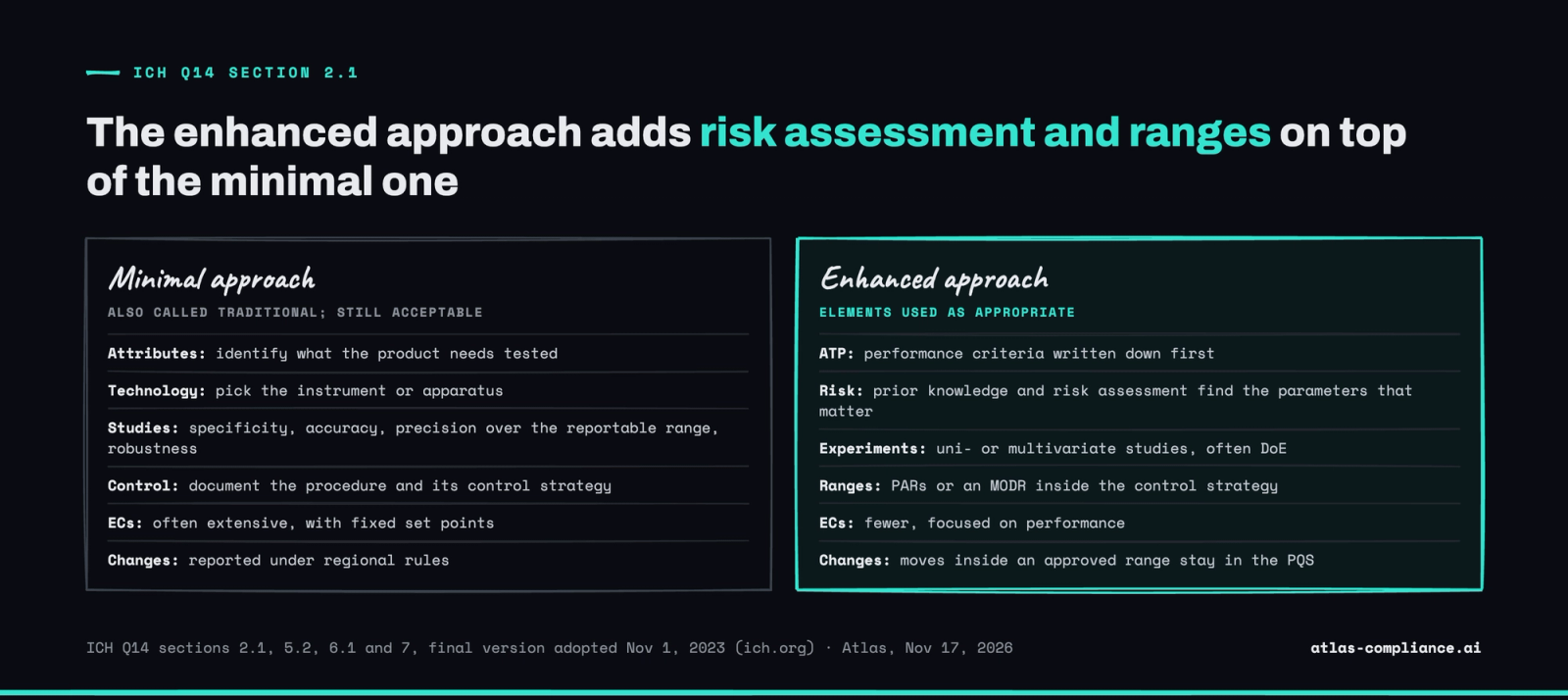
Section 2.1 lets an applicant use some elements of the enhanced approach and skip others, and section 2 also allows a platform procedure, such as protein content by UV spectroscopy, to skip parts of development and validation when the applicant justifies it.
What is an analytical target profile (ATP)?
An analytical target profile (ATP) is a statement of the intended purpose of an analytical procedure, the product attributes it measures, and the performance characteristics with the criteria the procedure must meet. Section 3 of ICH Q14 says the ATP drives the choice of technology and serves as the basis for the validation criteria in Q2(R2). Formal submission of an ATP is optional.
The Annex A stereoisomer example shows what an ATP holds in practice. Its intended purpose is quantitation of six stereoisomers in a drug substance for release testing, linked to a stereoisomeric purity CQA of at least 99.0%. The criteria then set accuracy at 80 to 120% average recovery for impurities specified at not more than 0.1%, intermediate precision RSD at 15% or less for those impurities, and a reportable range from 0.05% to 120% of the specification limit. The ATP names no instrument. The applicant in the example picked HPLC with UV detection afterwards, because development studies showed it could separate the stereoisomers.
Because the ATP states performance rather than a technique, Q14 section 7 allows it to form the basis of a post-approval change management protocol (PACMP) for a later switch between technologies.
What are established conditions for analytical procedures?
Established conditions (ECs) for analytical procedures are the elements of a procedure that an applicant proposes and the regulator approves as legally binding information, the term ICH Q12 uses, so that changing them needs regulatory communication. Section 6.1 of ICH Q14 applies the ICH Q12 EC concept to analytical methods and lists four kinds of ECs:
- Performance characteristics and their criteria, for example those in an ATP.
- The analytical procedure principle, meaning the physicochemical basis or specific technology.
- System suitability test (SST) and sample suitability criteria.
- Set points or ranges for one or more procedure parameters.
Each EC gets a reporting category based on risk: the criticality of the attribute measured, the complexity of the technology and the extent of the change. Under section 5.2, a move within an approved PAR or MODR needs no regulatory notification, while a move outside an approved range does. Changes to parameters that are not ECs need no regulatory communication at all, but the PQS still documents them. Section 6.1 also warns that the enhanced approach does not allow a thinner procedure description in Module 3 of the CTD.
Chapter 7 lists the ICH Q12 tools that apply whatever development approach the applicant used: ECs, PACMPs, the product lifecycle management document, the PQS, and regional change categories. Q14 Table 1 ties the depth of a bridging study to how much the lab knows and how risky the change is.
What changed from ICH Q2(R1) to Q2(R2)?
ICH Q2(R2) is a complete revision of the 2005 validation guideline Q2(R1), rewritten to cover newer techniques such as multivariate procedures and to align with Q14. Validation tests are now organized by the measured quality attribute (identity, impurity, assay), linearity sits under a broader "response" heading inside range, and accuracy and precision can be evaluated together.
| Topic | ICH Q2(R1), November 2005 | ICH Q2(R2), November 2023 |
|---|---|---|
| Validation table | Organized by type of analytical procedure | Organized by measured quality attribute |
| Linearity | A separate characteristic | Response (calibration model) under Range, linear or non-linear; residual plot review added |
| Detection and quantitation limits | Separate characteristics | Lower range limit within Range (QL, or DL for limit tests) |
| Range | Single range | Reportable range and working range distinguished |
| Specificity | Specificity | Specificity/selectivity; selectivity can be shown where a procedure is not specific |
| Accuracy and precision | Assessed separately | Separately, or with a combined approach such as confidence intervals |
| Robustness | Defined in the text, not in the table | Evaluated during development under Q14 section 5.1 |
| Multivariate procedures | Not covered | Section 2.5 and multivariate calibration tests |
| Lifecycle | Not addressed | Section 2.2 on revalidation, transfer and co-validation |
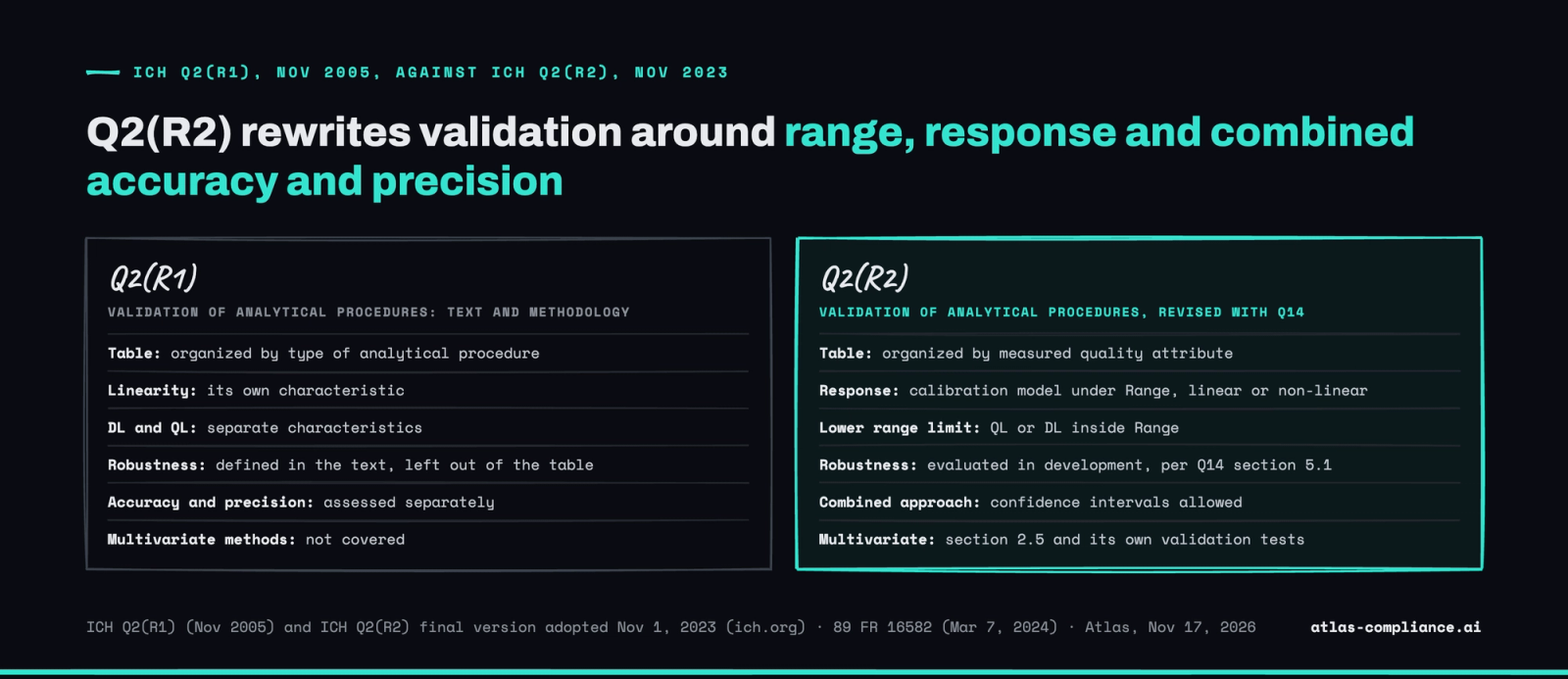
Some numbers did not move. Repeatability still needs at least 9 determinations across the range (for example 3 concentrations with 3 replicates each) or at least 6 at 100% of the test concentration, and linearity still needs at least 5 concentrations, per sections 3.2 and 3.3 of the ICH Q2(R2) guideline.
How often do FDA investigators cite analytical methods?
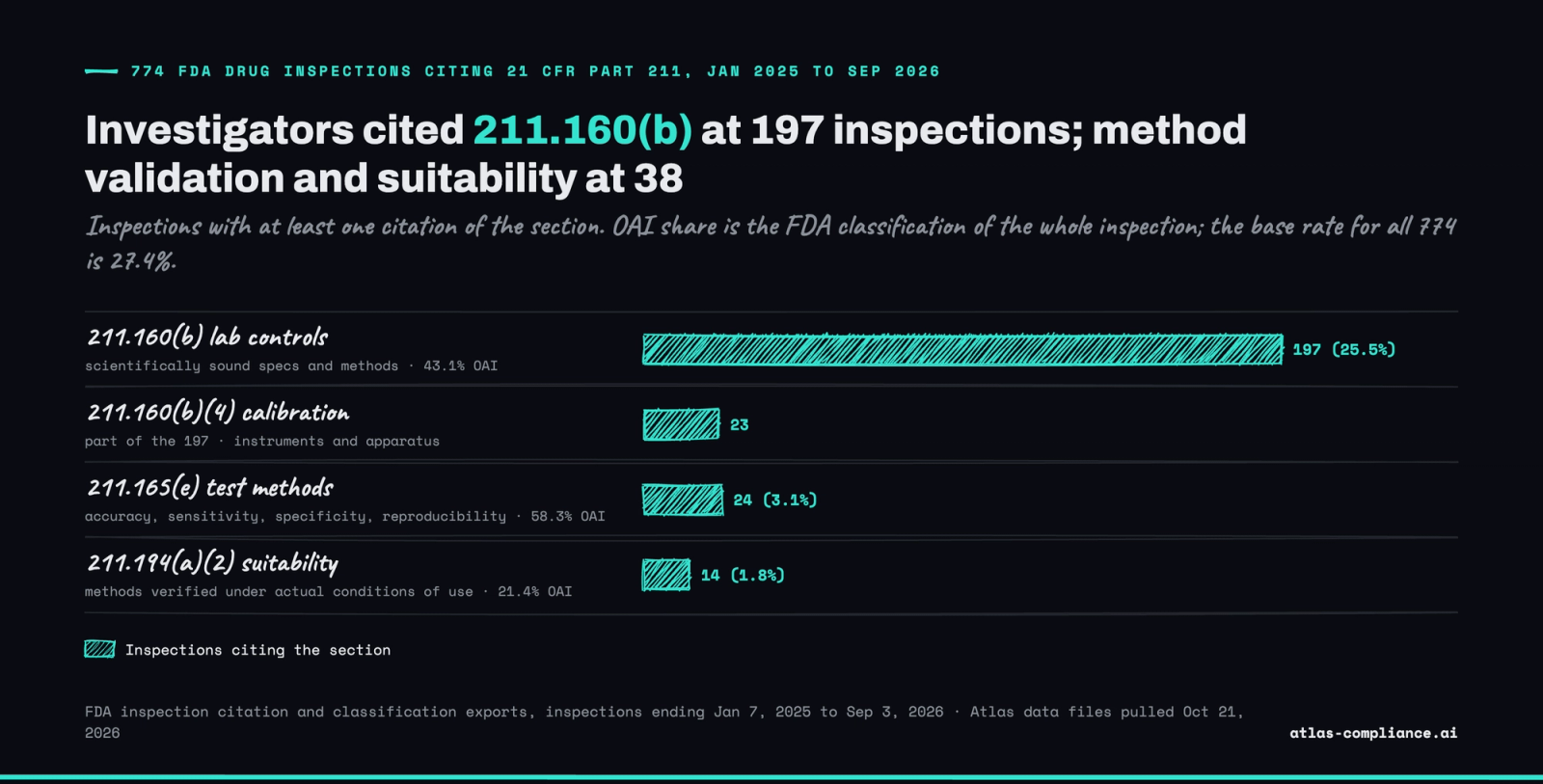
FDA investigators cited 21 CFR 211.160(b), scientifically sound laboratory specifications, standards and test procedures, at 197 of 774 drug inspections that cited Part 211 (25.5%), in the FDA inspection citation records in the Atlas data files (inspections ending January 7, 2025 to September 3, 2026, pulled October 21, 2026). Method validation under 211.165(e) appeared at 24 inspections and method suitability under 211.194(a)(2) at 14.
| 21 CFR section | What it requires | Inspections | Share of 774 | Ended OAI |
|---|---|---|---|---|
| 211.160(b) | Scientifically sound and appropriate specifications, standards, sampling plans and test procedures | 197 | 25.5% | 85 (43.1%) |
| 211.165(e) | Accuracy, sensitivity, specificity and reproducibility of test methods established and documented | 24 | 3.1% | 14 (58.3%) |
| 211.194(a)(2) | A statement of each method used, with the suitability of every method verified under actual conditions of use | 14 | 1.8% | 3 (21.4%) |
| All 774 Part 211 inspections | 774 | 100% | 212 (27.4%) |
FDA classifies the whole inspection, so an OAI rate here marks every finding at those facilities, not the method finding alone. Method findings usually came with others: 211.192 investigations appeared at 21 of the 38 inspections that cited 211.165(e) or 211.194(a)(2). Of the 24 test method citations, 23 said accuracy had not been established, and 20 each named specificity and reproducibility. The four performance terms in 211.165(e) map to Q2(R2) characteristics, and eCFR 21 CFR 211.165 allows the documentation to follow 211.194(a)(2).
Named Form 483s from the FDA Form 483 database:
- KVK-Tech, Newtown, Pennsylvania, March 14, 2025: four cited sections, led by 211.165(e) for test methods with accuracy, sensitivity and reproducibility not established. FDA classified the inspection OAI. Our KVK-Tech warning letter breakdown shows the same section behind the February 2020 letter.
- Westwood Laboratories, Azusa, California, March 26, 2026: 10 cited sections, including 211.194(a)(2), 211.160(b)(4) for instruments not meeting specifications, and 211.192. OAI.
- Hibrow Healthcare, Kancheepuram District, India, January 30, 2026: two cited sections, 211.165(e) and 211.113(a). VAI.
- Atlantic Analytical Laboratories, Whitehouse, New Jersey, March 17, 2026: one cited section, 211.194(a)(2), for methods not verified under actual conditions of use. VAI.
- Nexus Pharmaceuticals, Lincolnshire, Illinois, June 4, 2026 and Wyeth Pharmaceutical Division, Pearl River, New York, December 17, 2025: both cite method verification not performed under actual conditions of use. Both VAI.
Glenmark Pharmaceuticals in Dhar, India (February 14, 2025) also received a 211.165(e) citation, in an inspection FDA classified OAI. Sixteen of the 24 test method inspections were in the United States and three in India; all 14 suitability citations were at US facilities.
If your laboratory runs compendial or transferred methods, you can check which of these sections your likely investigator has written before the next inspection.
 Atlas
See what the FDA knows about your next investigator.
30 minutes with the founder. No pitch deck.
How should a QC lab apply ICH Q14 and Q2(R2) before an inspection?
A QC lab applies ICH Q14 and Q2(R2) before an inspection by checking that every release and stability method has a documented purpose, validation evidence against Q2(R2) characteristics, and a record of verification under the lab's own conditions. Five checks follow from the 2025 and 2026 citations above:
- List each release and stability method and write a short ATP or purpose statement for it: the attribute, the specification, and the accuracy and precision the decision needs.
- Match each method to a validation report that covers specificity, range, accuracy and precision as Table 1 of Q2(R2) requires for its attribute type.
- For compendial and transferred methods, keep the verification data that 211.194(a)(2) requires, run on your instruments, analysts and sample matrix.
- Confirm that system suitability criteria derive from the method's performance criteria and that the lab trends SST results, as Q14 chapter 6 recommends.
- Route every method change through change control with a risk assessment and a bridging study scaled to the risk, as Q14 Table 1 describes, and record whether it touches an approved established condition.
For release decisions built on these methods, our release testing guide covers each paragraph of 211.165, and the 21 CFR Part 211 guide maps the rest of Subpart I. The digest below sends new Form 483s with laboratory citations as FDA posts them.
AtlasFDA Inspection Intelligence Digest
We track every 483, EIR, and warning letter the moment it happens. Get the signals before they hit the FDA website.
Frequently asked questions
No. ICH Q14 is FDA guidance, announced as final on March 7, 2024, and FDA guidance does not create legally enforceable requirements. The binding rules for drug manufacturers remain 21 CFR Part 211, including 211.160, 211.165(e) and 211.194(a)(2). An applicant may still follow the minimal approach, which Q14 states remains acceptable, or any alternative that meets the regulations.

Written by
Bhavish Agarwal
Founder, Atlas
Bhavish Agarwal is the founder of Atlas and previously worked at Google and Microsoft. He has spent the past several years building regulatory data infrastructure for the pharmaceutical industry.