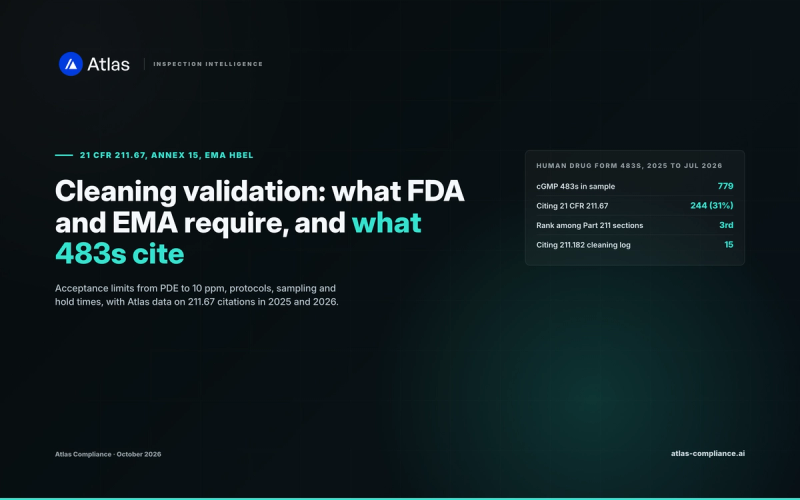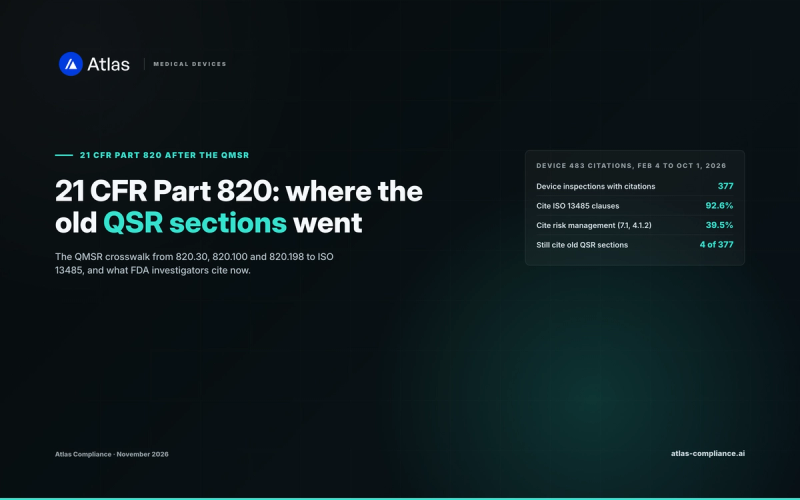

Bioburden is the number of viable microorganisms living on or in a product, component or solution before it is sterilized, and bioburden testing is the count that measures it, reported in colony-forming units (CFU). Drug makers count it to protect a sterile filter or a terminal sterilization cycle. Device makers count it per device to set and defend the sterilization dose.
This guide adds how often FDA investigators cited the controls bioburden data supports, from Atlas analysis of FDA inspection citation data: 774 drug inspections citing 21 CFR Part 211 and 1,124 device inspections that closed January 2025 to October 2026, pulled October 21, 2026, joined to FDA's inspection classifications.
Key facts:
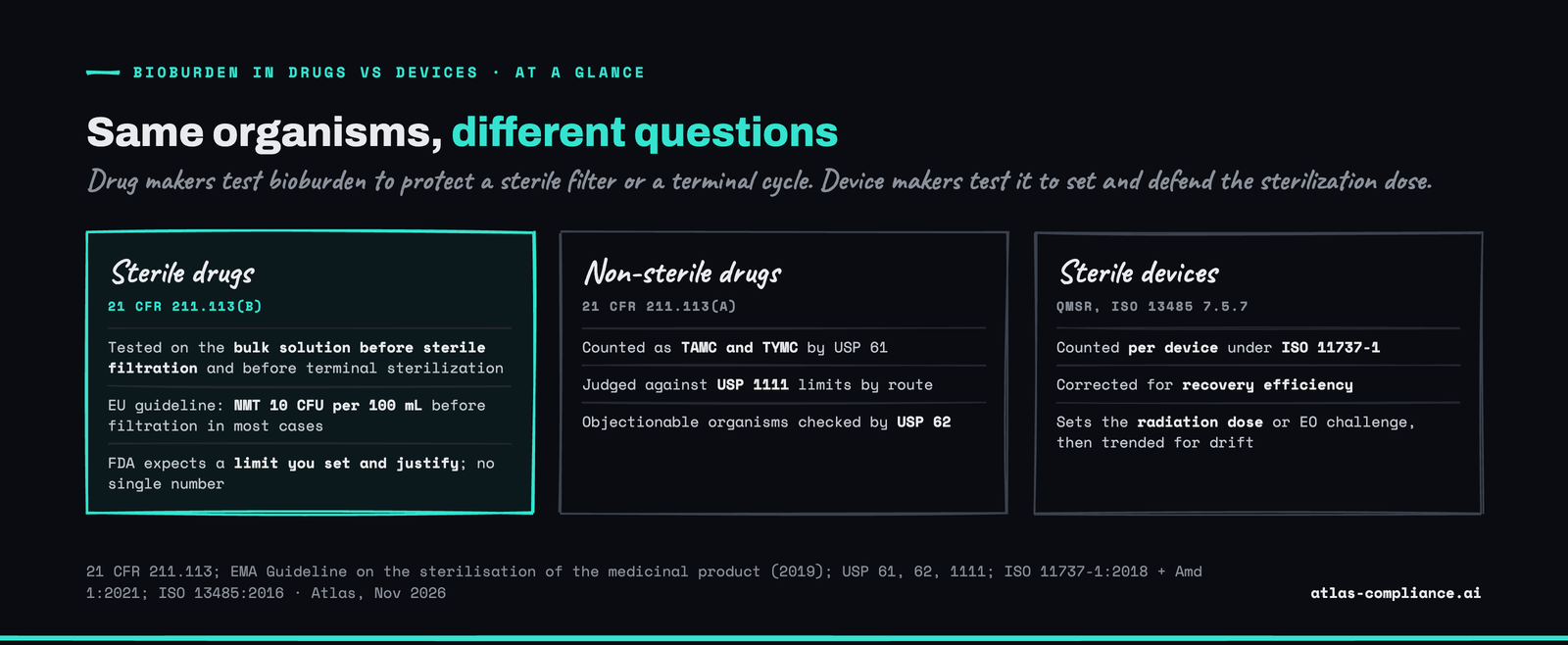
- Drug makers test bioburden on the bulk solution before sterile filtration and before terminal sterilization; EU guidance treats no more than 10 CFU per 100 mL before filtration as acceptable in most cases, while FDA expects a limit the firm sets and justifies.
- Device makers measure bioburden per device under ISO 11737-1, correct the count for recovery efficiency, and use it to set the radiation dose or challenge an ethylene oxide (EO) cycle.
- FDA cites bioburden problems under broader sections: 129 of 774 Part 211 drug inspections (16.7%) cited 21 CFR 211.113, and 56 of 1,124 device inspections (5.0%) cited contamination, environment or sterilization validation controls.
- 50.4% of the drug inspections citing 211.113 ended Official Action Indicated (OAI), against 22.8% of the other Part 211 drug inspections.
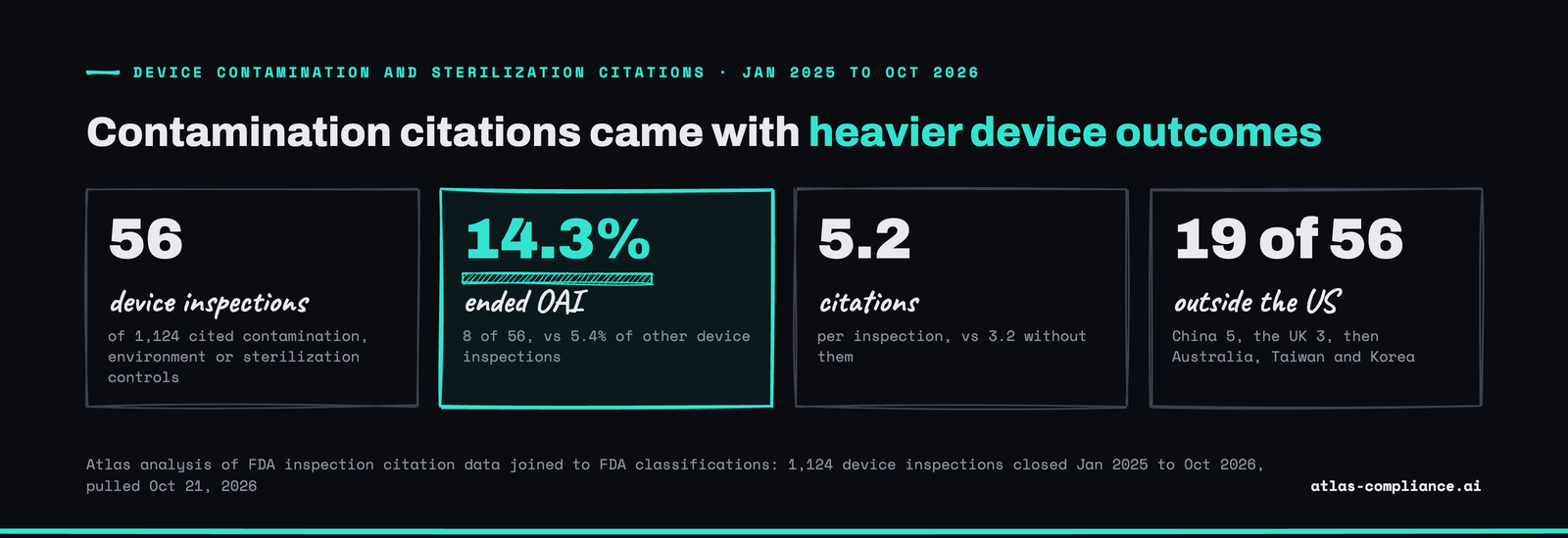
- 14.3% of the device inspections citing contamination controls ended OAI, against 5.4% of other device inspections.
What is bioburden testing?
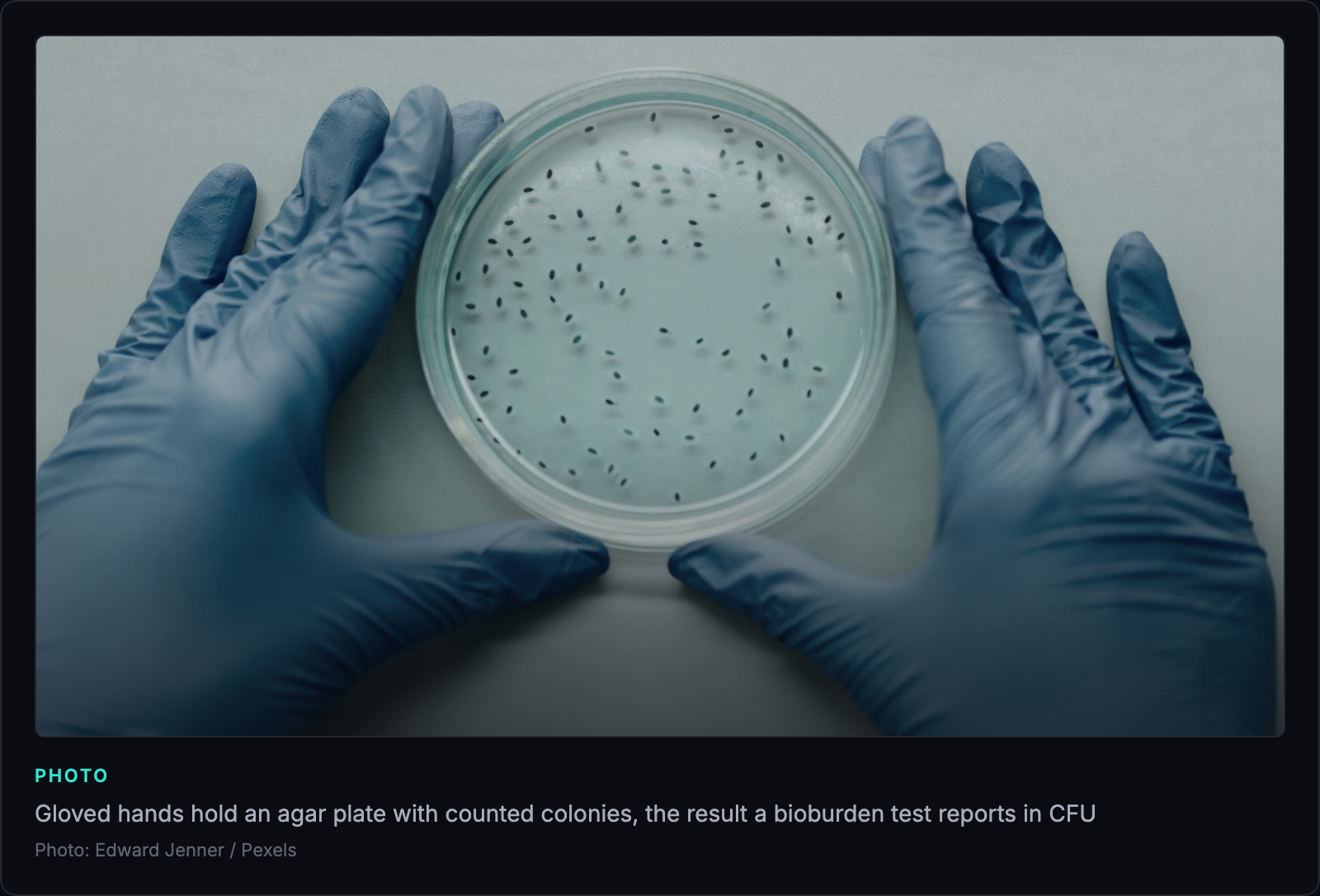
Bioburden testing counts the viable aerobic bacteria and fungi on a product or in a solution before sterilization, so the sterilization step has a known and controlled challenge. The test moves organisms off the sample into a fluid, plates or filters that fluid, incubates it, and counts colonies.
The number matters because every sterilization method is validated against a starting load. A sterile filter is qualified for a certain challenge. A radiation dose is calculated for a certain population on the device. An EO cycle is shown to kill a biological indicator that is harder to kill than the natural bioburden. When the starting load drifts upward and nobody notices, the validation stops describing the process that runs on the floor.
Bioburden testing differs from sterility testing. Sterility testing (USP 71 for drugs, ISO 11737-2 for device sterilization validation) checks for growth after sterilization. Bioburden testing counts what is there before it. For non-sterile drugs, the comparable counts are the total aerobic microbial count and total yeast and mold count in USP 61, covered in our USP 61 and 62 guide.
How is bioburden tested in drug manufacturing?
Drug manufacturers test bioburden on the bulk solution immediately before sterile filtration, and on the filled product or components before terminal sterilization. 21 CFR 211.113(b) requires written procedures designed to prevent microbiological contamination of drug products purporting to be sterile, including validation of all aseptic and sterilization processes; bioburden limits are how those procedures put a number on the incoming load.
Limits differ by region:
- EU: the EMA Guideline on the sterilisation of the medicinal product, active substance, excipient and primary container (2019) considers a bioburden of no more than 10 CFU per 100 mL acceptable in most situations, tested on a 100 mL sample taken just before the final sterile filter.
- US: FDA's 2004 guidance on sterile drug products produced by aseptic processing expects the firm to know its pre-filtration bioburden and to qualify the filter against an appropriate challenge, but it does not set one number. The limit is the firm's, and it has to be justified.
- Water: USP 1231 sets an action level of 10 CFU per 100 mL for Water for Injection, which is why WFI bioburden trends sit next to product bioburden in most sterile programs.
Hold times are where drug bioburden programs fail. A bulk solution held longer than the validated time before filtration can grow organisms the filter was never challenged with. Firms set a maximum hold time, show bioburden stays within the limit across it, and test at the end of the longest hold they allow.
How is bioburden tested for medical devices under ISO 11737-1?
Device manufacturers measure bioburden per device under ISO 11737-1:2018 plus Amendment 1:2021, the standard for determining the population of microorganisms on health care products. The result is reported in CFU per device and feeds directly into the sterilization method.
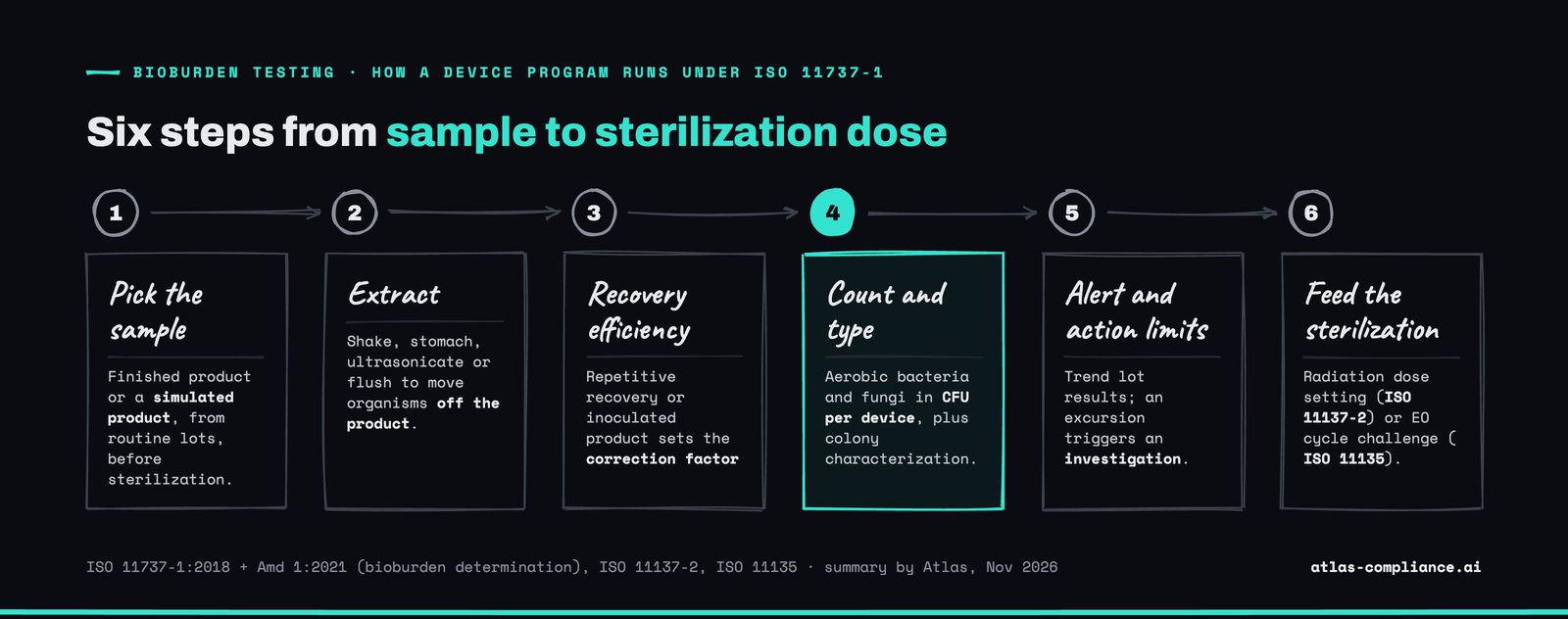
ISO 11737-1 asks for six things in practice:
- Sample selection. Finished devices, or a simulated product, from routine production lots, taken before sterilization.
- Extraction. Shaking, stomaching, ultrasonication or flushing to move organisms off the device into an eluent.
- Recovery efficiency. No extraction removes every organism, so the lab measures how much it recovers, by repetitive recovery (the same sample washed several times) or by inoculating product with a known count. The correction factor is the reciprocal of the recovery efficiency, so a method that recovers 74% gives a correction factor of about 1.4.
- Count and characterization. Aerobic bacteria and fungi are counted and the colonies characterized, since spore-formers matter more to a radiation dose than vegetative organisms.
- Alert and action limits. Results are trended lot to lot; an excursion triggers an investigation into raw materials, the environment and handling.
- Feeding the sterilization method. Radiation dose setting under ISO 11137-2 uses the bioburden level directly. EO cycles under ISO 11135 are validated with a biological indicator that has to be more resistant than the natural bioburden, which bioburden data has to show.
Since February 2, 2026, the Quality Management System Regulation (QMSR) incorporates ISO 13485:2016 by reference into 21 CFR Part 820. Clause 7.5.7 requires validation of sterilization and sterile barrier processes, clause 6.4.2 requires planned arrangements for contaminated product, and clause 7.5.2 covers product cleanliness. Our 21 CFR Part 820 guide maps the old sections to the new clauses.
What is an acceptable bioburden limit?
No single bioburden limit applies to every product. The limit depends on what the bioburden challenges:
| Setting | Where it is measured | Typical limit or basis | Rule or standard |
|---|---|---|---|
| Sterile-filtered drug | Bulk solution before final filtration | No more than 10 CFU per 100 mL in most cases (EU) | EMA sterilisation guideline (2019); 21 CFR 211.113(b) |
| Terminally sterilized drug | Filled product before the cycle | Set from the cycle's validated kill margin | 21 CFR 211.113(b) |
| Water for Injection | Point of use | 10 CFU per 100 mL action level | USP 1231 |
| Non-sterile drug | Finished product | TAMC and TYMC limits by route | USP 61, USP 1111 |
| Radiation-sterilized device | Device before irradiation | Sets or verifies the dose for the required sterility assurance level | ISO 11737-1, ISO 11137-2 |
| EO-sterilized device | Device before the cycle | Must stay below the biological indicator's resistance | ISO 11737-1, ISO 11135 |
Terminally sterilized devices and drugs are usually validated to a sterility assurance level (SAL) of 10⁻⁶, a one in a million probability that a unit is non-sterile. Bioburden is the input that makes that calculation true for a given product.
How often does FDA cite bioburden on Form 483s?
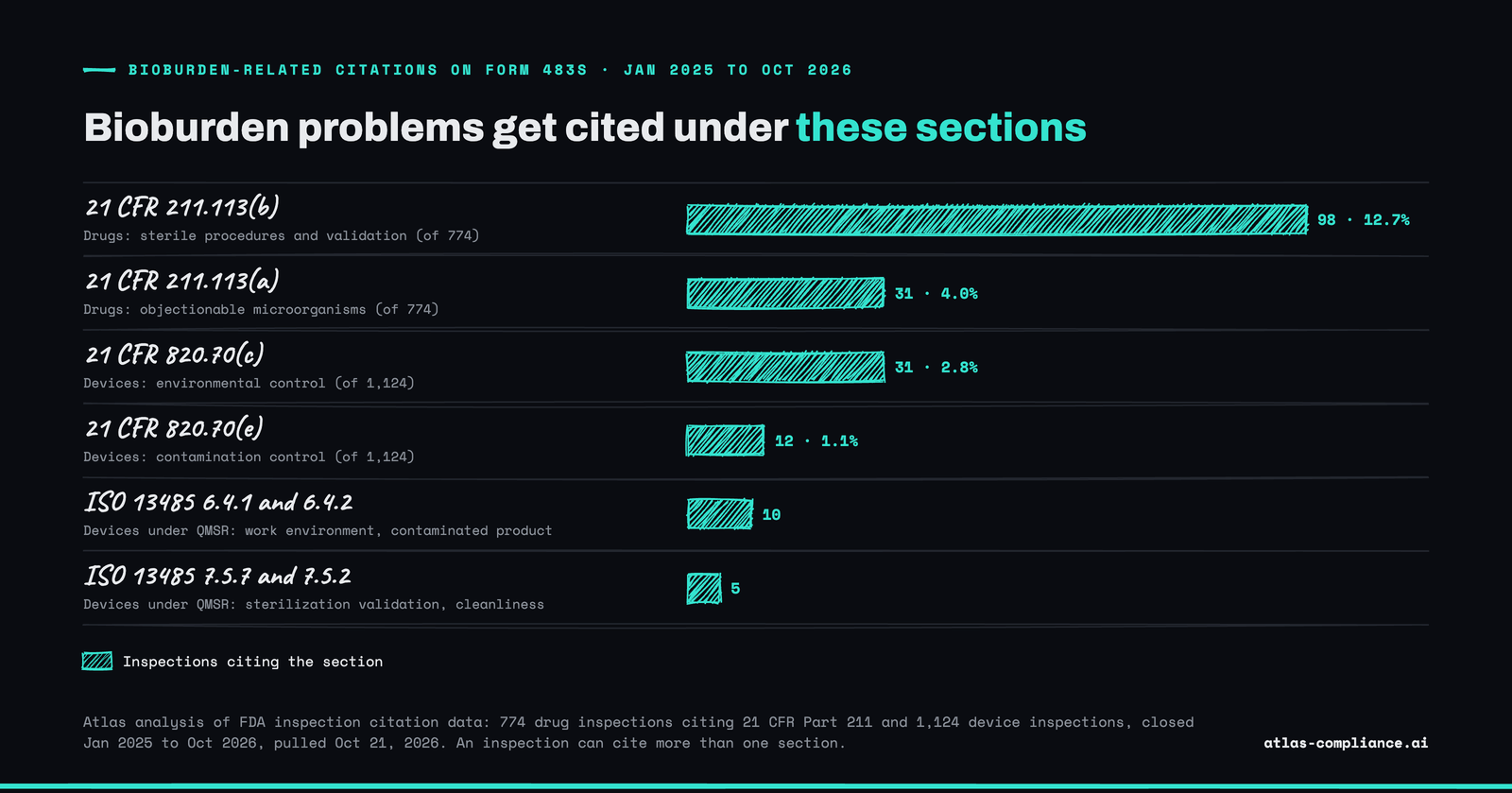
FDA rarely uses the word bioburden in a Form 483 heading; investigators cite the section the bioburden program was supposed to satisfy. In the Atlas citation data, 129 of 774 Part 211 drug inspections (16.7%) cited 21 CFR 211.113: 98 under 211.113(b) for sterile products and 31 under 211.113(a) for objectionable microorganisms in non-sterile products. The 98 sterile-product inspections carried 124 observations, filed under two headings: "Procedures for sterile drug products" and "Validation lacking for sterile drug products".
On the device side, 56 of 1,124 inspections (5.0%) cited a contamination, environment or sterilization control:
- 21 CFR 820.70(c), environmental control: 31 inspections.
- 21 CFR 820.70(e), contamination control: 12.
- ISO 13485 clauses 6.4.1 and 6.4.2, work environment and contaminated product: 10.
- ISO 13485 clauses 7.5.7 and 7.5.2, sterilization validation and cleanliness: 5.
Five Form 483s from the period show the pattern. Each links to its record in the FDA Form 483 database:
| Facility | Form 483 date | Bioburden-related citation | Other sections on the form | Classification |
|---|---|---|---|---|
| Sharp Sterile Manufacturing, Lee, MA | Mar 5, 2026 | 211.113(b) | 211.192, 211.22(d), 211.42(c)(10)(v), 211.56(a), 211.67(a) | OAI |
| Novartis Pharma Stein, Switzerland | May 19, 2026 | 211.113(b) | 211.22(d) | VAI |
| LeMaitre Vascular, North Brunswick, NJ | Apr 16, 2025 | 820.70(c), 820.70(e) | 820.100(a), 820.184, 820.25(b) and others | OAI |
| LeMaitre Vascular, North Brunswick, NJ | Jun 25, 2026 | ISO 13485 6.4.2 | 8 observations in total | OAI |
| Exactech Sarasota, FL | Jul 25, 2025 | 820.70(c) | 820.100(a), 820.25(b), 820.50, 820.70(a) | OAI |
LeMaitre is the clearest case of a contamination finding coming back: its April 2025 form cited environmental and contamination control under the old Part 820, and its June 2026 form cited contamination control again under ISO 13485 clause 6.4.2, after the QMSR took effect. Both inspections ended OAI.
Other forms from the period sit on facility pages rather than indexed 483 pages. Medtronic Grand Rapids was cited under 820.70(c) on December 15, 2025, and the inspection ended VAI; its record is on the Medtronic Grand Rapids facility page. Arthrosurface in West Bridgewater was cited on April 1, 2026 for undocumented sterilization validation procedures under clause 7.5.7, and Gilead Sciences in La Verne was cited under 211.113(b) on February 18, 2026; both ended VAI. Investigator Suyang Qin, who has 134 inspections across 105 sites on record, was on both the Medtronic Grand Rapids inspection and a June 2025 Cook Incorporated inspection in Bloomington that cited environmental control.
If your next inspection is with an investigator who has written contamination or sterilization observations before, their past Form 483s show which records they ask for first.
 Atlas
See what the FDA knows about your next investigator.
30 minutes with the founder. No pitch deck.
What does a contamination citation signal about the rest of the inspection?
A contamination or sterilization citation tends to arrive with a heavier inspection. Among drug inspections, 65 of the 129 that cited 211.113 (50.4%) ended OAI, against 147 of the other 645 Part 211 drug inspections (22.8%).
Device inspections show the same direction at a lower base rate. The 56 inspections that cited contamination, environment or sterilization controls averaged 5.2 citations, against 3.2 for other device inspections, and 8 of them (14.3%) ended OAI, against 58 of the other 1,068 (5.4%). 19 of the 56 were at facilities outside the US, led by China with 5 and the United Kingdom with 3.
The sections cited next to them point at the quality system more than the lab. On the 56 device inspections, 21 CFR 820.100(a) for CAPA procedures appeared at 22, 820.75(a) process validation at 13 and 820.184 device history records at 10. A bioburden excursion that nobody investigated becomes a CAPA citation as well as a contamination one; our CAPA guide covers what investigators expect that file to contain.
How do you build a bioburden program that holds up in an inspection?
A bioburden program holds up when each number in it traces to a validated method, a limit with a rationale, and an investigation record for every excursion. Five records carry most of the weight:
- Method validation. Recovery efficiency or method suitability data for each product family, with the correction factor and the date it was set.
- Limits with a rationale. Alert and action limits tied to the sterilization validation: the filter challenge, the dose audit, or the biological indicator's resistance.
- Trending. Lot-by-lot results plotted over time, with shifts reviewed even when no single result crosses a limit.
- Hold times. Validated maximum times between compounding and filtration, or between assembly and sterilization, with bioburden data at the end of the longest hold.
- Excursion investigations. Organism identification, root cause, impact on released lots, and the CAPA that followed, written to the standard of a 21 CFR Part 211 investigation.
Our media fill test guide covers the aseptic process simulation that sits beside pre-filtration bioburden in a sterile drug program, and our cleaning validation guide covers the equipment side, where bioburden limits on cleaned surfaces apply.
The bioburden citations above sit inside the weekly flow of new Form 483s, and a short digest is the fastest way to see when a peer facility gets one.
AtlasFDA Inspection Intelligence Digest
We track every 483, EIR, and warning letter the moment it happens. Get the signals before they hit the FDA website.
Frequently asked questions
Bioburden counts viable microorganisms before sterilization, in CFU. Endotoxin measures lipopolysaccharide from the cell walls of gram-negative bacteria, in endotoxin units, and it survives sterilization. A product can pass bioburden and sterility and still fail an endotoxin test, which is why parenteral and implant programs run both, with endotoxin tested by the LAL or recombinant factor C method.

Written by
Bhavish Agarwal
Founder, Atlas
Bhavish Agarwal is the founder of Atlas and previously worked at Google and Microsoft. He has spent the past several years building regulatory data infrastructure for the pharmaceutical industry.