
The electronic Common Technical Document (eCTD) is the standard electronic format for sending drug and biologic applications to regulators, and eCTD v4.0 is the ICH M8 version of it, built on the HL7 Regulated Product Submission (RPS) message instead of v3.2.2's folder tree and index file. As of October 2026, FDA accepts v4.0 for new applications but does not require it, EMA accepts it for new centralised applications, and Japan's PMDA requires it for new applications.
That timeline matters less to approval than most automation projects assume. In our classification of the Complete Response Letters FDA has published, 42 of the 65 letters issued in 2024 cited problems at a manufacturing facility. A perfectly published v4.0 dossier still fails if the facility named in Module 3 is not ready for inspection.
- FDA's CDER and CBER have accepted eCTD v4.0 for new NDAs, BLAs, ANDAs, INDs and master files since September 16, 2024; v3.2.2 remains supported and no required date has been announced.
- EMA opened optional v4.0 use for new centralised marketing authorisation applications on December 22, 2025, and its June 2026 update says mandatory use is not expected before late 2027.
- Existing FDA applications cannot move to v4.0 yet, because forward compatibility is a future implementation phase.
- FDA published 65 Complete Response Letters for 2024, 48 for 2025 and 17 for the first half of 2026, per our CRL dataset; 42 of the 65 from 2024 cited facility problems.
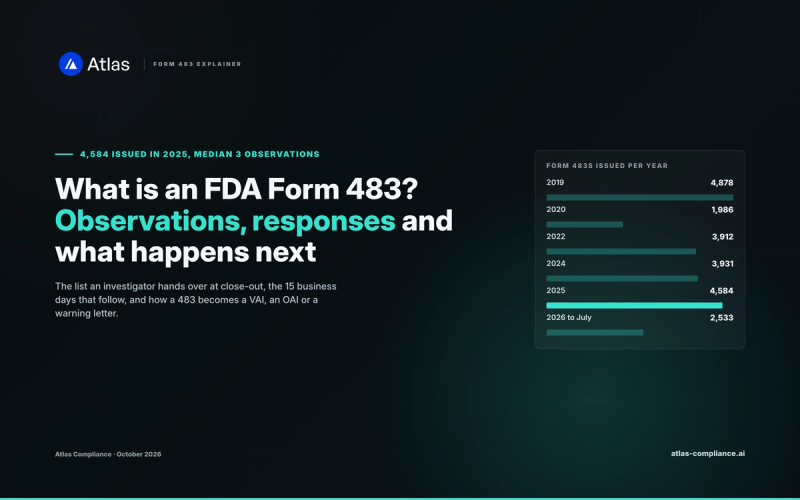
- FDA issued 755 Form 483s in the Human Drugs category and 269 in Biologics in 2025, per our Form 483 directory (release of August 15, 2026).
What is the eCTD 4.0 timeline in each region?
The eCTD 4.0 timeline differs by agency: Japan is the only major regulator that requires v4.0 today, FDA and EMA accept it for new applications only, and Health Canada has not opened v4.0 submissions. Every region still accepts v3.2.2 for applications already filed in it.
| Region | v4.0 accepted from | Scope today | v4.0 required | v3.2.2 status |
|---|---|---|---|---|
| United States (FDA, CDER and CBER) | September 16, 2024 | New NDA, BLA, ANDA, IND and master files | No date announced; FDA says it will give advance notice in the Federal Register | Supported; existing applications stay on v3.2.2 |
| European Union (EMA) | December 22, 2025 | New centralised (CAP) marketing authorisation applications | Not expected before late 2027 | Accepted during the transition; forward compatibility pilot since March 2026 |
| Japan (PMDA) | 2022 | New applications | April 1, 2026, per MHLW notification of February 2022 | Ended for new applications; lifecycle of older dossiers per the MHLW notice |
| Canada (Health Canada) | Not open | Draft Canadian Module 1 guide published June 26, 2019 | No decision announced | Current required eCTD format |
The FDA dates come from its eCTD v4.0 page, which also says forward compatibility for existing v3.2.2 applications and two-way communication will come in later phases, with no dates given. The EU dates come from EMA's June 15, 2026 digitalisation update, which also reports that the technical pilot for non-centralised new applications slipped to Q3 or Q4 2026. Health Canada's 2019 notice states that the decision to implement v4.0 had not been made, and we found no later date on canada.ca.

Two dates older articles still repeat are wrong for planning. The first is a fixed FDA mandatory year: FDA has published none. The second is an EMA mandatory date in 2026: EMA's own update now says late 2027 at the earliest. Medical devices are a separate track. CDRH does not use eCTD for 510(k)s; since October 1, 2023, 510(k) submissions go through the eSTAR template, covered in our 510(k) submission guide.
What changes from eCTD 3.2.2 to 4.0?
eCTD v4.0 changes the backbone of a submission, not its content. Modules 1 to 5 and the CTD headings stay where they are; what changes is how files are described, reused and replaced.
| Area | eCTD v3.2.2 | eCTD v4.0 |
|---|---|---|
| Backbone | index.xml plus a regional XML file, DTD based | One XML message per submission based on HL7 RPS |
| Folder structure | Meaningful; file location carries information | Not meaningful; metadata carries the information |
| Metadata values | Fixed in the specification and DTD | Controlled vocabularies maintained by ICH and each region, updatable without a new specification |
| Lifecycle | Operation attributes on each leaf: new, replace, append, delete | Context of use: documents are replaced or suspended at the context level; append is gone |
| Document reuse | Re-send the file or cross-reference it by path | Send a document once, then reference it by its identifier in later sequences |
| Study tagging files | Required in some regions for Modules 4 and 5 | Replaced by keywords and grouping |
| Agency to sponsor messages | Outside eCTD (letters, portals) | Defined in the standard; FDA lists two-way communication as a future phase |
Controlled vocabularies are the change with the longest tail for automation. In v3.2.2, a value like a manufacturer name or dosage form sits in an attribute your publishing tool hard-codes. In v4.0 those values are coded terms from a list the agency can update, so your master data has to map to the current list, and that mapping becomes something to validate.
Document reuse is the change that saves the most labor. A stability report or a facility description submitted once can be referenced in later sequences without being re-sent. It also means one wrong document propagates everywhere it is referenced, which raises the bar on review before the first submission.
Which parts of a regulatory submission can be automated?
Regulatory submission automation works well on mechanical, rule-based steps and poorly on judgment. The table below sorts the work by how much of it software can safely take over today.
| Task | Automate? | Why |
|---|---|---|
| Publishing: PDF rendering, bookmarks, hyperlinks, granularity | Yes | Deterministic rules from the specification |
| Technical validation against FDA and EMA criteria | Yes | Agencies publish the validation rules; tools run them before you send |
| Lifecycle bookkeeping: which document replaces which | Yes | v4.0 context of use and document IDs make this traceable |
| Content reuse and cross-references | Mostly | Software tracks IDs; a person decides whether the reused text is still true |
| Controlled vocabulary mapping | Mostly | Mapping tables automate it; changes to the lists need review |
| Drafting routine sections (administrative forms, tables of contents, boilerplate) | Partly | AI drafts are fast but must be reviewed and signed |
| Scientific narrative, risk-benefit, Module 2 summaries | No | Requires accountable expert judgment |
| Facility readiness for pre-approval inspection | No | Depends on the facility's GMP state, not the document |
The last row is where applications fail. In our CRL dataset, 42 of the 65 letters FDA published for 2024 cited facility problems, and no publishing or validation tool checks whether an open Form 483 at a contract manufacturer will block approval. Our analysis of 438 published Complete Response Letters found the same pattern across years: facility and Form 483 findings were the largest GMP theme.
Can AI write eCTD content?
AI eCTD authoring software can draft content, but the applicant remains accountable for every statement submitted. The safe use is extraction and first drafts: pulling batch data into tables, populating administrative sections, summarizing a report for a reviewer to check, and flagging inconsistencies between Module 2 and Module 3.
Three controls make AI drafting defensible in an inspection. Keep the model version, the prompt and the raw output as part of the record. Route every AI-drafted section through the same review and approval workflow as human text. And test the tool on known submissions before use, the way you would validate any computerized system under 21 CFR Part 11. AI is weakest exactly where errors are most expensive: the scientific justification and the facility commitments a reviewer will check against an inspection report.
Why do applications fail on facilities rather than formatting?
FDA rarely refuses an application because the eCTD was badly built. It refuses because the drug cannot yet be made reliably at the facilities the application names. Our CRL dataset counts 65 letters published for 2024, 48 for 2025 and 17 for the first half of 2026. In 2024, 42 of the 65, about two in three, cited facility problems: an unresolved Form 483, a failed or pending pre-approval inspection, or GMP findings at a contract site.
The live Complete Response Letter analytics break these letters down by theme and year. The pattern behind them is a sequencing failure. FDA asks that the facility's Form 483 response reach the district office before the sponsor's complete response, and that the response dates be stated in the resubmission. Regulatory affairs often learns about the 483 after the fact, because the facility belongs to a contract manufacturer or a different business unit.
Module 3 facility information: where inspection data belongs
Module 3 lists every facility that manufactures, tests or packages the product, and each of those facilities carries an inspection history FDA reviewers will read. Checking that history before filing is the one step in submission preparation that inspection data can do and publishing software cannot.
The volume is large enough that some named facility in a typical application has a recent 483. In the Atlas Form 483 directory (release of August 15, 2026), FDA issued 633 Form 483s in the Human Drugs category in 2024, 755 in 2025 and 323 from January to July 2026; Biologics had 218, 269 and 137. The Human Drugs count includes clinical investigator inspections as well as manufacturing sites, so filter by facility before you draw conclusions.
| Facility | Latest Form 483 | Observations | Sections cited | Inspection history |
|---|---|---|---|---|
| Carlsbad Technology, Carlsbad, California | June 30, 2026 | 3 | 21 CFR 211.192, 211.22(d), 211.67(a) | 17 inspections, 8 with a 483 |
| Epic Pharma, Laurelton, New York | June 12, 2026 | 4 | 21 CFR 211.22(d), 211.67(a), 211.68(b), 314.81(b)(1)(i) | 20 inspections, 7 with a 483 |
Two details in that table matter to a submission team. Epic Pharma's 483 cites 21 CFR 314.81(b)(1)(i), the field alert report requirement, which is an application obligation and not only a GMP one. And 211.192, the investigations requirement cited at Carlsbad, is the same section FDA put first in its September 22, 2026 warning letter to the Fresenius Kabi facility in Melrose Park, Illinois. You can look up any facility named in Module 3 with the FDA-inspected facility lookup. Our guide to what a Form 483 is explains how to read the observations.
 Atlas
See what the FDA knows about your next investigator.
30 minutes with the founder. No pitch deck.
How do you migrate to eCTD 4.0?
An eCTD 4.0 migration is mostly a data project. Run these steps before the first new application you plan to file in v4.0:
- Confirm the region and procedure accept v4.0 for your application type, using the table above and the agency page on the day you plan to file.
- Decide which new applications go to v4.0 and which stay on v3.2.2; existing FDA applications cannot switch yet.
- Confirm your publishing and review tools support HL7 RPS messages, v4.0 validation rules and the current regional Module 1.
- Build master data for controlled vocabulary values: product names, dosage forms, manufacturers, substances and their codes.
- Assign document identifiers and a reuse policy: who decides when a document is reused and who reviews it first.
- Replace study tagging files with keyword and grouping rules for Modules 4 and 5.
- Validate the toolchain under 21 CFR Part 11 and your computerized system SOPs, including any AI drafting component.
- Send an FDA sample submission if you want early feedback; FDA currently evaluates samples for new applications only.
- Build a dated log of every Form 483 and its response for each facility in Module 3, including contract sites; our EIR readiness guide covers what pre-approval investigators review.
- Keep v3.2.2 capability until every region you file in has published a forward compatibility route.
Step 9 is the only one that changes approval odds. The other nine change how fast and how cleanly the dossier arrives.
AtlasFDA Inspection Intelligence Digest
We track every 483, EIR, and warning letter the moment it happens. Get the signals before they hit the FDA website.
Frequently asked questions
No. As of October 2026, FDA accepts eCTD v4.0 for new NDA, BLA, ANDA, IND and master file submissions to CDER and CBER, and continues to support v3.2.2. FDA has not announced a date for requiring v4.0 and says it will give advance notice in the Federal Register before it accepts v4.0 only.

Written by
Bhavish Agarwal
Founder, Atlas
Bhavish Agarwal is the founder of Atlas and previously worked at Google and Microsoft. He has spent the past several years building regulatory data infrastructure for the pharmaceutical industry.