
A 510(k) is a premarket notification that a medical device maker files with FDA at least 90 days before selling a device, to show it is substantially equivalent to a device already legally on the US market, called the predicate. If FDA agrees, it issues an order that clears the device for commercial distribution. Clearance is not approval: 21 CFR 807.97 says a substantial equivalence finding "does not in any way denote official approval."
In short:
- The rules sit in 21 CFR Part 807, Subpart E. Every 510(k) now goes to FDA as an eSTAR through the CDRH Portal.
- FDA's MDUFA V goal is a decision within 90 FDA days. Days on hold for missing information do not count, so calendar time runs longer.
- A change to a cleared device needs a new 510(k) when it could significantly affect safety or effectiveness, or is a major change in intended use.
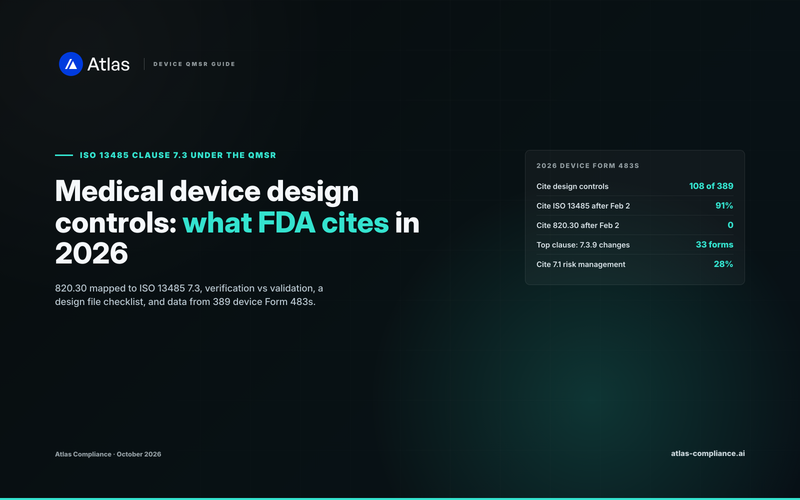
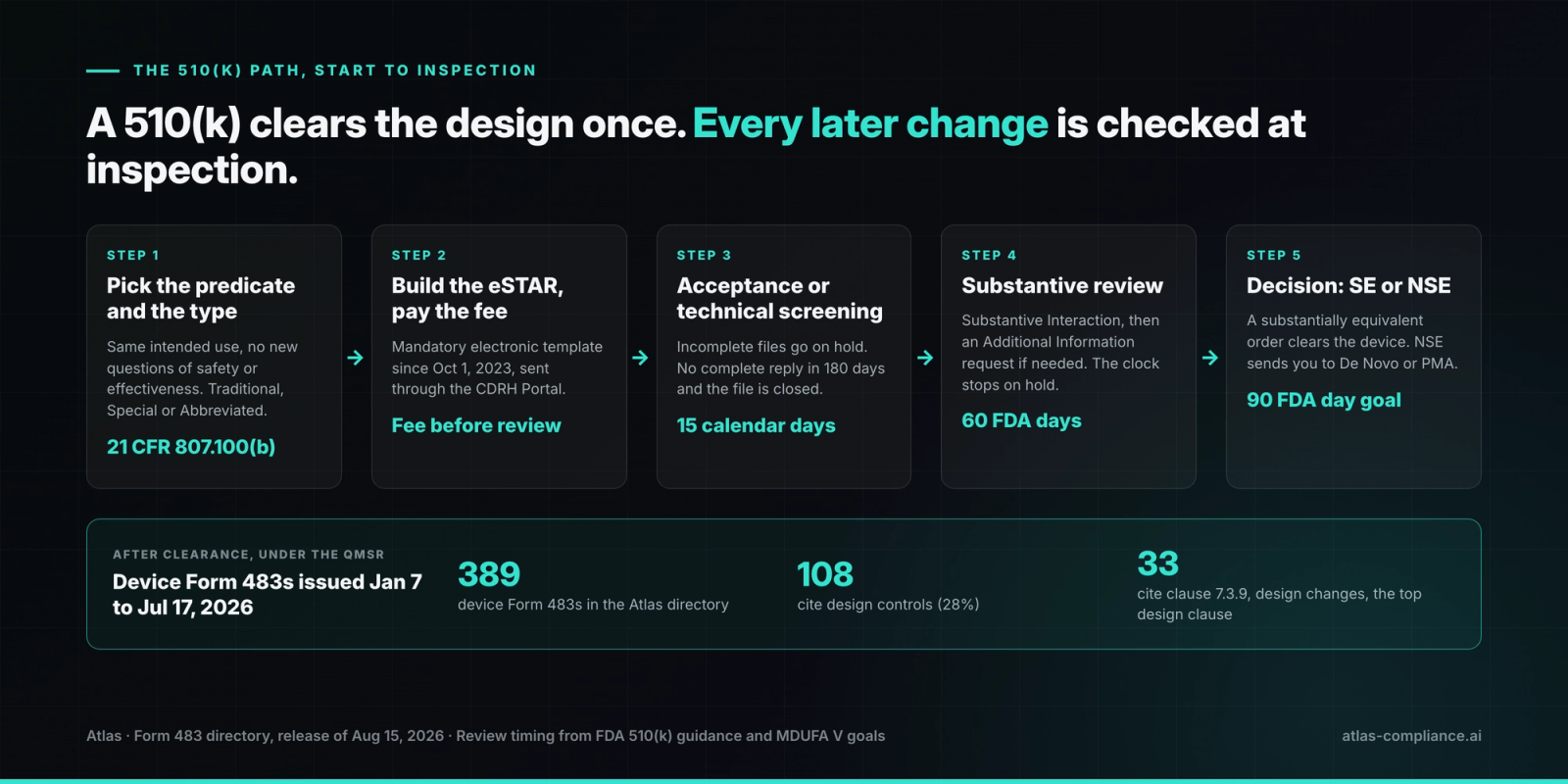
- Clearance is reviewed once; the design behind it is inspected for as long as you sell the device. In Atlas's directory of 389 device Form 483s issued from January 7 to July 17, 2026, 108 cite design controls, and design change control (ISO 13485 clause 7.3.9) is the most cited design clause.
What substantial equivalence and a predicate device mean
Substantial equivalence is the test FDA applies, set out in 21 CFR 807.100(b). Your device is substantially equivalent if it has the same intended use as the predicate and either has the same technological characteristics, or has different ones (materials, design, energy source) that do not raise different questions of safety and effectiveness, backed by data showing it is as safe and effective. The two devices do not need to be identical.
A predicate is any legally marketed device you compare against: a device on the market before May 28, 1976 (a preamendments device), a device reclassified from Class III to Class II or I, or a device already found substantially equivalent through a 510(k). Devices granted through De Novo can also serve as predicates once classified. Match intended use first; a mismatch ends the comparison before any test data is read.
If FDA finds the device not substantially equivalent (NSE), it cannot be marketed on that 510(k). The usual routes from there are a De Novo request, if the device is low enough in risk for general or special controls, or a PMA.
Who needs a 510(k), and who is exempt
Under 21 CFR 807.81, a 510(k) is required when a registered establishment introduces a device into commercial distribution for the first time, or when a device it already sells is about to be significantly changed in design, components, method of manufacture or intended use. FDA's premarket notification page lists who submits: domestic manufacturers, specification developers, some repackagers and relabelers, and foreign manufacturers or their US representatives. Contract manufacturers who build to someone else's specifications do not.
You do not need a 510(k) when:
- the device type is exempt by its classification regulation in 21 CFR 862 to 892, within the limitations that regulation sets
- it is a preamendments device that has not been significantly changed and keeps the same intended use
- it is a custom device within section 520(b) of the FD&C Act (807.85(a))
- you are a distributor or repackager putting your name on a device someone else already cleared, without changing anything else (807.85(b))
- a PMA or a reclassification petition is pending for it, or the change falls inside a cleared predetermined change control plan (PCCP) (807.81(b))
Exempt from 510(k) does not mean exempt from the rest of Part 820. Most exempt devices still fall under the QMSR.
Traditional, Special or Abbreviated: which 510(k) type fits
All three use the same eSTAR and carry the same user fee. The choice changes what you submit and how fast FDA aims to finish.
| Type | Use it when | What you submit | FDA review target |
|---|---|---|---|
| Traditional 510(k) | Any original 510(k), or any change to a cleared device | Full comparison to the predicate with complete test data | 90 days of receipt, after acceptance |
| Special 510(k) | A change to your own cleared device, where the methods to evaluate it are well established and results fit a summary or risk analysis format | Summary of design control activities, risk analysis and verification results | 30 days of receipt, after acceptance |
| Abbreviated 510(k) | FDA guidance, special controls or recognized consensus standards cover the device type | Summary reports and declarations of conformity in place of full data | 90 days of receipt, after acceptance |
The special 510(k) is the one most tied to design controls. It works because FDA relies on your change control records instead of reviewing raw data, so a weak design change process makes it the wrong choice. FDA also says it is generally not suitable for devices that make a biological product at the point of care.
How a 510(k) submission moves through FDA review
Five stages, with the clock rules that catch most teams:
- Submission. Since October 1, 2023, every 510(k) must be an eSTAR unless exempted, sent through the CDRH Portal. De Novo requests joined on October 1, 2025. A user fee applies to all three 510(k) types; FDA publishes the amount each fiscal year (the current table covers FY2027, from October 1, 2026), small businesses qualified by CDRH pay a reduced fee, and 510(k)s sent through an accredited third-party reviewer pay none. FDA does not route a 510(k) for review until the fee is confirmed.
- Acceptance. For a non-eSTAR file, FDA runs its Refuse to Accept (RTA) checklist within 15 calendar days. eSTAR files are not expected to go through RTA; they get technical screening instead, and an incomplete one is placed on hold. Either way, if you do not send a complete response within 180 days, FDA treats the 510(k) as withdrawn.
- Substantive Interaction. Within 60 FDA days, FDA either issues an Additional Information (AI) request or tells you it will proceed through interactive review.
- AI hold. An AI request puts the submission on hold and stops the FDA day count. You have 180 calendar days from the request to send a complete response, or the 510(k) is considered withdrawn.
- Decision. The MDUFA decision goal is 90 FDA days for 95% of submissions. Under 807.100(a), FDA issues a substantially equivalent order, an NSE order, a request for more information, a hold pending financial disclosure under Part 54, or advice that no 510(k) is needed. You cannot market until you hold the SE order.
FDA days count only time the file sits with FDA. The MDUFA V goal for average total time to decision, which includes your time answering questions, is 112 calendar days for FY2025 to FY2027.
510(k) vs De Novo vs PMA
| 510(k) | De Novo | PMA | |
|---|---|---|---|
| Device risk | Mostly Class II, some Class I and a few Class III types | Novel devices with no predicate, suitable for Class I or II | Class III, highest risk |
| Legal standard | Substantial equivalence to a predicate | General or special controls give reasonable assurance of safety and effectiveness | Valid scientific evidence of safety and effectiveness |
| Predicate needed | Yes | No | No |
| Clinical data | Sometimes | Often | Usually, from clinical investigations |
| FDA review goal | 90 FDA days | 150 review days | 180 days by statute |
| Outcome | Clearance (SE order) | Grant, which creates a new classification | Approval |
| Can become a predicate | Yes | Yes | No |
| eSTAR required | Yes, since Oct 1, 2023 | Yes, since Oct 1, 2025 | Voluntary |
Deciding when to submit a 510(k) for a change to an existing device
This is where most cleared devices get into trouble. FDA's guidance, Deciding When to Submit a 510(k) for a Change to an Existing Device (October 25, 2017), works through four flowcharts: labeling changes; technology, engineering and performance changes; materials changes; and IVD changes. Software changes have a separate companion guidance.
The guiding principles reduce to six rules:
- If the change is meant to significantly affect safety or effectiveness (to fix a known risk, respond to adverse events, or improve clinical outcomes), a new 510(k) is likely required.
- Run a risk-based assessment first. A new risk, or a change to an existing risk's score, acceptability or duration, usually means a new 510(k).
- Look for unintended consequences: a sterilization change can alter materials, and a materials change can alter performance.
- Compare against your most recently cleared device, not the last version you shipped. Changes add up, and the cumulative effect can cross the threshold even when no single change does.
- Routine verification and validation confirm a decision not to file. An unexpected result reopens that decision.
- Document every decision, including each decision not to file. The guidance calls this a letter to file.
That last record is a design change record. The guidance was written under the old QSR and points to 21 CFR 820.30; since February 2, 2026, the same record is required by ISO 13485 clause 7.3.9, which asks you to determine the significance of each change and its effect on risk management and delivered product. Our guide to medical device design controls under the QMSR maps every 820.30 paragraph to its clause. Selling a significantly changed device without a new 510(k) leaves it misbranded under section 502(o) of the FD&C Act, and an investigator can find the gap by reading the change log.
Clearance is not the end: what 2026 device Form 483s show
The QMSR took effect on February 2, 2026 and incorporates ISO 13485:2016 by reference. FDA reviews the 510(k) once; investigators then check that the design behind it stayed under control. We pulled every Medical Devices & Rad Health Form 483 with a 2026 issue date from the Atlas Form 483 database (data release of August 15, 2026).
| Measure (device Form 483s, 2026) | Count | Share |
|---|---|---|
| Form 483s issued Jan 7 to Jul 17, 2026 | 389 | 100% |
| Cite design controls (ISO 13485 7.3.x or legacy 820.30) | 108 | 28% |
| Cite ISO 13485 clause 7.3 | 94 | 24% |
| Cite clause 7.3.9, design and development changes | 33 | 35% of the 94 |
| Cite design changes under either 7.3.9 or 820.30(i) | 37 | 34% of the 108 |
Clause 7.3.9 tops the design list, ahead of design files (17) and validation (16); the full stage-by-stage count is in our design controls breakdown. In a separate sample of 96 device Form 483s from May to July 2026, 91 cited ISO 13485; clause 7.1 risk management appeared on 31%, 8.5.2 corrective action on 28%, 7.4.1 purchasing on 18% and 7.5.6 process validation on 17%, as tracked on our most prevalent ISO clauses by industry dashboard. Those clauses sit next to 7.3.9 for a reason: a design change touches the risk file, suppliers and validated processes.
Three indexable examples:
- First Source, Inc., Rochester, June 24, 2026: three observations, one each under 7.1 (risk management processes not documented), 7.3.9 (procedures to control design and development changes not documented) and 8.5.2 (corrective action procedures not documented), from investigator Matthew D Schnittker.
- Klarity Medical Products, Heath, May 20, 2026: eight observations, starting with records of design and development changes and their reviews not maintained (7.3.9), plus supplier records (7.4.1), process validation procedures (7.5.6) and rework verification (8.3.4).
- Vynacron Dental Resins, Jackson, January 21, 2025: four observations under the old QSR, including 820.30(i), design change procedures lacking or inadequate, alongside MDR procedures (803.17) and complaint handling (820.198(a)).
None of these Form 483s says a 510(k) was missed. Each says the firm could not show how it controlled changes, which is the evidence a "no new 510(k) needed" decision rests on. New to the form itself? Start with what an FDA Form 483 is.
 Atlas
See what the FDA knows about your next investigator.
30 minutes with the founder. No pitch deck.
How inspectors test a cleared design under Compliance Program 7382.850
Device inspections stopped using the Quality System Inspection Technique on February 2, 2026; our earlier post on the QSIT inspection describes the approach that was retired. Compliance Program 7382.850 treats Design and Development and Change Control as separate QMS areas, so one weak change record can be cited twice.
For a cleared device, expect the investigator to ask for:
- the 510(k) number and the device description that was cleared
- the change log since that clearance, with the significance determination for each change
- letters to file for changes judged not to need a new 510(k), with the risk assessment and verification behind each
- the risk management file, showing how each change was assessed against it
- validation records for any process changed since clearance
- supplier changes that affect a component named in the 510(k)
A change log that cannot connect today's device to the cleared one is where 7.3.9 observations come from. To see what an investigator has cited before at facilities like yours, search the Form 483 reports database by clause.
AtlasFDA Inspection Intelligence Digest
We track every 483, EIR, and warning letter the moment it happens. Get the signals before they hit the FDA website.
Frequently asked questions
FDA's MDUFA V goal is a decision within 90 FDA days, met for 95% of submissions. FDA days stop while a 510(k) is on hold for an Additional Information request, so calendar time is longer. The goal for average total time to decision, including the submitter's response time, is 112 calendar days for FY2025 to FY2027. A Special 510(k) targets 30 days.

Written by
Bhavish Agarwal
Founder, Atlas
Bhavish Agarwal is the founder of Atlas and previously worked at Google and Microsoft. He has spent the past several years building regulatory data infrastructure for the pharmaceutical industry.