
The Reliance Life Sciences FDA warning letter is a CDER warning letter dated August 18, 2026 that cites Reliance Life Sciences Private Limited's drug manufacturing facility in Rabale, Navi Mumbai (FEI 3009510975) for incomplete microbiology laboratory records under 21 CFR 211.194(a) and poor aseptic practice under 21 CFR 211.113(b). It followed a February 19 to 27, 2026 inspection that ended with a Form 483.
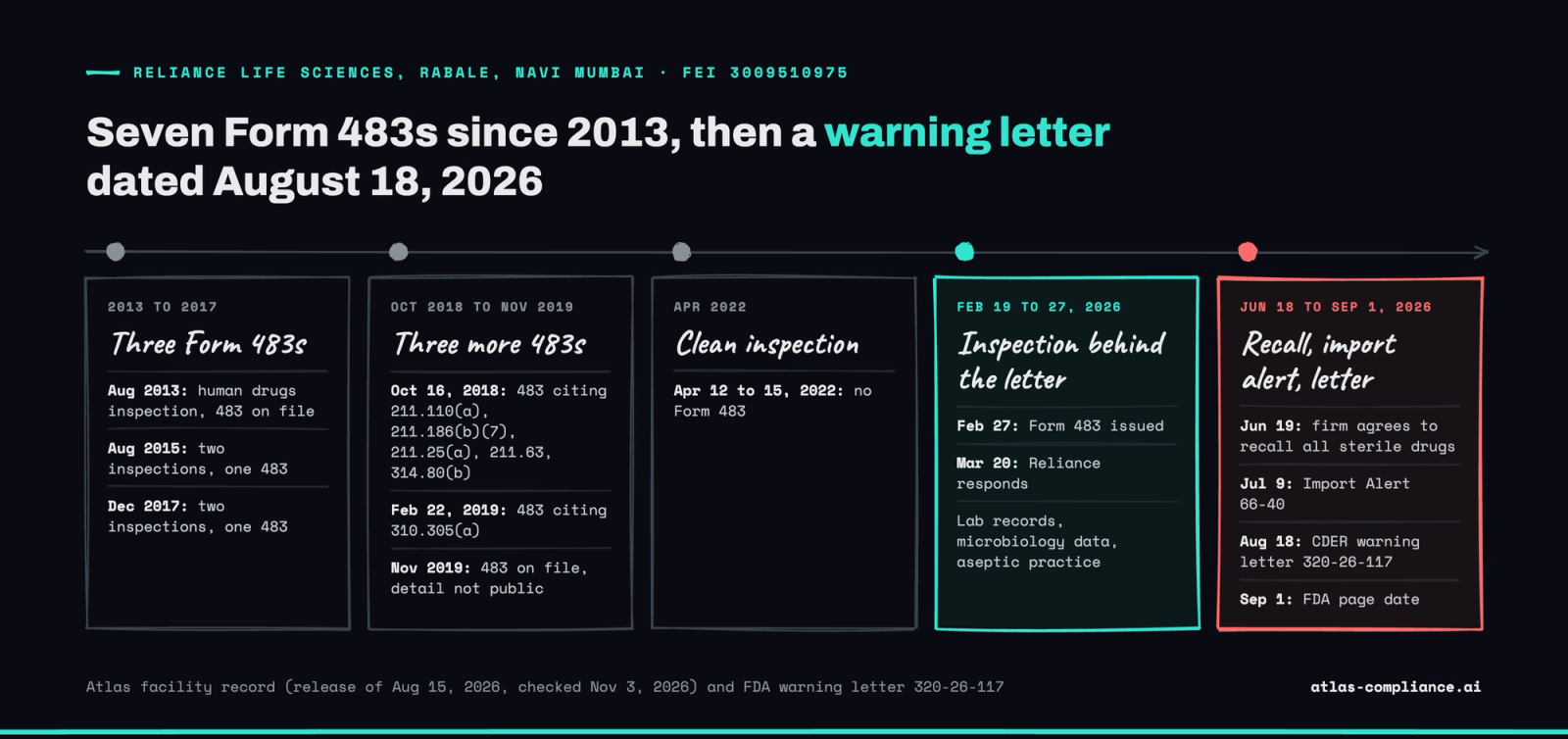
By the time FDA signed the letter, Reliance had already agreed to recall all sterile drugs from the US market, and FDA had placed the firm on Import Alert 66-40. The Atlas facility record (release of August 15, 2026, checked November 3, 2026) adds the history the letter leaves out: 11 FDA inspections at Rabale since 2013, seven of them ending with a Form 483.
Key facts:
- FDA's letter is reference 320-26-117 (MARCS-CMS 730801), issued by CDER's Office of Manufacturing Quality; the FDA page carries a date of September 1, 2026.
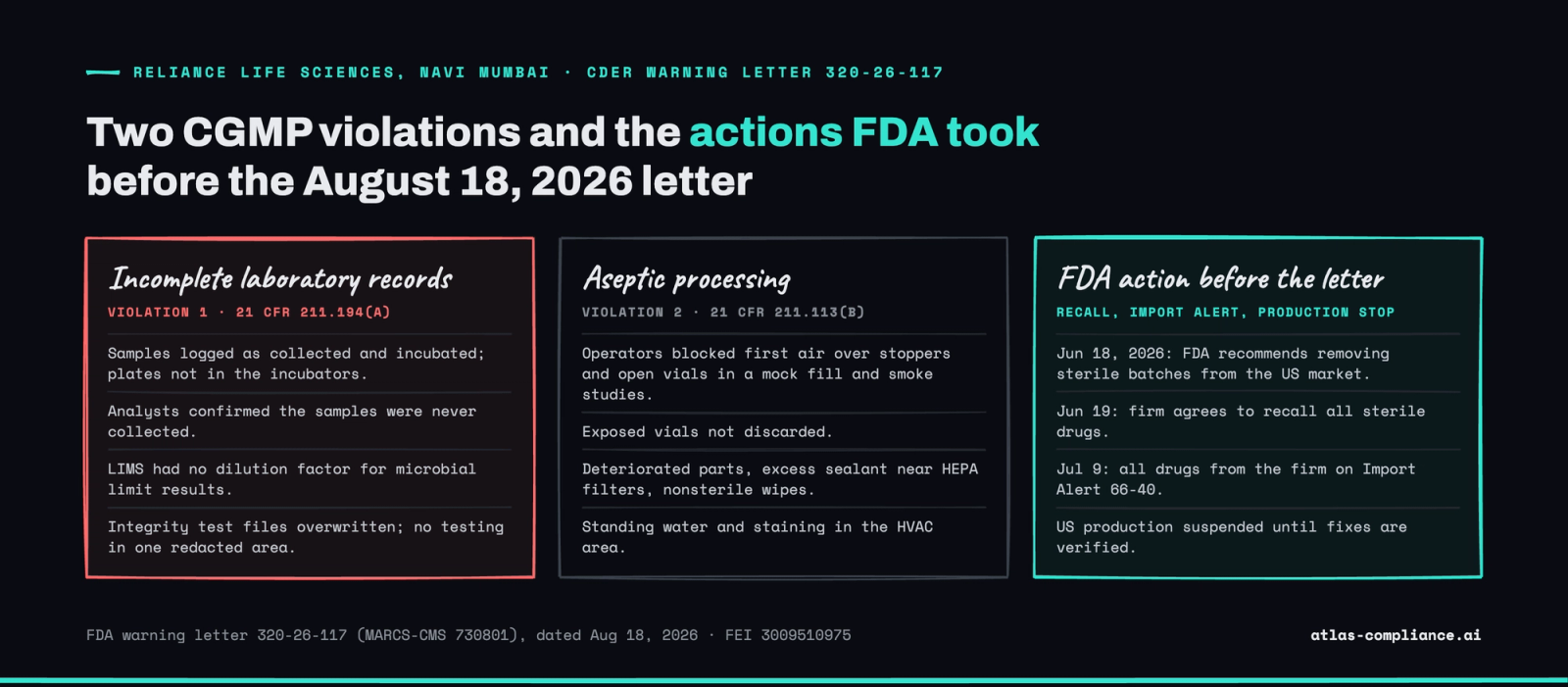
- FDA cites two violations: 21 CFR 211.194(a) for laboratory records and 21 CFR 211.113(b) for aseptic and sterilization procedures.
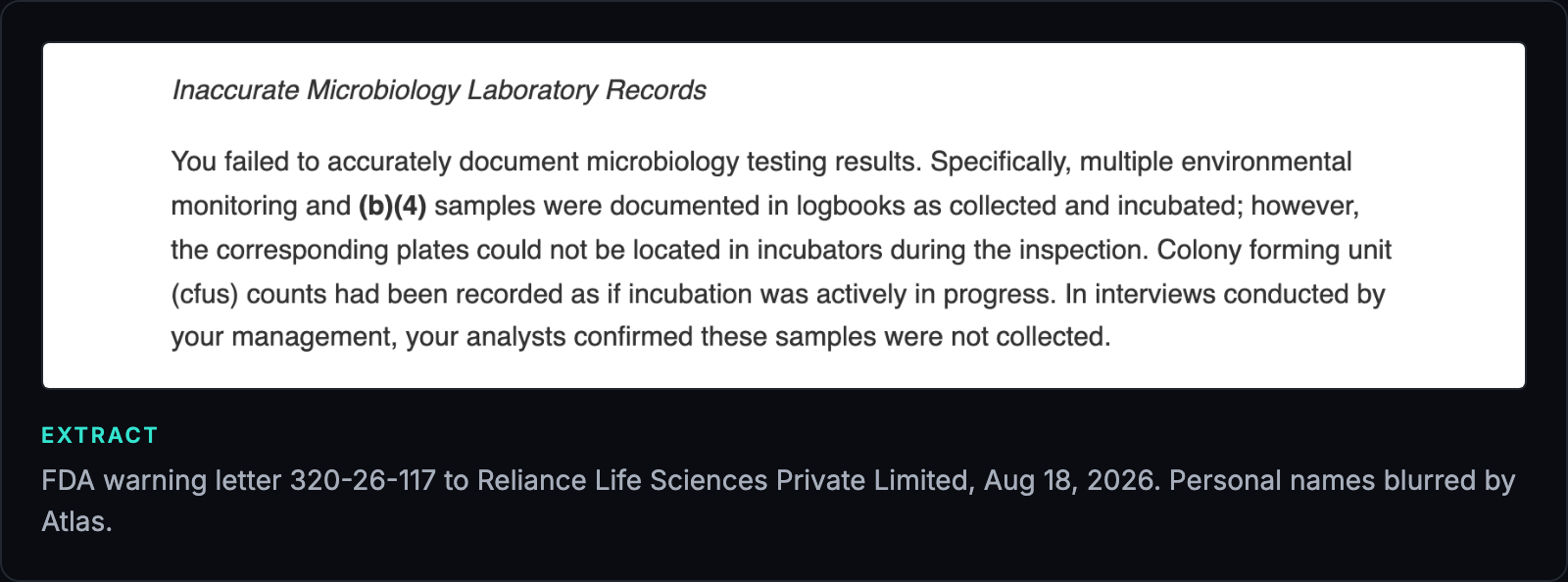
- Reliance analysts confirmed in management interviews that microbiology samples logged as collected and incubated had never been collected, according to the letter.
- On June 19, 2026 Reliance agreed to recall all sterile drug products, and on July 9, 2026 FDA placed all of the firm's drugs on Import Alert 66-40.
- Rabale has 11 FDA inspections on record in Atlas, and 7 ended with a Form 483.
- Reliance had 15 business days from receipt to respond in writing.
What does the Reliance Life Sciences FDA warning letter cite?
The Reliance Life Sciences FDA warning letter cites two CGMP violations at the Rabale facility, both under 21 CFR Part 211, the drug manufacturing rules. FDA says the drugs made there are adulterated under section 501(a)(2)(B) of the FD&C Act because the methods, facilities and controls do not conform to CGMP.
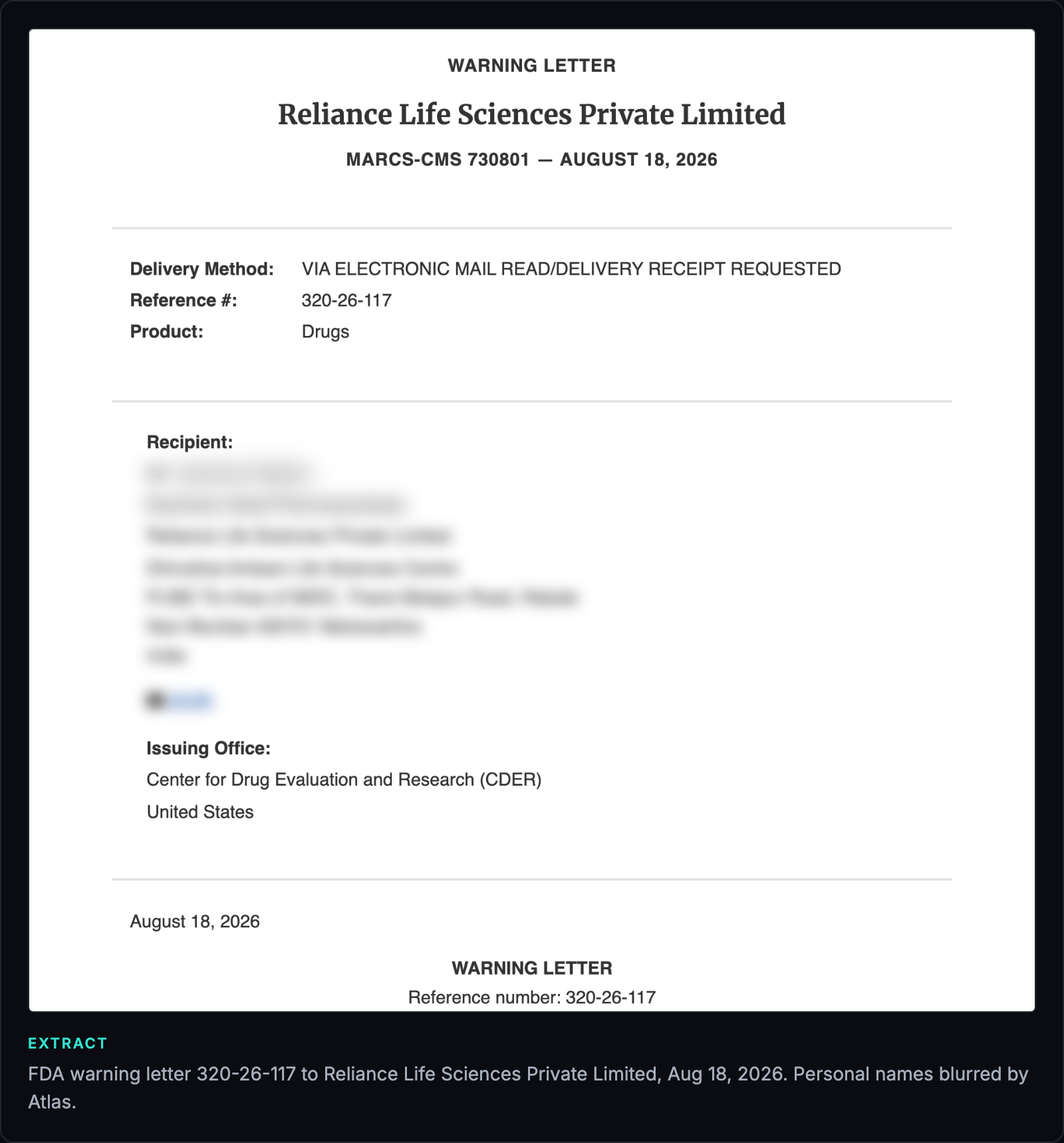
The source is FDA warning letter 320-26-117, dated August 18, 2026 and sent by email to the company's head of pharmaceuticals. FDA redacted equipment names and some figures as (b)(4).
| # | Section cited | What FDA found at Rabale |
|---|---|---|
| 1 | 21 CFR 211.194(a) | Environmental monitoring and other samples logged as collected and incubated, with plates missing from the incubators; CFU counts recorded as if incubation were running; LIMS applied no dilution factor to microbial limit results, so batches were released on raw plate counts; integrity test reports overwritten for lack of unique file names |
| 2 | 21 CFR 211.113(b) | Operators blocked first air over the stopper bowl and open vials during a mock fill and in smoke study video; exposed vials kept; deteriorated components, excess sealant next to HEPA filters, nonsterile wipes and standing water in the HVAC area |
The first violation carries the weight. FDA writes that the deficiencies indicate "a significant risk of systematic underreporting of microbial findings." Reliance's 483 response said the unaccounted samples "may have been misplaced," which FDA called contradictory, since the firm's own analysts had said the samples were never collected. FDA also rejected the retrospective review of integrity test failures because Reliance itself admitted that historical traceability was incomplete.
On aseptic processing, Reliance told FDA its procedures did not define hand positioning, intervention speed, first-air protection or rejection criteria for exposed units. The company committed not to resume operations until an aseptic process simulation with all listed interventions passes under worst-case conditions. FDA found the response too thin on the third-party risk assessment of all aseptic filling lines and on oversight of operator behavior.
What inspection led to the Reliance Life Sciences warning letter?
The inspection behind the Reliance Life Sciences warning letter ran from February 19 to 27, 2026 at the Dhirubhai Ambani Life Sciences Centre in Rabale and ended with a Form 483. Reliance answered on March 20, 2026. Atlas records that inspection as Human Drugs with a Form 483 on file; its observation detail is not yet public in the directory.
FDA then moved in four steps over 172 days:
- February 27, 2026: Form 483 issued at the close of the inspection.
- June 18, 2026: FDA held a teleconference recommending that Reliance consider removing sterile batches from the US market; on June 19, Reliance agreed to recall all sterile drug products and suspend production for the US.
- July 9, 2026: FDA placed all drugs and drug products offered for import from the firm on Import Alert 66-40.
- August 18, 2026: CDER issued the warning letter.
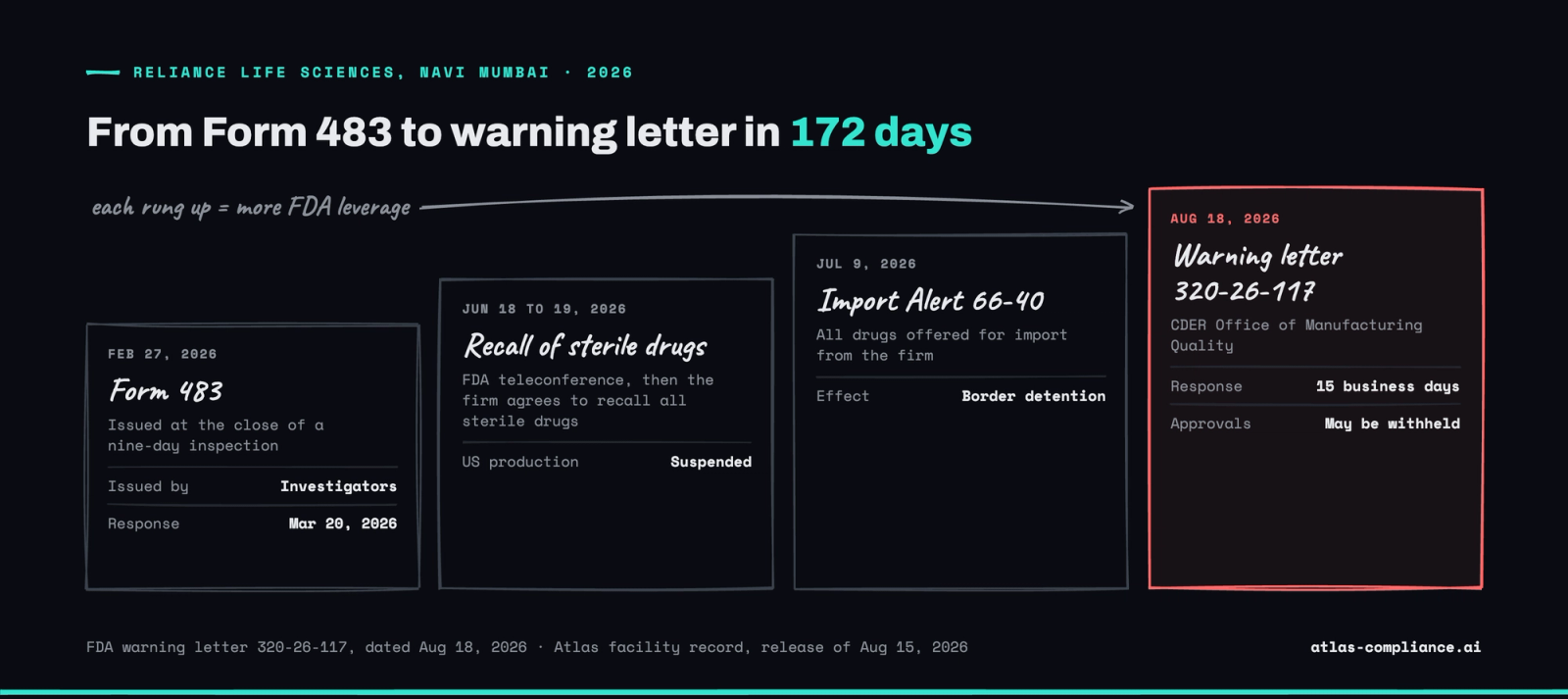
The recall and the import alert came before the letter, and that order shows how FDA read the findings: it pulled product from the market before it wrote to the firm. Our guide to what manufacturers should know about import alerts covers how detention without physical examination works and how a firm petitions for removal.
What is Reliance Life Sciences' FDA inspection history?
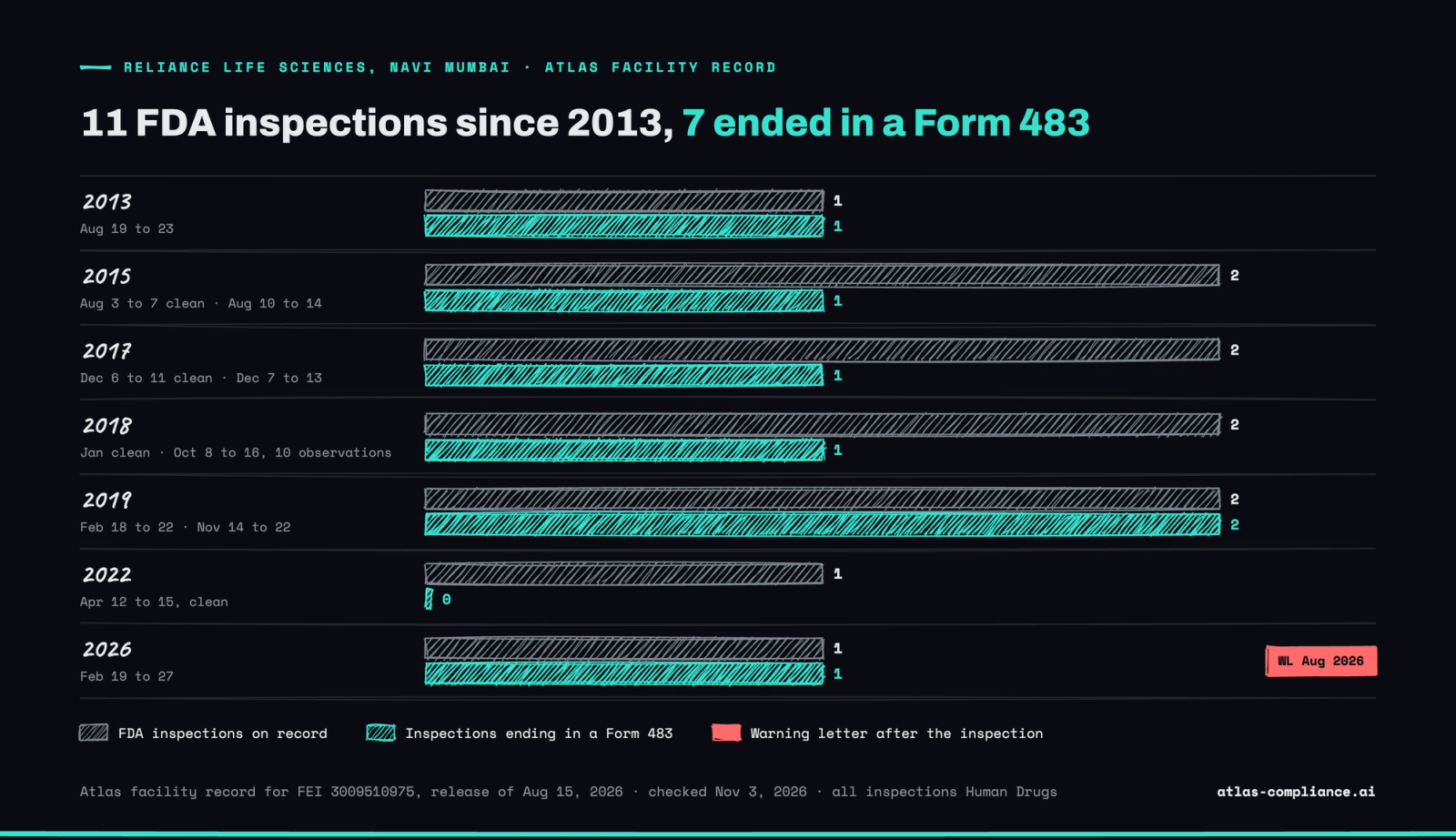
Reliance Life Sciences' Rabale facility has 11 FDA inspections on record in Atlas from August 2013 to February 2026, and 7 of them ended with a Form 483. Every inspection is categorized Human Drugs. The Reliance Life Sciences Navi Mumbai facility record is the only Reliance Life Sciences site in the Atlas FDA-inspected sites directory, and it matches the FEI in the letter.
| Year | FDA inspections | Ended with a 483 | Notes from the Atlas record |
|---|---|---|---|
| 2013 | 1 | 1 | August 19 to 23 |
| 2015 | 2 | 1 | August 3 to 7 clean; August 10 to 14, 483 |
| 2017 | 2 | 1 | December 6 to 11 clean; December 7 to 13, 483 |
| 2018 | 2 | 1 | January clean; October 8 to 16, 483 with 10 listed observations |
| 2019 | 2 | 2 | February 18 to 22 and November 14 to 22 |
| 2022 | 1 | 0 | April 12 to 15, clean |
| 2026 | 1 | 1 | February 19 to 27, followed by the warning letter |
The pattern is a 483 at nearly every visit from 2013 to 2019, a clean inspection in April 2022, then a four-year gap before the February 2026 visit. Atlas ties 15 FDA investigators to the facility, each with one inspection there. Two of them wrote the Form 483s with public detail: Angela E Glenn, who has 213 inspections and 728 Form 483 observations on record, wrote the October 2018 form, and Tiara N Brown-Crosen, with 50 inspections and 132 observations, wrote the February 2019 form.
If your facility makes sterile products for the US, the investigator assigned to your next inspection has a record like these, and you can read it before the team arrives.
 Atlas
See what the FDA knows about your next investigator.
30 minutes with the founder. No pitch deck.
Did earlier Reliance Life Sciences 483s cite the same sections?
No earlier Reliance Life Sciences Form 483 with public detail cites 21 CFR 211.194(a) or 211.113(b), the two sections in the 2026 letter. Atlas holds observation detail for two of the seven forms, from October 2018 and February 2019, and neither touches laboratory records or aseptic processing.
| Form 483 | Sections cited | Overlap with the 2026 letter |
|---|---|---|
| October 16, 2018 | 211.110(a) in-process controls, 211.186(b)(7) theoretical yield, 211.25(a) training, 211.63 equipment design, 314.80(b) adverse drug experience procedures | None |
| February 22, 2019 | 310.305(a) adverse drug experience reporting procedures | None |
| 2013, 2015, 2017, November 2019, February 2026 | Detail not public in Atlas | Unknown |
Two readings follow. First, the public record shows no repeat citation, so this letter does not fit the repeat-observation pattern behind letters such as Baxter's at Round Lake. Second, five of the seven forms have no public detail, including the February 2026 form that FDA's letter summarizes. The 2018 form does show production and training gaps, under 211.110(a) and 211.25(a), which sit close to the operator-behavior findings FDA wrote in 2026.
How does the Reliance letter compare with other Indian sterile and data integrity cases?
The Reliance letter combines the two citation themes FDA writes most often at Indian sterile facilities. In our analysis of FDA foreign inspections, 21 CFR 211.113 appeared on 27% of 74 Indian human-drug Form 483s citing Part 211 from January 2025 to July 2026, against 18% of 611 US forms.
| Measure (Atlas Form 483 directory, release of Aug 15, 2026) | Indian facilities | All or US facilities |
|---|---|---|
| 211.113 on Part 211 human-drug 483s, Jan 2025 to Jul 2026 | 27% of 74 | 18% of 611 US |
| 211.68(b) or 211.194(a) on Part 211 human-drug 483s | 23.0% (17 of 74) | 24.6% (192 of 779) |
| 211.194(a) alone on Part 211 human-drug 483s | n/a | 10.5% (82 of 779) |
The data integrity rate at Indian facilities sits close to the overall rate, as our study of data integrity citations on FDA Form 483s shows. Where Reliance stands apart is the kind of failure. Missing plates and counts entered for samples nobody collected go further than an audit trail gap, and FDA asked for interviews of current and former employees and a statement on whether the people responsible can still influence CGMP data.
Two cases set useful context. Mylan's Indore facility at Pithampur also went on Import Alert 66-40, with a December 2024 warning letter, as our Mylan and Viatris India inspection history records. In the US, FDA's October 6, 2026 letter to a Eurofins contract lab cited 211.194(a) for microbiology counts left out of the record; our Eurofins warning letter analysis covers it.
This letter came from CDER under the finished drug rules in Part 211, and it does not name the products concerned. Readers searching "Reliance Life Sciences 483" for a biologics license issue will find a drug CGMP case.
What happens next for Reliance Life Sciences?
Reliance had 15 business days from receipt of the August 18 letter to respond with corrections and timelines. US production stays suspended until the firm resolves the deficiencies, and FDA asked Reliance to hire a consultant qualified under 21 CFR 211.34 for a six-system audit before it seeks to resolve its compliance status.
FDA's list of requests is long. It includes a retrospective review of every microbial limit test result for products in the US market and within expiry, recalculated with the dilution factor, plus full microbiological testing of reserve samples. FDA also wants an independent assessment of the aseptic lines and cleanrooms that names the barrier system Reliance will use, and annual third-party audits for at least two years.
Until FDA confirms compliance, it may withhold approval of new applications or supplements listing the facility, and Import Alert 66-40 keeps the firm's drugs at the border. The letter notes that Reliance may qualify for a post-warning letter meeting under GDUFA III. Close-out usually requires a re-inspection, and our explainer on the FDA 483 vs warning letter response window sets out how responses at each stage differ. To see when FDA re-inspects Rabale or posts the next letter like this one, the digest below tracks new warning letters and Form 483s as they appear.
AtlasFDA Inspection Intelligence Digest
We track every 483, EIR, and warning letter the moment it happens. Get the signals before they hit the FDA website.
Frequently asked questions
Import Alert 66-40 lets FDA detain drugs from listed foreign manufacturers without physical examination because their CGMP compliance is in doubt. FDA placed all drugs offered for import from Reliance Life Sciences on it on July 9, 2026. A firm usually leaves the alert only after FDA re-inspects, finds the corrections in place and grants a removal petition.

Written by
Bhavish Agarwal
Founder, Atlas
Bhavish Agarwal is the founder of Atlas and previously worked at Google and Microsoft. He has spent the past several years building regulatory data infrastructure for the pharmaceutical industry.