
The Orange Book is FDA's official list of drug products approved as safe and effective under the Federal Food, Drug, and Cosmetic Act, with a therapeutic equivalence code for each product and the patents and exclusivities that decide when a generic can launch. Its formal title is "Approved Drug Products With Therapeutic Equivalence Evaluations," and the current printed version is the 46th edition (2026).
This guide explains what the Orange Book lists, how to search it, how to read A and B codes, and how Paragraph IV patent challenges run. It then covers what the Orange Book does not show: the inspection record of the facilities that make each product, using Atlas data on FDA drug inspections through October 2026.
- An NDA holder must submit patents that claim the drug substance, drug product or an approved method of use; process, packaging, metabolite and intermediate patents must not be submitted (21 CFR 314.53).
- A patent issued after approval must reach FDA within 30 days of issuance to count as timely filed.
- If a patent owner sues within 45 days of a Paragraph IV notice, FDA can approve the ANDA no earlier than 30 months after the notice was received, unless a court shortens or ends that period.
- FDA will refuse to approve an ANDA when the facilities and controls used to make the drug are inadequate, under 21 CFR 314.127(a)(1).
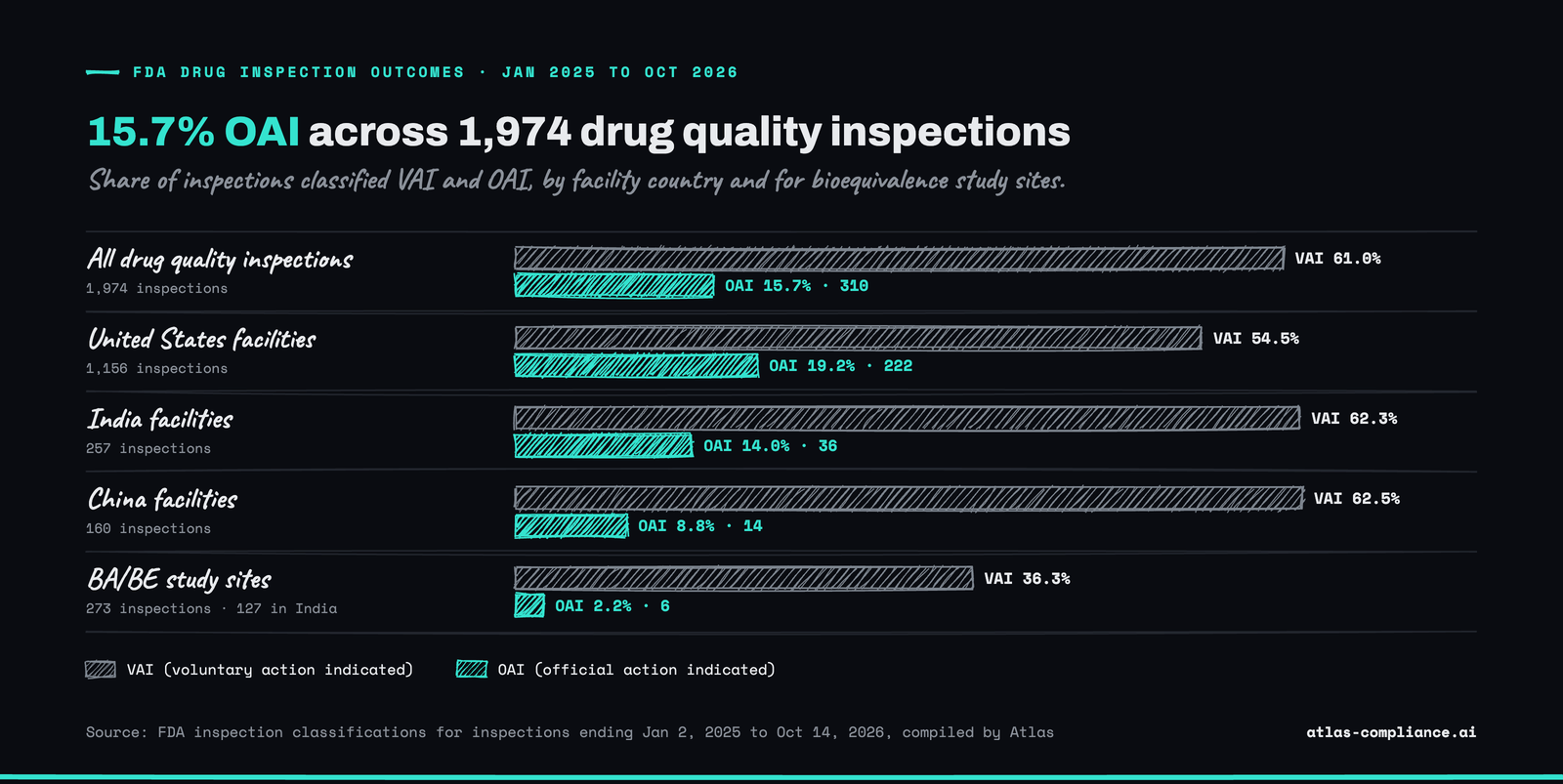
- Of 1,974 FDA drug quality inspections that closed from January 2, 2025 to October 14, 2026, 310 (15.7%) ended OAI, in FDA's published classifications compiled by Atlas.
What is the FDA Orange Book?
The FDA Orange Book is the agency's list of drug products approved on the basis of safety and effectiveness under section 505 of the FD&C Act, through new drug applications (NDAs) and abbreviated new drug applications (ANDAs). The Orange Book gives each product a therapeutic equivalence (TE) evaluation and, in its addendum, the patents and exclusivities attached to it.
The Hatch-Waxman Act of 1984 set up the ANDA pathway and the patent listing system the Orange Book now carries. FDA publishes an annual edition with monthly cumulative supplements, and the online version and its downloadable data files sit on FDA's drug databases pages under "Orange Book." The Orange Book does not list biologics licensed under the Public Health Service Act; those sit in the Purple Book. The BLA vs NDA comparison explains which pathway applies to which product.
What information does the Orange Book list?
The Orange Book lists every approved drug product that has not been withdrawn for safety or effectiveness reasons, split into four parts, plus a patent and exclusivity addendum. FDA does not include products with only tentative approval.
- Prescription Drug Product List.
- Over-the-Counter (OTC) Drug Product List.
- Drug products approved under section 505 and administered by CBER.
- Discontinued Drug Product List.
For each product, the online Orange Book shows the active ingredient, proprietary name, application number, dosage form, route, strength, marketing status, TE code, applicant holder, and two flags: RLD and RS.
The reference listed drug (RLD) is the listed drug FDA identifies as the product an ANDA applicant relies on. The reference standard (RS) is the product FDA selects for the in vivo bioequivalence study. The RS is usually the RLD, but the two can differ, for example when the RLD has left the market for reasons other than safety.
How do you search the Orange Book?
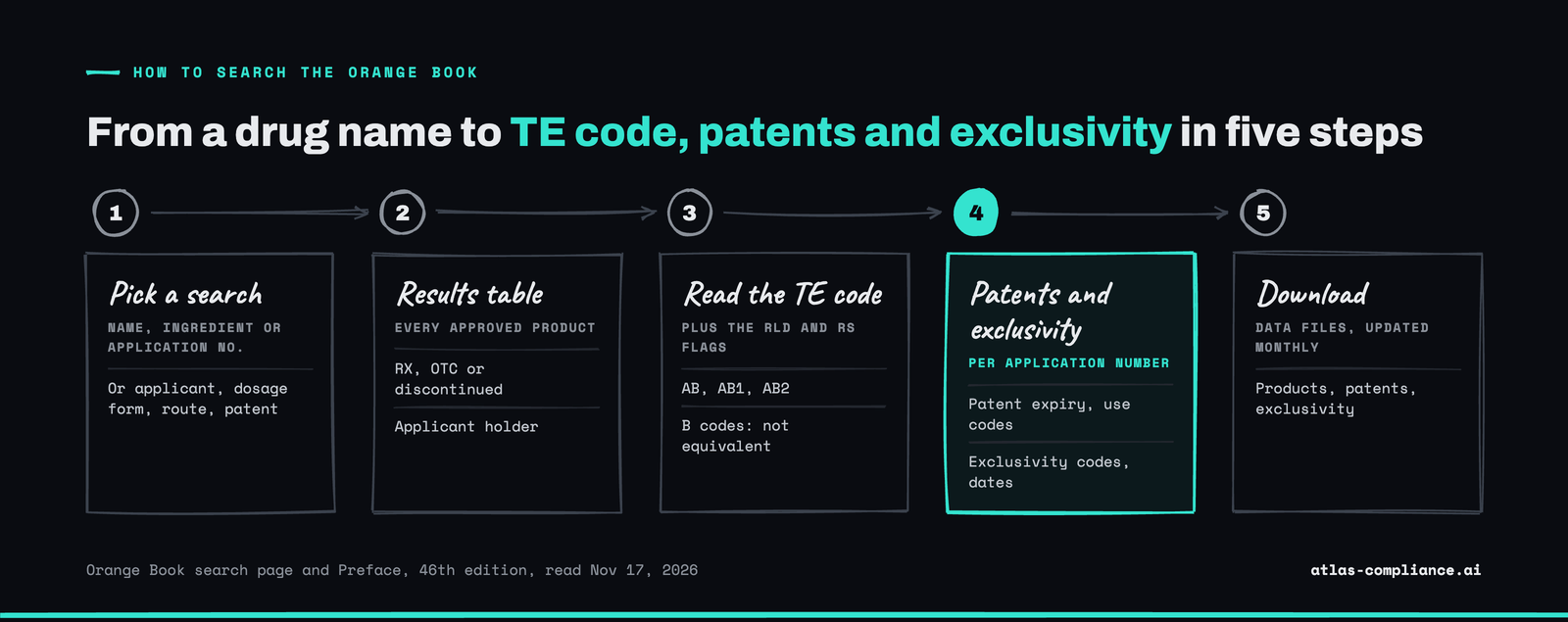
You search the Orange Book by typing a proprietary name, active ingredient or application number into its search page, then opening a product's patent and exclusivity details. The search page also lets you search by applicant, dosage form, route of administration and patent number.
- Choose a search field: proprietary name, active ingredient or application number. Use applicant (company) to see every product one firm holds.
- Read the results table. It shows every approved product that matches, labeled RX, OTC or DISCN, with the applicant holder.
- Read the TE code column, and check which product carries the RLD and RS flags.
- Open the application number for its patents (with expiry dates and use codes) and exclusivity codes with expiry dates.
- For bulk work, download the Orange Book data files (products, patents and exclusivity), which FDA updates monthly.
The Orange Book shows who holds each application, not where the drug is made. For the manufacturing sites, you need the facility's registration and inspection history; the FDA registration lookup guide shows how to find a facility's FEI number.
What are therapeutic equivalence codes in the Orange Book?
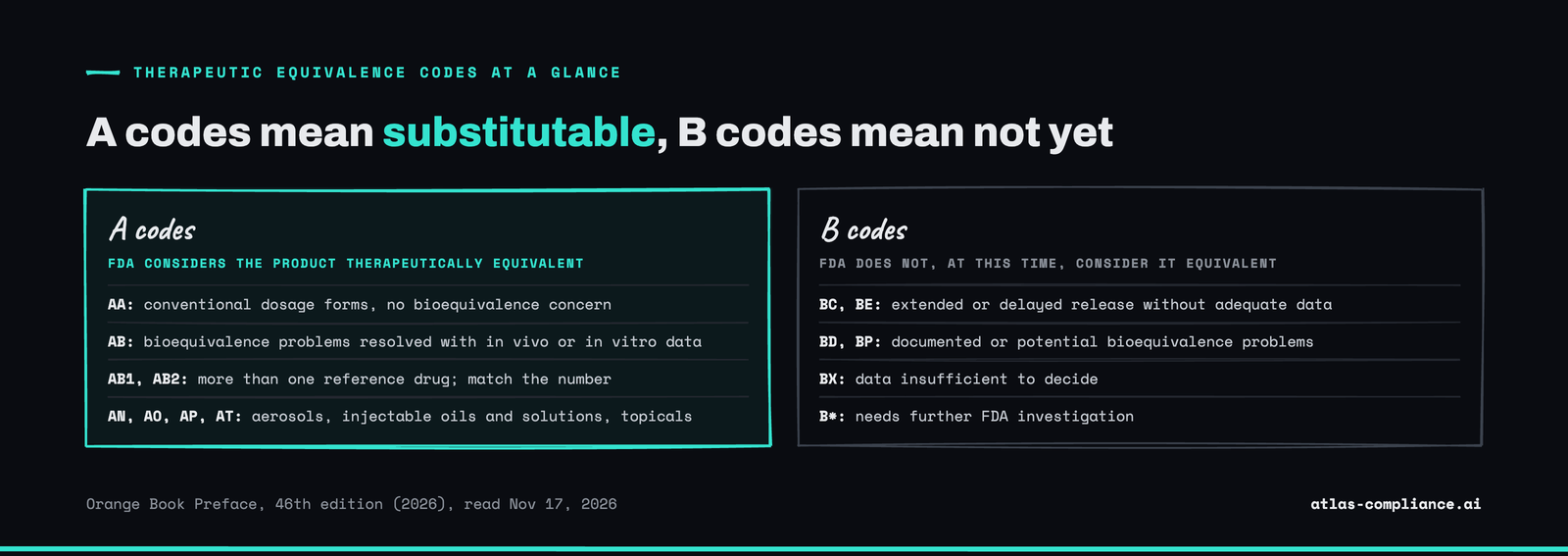
Therapeutic equivalence codes are two-letter ratings that tell you whether FDA considers a drug product therapeutically equivalent to other pharmaceutically equivalent products. A code starting with A means FDA considers the product therapeutically equivalent. A code starting with B means FDA does not, at this time, consider it equivalent, usually because bioequivalence questions are unresolved or the data are insufficient.
| Code | Meaning in the Orange Book Preface |
|---|---|
| AA | Conventional dosage forms with no known bioequivalence problem |
| AB | Actual or potential bioequivalence problems resolved with adequate in vivo and/or in vitro evidence |
| AB1, AB2, AB3 | Several reference drugs of the same strength; equivalent only to the reference with the same number |
| AN | Solutions and powders for aerosolization |
| AO | Injectable oil solutions with the same active ingredient, concentration and type of oil |
| AP | Injectable aqueous solutions and some intravenous non-aqueous solutions |
| AT | Topical products |
| BC | Extended-release dosage forms without bioequivalence data |
| BD | Active ingredients with documented bioequivalence problems |
| BE | Delayed-release oral dosage forms without in vivo bioequivalence studies |
| BP | Potential bioequivalence problems without adequate data |
| BX | Data insufficient to decide therapeutic equivalence |
| B* | Needs further FDA investigation before FDA takes a position |
When two reference drugs share an ingredient and strength but are not bioequivalent to each other, FDA numbers them. The Preface uses nifedipine extended-release tablets as the example: Adalat CC is rated AB1 and Procardia XL is rated AB2, and a generic is equivalent only to the reference product with its matching number.
How do Orange Book patent listings and Paragraph IV challenges work?
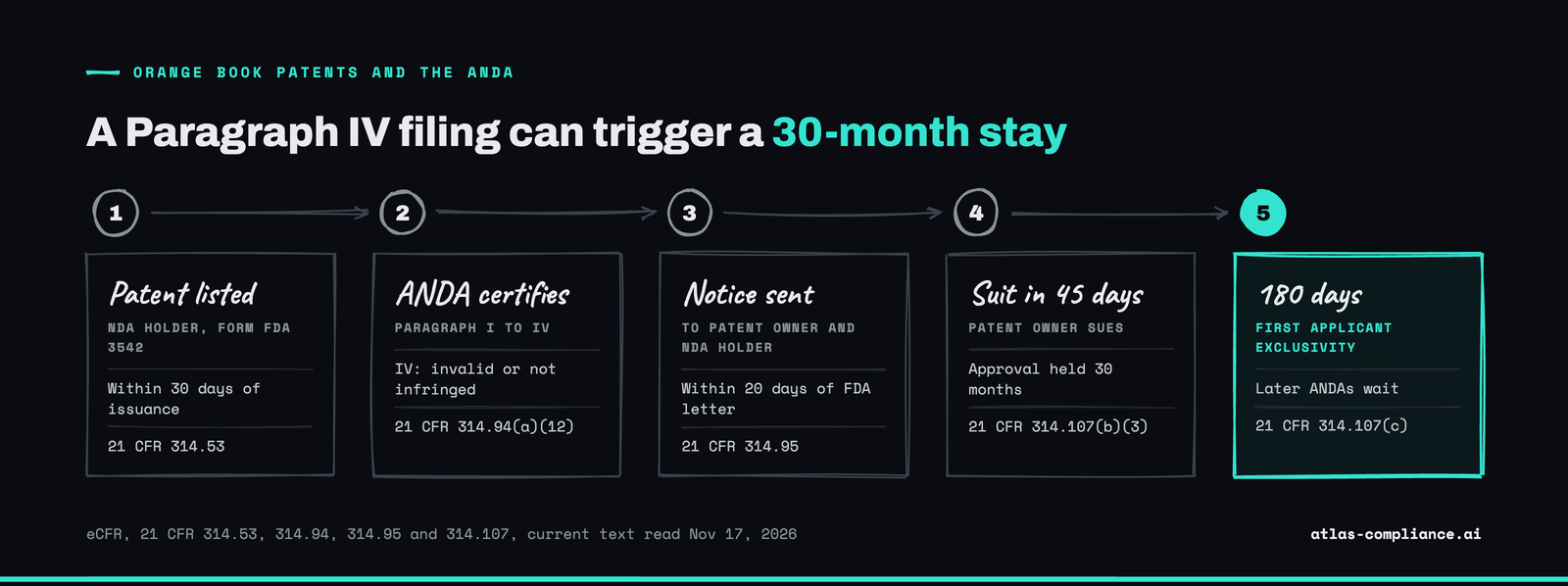
Orange Book patent listings work as a filing duty for the NDA holder and a certification duty for each ANDA applicant. Under 21 CFR 314.53, the NDA holder submits Form FDA 3542 within 30 days of approval for each patent that claims the drug substance, the drug product or an approved method of use. A patent issued later must be submitted within 30 days of issuance; FDA still lists a late patent, but certification rules for applicants change.
Each ANDA must then certify to every listed patent under 21 CFR 314.94(a)(12):
- Paragraph I: the patent information has not been submitted to FDA.
- Paragraph II: the patent has expired.
- Paragraph III: the date the patent will expire, with approval sought after that date.
- Paragraph IV: the patent is invalid, unenforceable, or will not be infringed by the generic.
A method-of-use patent that does not claim the indication the generic seeks can instead get a "section viii" statement, with that use carved out of the label.
Under 21 CFR 314.95, the applicant sends notice to the patent owner and the NDA holder no later than 20 days after the postmark on FDA's Paragraph IV acknowledgment letter. If the patent owner sues within 45 days of receiving that notice, 21 CFR 314.107(b)(3) holds approval for 30 months, unless a court decision or a dismissal without a finding of infringement ends the stay earlier.
The first applicant, an ANDA applicant that submits a substantially complete application with a Paragraph IV certification on the first day anyone does, can earn 180-day exclusivity. Under 314.107(c), FDA will not approve a later applicant's ANDA during that period, and the period cannot run past the patent it was based on.
Exclusivities sit beside patents in the addendum. Under 21 CFR 314.108, a new chemical entity gets 5 years during which no ANDA may be submitted, cut to 4 years for an ANDA with a Paragraph IV certification. An NDA that needed new clinical investigations gets 3 years during which FDA will not approve an ANDA for those conditions of approval.
Orange Book vs Purple Book: what is the difference?
The difference between the Orange Book and the Purple Book is the law each product was approved under. The Orange Book lists drugs approved through NDAs and ANDAs under section 505 of the FD&C Act. The Purple Book lists biological products licensed under section 351 of the Public Health Service Act, including biosimilars and interchangeables.
| Point | Orange Book | Purple Book |
|---|---|---|
| Products | NDA drugs and ANDA generics | Licensed biologics, biosimilars, interchangeables |
| Statute | FD&C Act 505(b) and 505(j) | PHS Act 351(a) and 351(k) |
| Substitution signal | Therapeutic equivalence codes (A and B) | Interchangeable designation |
| Patents | Listed by the NDA holder under 21 CFR 314.53 | Only lists exchanged with a 351(k) applicant |
| Main exclusivities | 5-year NCE, 3-year new clinical investigation, 180-day first filer | 12-year reference product, first interchangeable |
| Facility check | ANDA refused if facilities and controls are inadequate, 21 CFR 314.127(a)(1) | License only after establishment inspection, 21 CFR 601.20(d) |
Review timing for NDAs and BLAs runs on the user fee goal dates covered in the PDUFA date guide.
Who makes the drugs in the Orange Book, and how do their facilities fare in FDA inspections?
The drugs in the Orange Book are made at facilities that FDA inspects under its drug quality program, and their record is mixed. In FDA's published classifications for inspections that closed from January 2, 2025 to October 14, 2026, compiled by Atlas, 1,974 drug quality inspections ended 23.3% NAI, 61.0% VAI and 15.7% OAI.
| Group (Jan 2025 to Oct 2026) | Inspections | VAI | OAI |
|---|---|---|---|
| All drug quality inspections | 1,974 | 61.0% | 15.7% (310) |
| United States facilities | 1,156 | 54.5% | 19.2% (222) |
| India facilities | 257 | 62.3% | 14.0% (36) |
| China facilities | 160 | 62.5% | 8.8% (14) |
| Bioavailability and bioequivalence study sites | 273 | 36.3% | 2.2% (6) |
The FDA dataset does not tag a facility as NDA or ANDA, so these rows cover every drug manufacturer FDA inspected under the drug quality program. The bioequivalence row is closer to the generic process: FDA inspects the clinical and bioanalytical sites that run the bioequivalence studies behind an AB rating, and 127 of those 273 inspections took place in India.
The Form 483s behind those outcomes cite the same rules again and again. In the Atlas citation dataset for drug inspections ending January 7, 2025 to September 3, 2026, 34.3% of 862 inspections with published citations cited 21 CFR 211.192 (investigations of discrepancies), 33.9% cited 211.22(d) (quality unit procedures) and 21.9% cited 211.100(a) (written production procedures).
Lupin Limited and Dr. Reddy's Laboratories Limited both appear as applicants in the Orange Book search menu. Lupin's Pithampur, India facility has 8 FDA inspections on record, all ending with a Form 483, and FDA classified its July 2025 inspection OAI. That Form 483 of July 17, 2025 cites 21 CFR 211.110(a), 211.113(b), 211.192 and 211.42(c)(10)(iii). Lupin's Aurangabad facility has 10 inspections and 7 Form 483s; the September 5, 2025 Form 483 cites 211.160(b) and 211.67(c).
Dr. Reddy's Bachupally facility has 2 inspections on record, October 2023 and September 2025, and both ended with a Form 483. Granules India Limited, another Orange Book applicant, has an Atlas record for its Medchal-Malkhajgiri District facility showing an August to September 2024 inspection that led to a warning letter. For bioequivalence work, the Raptim Research facility in Navi Mumbai has 13 FDA inspections on record, and FDA classified its July 2025 bioanalytical BA/BE inspection OAI.
If one of these facilities makes or tests a product in your filing, the investigators who wrote its last Form 483 and the sections they cite most are the first thing to check before the next inspection.
 Atlas
See what the FDA knows about your next investigator.
30 minutes with the founder. No pitch deck.
What should an ANDA applicant check beyond the Orange Book?
An ANDA applicant should check the inspection record of every facility named in the application, because FDA can refuse approval on facility grounds under 21 CFR 314.127(a)(1) no matter how clean the patent position is. The Atlas FDA Form 483 database holds 8,946 human drug Form 483s, 755 of them issued in 2025 (release of August 15, 2026).
- Confirm the RLD and RS in the Orange Book, and the TE code your product will need to match.
- Map every listed patent and exclusivity to a certification and a filing date.
- List each facility in the ANDA: API, finished dosage, packaging, testing labs and the bioequivalence study sites.
- Pull each facility's last three FDA classifications and read any OAI from the past two years as a likely reinspection.
- Read the open Form 483s, and confirm each response reached the FDA office named on the form.
The FDA inspection database guide explains the six public sources of inspection data and how to join them to a facility. To get new drug Form 483s and inspection classifications as Atlas publishes them, subscribe to the digest.
AtlasFDA Inspection Intelligence Digest
We track every 483, EIR, and warning letter the moment it happens. Get the signals before they hit the FDA website.
Frequently asked questions
The Orange Book is published as an annual edition with monthly cumulative supplements, and the 46th edition is the 2026 version. FDA also updates the downloadable Orange Book data files, which hold the product, patent and exclusivity tables, every month. The online search page shows how current the data is and lists newly added and delisted patents, so check it before relying on a printed copy.

Written by
Bhavish Agarwal
Founder, Atlas
Bhavish Agarwal is the founder of Atlas and previously worked at Google and Microsoft. He has spent the past several years building regulatory data infrastructure for the pharmaceutical industry.