
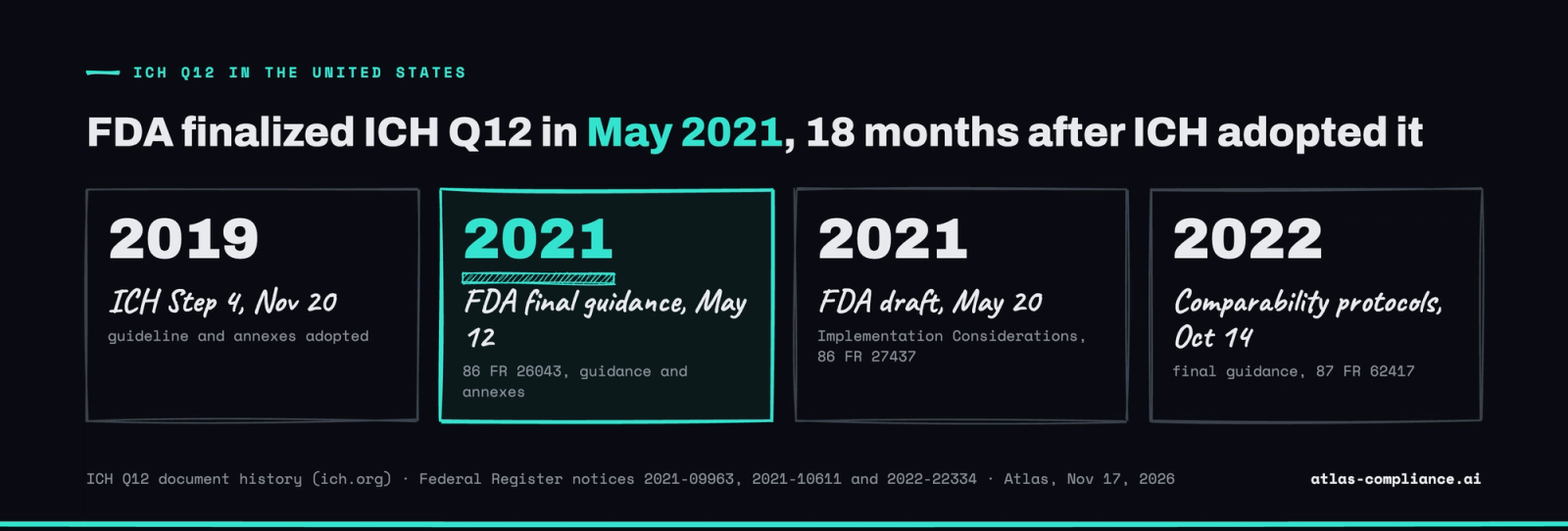
ICH Q12 is the ICH guideline on technical and regulatory considerations for pharmaceutical product lifecycle management that sets a shared framework for deciding which post-approval chemistry, manufacturing and controls (CMC) changes need a regulatory filing, at what level, and how the company's quality system manages the rest. ICH adopted Q12 and its annexes at Step 4 on November 20, 2019, and FDA published both as final guidance in May 2021.
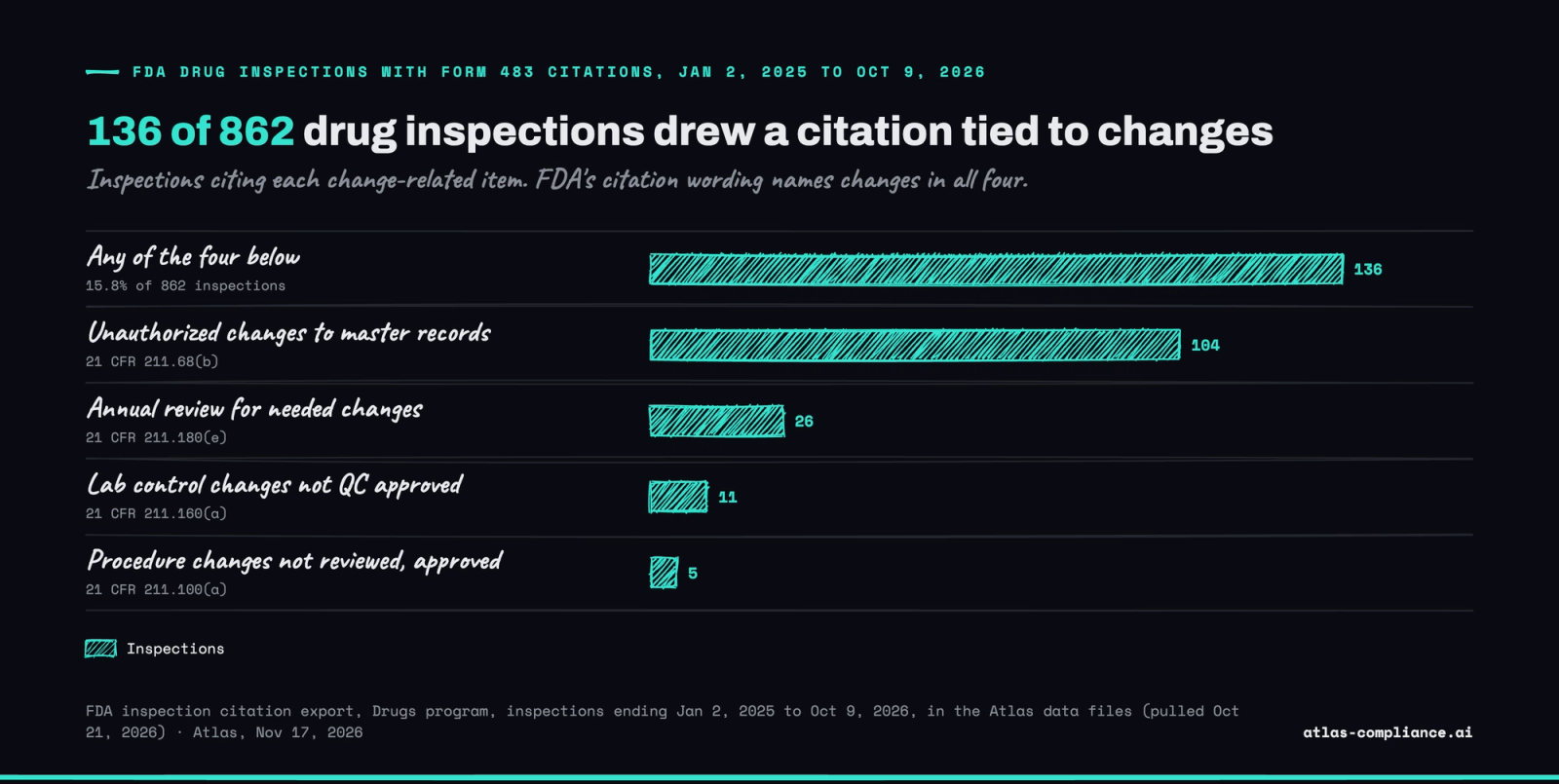
This guide explains the Q12 tools, maps them to FDA's filing categories in 21 CFR 314.70, and reads FDA's Form 483 record: Atlas counted 136 drug inspections from January 2025 to October 2026 that drew a citation about changes.
Key facts:
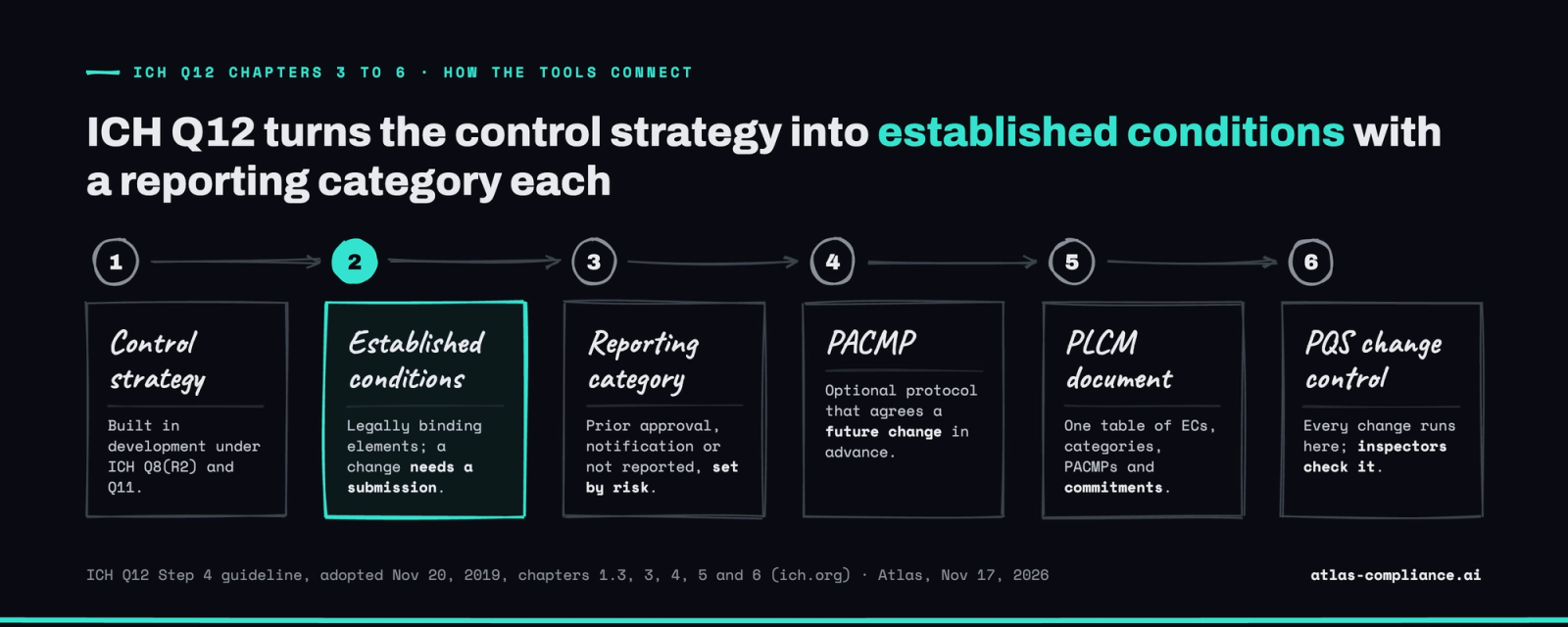
- ICH Q12 defines established conditions (ECs) as legally binding information considered necessary to assure product quality, so any change to an EC needs a submission to the regulator.
- A post-approval change management protocol (PACMP) runs in two steps: the regulator approves the protocol first, then the company runs the studies and reports the change in the category the protocol set.
- The product lifecycle management (PLCM) document lists the ECs, the reporting category for each, any PACMPs and post-approval CMC commitments, and Q12 places it in CTD Module 3.2.R.
- FDA announced the final Q12 guidance and annexes in the Federal Register on May 12, 2021 (86 FR 26043), and a draft on US implementation on May 20, 2021 (86 FR 27437).
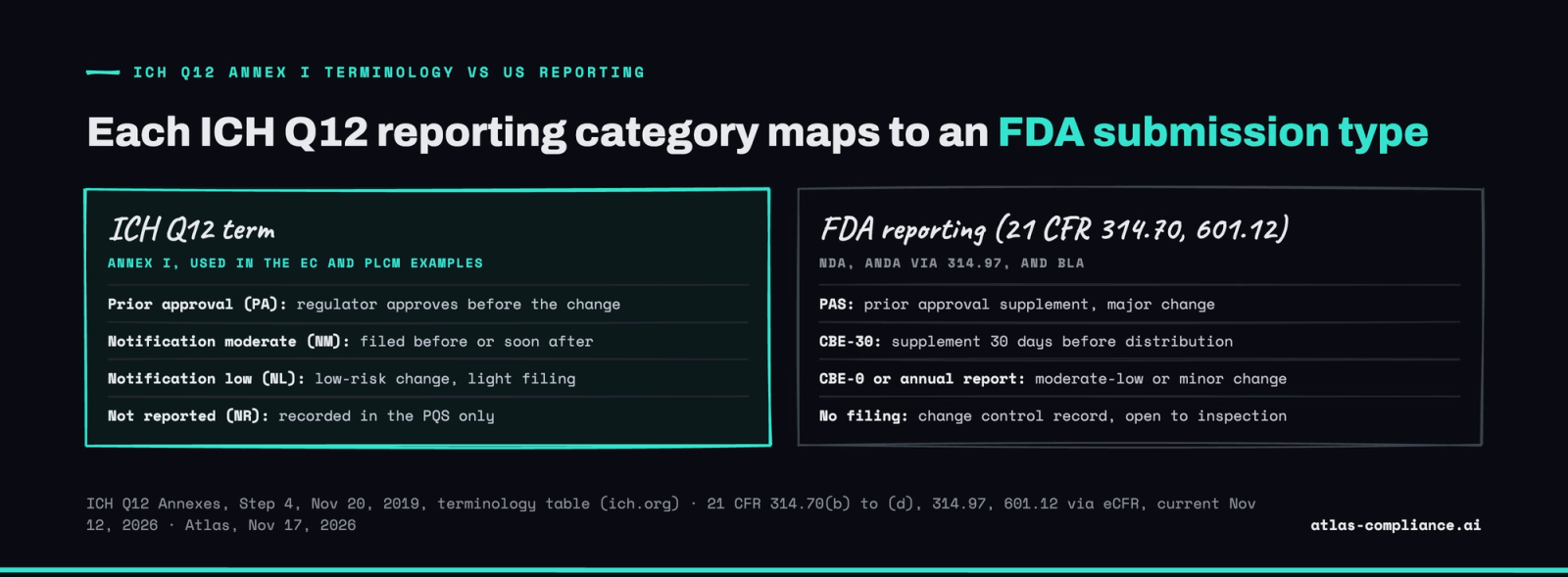
- Under 21 CFR 314.70, an NDA holder files a prior approval supplement for major changes, a CBE-30 or CBE-0 supplement for moderate changes, and an annual report entry for minor changes; 314.97 applies the same rules to ANDAs.
- In FDA's citation export for drug inspections ending January 2, 2025 to October 9, 2026, 136 of 862 inspections with Form 483 citations (15.8%) carried a citation whose wording names changes.
What does ICH Q12 cover?
ICH Q12 covers the commercial phase of a product's life: how a marketing authorization holder (MAH) plans, files and controls CMC changes after approval for chemical and biological drug substances and products, including drug-device combination products. Changes made only to meet a new or revised pharmacopoeial monograph sit outside its scope. Our ICH guidelines overview places Q12 next to Q8, Q9, Q10 and Q11, which it builds on.
The ICH Q12 guideline runs to 11 chapters and 2 appendices. Seven chapters carry the working tools:
| Chapter | Tool or enabler | What it sets out |
|---|---|---|
| 2 | Categorisation of post-approval CMC changes | A risk-based system of prior approval, notification and changes recorded only in the quality system |
| 3 | Established conditions | Which application elements need a filing if changed, and how to set their reporting category |
| 4 | PACMP | A protocol agreed in advance for a planned change |
| 5 | PLCM document | One summary of ECs, categories, protocols and commitments |
| 6 | PQS and change management | The quality system and change control that every tool depends on |
| 8 | Structured approaches for frequent changes | Post-implementation notification for routine changes, shown for analytical procedures in Annex II |
| 9 | Stability data approaches | Confirmatory stability strategies to support a change |
The ICH Q12 annexes hold worked examples: ECs for a chemical tablet, a biologic and analytical procedures, two PACMPs and a sample PLCM table.
What are established conditions in ICH Q12?
Established conditions in ICH Q12 are the legally binding elements of a marketing application that the company and the regulator agree are necessary to assure product quality, so a change to any of them needs a regulatory submission. Everything else in the dossier is supportive information, which the company can change under its own quality system without a filing.
The MAH proposes which CMC elements are ECs and justifies each one in the relevant CTD module, along with the reporting category it proposes for a change. Section 3.2.3.1 describes three ways to set ECs for a manufacturing process:
- A minimal (traditional) approach, where limited process understanding leads to many inputs and outputs being ECs.
- An enhanced approach, where better understanding of how inputs affect quality attributes focuses ECs on the parameters that matter most.
- A performance-based approach, where ECs center on process outputs, made possible by in-line monitoring, models or process analytical technology.
Critical process parameters, and any parameter whose effect on quality cannot reasonably be excluded, should be ECs. Q12 states that identifying ECs is not mandatory unless a regional rule requires it, and that a batch that falls outside a process EC during routine work is a deviation handled under GMP, not a new filing. US law already speaks in these terms: 21 CFR 314.70(a)(1)(i) requires an NDA holder to notify FDA of "each change in each condition established in an approved NDA."
Process ECs draw on what process validation taught you about the process.
What is a PACMP in ICH Q12?
A PACMP in ICH Q12 is a post-approval change management protocol: a written plan, approved by the regulator before any work starts, that describes a CMC change the company intends to make, the studies and acceptance criteria that will prove it has no adverse effect, and the lower reporting category the change will use once those criteria are met.
Section 4.2 sets two steps:
- Step 1: the MAH submits the protocol with the change, its rationale, the risk assessment, the studies, acceptance criteria, other conditions and the proposed reporting category. The regulator reviews and approves it.
- Step 2: the MAH runs the studies. If every criterion and condition is met, the MAH reports the results in the category the protocol set. If any criterion fails, the change goes back to the normal regulatory route.
A PACMP can cover one change to one product or a change across several products or sites, such as a new stopper for every product that shares a container closure system. Annex ID adds a drug substance site, with three consecutive batches from the new site meeting the approved specification. Q12 rules out protocols for changes that need clinical, nonclinical or human PK/PD data.
FDA's regulations call this tool a protocol. Under 21 CFR 314.70(e) and 601.12(e), an applicant files the protocol as a prior approval supplement, and an approved protocol "may subsequently justify a reduced reporting category." FDA's final guidance on comparability protocols for NDA, ANDA and BLA holders appeared in the Federal Register on October 14, 2022 (87 FR 62417).
What is the product lifecycle management (PLCM) document?
The product lifecycle management (PLCM) document is the ICH Q12 summary that lists a product's established conditions, the reporting category for changing each one, any PACMPs and any post-approval CMC commitments, so that assessors and inspectors can see in one place how the company plans to manage post-approval changes. Q12 recommends a table and places the document in CTD Module 3.2.R, although some regions take it in Module 1.
The MAH submits it with the original application, or in a supplement when it defines ECs for a marketed product, and updates it with each later CMC submission. Annex IF shows the format for a fictional tablet: the API particle size range (5 to 200 microns) is an EC with "notification low" to tighten it and "notification moderate" to widen it, the blending principle is "prior approval," and the blender type and 200 kg scale are "notification low."
| Change category | Regulatory reporting in the US | Example from 21 CFR 314.70 or the Q12 annexes |
|---|---|---|
| Prior approval (major) | Prior approval supplement; FDA approves before distribution (314.70(b)) | Change in drug substance synthesis that may affect the impurity profile |
| Notification moderate | CBE-30 supplement, filed at least 30 days before distribution (314.70(c)) | Container closure change that does not affect drug product quality |
| Notification moderate to low | CBE-0 supplement; distribution can start when FDA receives it (314.70(c)(6)) | An added specification test that gives increased assurance of quality |
| Notification low (minor) | Annual report entry (314.70(d)) | Replacing equipment with equipment of the same design and operating principles |
| Not reported | No filing; recorded in PQS change control and open to inspection | A change to a parameter the application lists as supportive information, not an EC |
The Q12 annexes give the mapping in the second column: "prior approval" corresponds to a US PAS, "notification moderate" to a CBE-30, and "notification low" to a CBE-0 or annual report. For biologics, 21 CFR 601.12 sets the same three tiers for BLAs.
How did FDA implement ICH Q12?
FDA implemented ICH Q12 by publishing the guideline and its annexes as final guidance, announced in the Federal Register on May 12, 2021 (86 FR 26043), which replaced the draft of May 31, 2018 (83 FR 25018). On May 20, 2021, FDA issued a separate draft, "ICH Q12: Implementation Considerations for FDA-Regulated Products" (86 FR 27437), to explain how the tools fit the US system of supplements and annual reports. The Federal Register shows no final version of that draft as of November 2026.
FDA had run an established conditions pilot program from February 2019 (84 FR 4478). The existing rules stayed in force: 21 CFR 314.70 for NDAs, 314.97 for ANDAs and 601.12 for BLAs. Section 314.70(a)(3) already requires an applicant to use a less burdensome filing route when a regulation or guidance provides one, which is the opening Q12 reporting categories use.
What role does the pharmaceutical quality system play in ICH Q12?
The pharmaceutical quality system is what lets a company use ICH Q12 flexibility at all: chapter 6 states that an effective PQS under ICH Q10, plus compliance with regional GMP, is necessary across the whole supply chain, and that change management problems in the PQS may restrict a company's ability to use the guideline's flexibility.
Appendix 2 lists 12 principles for a change management system. Four of them show up in inspections:
- Assess each change for its effect on ECs and on aspects that are not ECs, in every affected application.
- Use a defined change control process in which manufacturing, quality and regulatory affairs approve or reject the change.
- Verify after implementation that the change worked with no unintended effect on quality, and route any deviation through the deviation and CAPA systems.
- Keep the change management system available for review during an audit or inspection.
Appendix 2 also asks management review to track how fast changes close. Post-change monitoring overlaps with continued process verification, and the risk scoring follows ICH Q9 quality risk management. Contracts with contract manufacturers should define how each side reports changes to ECs.
How often does FDA cite change control on Form 483s?
FDA cited change-related failures in 136 of 862 drug inspections with Form 483 citations (15.8%) that ended between January 2, 2025 and October 9, 2026, according to the FDA inspection citation export in the Atlas data files (Drugs program, pulled October 21, 2026). We counted an inspection when at least one of its citations used FDA wording that names changes.
| Citation | FDA wording in the export | Inspections |
|---|---|---|
| 21 CFR 211.68(b) | Controls do not ensure that changes in master production and control records are made only by authorized personnel | 104 |
| 21 CFR 211.180(e) | Records not kept so they can be reviewed at least annually to decide whether specifications or procedures need changes | 26 |
| 21 CFR 211.160(a) | Specifications, test procedures and laboratory controls, including any changes, not reviewed and approved by the quality control unit | 11 |
| 21 CFR 211.100(a) | Changes to written procedures not reviewed and approved by the quality control unit | 5 |
| Any of the four | 136 |
Section 211.100(a) requires that production and process control procedures, "including any changes," be drafted, reviewed and approved by the right units and by the quality control unit. FDA cited 211.100(a) in 189 drug inspections (21.9%) over the same period, but 180 of its 190 citations used the wording for absent written procedures. Section 211.192, on investigations of discrepancies, appeared in 296 inspections (34.3%). Its standard wording does not mention changes, so we left it out of the 136, although Q12 Appendix 2 sends any deviation after a change through that same investigation system.
Four Form 483s in the FDA Form 483 database show the pattern (Atlas records pulled November 17, 2026):
- PTI Georgia, Royston, January 16, 2026: 9 observations, including procedure changes not reviewed and approved under 211.100(a), laboratory control changes under 211.160(a), the annual record review under 211.180(e) and two 211.192 investigation citations. All 4 FDA inspections on record at the facility ended with a Form 483.
- Chartwell Pharmaceuticals Congers, November 18, 2025: 15 observations, led by changes to procedures not reviewed and approved, plus 211.160(a) and the annual review of a representative number of batches under 211.180(e)(1). The Chartwell Congers facility record lists 14 inspections, 13 of them with a Form 483.
- CSL Behring, Marburg, February 18, 2026: 5 observations, the first being changes to procedures not reviewed and approved under 211.100(a).
- Emergent BioSolutions Canada, Winnipeg, May 12, 2026: 9 observations, including unapproved procedure changes, 211.192 investigations and quality unit authority under 211.22(a). The facility has 16 FDA inspections on record, 11 with a Form 483.
If your next inspection is close, you can check which citations the assigned investigator has written before and whether change control is among them.
 Atlas
See what the FDA knows about your next investigator.
30 minutes with the founder. No pitch deck.
How should a facility prepare change control for an ICH Q12 inspection?
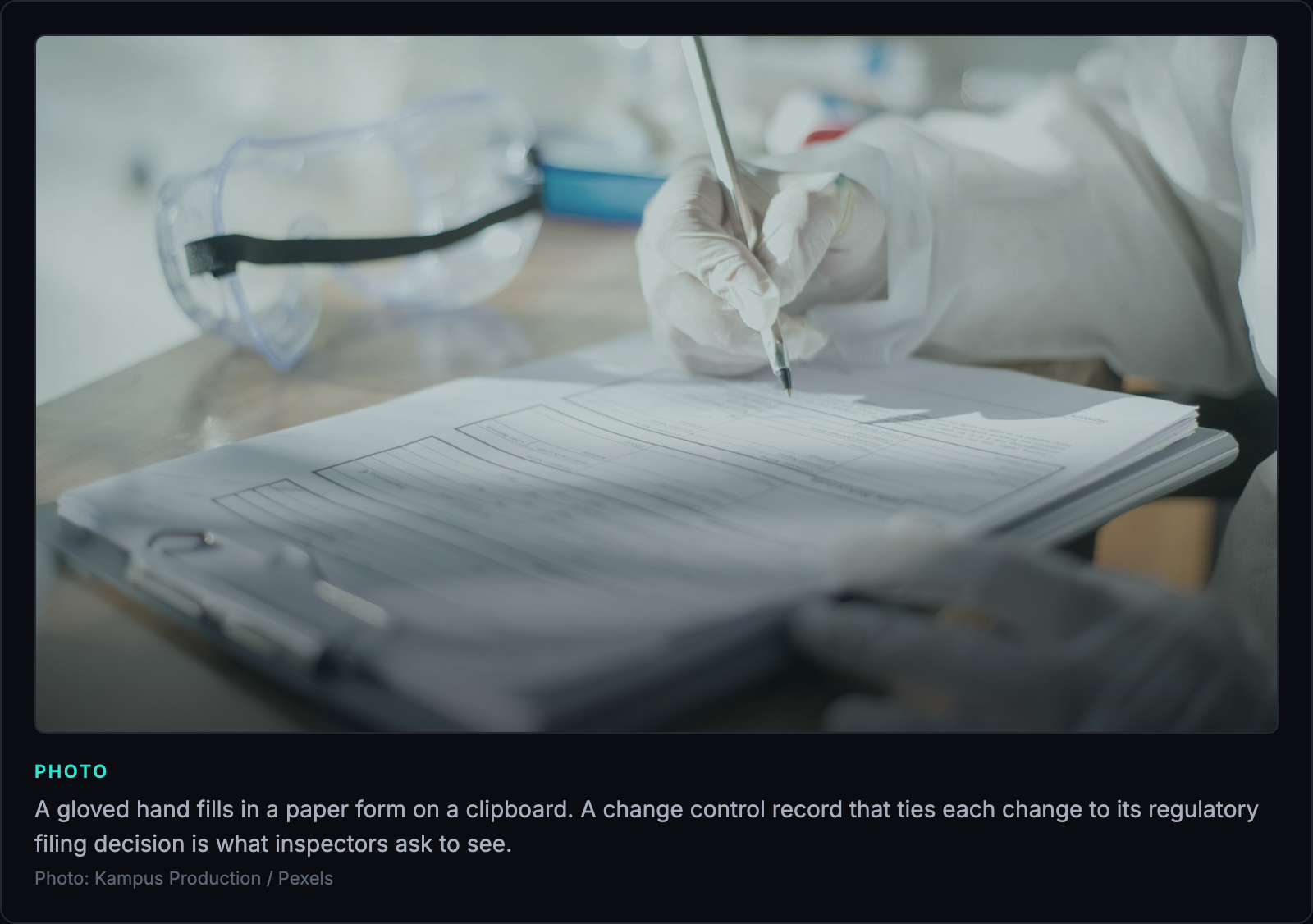
A facility prepares change control for an ICH Q12 inspection by proving that every change it made was assessed against the approved established conditions, filed in the right category, approved by the quality unit and checked after implementation. Five checks follow from the Q12 appendix and the 2025 to 2026 citations:
- Map each open and recent change record to the PLCM document or the approved application, and record why it needed a PAS, a CBE-30, a CBE-0, an annual report entry or no filing.
- Confirm that the quality unit signed every change to procedures, specifications and test methods before use, as 211.100(a) and 211.160(a) require.
- Check access controls on electronic master records, since 211.68(b) drove 104 of the 136 inspections.
- Pull the last product quality review and show where it recommended changes, as 211.180(e) asks.
- For each change under a PACMP, keep the approved protocol, the results against each acceptance criterion and the post-change monitoring data together.
Our walkthrough of change control steps under 21 CFR 211.100 covers the record itself. The digest below sends new Form 483s and warning letters as FDA posts them, so you can see change control citations at other facilities as they appear.
AtlasFDA Inspection Intelligence Digest
We track every 483, EIR, and warning letter the moment it happens. Get the signals before they hit the FDA website.
Frequently asked questions
ICH Q12 is guidance, not a regulation, in the United States. FDA published it as final guidance in May 2021, and the binding filing rules remain 21 CFR 314.70, 314.97 and 601.12. Q12 also says that identifying established conditions is optional unless a regional rule requires it. A company that does not use Q12 tools still files every change under the existing supplement and annual report categories.

Written by
Bhavish Agarwal
Founder, Atlas
Bhavish Agarwal is the founder of Atlas and previously worked at Google and Microsoft. He has spent the past several years building regulatory data infrastructure for the pharmaceutical industry.