
A GMP audit checklist is a list of yes/no questions that an auditor answers from records and floor observation to test whether a drug facility meets current good manufacturing practice under 21 CFR Parts 210 and 211. The checklist below follows the six systems FDA investigators use for drug manufacturing inspections and gives each system a weight from FDA's own citation record.
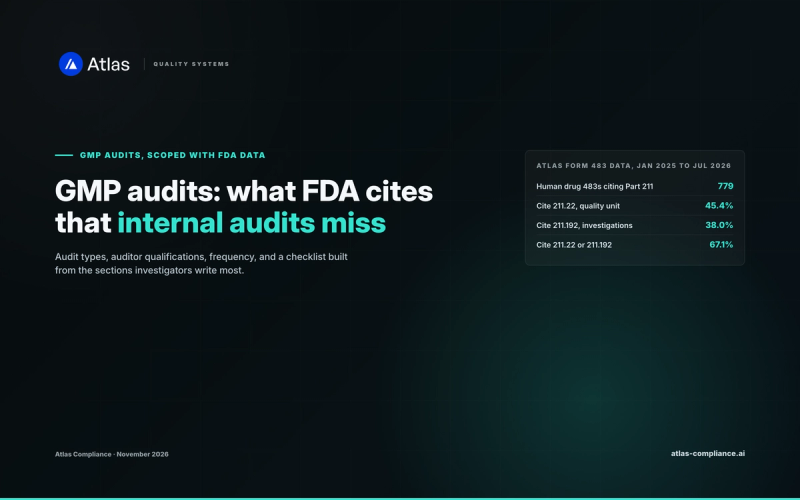
That weight is what most checklists leave out. Atlas grouped every 21 CFR 211 citation in FDA Data Dashboard exports (downloaded October 21, 2026) by system: 753 drug inspections that ended January 2025 to June 2026 carried at least one Part 211 citation, and the numbers below show where FDA wrote them and how often each system ended in Official Action Indicated (OAI). Data current as of November 2026.
Key facts:
- FDA Compliance Program 7356.002, Drug Manufacturing Inspections (implemented October 17, 2022), divides a drug facility into six systems: quality, facilities and equipment, materials, production, packaging and labeling, and laboratory controls.
- Under that program, a full inspection covers at least four systems and an abbreviated inspection at least two; the quality system is mandatory in both.
- The quality system was cited in 560 of 753 drug inspections with a Part 211 citation (74.4%), January 2025 to June 2026.
- Packaging and labeling was cited least, in 41 inspections (5.4%), but 46.3% of those ended OAI, the highest rate of the six systems.
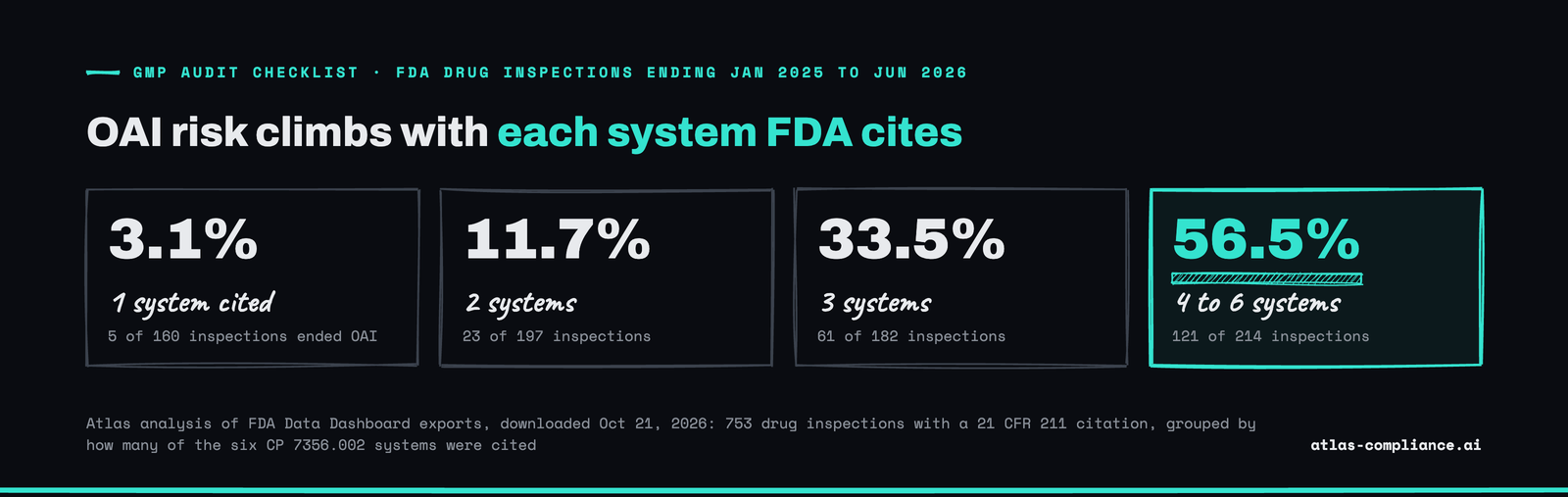
- 56.5% of inspections citing four to six systems ended OAI, against 3.1% of inspections citing one system.
- 21 CFR 211.84, component testing and supplier results, was cited in 172 of the 753 inspections (22.8%), the core section for any vendor audit checklist.
What are the six systems in a GMP audit checklist?
The six systems in a GMP audit checklist are the ones FDA names in Compliance Program 7356.002: quality, facilities and equipment, materials, production, packaging and labeling, and laboratory controls. The program makes the quality system mandatory in every surveillance inspection and tells investigators to use it to find problems that link to the other five.
The table maps each system to the Part 211 sections Atlas used to count FDA citations. The program itself lists inspection areas, not section numbers, so the mapping follows the Part 211 subparts and the program's area lists.
| System | What the auditor checks | Part 211 sections counted |
|---|---|---|
| Quality | Quality unit, investigations, CAPA, change control, product reviews, complaints, training | 211.22, 211.25, 211.28, 211.34, 211.180, 211.192, 211.198, 211.204, 211.208 |
| Facilities and equipment | Buildings, air handling, equipment design, cleaning, maintenance, calibration, computerized systems | 211.42 to 211.72 |
| Materials | Component, container and closure testing, supplier results, quarantine, storage, distribution | 211.80 to 211.94, 211.142, 211.150, 211.184, 211.196 |
| Production | Written procedures, charge-in, yields, in-process controls, sterile controls, batch records | 211.100 to 211.115, 211.182, 211.186, 211.188 |
| Packaging and labeling | Label control, issuance and reconciliation, line clearance, expiry dating, tamper-evident packaging | 211.122 to 211.137 |
| Laboratory controls | Specifications, test methods, stability, reserve samples, laboratory records, OOS handling | 211.160 to 211.176, 211.194 |
For what each subpart requires, see our guide to 21 CFR Part 211 or the full text on eCFR.
Which GMP systems does FDA cite most often?
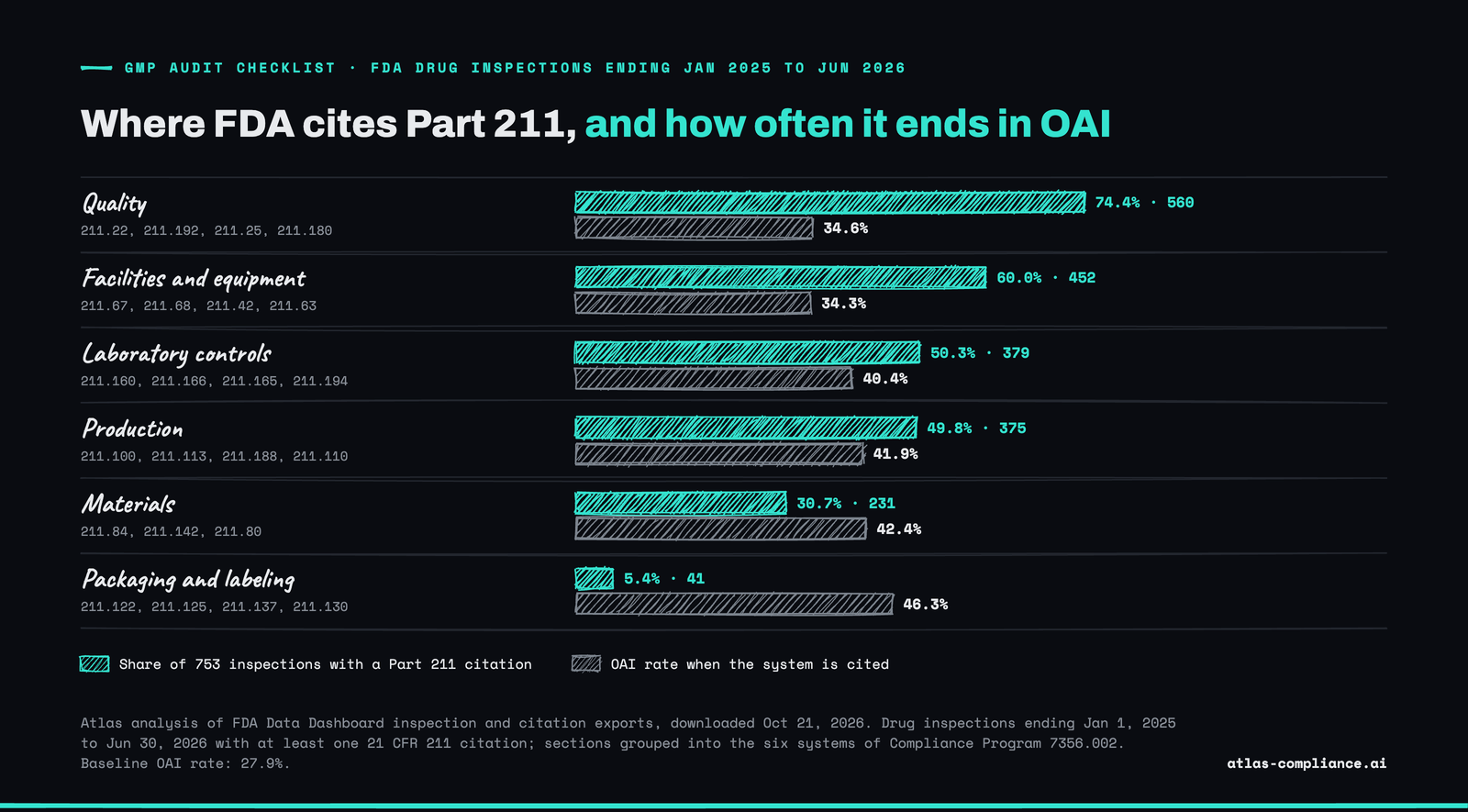
FDA cites the quality system most often: 74.4% of the 753 drug inspections with a Part 211 citation that ended January 2025 to June 2026 included a quality system section, mostly 211.22 and 211.192. Facilities and equipment came second at 60.0%, followed by laboratory controls (50.3%), production (49.8%), materials (30.7%) and packaging and labeling (5.4%).
| System | Inspections citing it | Share of 753 | Ended OAI when cited | Most cited sections |
|---|---|---|---|---|
| Quality | 560 | 74.4% | 34.6% | 211.22 (345), 211.192 (288) |
| Facilities and equipment | 452 | 60.0% | 34.3% | 211.67 (228), 211.68 (167) |
| Laboratory controls | 379 | 50.3% | 40.4% | 211.160 (215), 211.166 (130) |
| Production | 375 | 49.8% | 41.9% | 211.100 (220), 211.113 (129) |
| Materials | 231 | 30.7% | 42.4% | 211.84 (172), 211.142 (37) |
| Packaging and labeling | 41 | 5.4% | 46.3% | 211.122 (16), 211.125 (10) |
Two readings matter for audit planning. Frequency tells you where an investigator will most likely write an observation, so the quality and facilities checks deserve the most hours. The OAI column tells you which findings carry weight: across all 753 inspections, 210 ended OAI (27.9%), and every system sits above that baseline when it is cited, with materials, production and packaging highest. A rare packaging finding still pulls an inspection toward OAI more often than a common quality finding does.
The count of systems cited matters more than any single one. FDA classified 5 of 160 single-system inspections as OAI (3.1%), and 121 of 214 inspections that cited four to six systems (56.5%). If your own audit finds gaps in four systems, expect an investigator who finds the same gaps to recommend official action more often than not. Our explainer on NAI, VAI and OAI covers what each classification triggers.
Real Form 483s show the pattern. Each of the forms below cites four or five systems, the band where OAI rates pass 50%.
| Form 483 | Issued | Observations | Systems cited |
|---|---|---|---|
| Gasco Industrial Corp., Gurabo, Puerto Rico | Feb 27, 2026 | 13 | Quality, facilities and equipment, materials (211.84(d)(1)), production, laboratory |
| Unither Manufacturing, Rochester, US | May 15, 2026 | 9 | Quality, facilities and equipment, materials, production, laboratory (211.160, 211.165, 211.166) |
| Eli Lilly and Company, Indianapolis, US | May 20, 2025 | 5 | Quality, facilities and equipment, materials (211.84(d)(2)), production |
Investigators differ in which systems they open first. Before you set audit hours, check which sections the investigator likely to visit your facility has cited elsewhere.
 Atlas
See what the FDA knows about your next investigator.
30 minutes with the founder. No pitch deck.
The GMP audit checklist: 40 yes/no questions by system
The checklist has 40 questions, more in the systems FDA cites most. Answer "yes" only when you have seen the record, log, audit trail or practice that proves it. A written procedure alone earns a "no" until you have checked that people follow it, which is the test Compliance Program 7356.002 tells investigators to apply.
Quality system (cited in 74.4% of inspections, 8 checks)
- Does the quality unit approve or reject every procedure, specification and batch, with signed records? (211.22)
- Do the quality unit's own procedures match what staff did in the last 90 days of records? (211.22(d))
- Does every closed deviation and OOS investigation name a root cause backed by evidence? (211.192)
- Did each investigation check other batches and products that could share the cause? (211.192)
- Does every CAPA have an effectiveness check that was performed and recorded?
- Was each change assessed for risk, approved before use and checked for revalidation needs?
- Is an annual product review complete for every product, with trends acted on? (211.180(e))
- Is every complaint reviewed, and are those involving a possible failure investigated? (211.198)
Facilities and equipment system (60.0%, 7 checks)
- Do equipment cleaning and maintenance records match the equipment use log for the same dates? (211.67)
- Is cleaning validated for every shared or multiproduct piece of equipment?
- Is every instrument in use inside its calibration date, with out-of-tolerance results investigated?
- Are computerized systems validated, with user access limited and audit trails reviewed? (211.68)
- Do the facility layout and air handling separate operations to prevent mix-ups and cross-contamination? (211.42, 211.46)
- Are equipment and building changes routed through change control?
- Are storage refrigerators and freezers qualified and monitored with alarms?
Laboratory controls system (50.3%, 7 checks)
- Is every specification, sampling plan and test method scientifically justified and approved? (211.160)
- Are analytical methods validated or verified for the way the laboratory uses them? (211.165(e))
- Do result summaries match the raw data, with no unexplained injections or deleted runs? (211.194)
- Is every OOS result investigated on time under a written OOS procedure?
- Does the stability program use stability-indicating methods and support the labeled expiry date? (211.166)
- Are reference standards traceable and qualified, and do chromatographic runs pass system suitability?
- Are reserve samples retained and examined as required? (211.170)
Production system (49.8%, 7 checks)
- Are written production procedures followed step by step, with deviations recorded and justified? (211.100)
- Is each batch record completed at the time of each step, with no gaps or backdating? (211.188)
- Are actual yields calculated and compared with theoretical yields at each phase? (211.103)
- Are in-process controls tested at the frequency and limits in the master record? (211.110)
- For sterile products, do media fills and environmental monitoring trends support aseptic control? (211.113(b))
- Is every piece of equipment and every container in use labeled with its contents and batch status? (211.105)
- Is the process validated, with ongoing data reviewed for drift?
Materials system (30.7%, 6 checks)
- Is at least one specific identity test run on every lot of every component? (211.84(d)(1))
- Where you accept a supplier's certificate of analysis, have you validated the supplier's results at set intervals? (211.84(d)(2))
- Are components, containers and closures held in quarantine until the quality unit releases them? (211.82, 211.84)
- Are rejected materials identified and stored apart from released stock? (211.89)
- Are storage conditions monitored, and is stock used oldest first? (211.142, 211.150)
- Can you trace each finished lot to its distribution records? (211.196)
Packaging and labeling system (5.4%, 5 checks)
- Is incoming labeling examined against the approved master before release? (211.122)
- Is labeling issued in counted quantities and reconciled after each run, with discrepancies investigated? (211.125)
- Is each packaging line cleared and inspected before a new product or lot starts? (211.130)
- Does every label carry an expiration date supported by stability data? (211.137)
- Are labels of similar size, shape or color for different products kept apart or verified by 100% checks? (211.122)
How do you run a GMP audit checklist before an FDA inspection?
You run a GMP audit checklist before an FDA inspection in five steps: pick the systems, weight them by FDA citation data, answer each question from records, trace one batch across every system, then grade and close each "no". Plan to cover at least four systems including quality, the floor FDA sets for a full inspection.
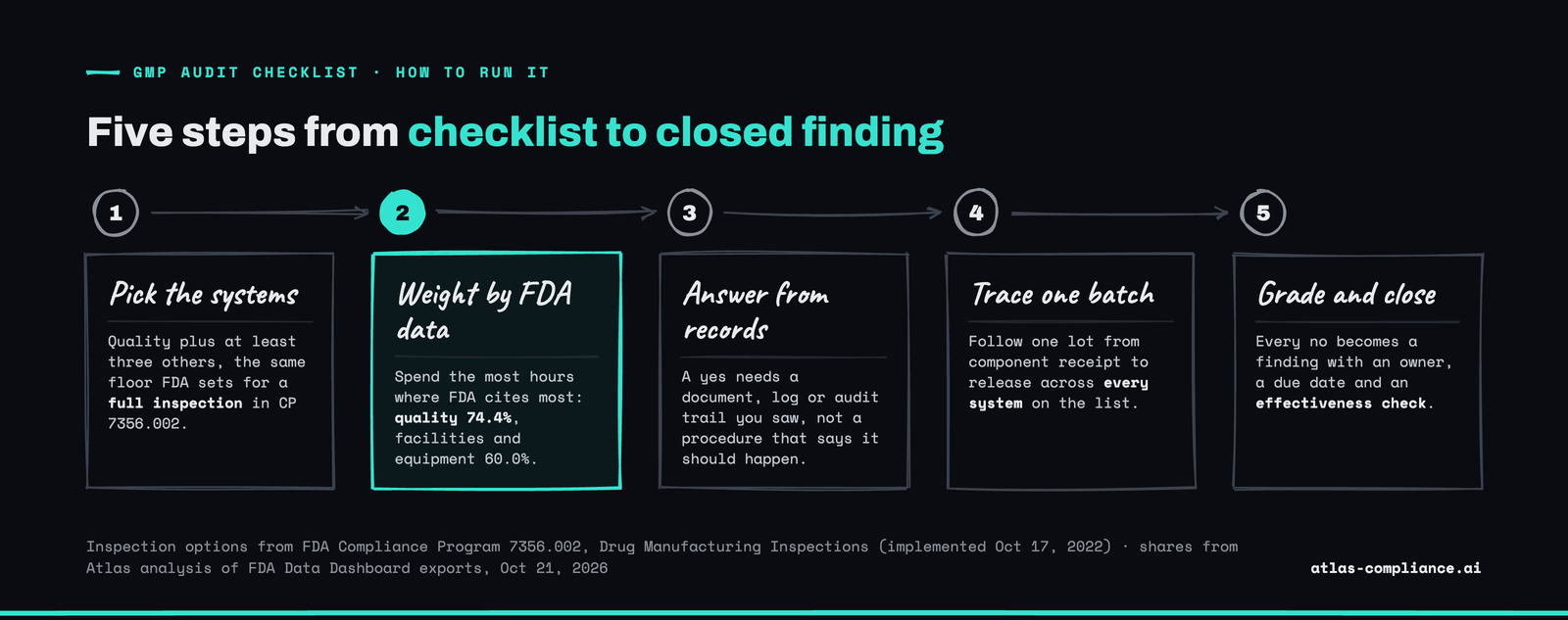
- Pick the systems. An abbreviated FDA inspection covers at least two systems and a full one at least four, with quality in both. Audit all six if your facility has not been inspected in years or had a recent Form 483.
- Weight by FDA data. Split audit hours roughly in line with the citation shares above, then move a system up if your own deviation trend points there.
- Answer from records. Pull the evidence for every "yes": a log, a signed form, an audit trail entry. Interview the operator who does the work, not the supervisor.
- Trace one batch. Follow one released lot from component receipt to distribution. A single trace tests materials, production, laboratory, packaging and quality links in one pass.
- Grade and close. Grade each "no" as critical, major or minor, give it an owner and a date, and send quality-system gaps to management review.
A checklist audit works best as one part of a mock FDA inspection, where a colleague plays the investigator and asks for documents under time pressure. To see what that day looks like from the inside, read what happens during an FDA inspection. Warehouses and distribution centers need a narrower list, covered in the warehouse FDA inspection readiness checklist.
How do you use the GMP audit checklist for a vendor audit?
You use the GMP audit checklist for a vendor audit by keeping the same six systems and changing the weight: the materials questions become the core, and the quality system questions test whether the supplier's quality unit controls its own operations. Compliance Program 7356.002 lists "quality oversight of contracted operations and material suppliers" as a quality system area, so investigators check your supplier program at your facility too.
FDA cites the supplier link often. In the same Atlas analysis, 21 CFR 211.84 appeared in 172 of 753 inspections (22.8%), and 48.8% of those inspections ended OAI. Paragraph (d)(2), which lets you accept a supplier's report of analysis only after you establish the reliability of the supplier's results through validation at appropriate intervals, was cited in 94 inspections. Paragraph (d)(1), the identity test on every component, was cited in 55.
Add these checks to the materials and quality sections when the auditee is an API, excipient, packaging or contract manufacturer:
| Vendor audit check | Why it matters |
|---|---|
| Do the supplier's certificate results match its raw data for the lots you received? | Evidence for 211.84(d)(2) reliance on the certificate |
| Does a signed quality agreement define who releases, who investigates and who reports changes? | FDA guidance Contract Manufacturing Arrangements for Drugs: Quality Agreements (November 2016) |
| Does the supplier notify you of process, site and specification changes before it makes them? | Changes can affect your validated process and filings |
| Has the supplier received a Form 483 or warning letter in the last three years, and is the CAPA closed? | Public FDA findings show gaps a scheduled audit can miss |
| Are the supplier's OOS and deviation investigations as complete as you require of your own? | The same 211.192 test applies to what you rely on |
Score the supplier on the same yes/no basis and tie the result to your approved supplier list: approve, approve with conditions and a follow-up date, or reject. Our GMP audits guide covers audit types, auditor qualification and audit frequency. To check a supplier's public record before the visit, search the FDA Form 483s directory by company or facility name.
These citation shares move as FDA posts new Form 483s and classifications. The digest below sends the new citations that change audit scope.
AtlasFDA Inspection Intelligence Digest
We track every 483, EIR, and warning letter the moment it happens. Get the signals before they hit the FDA website.
Frequently asked questions
No. FDA does not publish a GMP audit checklist PDF for drug manufacturers. The nearest official source is Compliance Program 7356.002, Drug Manufacturing Inspections, which lists the areas investigators cover in each of the six systems. Industry groups such as ISPE and PIC/S publish audit aids, and many companies build their own checklist from 21 CFR Part 211 and that program.

Written by
Bhavish Agarwal
Founder, Atlas
Bhavish Agarwal is the founder of Atlas and previously worked at Google and Microsoft. He has spent the past several years building regulatory data infrastructure for the pharmaceutical industry.