
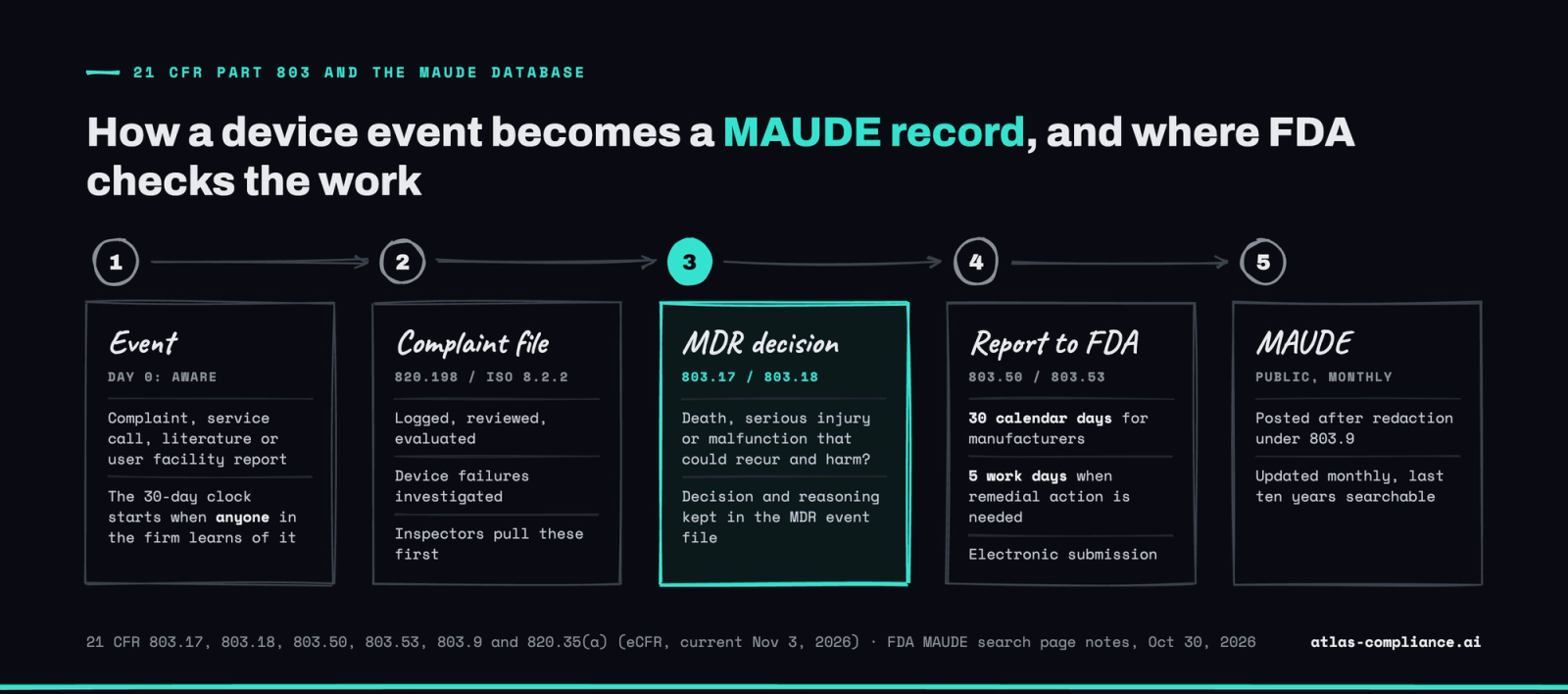
The MAUDE database (Manufacturer and User Facility Device Experience) is FDA's public database of medical device reports (MDRs) that manufacturers, importers, user facilities and voluntary reporters file about device-related deaths, serious injuries and malfunctions. FDA updates it monthly, and the search covers the last ten years of reports.
This guide also covers what MAUDE cannot show: how FDA investigators cite MDR and complaint-handling failures at device facilities, from Atlas Form 483 records (release of August 15, 2026, pulled November 6, 2026).
Key facts
- Manufacturers must report a device-related death, serious injury or reportable malfunction to FDA within 30 calendar days of becoming aware of it, under 21 CFR 803.50(a).
- A 5-day report is due within 5 work days when an event needs remedial action to prevent an unreasonable risk of substantial harm, or when FDA asks for one in writing (21 CFR 803.53).
- MAUDE simple and advanced searches each return at most 500 records; larger pulls need FDA's MDR data files, which FDA also refreshes monthly.
- Of 10,321 medical device Form 483s in Atlas (2013 to July 2026), 2,219 cite 21 CFR Part 803 and 3,674 cite 21 CFR 820.198 complaint files.
- 21 CFR 803.17, written MDR procedures, appears on 1,612 device Form 483s, more than any other Part 803 section.
- FDA launched its Adverse Event Monitoring System (AEMS) on March 11, 2026 and says MAUDE data will move into it during 2026; the MAUDE search pages were still live on November 6, 2026.
What is the MAUDE database?
The MAUDE database is FDA's searchable store of medical device reports, both mandatory reports filed under 21 CFR Part 803 and voluntary reports from health professionals, patients and consumers. Each MAUDE record carries a report number, the reporter type, an event type (death, serious injury, malfunction, other or no answer), the device's brand, model, manufacturer and product code, and the event narrative.
FDA's notes on the search page say MAUDE is updated every month with reports received through the last day of the previous month. Older material sits in FDA's MDR data files: voluntary reports since June 1993, user facility reports since 1991, distributor reports since 1993 and manufacturer reports since August 1996. Reports filed under exemptions or alternative summary reporting granted under 21 CFR 803.19 before June 2019 may be missing from the search.
FDA is moving all adverse event data into AEMS. The agency launched AEMS on March 11, 2026, and its MDR data files page, current as of September 2, 2026, says MAUDE data will become available there in 2026.
Who must file a medical device report under 21 CFR Part 803?
Manufacturers, importers and device user facilities must file medical device reports under 21 CFR Part 803; distributors keep incident files but do not report. Each reporter has its own trigger, recipient and deadline:
| Reporter | What must be reported | Sent to | Deadline |
|---|---|---|---|
| Manufacturer | Deaths, serious injuries, malfunctions likely to cause one if they recur | FDA | 30 calendar days (803.50) |
| Manufacturer | Events needing remedial action, or on FDA's written request | FDA | 5 work days (803.53) |
| Manufacturer | New information missing from an earlier report | FDA | 30 calendar days (803.56) |
| Importer | Deaths and serious injuries | FDA and the manufacturer | 30 calendar days (803.40) |
| Importer | Reportable malfunctions | Manufacturer | 30 calendar days (803.40) |
| User facility | Deaths | FDA and the manufacturer | 10 work days (803.30) |
| User facility | Serious injuries | Manufacturer, or FDA if unknown | 10 work days (803.30) |
| User facility | Annual summary, Form FDA 3419 | FDA | January 1 (803.33) |
The clock starts when the firm "becomes aware". For a manufacturer, 21 CFR 803.3 counts that as the day any employee learns of a reportable event. Every user facility, importer and manufacturer also needs written MDR procedures (803.17) and MDR event files that record why each event was or was not reported (803.18). Manufacturers keep those files for two years or the expected life of the device, whichever is longer.
Voluntary reports come in through MedWatch on Form FDA 3500; manufacturers and importers file Form FDA 3500A content electronically, and user facilities may still file 3500A on paper.
How do you search the MAUDE database?
A MAUDE search runs in one of two modes: simple search for keywords within one year of reports, and advanced search for specific fields across a date range. Both return up to 500 records.
- Pick the mode. Simple search accepts a single word, an exact phrase in quotes, terms joined by "and", or a device UDI, and covers reports FDA received in the year you select.
- In advanced search, start with the three-letter product code. It catches every brand and manufacturer of that device type, which brand names and free text miss. Our 510(k) submission guide explains how product codes link a device to its classification.
- Narrow with the other advanced fields: Product Problem, Product Class, Event Type, Manufacturer, Model Number, Report Number, Brand Name, Summary Report, Exemption Number, UDI-Device Identifier, PMA/510(k) number and Date Report Received by FDA.
- If you hit 500 results, split the date range, or download FDA's MDR data files and work on them in a spreadsheet or database.
- Read the narratives as well as the counts: the event type is the reporter's view, and the manufacturer's narrative often holds the failure analysis.
What are the limits of MAUDE data?
MAUDE data is passive surveillance: FDA publishes what reporters submit, without verifying it, so treat a MAUDE count as a lead to investigate. FDA's own notes on MAUDE and AEMS list the limits:
- Underreporting. Many events never reach FDA, so the database undercounts.
- No verification. FDA states that a report does not show the device caused or contributed to the event, and that report details are not verified.
- No denominator. MAUDE has no data on how often a device is used, so FDA says the reports cannot be used to calculate rates.
- Duplicates and gaps. The same event can arrive from a user facility and from the manufacturer, and FDA's AEMS notes say duplicate and incomplete reports are present.
- Redactions. Under 21 CFR 803.9, FDA removes trade secrets, patient identifiers including implant serial numbers, and the names of voluntary third-party reporters before release.
- Summary reports. One record under the Voluntary Malfunction Summary Reporting program can stand for many malfunction events, so record counts and event counts differ.
- Lag. Monthly loading means a report received early in a month appears only after that month closes.
How do MDR and complaint failures show up on FDA Form 483s?
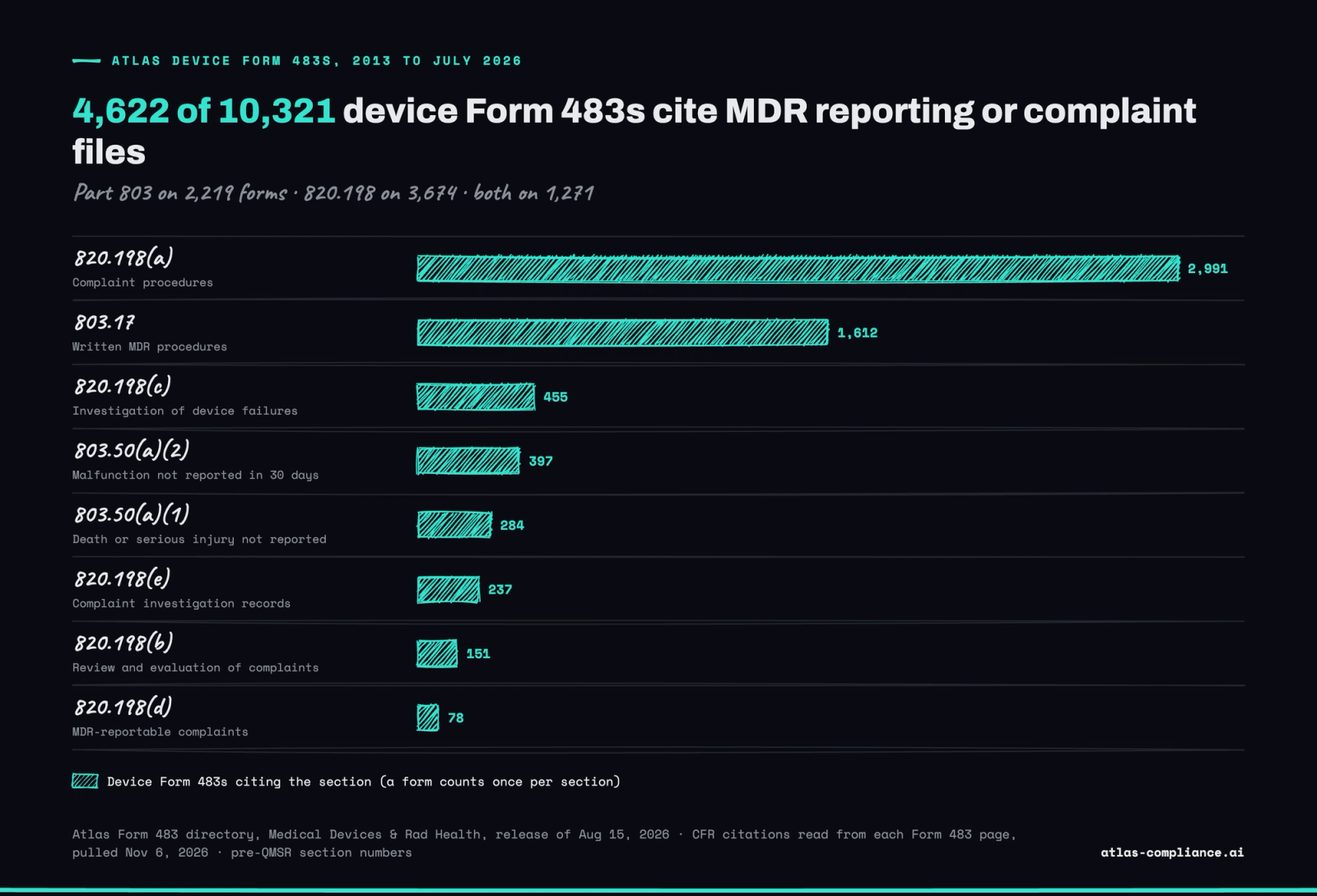
MDR and complaint failures show up on FDA Form 483s as citations of 21 CFR Part 803 and 21 CFR 820.198, and in Atlas they appear on 4,622 of 10,321 medical device Form 483s issued from 2013 to July 2026 (45%). Part 803 is cited on 2,219 forms, 820.198 on 3,674, and 1,271 cite both.
Investigators work from the firm's complaint log: they sample complaints and check each one against its MDR event file. The most common findings concern missing or weak procedures:
| Section | What the investigator found | Device 483s citing it |
|---|---|---|
| 820.198(a) | Complaint procedures missing or inadequate | 2,991 |
| 803.17 | Written MDR procedures missing or inadequate | 1,612 |
| 820.198(c) | Device failures not investigated | 455 |
| 803.50(a)(2) | Reportable malfunction not reported in 30 days | 397 |
| 803.50(a)(1) | Death or serious injury not reported in 30 days | 284 |
| 820.198(e) | Complaint investigation records incomplete | 237 |
| 820.198(d) | MDR-reportable complaints not handled as such | 78 |
Four recent Form 483s in the FDA Form 483 database cite 21 CFR 803.50:
- Intuitive Surgical, Sunnyvale, California, November 5, 2025: six observations, led by 803.50(a)(1) on death or serious injury reports, plus 806.10(a)(1) on reporting a correction or removal, CAPA and design verification and validation.
- Abbott Diabetes Care, Alameda, California, October 23, 2025: two observations, 803.50(a)(2) on individual malfunction reports and 820.30(h) on design transfer.
- Atrium Medical, Merrimack, New Hampshire, November 26, 2024: eight observations, including both 803.50(a)(1) and (a)(2) and 820.198(c) on investigating device failures.
- Noah Medical, San Jose, California, November 26, 2024: 13 observations, among them 803.50(a)(1) and (a)(2), 820.198(a) complaint procedures and 806.10(b), the 10-day deadline for reports of corrections and removals.
Each form pairs a reporting citation with a quality system one. A late MDR often starts as a complaint nobody evaluated for reportability, which is why 1,271 device forms cite both 820.198 and Part 803.
The same records exist for your own facilities and your suppliers, with the investigators who wrote each form and the sections they cite most.
 Atlas
See what the FDA knows about your next investigator.
30 minutes with the founder. No pitch deck.
What changed for complaint citations under the QMSR?
Complaint citations changed form on February 2, 2026, when the Quality Management System Regulation replaced the old Quality System regulation: investigators now cite ISO 13485:2016 clause 8.2.2 or 21 CFR 820.35(a) instead of 820.198. Part 803 did not change.
Section 820.35(a) keeps the US-specific complaint record rules, including seven data elements for every complaint that is reportable under Part 803 or that the manufacturer investigates. In Atlas, 349 device Form 483s were issued between February 2 and July 17, 2026. Of those, 78 (22%) cite complaint handling under 8.2.2, 820.35 or 820.198, and 43 (12%) cite Part 803, with 803.17 on 32.
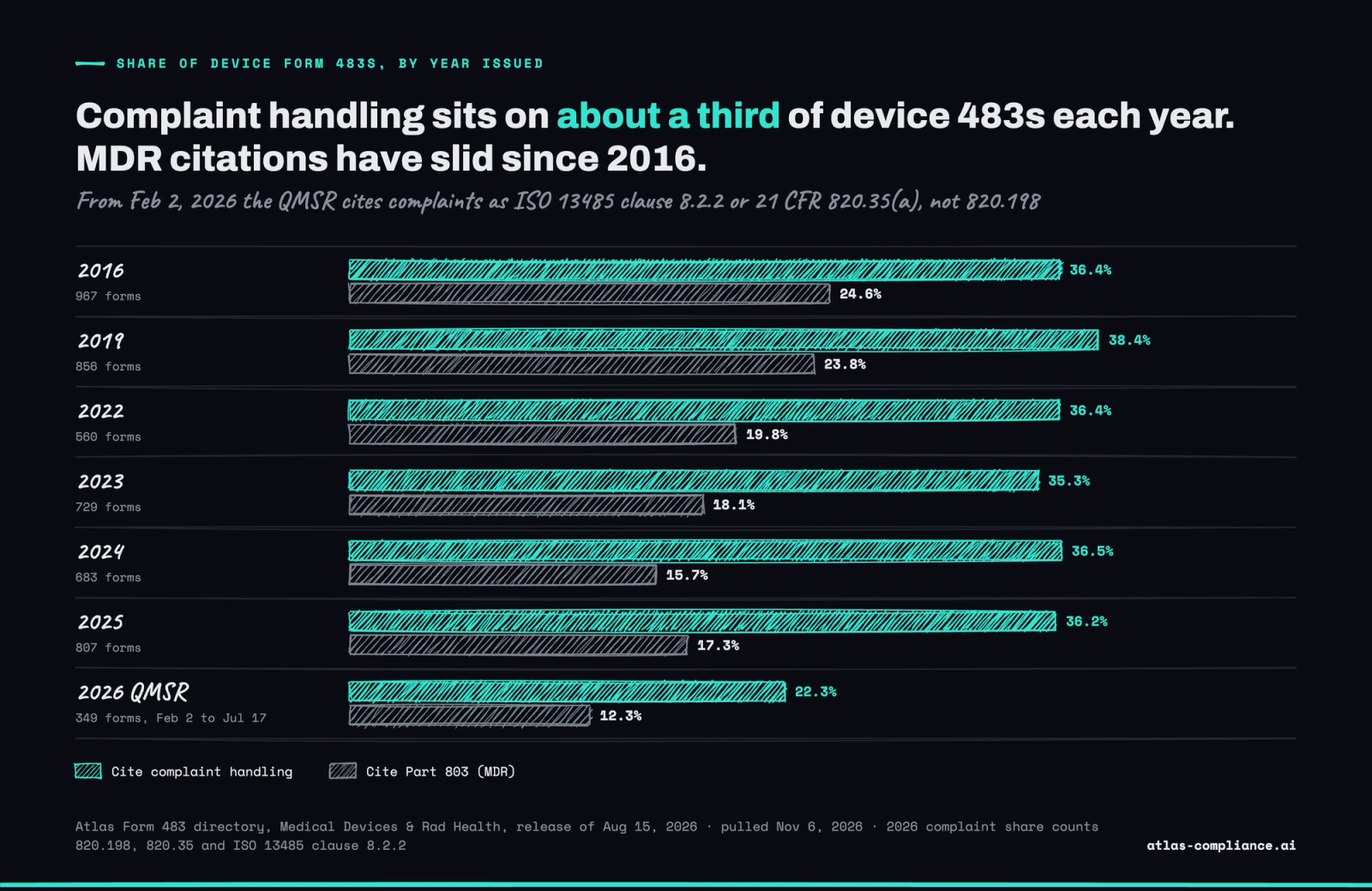
The 2026 figures cover five and a half months. Over the longer run, complaint handling appeared on 34% to 40% of device 483s every year from 2013 to 2025, while Part 803 citations fell from 24.6% in 2016 to 17.3% in 2025.
What did the Olympus warning letter cite on MDRs?
FDA's warning letter CMS 729208 to Olympus, dated October 7, 2026, cites 21 CFR 803.50(a)(2) and 803.52 as violation 12, for two late malfunction reports on resection sets from the Hamburg facility. Olympus became aware of the complaints on February 12 and 13, 2025, and filed the MDRs on June 16 and October 20, 2025, 124 and 249 days later.
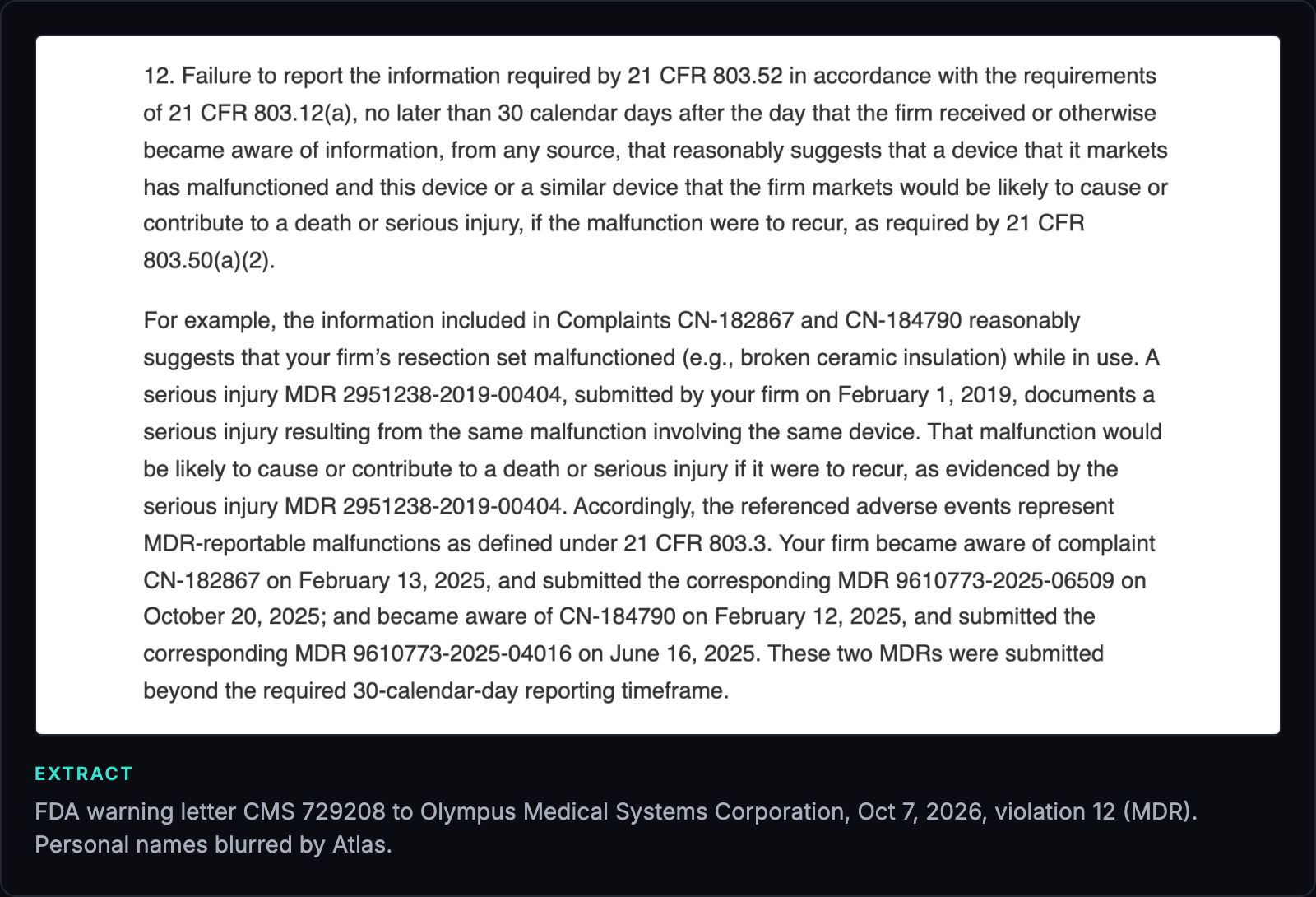
The letter ties the late filings to an earlier MAUDE record, a 2019 serious injury MDR for the same malfunction on the same device, which made any recurrence reportable within 30 days. FDA could not yet judge the Olympus response adequate because the corrective actions were still open.
The Atlas record for Olympus Winter & IBE in Hamburg shows 803.50(a)(2) on its November 2025 Form 483, and 820.198(a) complaint procedures cited in 2017 and again in 2025. Olympus's Hachioji facility received warning letters after its 2015 and 2022 inspections, both centered on 803.50(a)(1). Our Olympus warning letter analysis covers all 12 violations, and the October 2026 warning letter roundup puts it next to that month's other letters.
MAUDE vs MedWatch vs recalls vs Form 483: what does each record tell you?
MAUDE tells you what reporters said went wrong with a device; a Form 483 tells you whether the manufacturer's complaint and MDR systems worked. Each FDA record answers a different question:
| Record | What it holds | What it tells you | What it cannot tell you |
|---|---|---|---|
| MAUDE | MDRs from manufacturers, importers, user facilities and voluntary reporters | Device problems and outcomes as reported | Event rates, cause, or whether a report was late |
| MedWatch | FDA's reporting program and Form 3500 | How clinicians and patients report an event | Nothing separate: device reports filed through it are searched in MAUDE |
| Medical device recalls | Recalls classified I, II or III, and corrections and removals under Part 806 | That FDA and the firm acted on a problem, and how serious FDA judged it | The complaints and MDRs behind the recall |
| Form 483 records | Investigator observations at a facility | Whether complaint handling and MDR reporting meet 820.198 and Part 803 | The adverse events themselves |
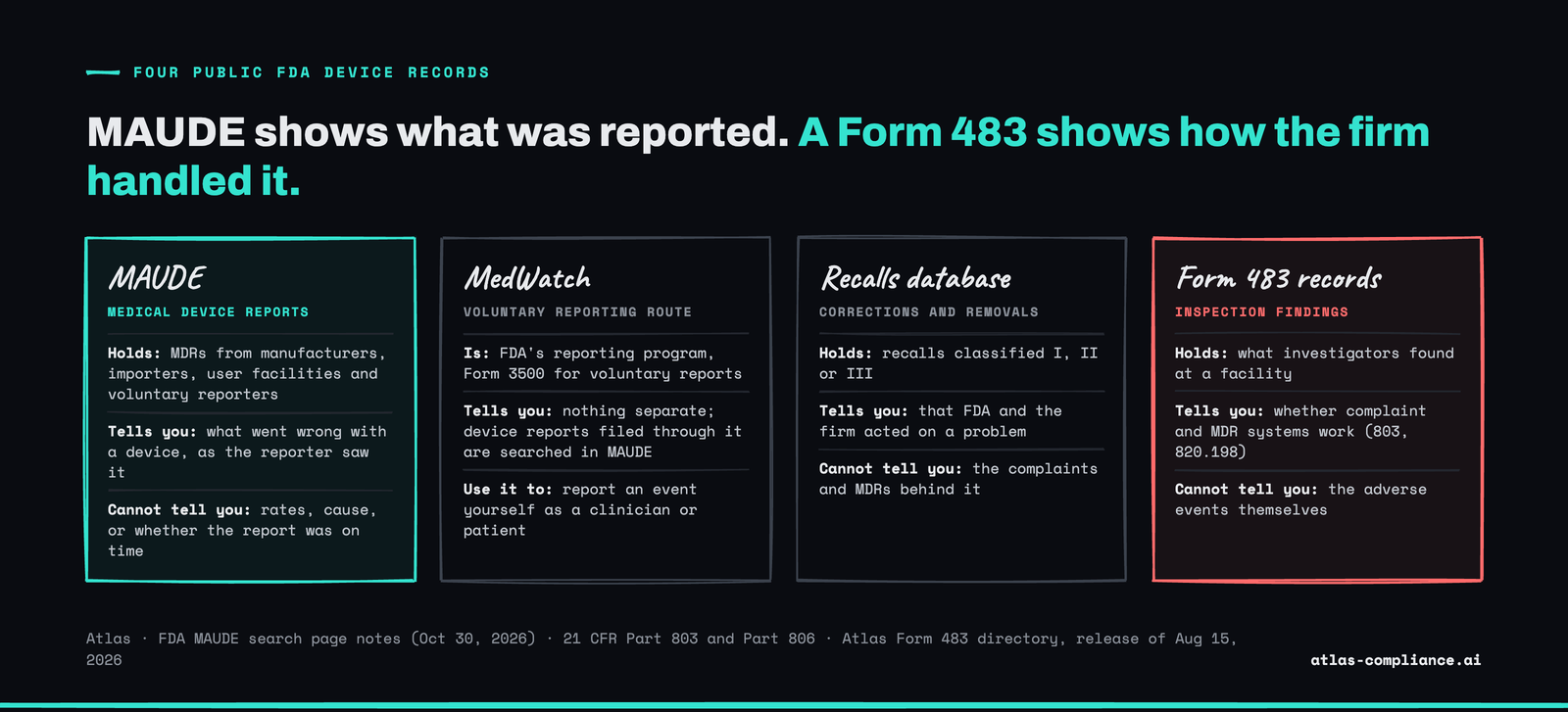
Used together, the four records can tell one story: a cluster of MAUDE malfunction reports, a recall, then a Form 483 citing 803.50 or 820.198 at the facility that made the device. Our explainer on what a Form 483 is covers the inspection side.
How should device quality teams use MAUDE before an inspection?
Device quality teams should use MAUDE to test their own reporting before an investigator does, by matching what FDA has on file against the complaint log.
- Pull every MAUDE record for your product codes for the last two years, then match each one to a complaint number and an MDR event file. A MAUDE report with no matching complaint is a gap in your intake.
- For each complaint closed as "not reportable", check that the MDR event file records the reasoning, as 803.18 requires. Investigators sample these files.
- Compare awareness dates with the date FDA received each report. Anything past 30 calendar days is the 803.50 finding that cost Olympus a warning letter violation.
- Search competitors' devices under the same product code. Repeated malfunctions there are inputs for your risk file and design reviews; our guide to medical device design controls shows where those inputs belong.
- Confirm your written MDR procedures (803.17) name who decides reportability and how 5-day reports are triggered. That section alone is on 1,612 device Form 483s.
The Atlas digest sends new device Form 483s and warning letters as they appear, so you can see which MDR and complaint sections investigators are citing this month.
AtlasFDA Inspection Intelligence Digest
We track every 483, EIR, and warning letter the moment it happens. Get the signals before they hit the FDA website.
Frequently asked questions
MAUDE stands for Manufacturer and User Facility Device Experience. The name reflects its two main sources of mandatory reports: device manufacturers and user facilities such as hospitals, nursing homes and ambulatory surgical facilities. MAUDE also holds reports from importers and voluntary reports from health professionals, patients and consumers. FDA's Center for Devices and Radiological Health runs it.

Written by
Bhavish Agarwal
Founder, Atlas
Bhavish Agarwal is the founder of Atlas and previously worked at Google and Microsoft. He has spent the past several years building regulatory data infrastructure for the pharmaceutical industry.