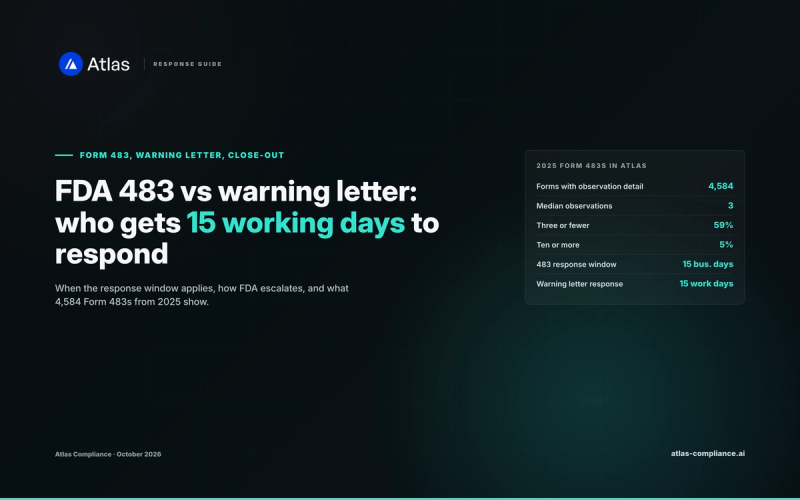

FDA 483 response management software is a tool that helps a quality team answer a Form 483 within FDA's 15 business day window by tracking each observation, linking it to root cause, CAPA and evidence, and showing how FDA has cited the same regulation at other facilities. No single product covers all of that, so in practice the work splits between a quality management system and FDA inspection data.
This guide sets out what a response must contain, a vendor-neutral checklist for choosing software, and data from the Atlas Form 483 directory (release of August 15, 2026, pulled November 17, 2026) and FDA's inspection classification records for 2025.
Key facts:
- FDA's notice "Review of Post-Inspection Responses" (74 FR 40211, August 11, 2009) says FDA will generally allow 15 business days for a response to Form 483 observations before it issues a warning letter.
- A response FDA receives after day 15 will not ordinarily delay a warning letter, and ongoing or promised corrective actions generally do not prevent one, according to the same notice.
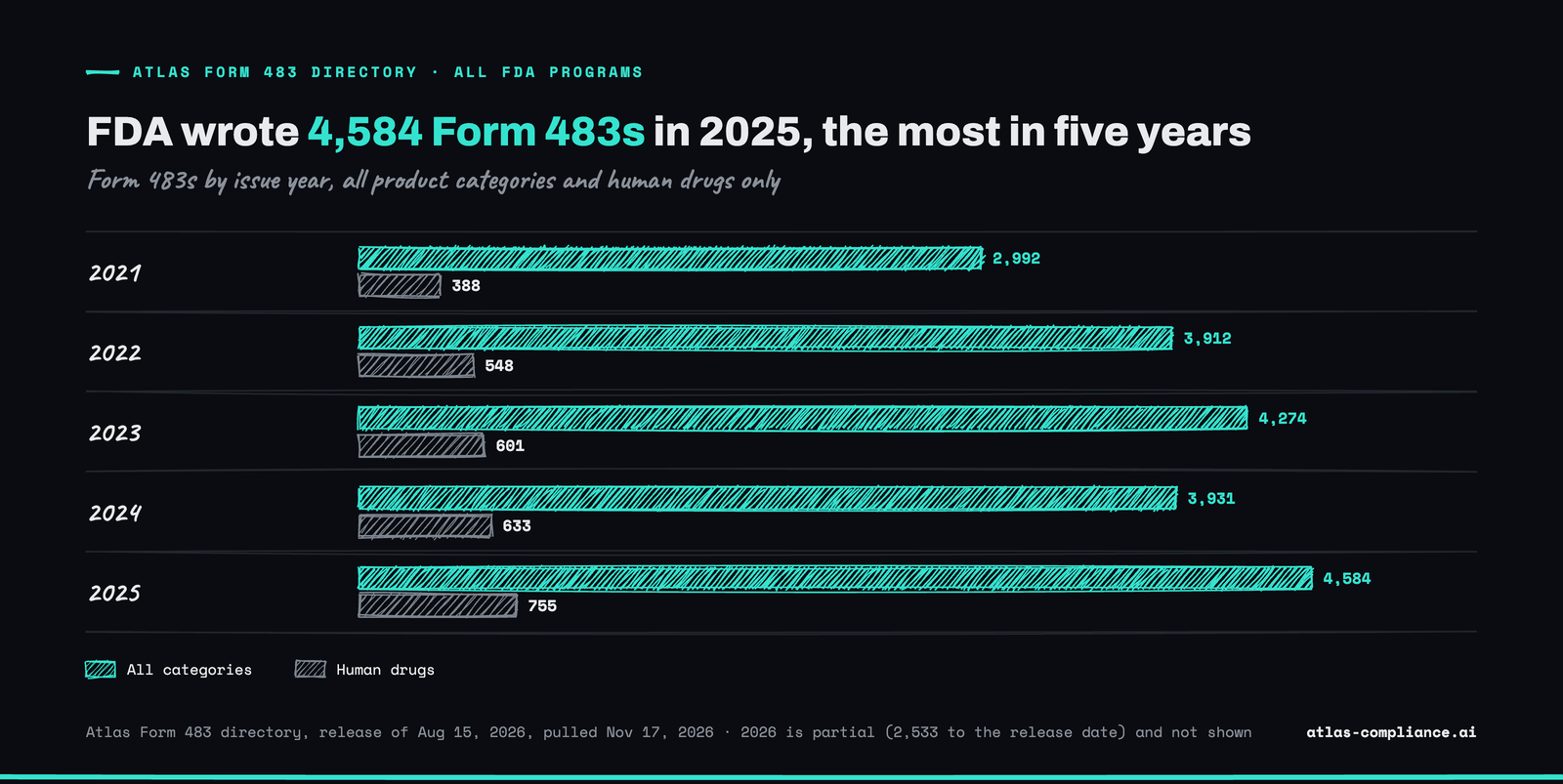
- The Atlas Form 483 directory lists 4,584 Form 483s issued in 2025, the highest count of the five years from 2021 to 2025. Of those, 755 went to human-drug establishments.
- Of 681 human-drug inspections that ended in 2025 with posted Form 483 citations, FDA classified 169 (24.8%) as Official Action Indicated, the outcome under which it considers a warning letter.
- FDA's March 9, 2026 notice of draft guidance on Form 483 responses (91 FR 11325) says inadequate responses lacked relevant data, carried excessive data or failed to address root cause.
What must an FDA 483 response contain?
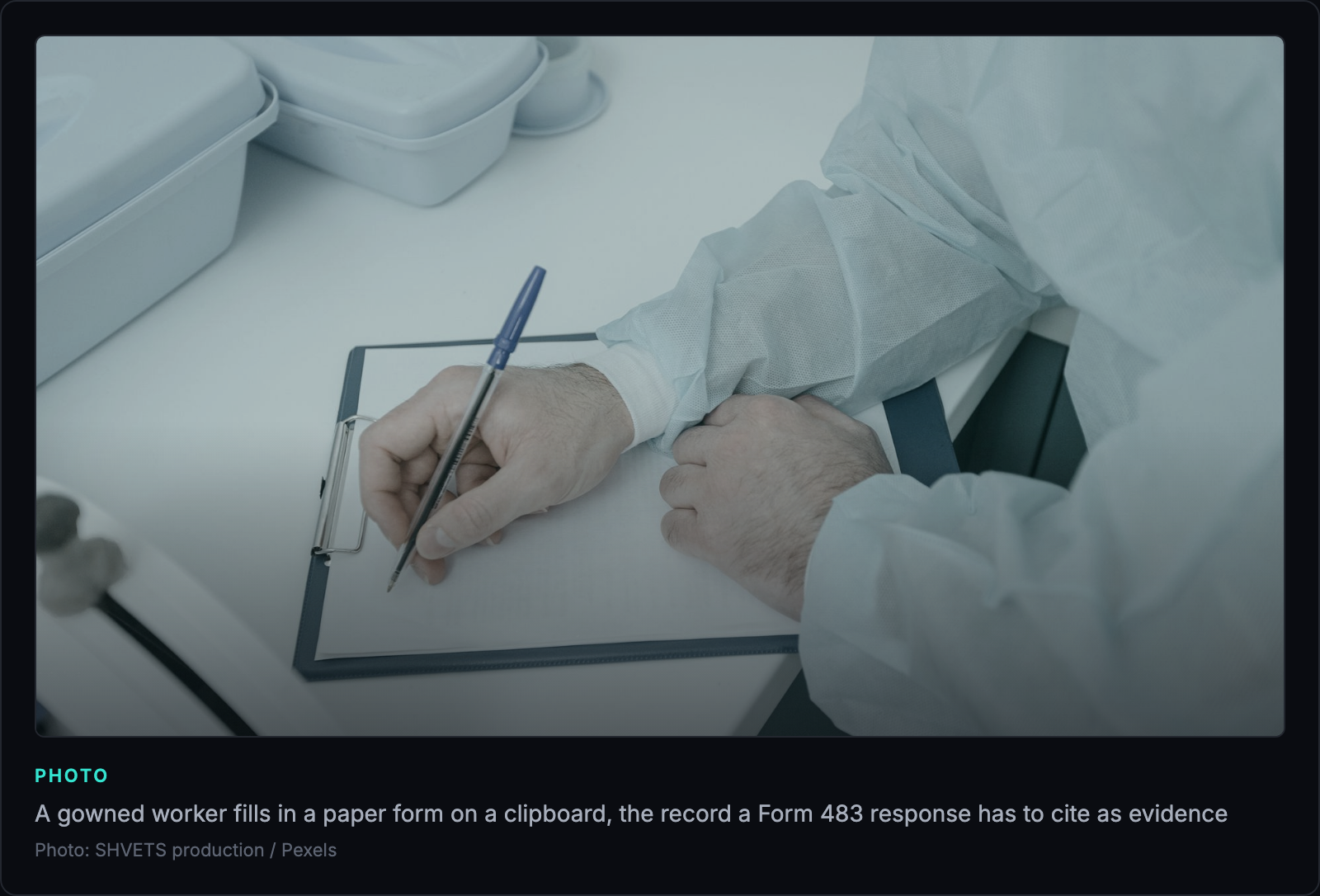
An FDA 483 response must answer every observation on the form with the facts, the root cause, the scope of the problem, the corrections already made, the corrective and preventive actions (CAPA) still to come with owners and dates, and the evidence that proves each step. The site head or another senior manager signs it, and the response goes to the FDA address printed on the form.
FDA has said what it does not want. In its March 9, 2026 Federal Register notice announcing the draft guidance "Responding to FDA Form 483 Observations at the Conclusion of a Drug CGMP Inspection" (91 FR 11325), FDA wrote that past responses fell short through missing data, too much data, or a failure to address the root cause of the observation. The draft covers drug establishments regulated by CDER, CBER and CVM. It is still a draft, so read it as FDA's current thinking, not a final rule.
Each part of the response leaves a record your team has to produce and keep:
- The observation, quoted as FDA wrote it, with the 21 CFR section it touches.
- Your position: agree, agree in part, or dispute with a document the investigator did not see.
- The investigation and root cause, written to the standard of 21 CFR 211.192 for drug manufacturers.
- Scope: other lots, lines, products and facilities with the same weakness.
- Corrections done, and CAPA with an owner and a completion date for each action.
- Exhibits, numbered and referenced from the text.
- A schedule for update letters until every commitment is closed.
Our FDA 483 response template walks through each part with examples. Every item on this list is a record someone on your team has to find, approve and track, and that is the work response software takes on.
How long do you have to respond to an FDA Form 483?
A company has 15 business days from the date FDA issues the Form 483 for FDA to receive a response it will review before deciding on a warning letter. The window comes from FDA's 2009 notice "Review of Post-Inspection Responses" (74 FR 40211), which started the program on September 15, 2009.
The notice sets out two paths. If FDA receives the response within 15 business days, it plans a detailed review before deciding, and any warning letter it then issues will comment on how adequate the corrective actions look. If the response arrives later, FDA does not plan to address it in the warning letter and will evaluate it with the company's reply to the letter instead. FDA also said it can issue a warning letter at any time, response or not.
A response is not legally required, but the window is the only point where your corrective actions can shape FDA's decision. The notice also explains why FDA set a deadline at all: some companies sent multiple responses over many months, which delayed warning letters. One complete response by day 15, followed by scheduled updates, fits what FDA asked for. The differences between this window and the one a warning letter opens are in our guide to the 483 vs warning letter response.
How often does a Form 483 lead to official action?
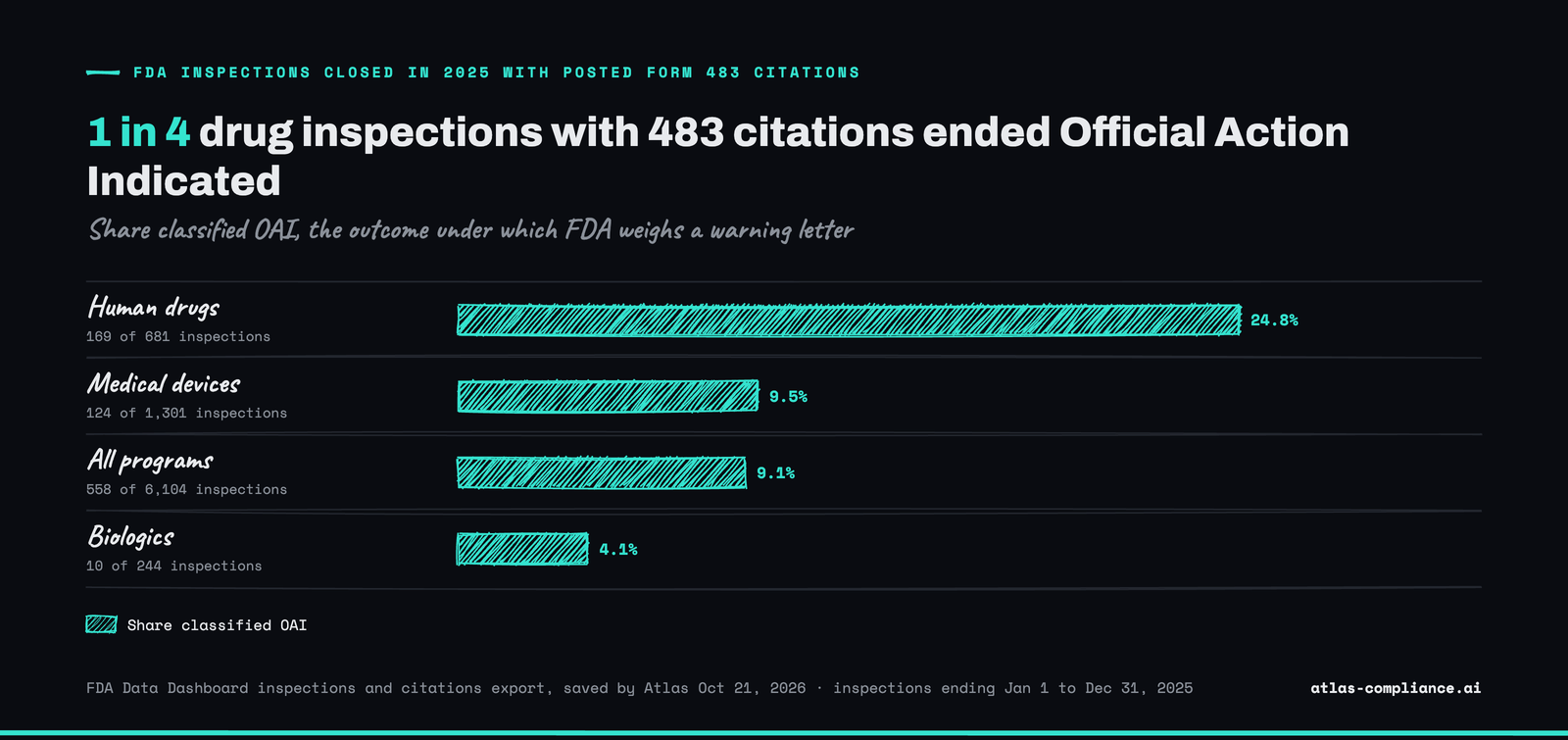
About one in four human-drug inspections that ended in 2025 with posted Form 483 citations was classified Official Action Indicated (OAI). The FDA Data Dashboard inspections and citations export, saved by Atlas on October 21, 2026, lists 681 such drug inspections, and FDA classified 169 of them OAI.
OAI is the classification under which FDA considers regulatory action such as a warning letter. It is not the same as a warning letter, and the 2009 notice says FDA reviews a timely response before it decides on one. The share still shows how much rides on the response. Across all FDA programs, 558 of 6,104 inspections with posted citations ended OAI (9.1%). Device inspections ran at 9.5% (124 of 1,301) and biologics at 4.1% (10 of 244). Our explainer on NAI, VAI and OAI covers what each class means.
The Atlas Form 483 directory holds 2,992 Form 483s issued in 2021, 3,912 in 2022, 4,274 in 2023, 3,931 in 2024 and 4,584 in 2025. Human-drug forms rose every year in that span, from 388 to 755. The directory had recorded 2,533 forms for 2026 by the August 15, 2026 release. You can search them by company, facility, category or investigator in the FDA Form 483 database, and our guide to finding FDA 483 reports explains the other public routes.
Before you write a response, check what FDA has on record for the investigator who signed your form and for your facility. That record shows which sections FDA cited before and which answers did not hold.
 Atlas
See what the FDA knows about your next investigator.
30 minutes with the founder. No pitch deck.
What should you look for in FDA 483 response software?
FDA 483 response software should cover ten capabilities: observation capture with CFR tagging, owner and deadline tracking, CAPA linkage, evidence control, an audit trail, same-section comparison against FDA's record, investigator history, facility and peer history, drafting support, and commitment tracking after day 15. Rows 1 to 5 and row 10 belong in a quality management system. Rows 6 to 9 need FDA inspection data.
| # | Capability | Why it matters for the response | Question to ask in a demo | Usually found in |
|---|---|---|---|---|
| 1 | Observation capture and CFR tagging | Each answer maps to one observation and one regulation | Can we log each observation word for word and tag its 21 CFR section? | QMS or eQMS |
| 2 | Owners and a 15 business day calendar | Due dates have to count back from FDA's day 15, not calendar days | Does it count business days from the 483 issue date? | QMS or eQMS |
| 3 | CAPA linkage | FDA reads the CAPA as the answer to root cause | Is each CAPA linked to the observation it answers? | QMS or eQMS |
| 4 | Evidence and exhibit control | Exhibits must be the approved, current version | Can exhibits come straight from controlled documents? | QMS or document control |
| 5 | Audit trail and electronic signatures | Approvals on the response and CAPA must hold up later | Does it meet 21 CFR Part 11 for signatures and records? | QMS or eQMS |
| 6 | Same-section comparison | Shows how FDA wrote the same citation at other facilities | Can we search FDA observations by CFR section and keyword? | Inspection intelligence |
| 7 | Investigator history | The investigator's past citations show what the EIR will stress | Can we see every inspection and citation for one investigator? | Inspection intelligence |
| 8 | Facility and peer history | Repeat citations at your site or peers raise the stakes | Can we pull a facility's inspection and 483 history by site? | Inspection intelligence |
| 9 | Drafting support | Cuts the time to a first draft of investigations and CAPA | What records does the draft draw on, and can we check them? | Inspection intelligence or AI tools |
| 10 | Commitment tracking after day 15 | Update letters must arrive when you promised them | Are promised dates tracked to closure with reminders? | QMS or eQMS |
Before you buy, check whether your current QMS already does rows 1 to 5 and 10. Many quality teams already own CAPA, document control and signatures, and a second system for the same records adds work. Rows 6 to 8 are where a response gains substance. A team that knows FDA cited the same section at a peer facility, and what that peer's response led to, can scope its own answer before FDA asks.
How does Atlas fit into a 483 response?
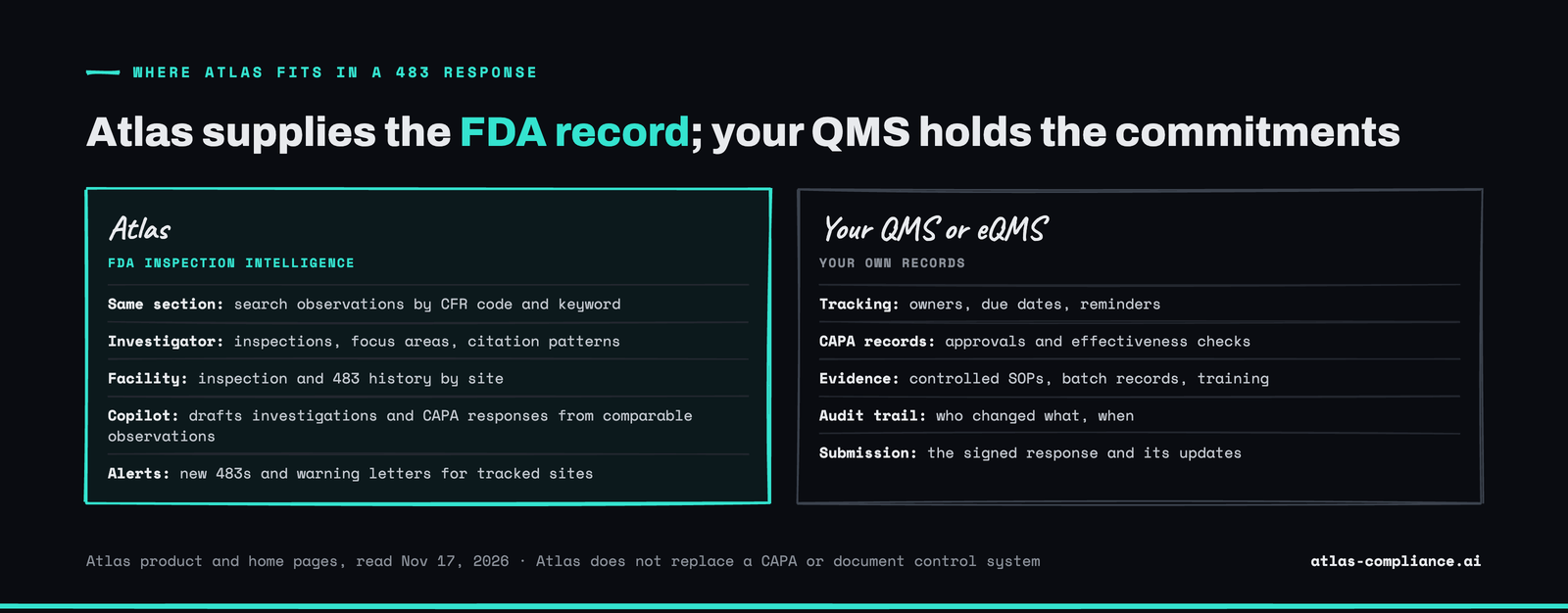
Atlas fits into a 483 response as the FDA record behind rows 6 to 9 of the checklist: it searches FDA observations by CFR section, investigator, company, facility and keyword, and its AI copilot drafts investigations and CAPA responses grounded in comparable FDA observations. Atlas is an inspection and enforcement intelligence platform. It does not replace your CAPA or document control system.
Same-section comparison. Every Form 483 page in Atlas tags each observation with the regulation it cites. The January 22, 2026 Form 483 for Excel Vision in Annonay, France lists 13 observations with 10 structured CFR citations, including 211.192 and 211.113(b). A team answering its own 211.192 observation can set that wording next to the October 25, 2021 Regeneron Form 483, which cites 211.192 twice among six observations. To pull every citation out of your own form first, paste it into the free 21 CFR citation finder; the text never leaves your browser.
Investigator history. Atlas holds more than 6,000 investigator reports with focus areas by CFR code and citation patterns over time. One public investigator profile shows 279 inspections across 240 sites since August 2008 and 1,374 observations, with links to each recent Form 483.
Facility history. Site pages show every inspection, its outcome and each Form 483. The Regeneron Rensselaer facility record lists 19 inspections, 9 of them ending in a Form 483, the kind of repeat pattern FDA weighs when it reads a response.
Drafting and alerts. In the full platform, the copilot answers questions about any investigator, observation or CFR code and drafts investigations and CAPA responses from comparable observations. Your team still verifies every draft against its own records. Alerts by email or WhatsApp flag new inspections, 483s and warning letters for the companies, facilities and investigators you track, so you see when a peer with the same citation receives a warning letter.
What Atlas leaves to your QMS: owner and due-date tracking, CAPA approvals, controlled exhibits, electronic signatures and the signed submission. The Atlas product page lists the full data coverage, and our answers to common buyer questions cover onboarding and security.
A short checklist for the next Form 483
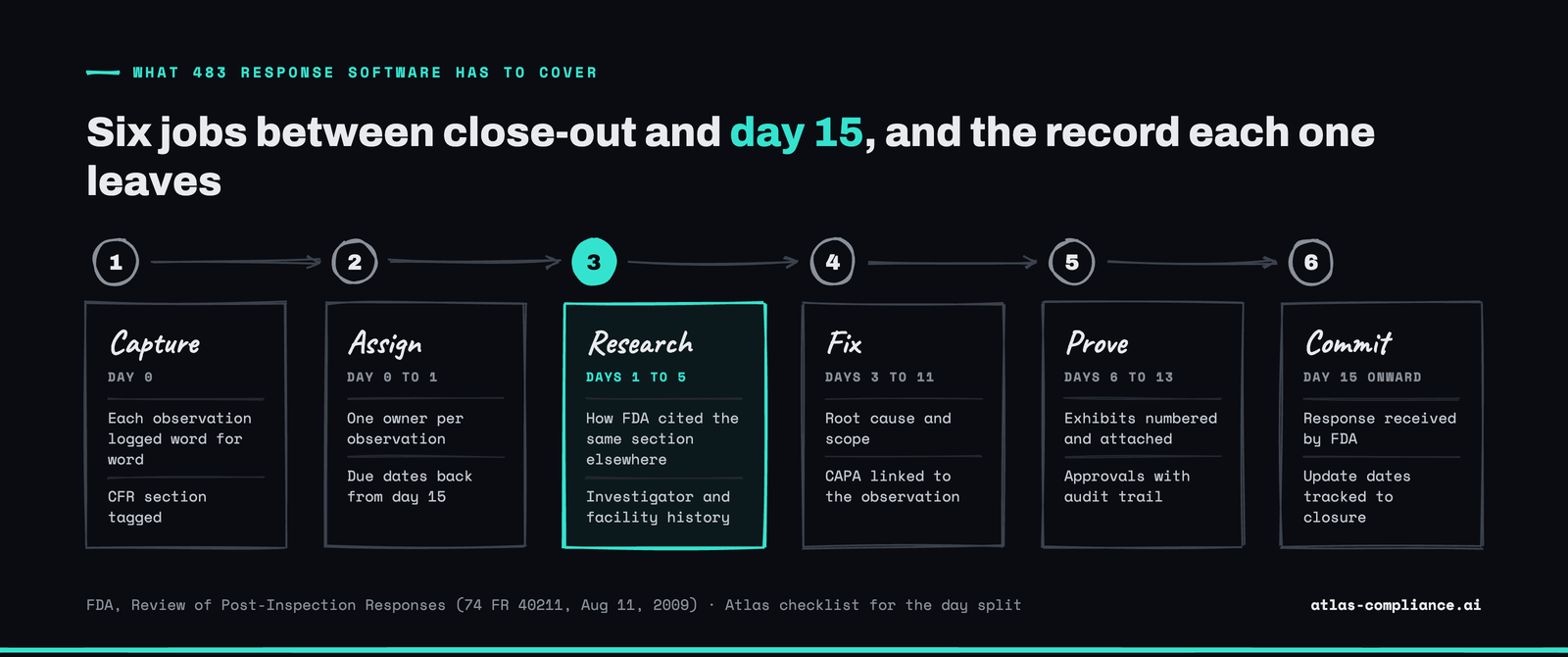
Use this list on the day an inspection closes, whatever software you run:
- Log every observation word for word and tag its 21 CFR section.
- Count 15 business days from the issue date and set internal due dates from day 12.
- Name one owner per observation and one signatory for the response.
- Pull the investigator's record and your facility's 483 history.
- Search how FDA wrote the same sections at other facilities.
- Link a CAPA, with an owner and a date, to every observation.
- Attach approved exhibits and send one complete response by day 15.
- Track every promised update until the last commitment closes.
AtlasFDA Inspection Intelligence Digest
We track every 483, EIR, and warning letter the moment it happens. Get the signals before they hit the FDA website.
Frequently asked questions
No law requires a response to a Form 483, but FDA reads a response it receives within 15 business days before deciding whether to issue a warning letter. Without one, FDA decides on the inspection record alone. The preprinted text on the form invites companies to discuss objections or corrective actions, and a written response is common practice.

Written by
Bhavish Agarwal
Founder, Atlas
Bhavish Agarwal is the founder of Atlas and previously worked at Google and Microsoft. He has spent the past several years building regulatory data infrastructure for the pharmaceutical industry.