

Atlas Compliance is an FDA inspection and enforcement intelligence platform for quality teams at pharma and medical device companies. It puts FDA inspections, Form 483s, warning letters, investigator histories, and five international regulators in one searchable place, with new inspection data typically within a business week.
These are the ten questions quality, regulatory, and supplier quality leaders ask most often before choosing Atlas, with direct answers.
| Question | Short answer |
|---|---|
| What it is | FDA inspection and enforcement intelligence for pharma and medical device quality teams |
| What data it holds | 700,000+ FDA inspections since 2010, 30,000+ Form 483s and EIRs, 11,828 warning letters, plus MHRA, PMDA, Health Canada, CDSCO, and Swissmedic |
| How fresh | Typically within a business week of an inspection, before it appears on the FDA website |
| Security | ISO 27001, cybersecurity insurance, hosted on Azure, SOC 2 in progress |
| Onboarding | Activates with a click: no implementation project, no setup fees |
| Licensing | Named user annual subscription |
What is Atlas Compliance?
Atlas is an FDA inspection and enforcement intelligence platform. It takes FDA data that is normally scattered across PDFs, FOIA requests, and spreadsheets, structures it, and makes it searchable for the way quality teams actually work: by company, facility, investigator, regulation, and observation.
Every document is AI-tagged by keyword, CFR code, and observation category, and returns in under a second. Teams use it to prepare for inspections, monitor suppliers, write stronger CAPAs, and benchmark against peers. For the full product overview, see what Atlas Compliance is and how it helps pharma and medical device companies, or the Atlas product page.
Who uses Atlas?
Atlas is built for the people accountable for inspection outcomes:
- VP Quality, Head of Site Quality, Chief Quality Officers, and Directors of Corporate Quality
- Regulatory affairs teams
- Supplier and external manufacturer quality managers
- Internal audit and training leads
Customers include J&J, Kenvue, Bayer, Zydus, Cipla, Grifols, Natco, Alembic, Strides, and dozens more.
What problems does Atlas solve for quality teams?
Quality teams usually come to Atlas with one of four problems:
- FDA data is scattered across PDFs, spreadsheets, and the memory of whoever handled the last inspection.
- No visibility when a supplier or peer is inspected, so a supplier's 483 surfaces months later, after it has already affected supply.
- Legacy platforms sell expensive, predetermined reports that do not match the question the team is trying to answer.
- Investigator patterns shift year over year, and nobody has time to track them by hand.
Atlas addresses all four: complete data, custom analytics built for your use case, alerts on any company, facility, or investigator you monitor, and 6,000+ investigator reports.
What FDA and international data does Atlas include?
| Record type | Coverage |
|---|---|
| FDA inspections | 700,000+ since 2010 |
| Form 483s and Establishment Inspection Reports (EIRs) | 30,000+ since 2010 |
| Warning letters | 11,828 since 2008 |
| Complete Response Letters (CRLs) | About 500, updated continuously |
| Searchable observations | 100,000+ |
| Investigator reports | 6,000+, with focus areas and citation patterns |
| Other FDA actions | Import alerts, recalls, debarment letters |
| International agencies | MHRA, PMDA, Health Canada, CDSCO, Swissmedic |
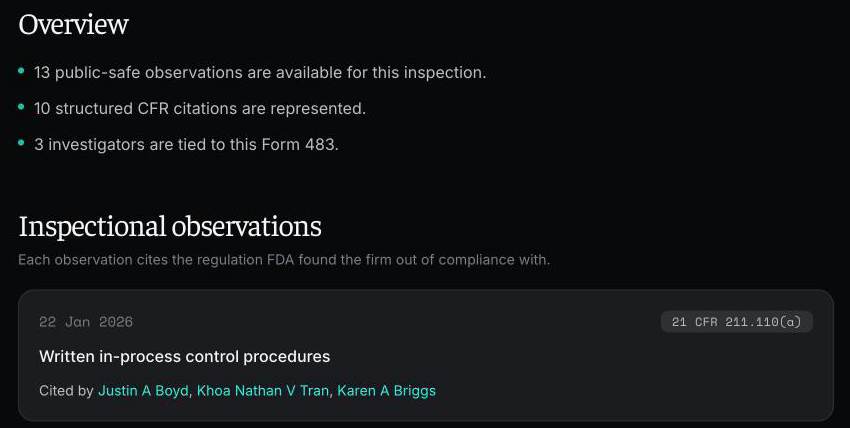
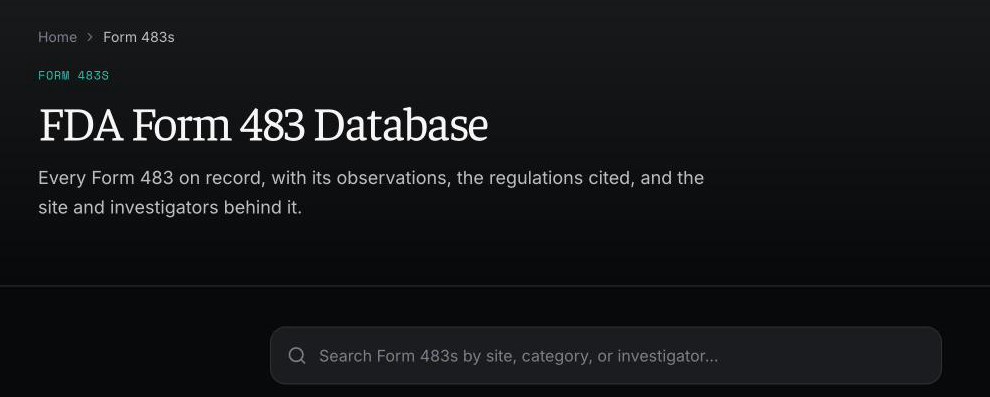
Inspection histories connect across companies, facilities, investigators, and countries. Part of this data is free to explore: you can search the FDA Form 483 database and the FDA investigator lookup without an account.
 Atlas
See what the FDA knows about your next investigator.
30 minutes with the founder. No pitch deck.
How fresh is the data, and does Atlas send alerts?
New inspection data typically arrives on Atlas within a business week of the inspection, through proprietary market intelligence. That is usually before it appears on the FDA website.
Teams set up email or WhatsApp alerts for the events that matter to them:
- A supplier or external manufacturer is inspected
- A peer company receives a Form 483 or warning letter
- A specific investigator is active in a region you care about
More detail on how alerts work is in does Atlas offer real-time inspection alerts.
How is Atlas different from Redica and other platforms?
Three differences matter most to buyers comparing Atlas with legacy platforms:
- Fresher data. Inspection records typically reach Atlas within a business week, before they appear on the FDA website or on competing platforms.
- More customizable. We build custom analytics for your exact use case quickly, at no extra cost, instead of selling predetermined reports.
- More accessible. Named user annual subscription licenses make inspection intelligence available to companies that could not justify legacy enterprise pricing.
Atlas was built by ex-Google engineers and activates with a click. For a side-by-side comparison, see Atlas as a Redica Systems alternative.
How secure is Atlas?
| Control | Status |
|---|---|
| ISO 27001 | Obtained |
| Cybersecurity insurance | Obtained, required by customers including BMS and Thermo Fisher |
| SOC 2 | In progress |
| Hosting | Microsoft Azure |
| Access | Role-based access controls and audit logging |
How does Atlas help during an FDA inspection?
Atlas does most of its work in the preparation phase, and it supports the response too:
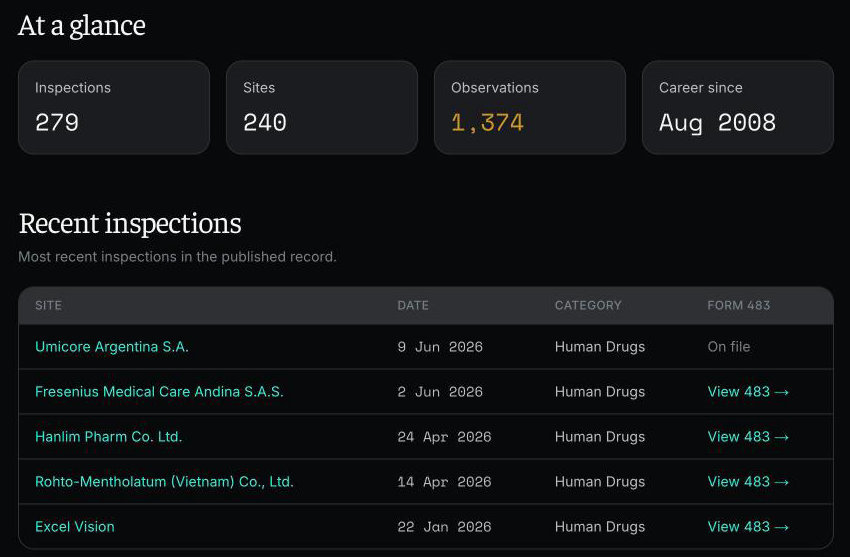
- Know your investigator. Pull the assigned investigator's complete inspection history, focus areas, and citation patterns before they arrive. To see what a profile contains, open a free one such as Justin A Boyd's investigator profile.
- See how peers handled the same observation. Research how similar observations were resolved at comparable companies.
- Benchmark your CAPAs against actual enforcement outcomes rather than guesswork.
- Compare your site with peers on inspection frequency and outcomes.
One customer ran a manual gap assessment and found zero gaps. Atlas found 100. If an inspection has already ended in a Form 483, our guide to Form 483 response strategies covers the 15-business-day response.
What is onboarding like?
Atlas activates with a click. There is no implementation project, no onboarding team, and no setup fee.
Feature requests go straight to the engineering team. There are no account managers or support tiers between you and the people who build the product: engineers pick up the phone.
How much does Atlas cost, and what is the ROI?
Atlas uses named user annual subscription licenses. Typical range: $30K-$80K depending on company size and geography. That's a fraction of the legacy alternative, which runs $300-500K for enterprise deals.
Return on investment comes from four places:
- Faster inspection preparation: hours of manual document hunting replaced with sub-second search.
- Better CAPAs: grounded in actual enforcement data, not guesswork.
- Supplier visibility: catch a supplier's 483 before it disrupts your supply chain.
- Benchmarking: know what the FDA is citing at companies like yours.
Want to see how Atlas fits your situation? Book a demo and we will walk through your exact use case.
Frequently asked questions
Yes. The public part of Atlas, the FDA inspection database with investigator, facility, and Form 483 pages, is free to search without an account at atlas-compliance.ai/inspection-intelligence. The full platform, with verbatim observations, source documents, analytics, and alerts, is shown in a 30-minute demo with the founder.

Written by
Bhavish Agarwal
Founder, Atlas
Bhavish Agarwal is the founder of Atlas and previously worked at Google and Microsoft. He has spent the past several years building regulatory data infrastructure for the pharmaceutical industry.