
Container closure integrity testing (CCIT) is a set of physical or microbiological leak tests that shows a sealed drug package, such as a stoppered and crimped vial, a prefilled syringe or a fused ampoule, keeps microorganisms and gases out from filling to expiry. Sterile drug manufacturers use it to meet 21 CFR 211.94(b), which requires container closure systems to protect the product against foreseeable contamination in storage and use.
This guide covers the USP <1207> methods, when CCIT is expected and how it fits the product life cycle. It adds what FDA investigators wrote when containers and closures fell short: 95 drug inspections that cited 21 CFR 211.94, out of 8,123 drug inspections citing 21 CFR Part 211 that closed between October 2008 and September 2026, from the Atlas Form 483 citation dataset (pulled October 2026) joined to FDA's inspection classifications.
Key facts:
- USP General Chapter <1207>, Package Integrity Evaluation: Sterile Products, and its three subchapters <1207.1>, <1207.2> and <1207.3> became official on August 1, 2016.
- USP <1207> sorts leak tests into deterministic methods, such as vacuum decay and high-voltage leak detection, and probabilistic methods, such as dye ingress and microbial challenge, and prefers deterministic methods where the package allows.
- FDA's February 2008 guidance lets a validated container closure integrity test replace the sterility test in a stability protocol, but never the sterility test at batch release.
- EU GMP Annex 1 (2022), paragraph 8.22, requires 100% integrity testing of glass ampoules, blow-fill-seal units and other fusion-closed containers of 100 mL or less, and states that visual inspection is not an acceptable integrity test.
- In the Atlas dataset, 50 of the 95 inspections that cited 211.94 (52.6%) ended Official Action Indicated (OAI), against 17.6% of the other 8,028 Part 211 drug inspections.
What does container closure integrity testing prove?
Container closure integrity testing proves that a package has no leak large enough to let microorganisms, liquids or gases in or out over the product's shelf life. For a sterile injectable, a passing result means the sterility achieved at filling can hold until the patient opens the container.
CCIT does not prove that the product was sterile when it was filled. That is the job of sterilization validation, aseptic process simulation and the release sterility test. Our guides to aseptic processing and the media fill test cover how a filling line earns that first claim.
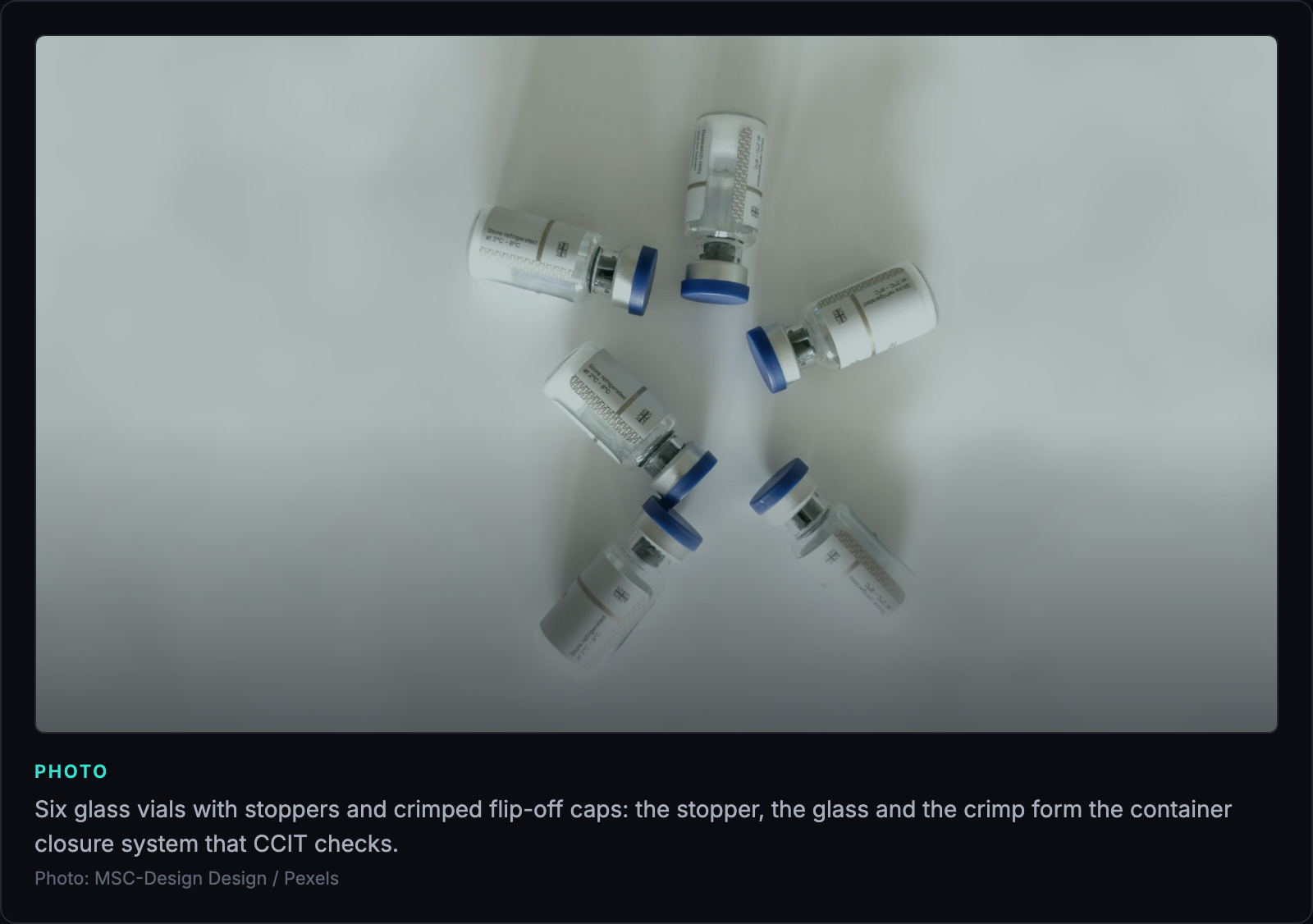
A container closure system is every part that touches or protects the product: the glass or polymer container, the elastomeric stopper or plunger, the seal or crimp, and any secondary part that the package depends on for protection. Three US rules frame the work:
- 21 CFR 211.94(b) requires container closure systems to give adequate protection against foreseeable external factors in storage and use that can cause deterioration or contamination (eCFR, 21 CFR 211.94).
- 21 CFR 211.94(d) requires written standards, specifications and methods of testing for containers and closures.
- 21 CFR 211.166(a)(4) requires the stability program to test the drug product in the same container-closure system in which it is marketed (eCFR, 21 CFR 211.166).
What are the USP 1207 chapters?
The USP 1207 chapters are one general chapter and three subchapters on package integrity for sterile products. USP <1207> sets the concepts, and each subchapter covers one part of the work. USP revised <1207> and added the three subchapters with the first supplement to USP 39-NF 34, official August 1, 2016.
| Chapter | Title | What it covers |
|---|---|---|
| Package Integrity Evaluation: Sterile Products | Integrity assurance for nonporous packages of sterile products | |
| Package Integrity Testing in the Product Life Cycle: Test Method Selection and Validation | How to select, develop and validate a leak test for package development, manufacturing and shelf-life stability | |
| Package Integrity Leak Test Technologies | The leak test technologies, chosen on published research and precision and bias data | |
| Package Seal Quality Test Technologies | Seal characterization methods, such as peel force, which USP states are not leak tests |
The chapters are informational, numbered above 1000, so they guide method choice rather than set a pass or fail limit. Your firm still has to justify the method and its acceptance criterion for each product and package.
Deterministic vs probabilistic CCIT methods: what is the difference?
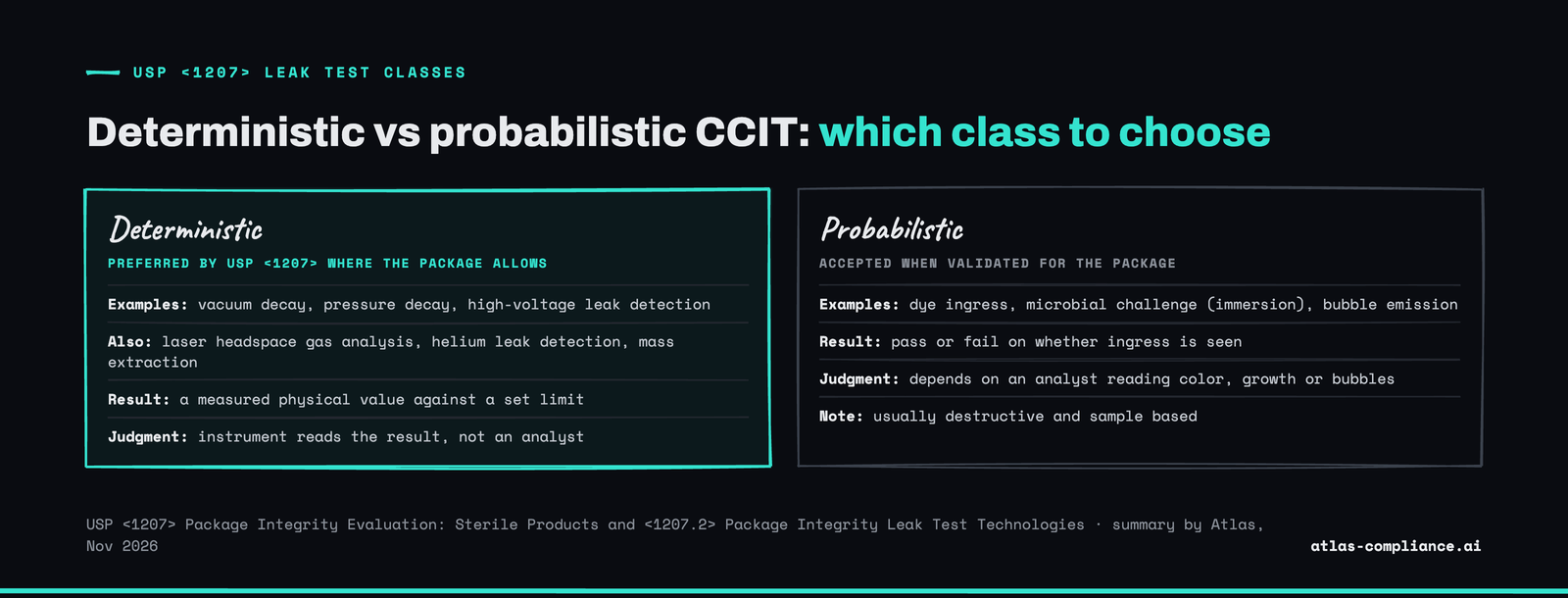
Deterministic CCIT methods measure a physical value, such as a pressure change or a gas concentration, and compare it with a set limit, so the instrument decides the result. Probabilistic CCIT methods expose the package to a challenge, such as dye or microorganisms, and an analyst judges whether ingress occurred. USP <1207> prefers deterministic methods where the product and package allow them.
| Method | Class | What the test measures | Who reads the result |
|---|---|---|---|
| Vacuum decay | Deterministic | Pressure rise in a test chamber as gas or liquid escapes the package | Instrument |
| Pressure decay | Deterministic | Pressure loss from a pressurized package or chamber | Instrument |
| High-voltage leak detection (HVLD) | Deterministic | Current flow through a leak path into a conductive liquid product | Instrument |
| Laser headspace gas analysis | Deterministic | Change in gas concentration or pressure in the container headspace | Instrument |
| Helium leak detection | Deterministic | Helium tracer gas escaping the package | Instrument |
| Dye ingress | Probabilistic | Dye entering the container under a pressure or vacuum challenge | Analyst |
| Microbial challenge (immersion) | Probabilistic | Growth inside media-filled units after immersion in a microbial suspension | Analyst |
| Bubble emission | Probabilistic | Bubbles from a submerged, pressurized package | Analyst |
The choice turns on the product and package. HVLD, for example, relies on a liquid product that conducts current better than the container wall. Dye ingress and microbial challenge destroy the units they test and depend on an analyst's reading, so firms that use them for routine release or stability work need a larger sample to reach the same confidence.
When is container closure integrity testing required?
Container closure integrity testing is required wherever a sterile product depends on its package to stay sterile, which covers injectables, ophthalmics and other sterile dosage forms. In the US, the duty comes from 21 CFR 211.94 and 211.166, and FDA's 2008 guidance describes how CCIT fits the stability program. The EU spells the expectation out in more detail in Annex 1.
The FDA guidance, "Container and Closure System Integrity Testing in Lieu of Sterility Testing as a Component of the Stability Protocol for Sterile Products" (February 2008), makes three points:
- A validated container closure integrity test may replace the sterility test in the stability protocol, because FDA does not recommend the sterility test for confirming continued sterility over shelf life, given that test's limits.
- The CCI test does not replace the sterility test before batch release.
- The stability program should run a container closure integrity test annually and at expiry. The guidance names physical and chemical tests, such as pressure or vacuum decay and dye penetration, and microbial challenge tests as options, and rules out preservative effectiveness testing as a substitute.
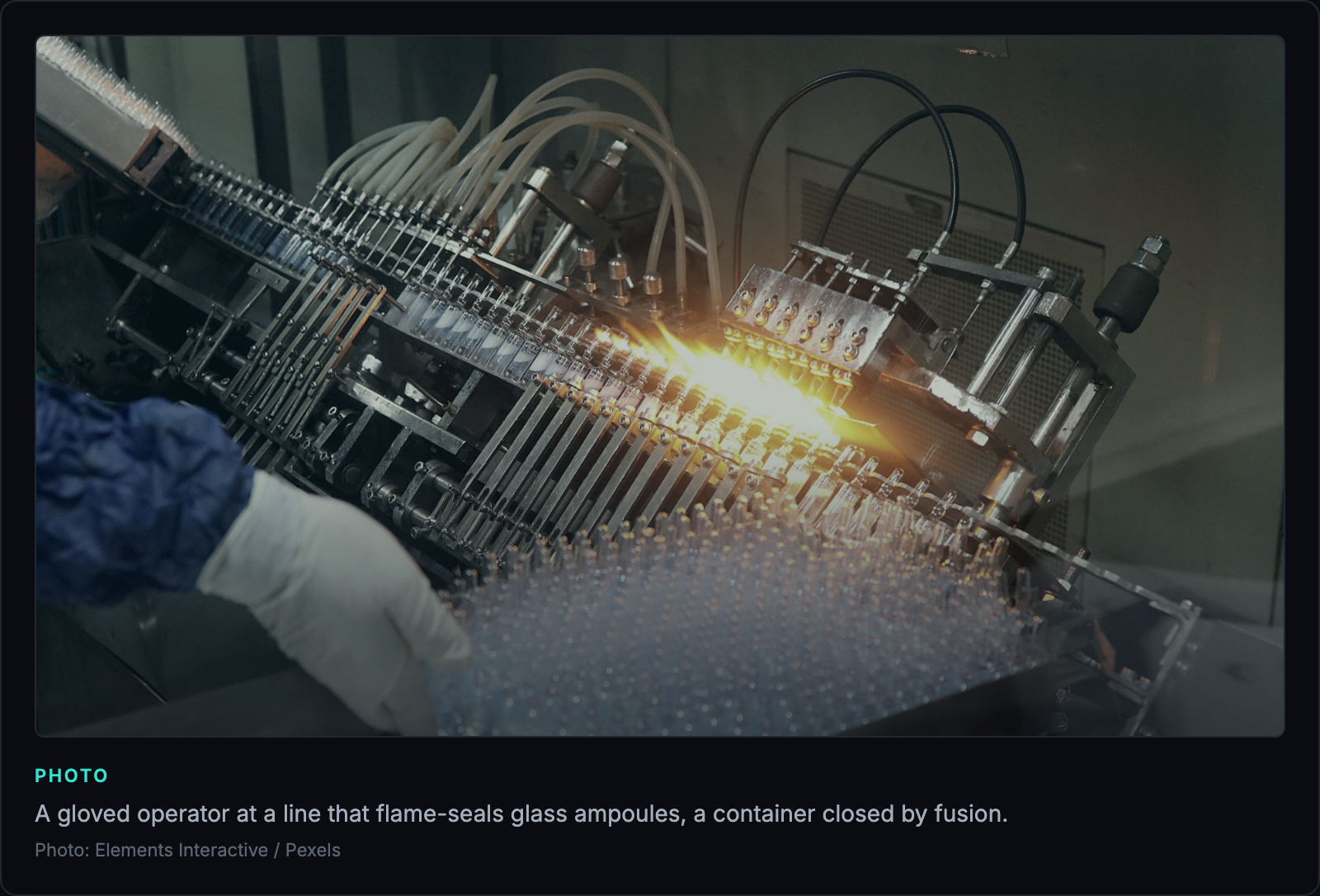
EU GMP Annex 1 (2022) adds four paragraphs that a US sterile facility exporting to Europe has to meet. Paragraph 8.22 calls for 100% testing of fusion-closed units of 100 mL or less, paragraph 8.23 calls for a justified sampling plan for other closures, paragraph 8.24 requires vacuum-sealed containers to be tested for maintenance of vacuum before release and during shelf life, and paragraph 8.25 asks the validation to consider transport stresses such as decompression and extreme temperatures. Our EU GMP Annex 1 guide maps the rest of the annex to what FDA cites.
How does CCIT fit the product life cycle?
CCIT runs at three stages that USP <1207.1> names: package development and validation, product manufacturing, and commercial shelf-life stability. The method your team validates at the first stage often has to work at the later two, so pick it with all three in mind.
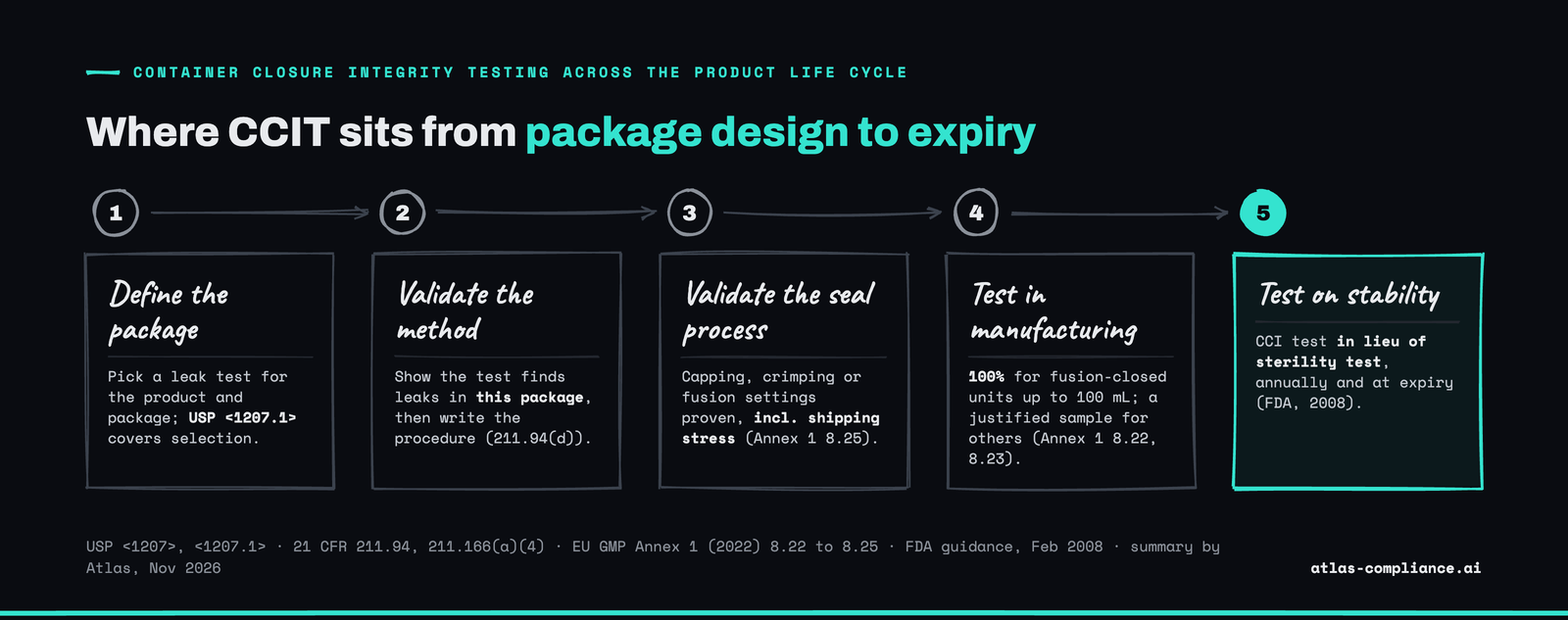
- Define the package. Record the container, stopper and seal specifications, then choose a leak test that suits the product, the package and the leak size that would put the product at risk.
- Validate the method. Show that the test detects leaks in this package and this product, then write the procedure that 211.94(d) requires.
- Validate the sealing process. Prove the capping, crimping or fusion settings, and include the worst-case components and the shipping conditions the product will see.
- Test in manufacturing. Run 100% testing where Annex 1 requires it, and a justified sample elsewhere.
- Test on stability. Run the CCI test on stability samples in place of the sterility test, annually and at expiry, in the marketed container closure system.
A change to the stopper supplier, the vial, the crimp settings or the shipping route sends you back to step 2 or 3. If the stability samples no longer match the commercial package, your program falls outside 211.166(a)(4), which requires testing in the same container-closure system as marketed.
What does FDA cite when containers and closures fall short?
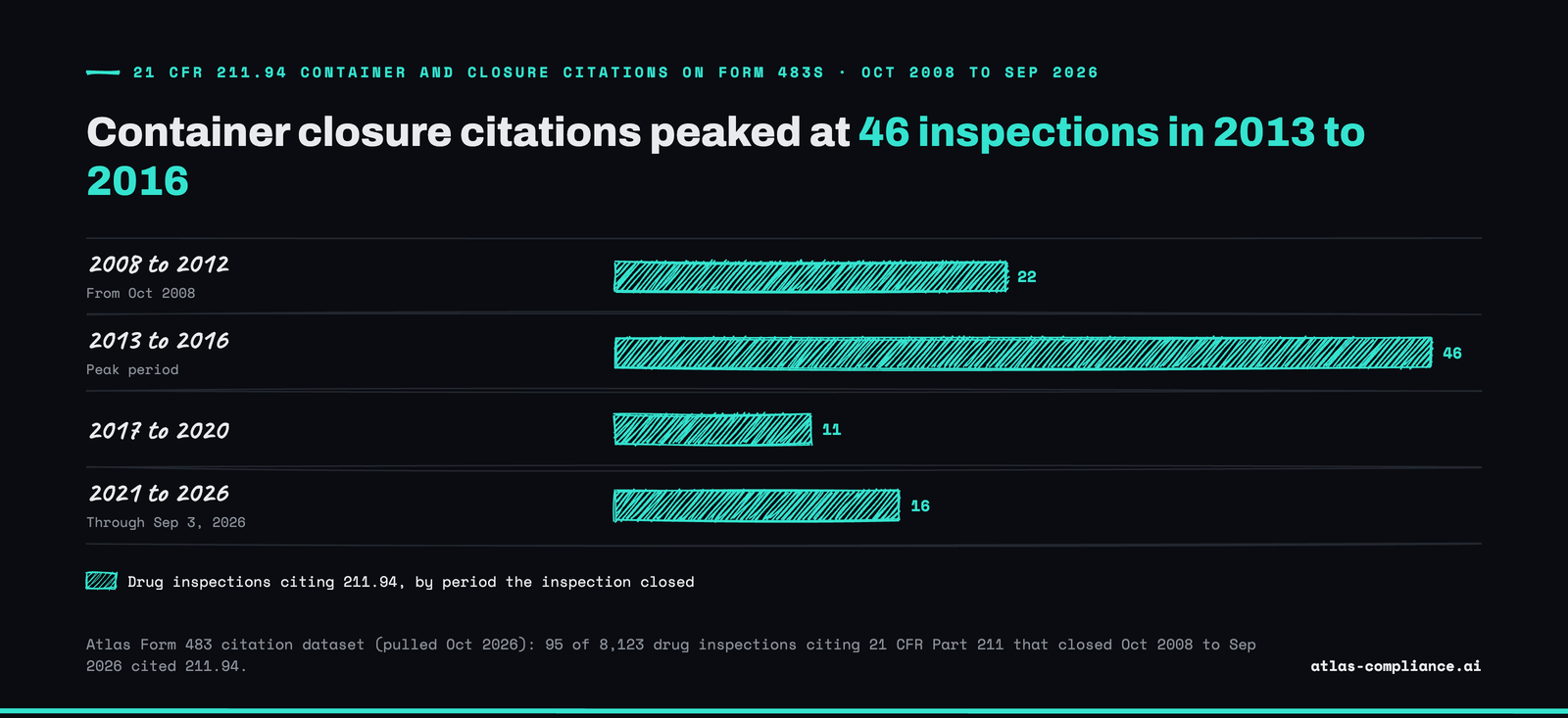
FDA cites container and closure failures under 21 CFR 211.94, with four standard headings, one per paragraph. In the Atlas dataset, 95 drug inspections carried at least one 211.94 citation, out of 8,123 Part 211 drug inspections that closed between October 2008 and September 2026.
| 211.94 paragraph | Standard heading on the Form 483 | Citations |
|---|---|---|
| 211.94(c) | Containers and closures clean, sterilized, pyrogen-free | 44 |
| 211.94(b) | Protection from external factors | 35 |
| 211.94(a) | Reactive, additive or absorptive containers and closures | 17 |
| 211.94(d) | Written procedures to remove pyrogens | 4 |
The 35 citations under 211.94(b) are the ones closest to container closure integrity: each one recorded that the container closure system did not give adequate protection against foreseeable factors that can cause deterioration or contamination. The 2013 to 2016 period accounts for 46 of the 95 inspections, and 25 of the 95 were at firms with pharmacy, compounding, Rx, apothecary, drug store or outsourcing in the legal name. Of the 95, 86 were at US facilities.
A second citation tracks the stability side. 21 CFR 211.166(a)(4), for a stability program that does not test the product in its marketed container-closure system, appeared at 42 drug inspections in the same period. Seven of them closed in 2025, more than in any other year.
Recent examples in the FDA Form 483 database:
| Facility | Inspection closed | 211.94 paragraph | Other Part 211 citations on the form | Classification |
|---|---|---|---|---|
| Coupler LLC, West Chester, US | Mar 2, 2026 | 211.94(b) | 211.100(a), 211.170(b), 211.67(b) | VAI |
| Denison Pharmaceuticals, Lincoln, US | Feb 9, 2023 | 211.94(b) | 211.113(a), 211.192 and six more | OAI |
| Nang Kuang Pharmaceutical, Tainan, Taiwan | Apr 2, 2024 | 211.94(a) | 211.160(b), 211.192 and three more | OAI |
| ALK-Abello, Plainville, US | Oct 21, 2022 | 211.94(c) | 211.113(b), 211.42(c)(10)(iv) and eight more | OAI |
| Empower Clinic Services, Houston, US | Aug 5, 2022 | 211.94(c) | 211.113(b), 211.192 and nine more | OAI |
| US Specialty Formulations, Allentown, US | Apr 26, 2022 | 211.94(b) | 211.113(b), 211.42(c)(10)(iv) and eleven more | OAI |
The Coupler site page shows 8 FDA inspections on record, 6 of them ending in a Form 483. The US Specialty Formulations site page also shows 8 inspections, with 7 Form 483s, the latest closing January 14, 2026.
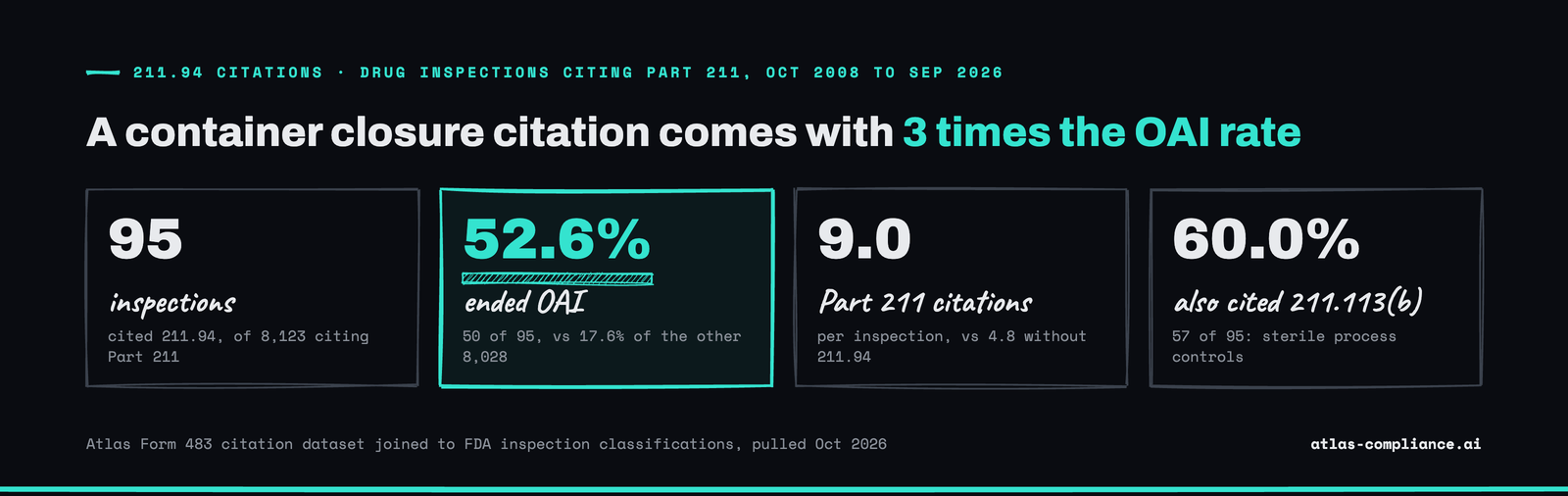
FDA investigators seldom cite 211.94 on its own: 57 of the 95 inspections (60.0%) also cited 211.113(b) for sterile process controls, 41 cited 211.192 investigations, 39 cited environmental monitoring under 211.42(c)(10)(iv), and 27 cited 211.167(a) sterility and pyrogen testing. The inspections averaged 9.0 distinct Part 211 citations, against 4.8 for the rest. The NAI, VAI and OAI classifications explain what an OAI outcome sets in motion, and the 21 CFR Part 211 guide shows where 211.94 sits among the other subparts.
The investigators who wrote these forms have full inspection histories in the same database, so a sterile facility can see which Part 211 sections its likely investigator has cited at peer sites before the opening meeting.
 Atlas
See what the FDA knows about your next investigator.
30 minutes with the founder. No pitch deck.
How do you prepare a CCIT program for an FDA inspection?
You prepare a CCIT program for inspection by making sure every claim in the stability protocol and the batch record traces to a validated method, a written procedure and data for the marketed package. Have these five records ready and current:
- The container closure specifications and supplier qualification records for the glass, stoppers and seals.
- The CCI method validation report, showing the method detects leaks in this package and product.
- The sealing process validation, including crimp or fusion settings and worst-case components.
- The stability protocol, showing CCI testing at the intervals the protocol states and in the marketed container-closure system.
- Any CCI failures, with the investigation under 21 CFR 211.192 and its extension to other batches.
Item 4 maps to 211.166(a)(4), and items 2 and 3 support the protection that 211.94(b) requires. Sterility and pyrogen problems with the components themselves land under 211.94(c), the most cited paragraph in the Atlas data.
New container closure and sterile product citations arrive each month, and the digest below sends the ones that matter for sterile operations as FDA publishes them.
AtlasFDA Inspection Intelligence Digest
We track every 483, EIR, and warning letter the moment it happens. Get the signals before they hit the FDA website.
Frequently asked questions
CCIT stands for container closure integrity testing. The term covers any validated leak test that checks whether a sealed pharmaceutical package keeps microorganisms, liquids and gases out. Some firms write CCI testing or package integrity testing, which USP <1207> uses. All three names refer to the same work on sterile product packages such as vials, syringes, cartridges, ampoules and bags.

Written by
Bhavish Agarwal
Founder, Atlas
Bhavish Agarwal is the founder of Atlas and previously worked at Google and Microsoft. He has spent the past several years building regulatory data infrastructure for the pharmaceutical industry.