
Audit trail review is the documented check, made by the person responsible for approving a GMP record, that every creation, change and deletion logged by the computer system behind that record is expected, explained and reflected in the record itself. FDA treats it as part of reviewing the record, in the same way a reviewer reads cross-outs on a paper batch record.
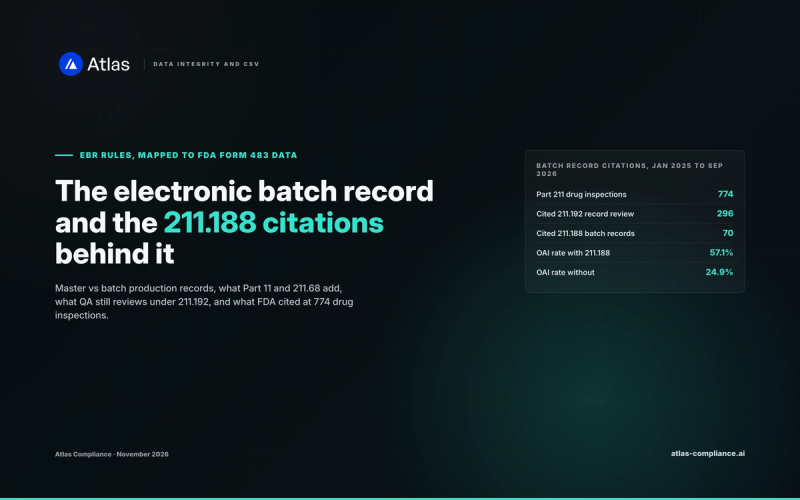
This guide sets out what the regulations and three regulators' guidance documents ask for, a step-by-step procedure and checklist, and what FDA investigators cited: the Atlas Form 483 citation dataset (pulled October 2026) covers 774 drug inspections that cited 21 CFR Part 211 between January 7, 2025 and September 3, 2026.
Key facts:
- 21 CFR 11.10(e) requires secure, computer-generated, time-stamped audit trails that record operator actions creating, modifying or deleting electronic records, kept as long as the records themselves.
- FDA's December 2018 data integrity Q&A says the people who review a CGMP record should review its audit trail at the same time, and at the same frequency the regulations set for the data.
- PIC/S PI 041-1 (July 2021) expects critical audit trails to be reviewed before the data is relied on for a decision such as batch release, and the review to be documented.
- In the Atlas dataset, 132 of 774 Part 211 drug inspections (17.1%) cited 211.68(b) computer controls and 84 (10.9%) cited 211.194 laboratory records.
- Only 5 of the 774 inspections carried FDA citation text that names audit trail requirements; investigators usually cite the predicate rule instead.
What is an audit trail review?
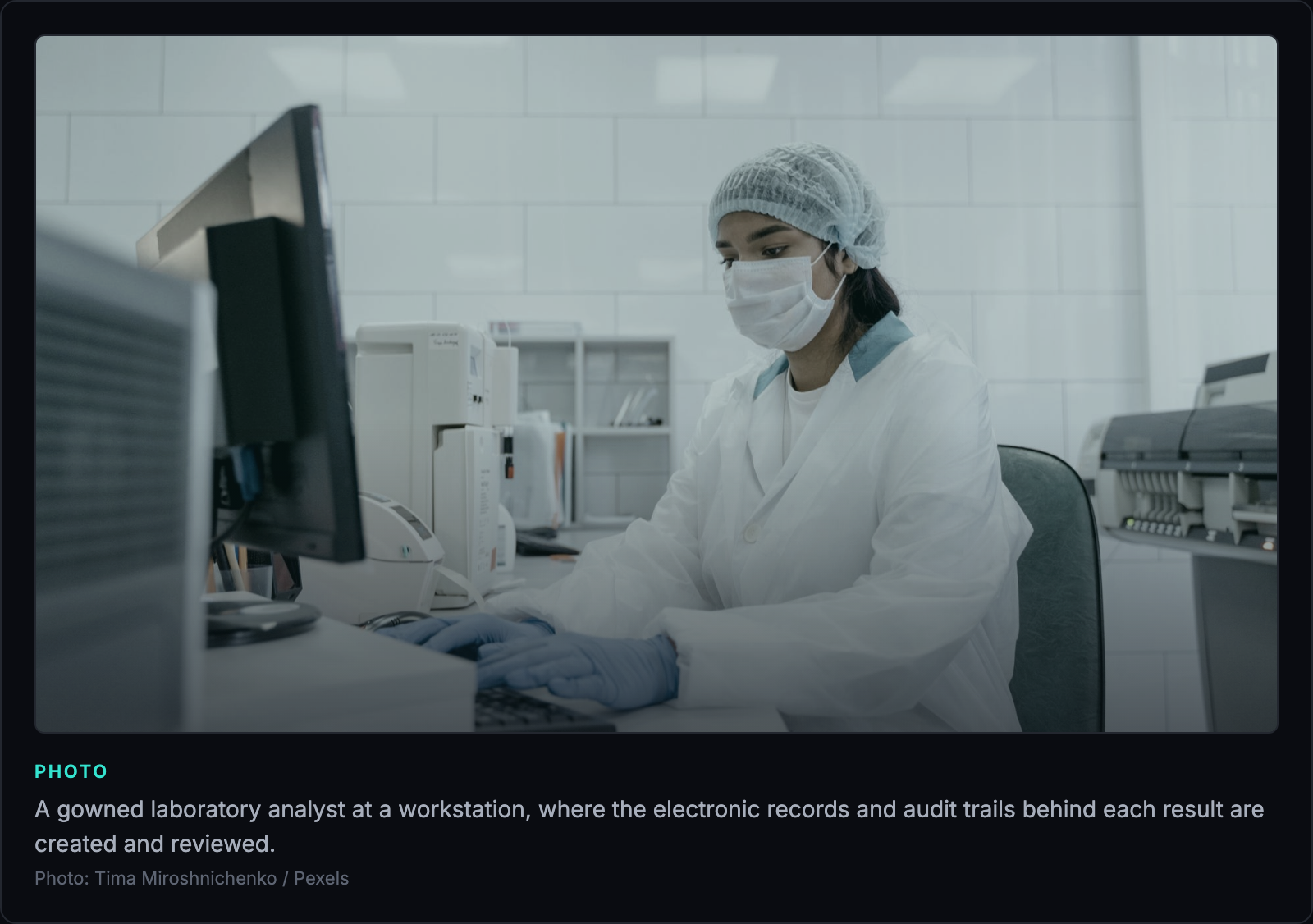
An audit trail review is a check of the system-generated log of who created, changed or deleted data, when, and why, made before the related record is approved. FDA's 2018 Q&A defines an audit trail as a secure, computer-generated, time-stamped electronic record that lets you reconstruct the course of events around creating, modifying or deleting an electronic record.
The guidance says an HPLC run's audit trail should show the user, the run date and time, the integration parameters and any reprocessing with its justification. It separates trails that track data changes from trails that track system actions, such as access attempts or file deletions. A complete review covers both.
Testing that the audit trail works belongs in validation; our guide to OQ audit trail tests for computerized system validation covers that side.
What do Part 11, 211.68 and 211.194 require for audit trails?
Part 11 requires the audit trail itself, 21 CFR 211.68(b) limits record changes in computer systems to authorized people, and 211.194(a) requires complete laboratory data with a second-person review of the original records.
| Regulation | What the text requires | What it means for the review |
|---|---|---|
| 21 CFR 11.10(e) | Secure, computer-generated, time-stamped audit trails of operator entries and actions that create, modify or delete records; changes must not obscure earlier entries; trails kept as long as the records and available to FDA | There is a trail to review, and FDA can ask for it |
| 21 CFR 211.68(b) | Changes to master production and control records or other records only by authorized personnel; input and output checked for accuracy; backups exact, complete and secure | The review confirms only authorized users made changes |
| 21 CFR 211.194(a) | Complete data from all tests; under (a)(8), initials or signature of a second person showing the original records were reviewed for accuracy, completeness and compliance | The second-person review covers the original electronic records, audit trails included |
| 21 CFR 211.192 and 211.22 | Quality unit reviews and approves production and control records before release | Audit trail review happens before batch disposition |
FDA's 2003 Part 11 scope guidance placed audit trails under enforcement discretion, but the predicate rules above still apply, which is why investigators cite them. Our 21 CFR Part 11 guide explains how that discretion works.
Who should review audit trails?
FDA's answer is that the personnel responsible for record review under CGMP should review the audit trails that capture changes to that record's data, as they review the rest of the record. The December 2018 guidance, Data Integrity and Compliance With Drug CGMP: Questions and Answers, compares audit trail review to assessing cross-outs on paper.
The answer cites 211.192: the quality unit reviews and approves all production and control records, audit trails included, while 211.188 lets a person directly supervising or checking a step review it. In practice a peer or supervisor reviews the trail during record review, and the quality unit confirms that review before approval.
PIC/S PI 041-1 agrees: the originating department reviews, and the quality unit verifies where necessary.
How often should audit trails be reviewed?
Audit trail review frequency follows the review frequency the regulations set for the data. FDA's 2018 Q&A gives two examples: 211.188(b) requires review after each significant step in manufacture, and 211.22 requires data review before batch release, so the audit trail review follows the same schedule.
Where the regulations set no frequency, FDA expects one set by risk assessment of data criticality, control mechanisms and product impact; instrument logs and alert records are its examples.
| Data or trail type | Review timing | Basis |
|---|---|---|
| Laboratory results used for release | With the second-person review of each test, before results are approved | 211.194(a)(8), FDA Q&A question 8 |
| Batch production records and EBR entries | After each significant step and before batch release | 211.188(b), 211.22, FDA Q&A question 8 |
| Critical trails in any GMP system | Before the data is relied on for a critical decision | PIC/S PI 041-1, section 9.6 |
| Non-critical trails, system logs, instrument alerts | At a predefined interval during periodic system review | PIC/S PI 041-1, FDA Q&A footnote 13 |
What do MHRA and PIC/S expect from audit trail review?
MHRA and PIC/S both expect a risk-based audit trail review built into routine data review, written into an SOP and documented. MHRA's 'GXP' Data Integrity Guidance and Definitions (Revision 1, March 2018) says routine data review should include a documented audit trail review where a risk assessment calls for it.
MHRA section 6.13 adds that required audit trails should be switched on and locked against users, that review can be limited to GXP-relevant entries, and that trails may be reviewed through exception reporting, a validated search that flags predetermined abnormal data or actions. Reviewers need the knowledge and system access to read trails, raw data and metadata.
PIC/S PI 041-1, Good Practices for Data Management and Integrity in Regulated GMP/GDP Environments (July 2021), section 9.6, expects an SOP on how to review audit trails and what to look for, a documented record of each review, investigation of significant variations, and quality unit audit trail checks in self-inspection, both random and targeted.
How do you perform an audit trail review? Seven steps
An audit trail review runs in seven steps, and the reviewer compares the trail with the record before approving it.
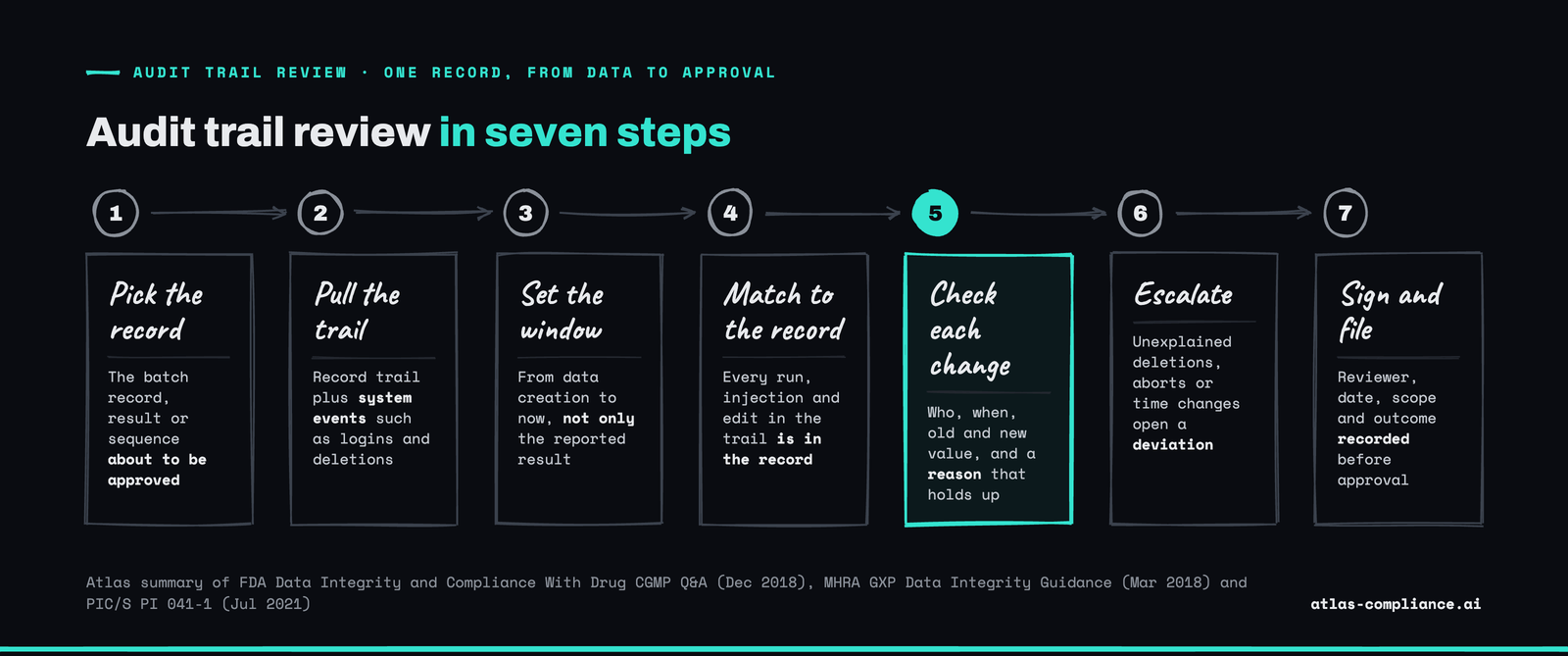
- Pick the record that is about to be approved: a batch record, a test result, or a chromatography sequence.
- Pull the record-level audit trail and the system-level events for the same period, such as logins, file renames and deletions.
- Set the review window from data creation to the review date, so changes made after the reported result are included.
- Match the trail to the record. Every run, injection and edit in the trail should appear in the record or be explained.
- Check each change for the user, the date and time, the old and new values, and a stated reason that fits the event.
- Escalate anything unexplained, such as a deleted result or an aborted run with no justification, into a deviation or investigation.
- Record the reviewer, the date, the scope and the outcome before the record is approved, and file the evidence with the record.
In a laboratory, steps 4 and 5 carry the weight: FDA's Q&A says aborted or incomplete injections should be investigated and justified, and that each reprocessed chromatography result must be retained for review.
Audit trail review checklist: what should the reviewer look for?
An audit trail review checklist should cover data changes, run events and system events, the three places FDA, MHRA and PIC/S point reviewers to. The first two show what happened to the result; the third shows how a change was possible.
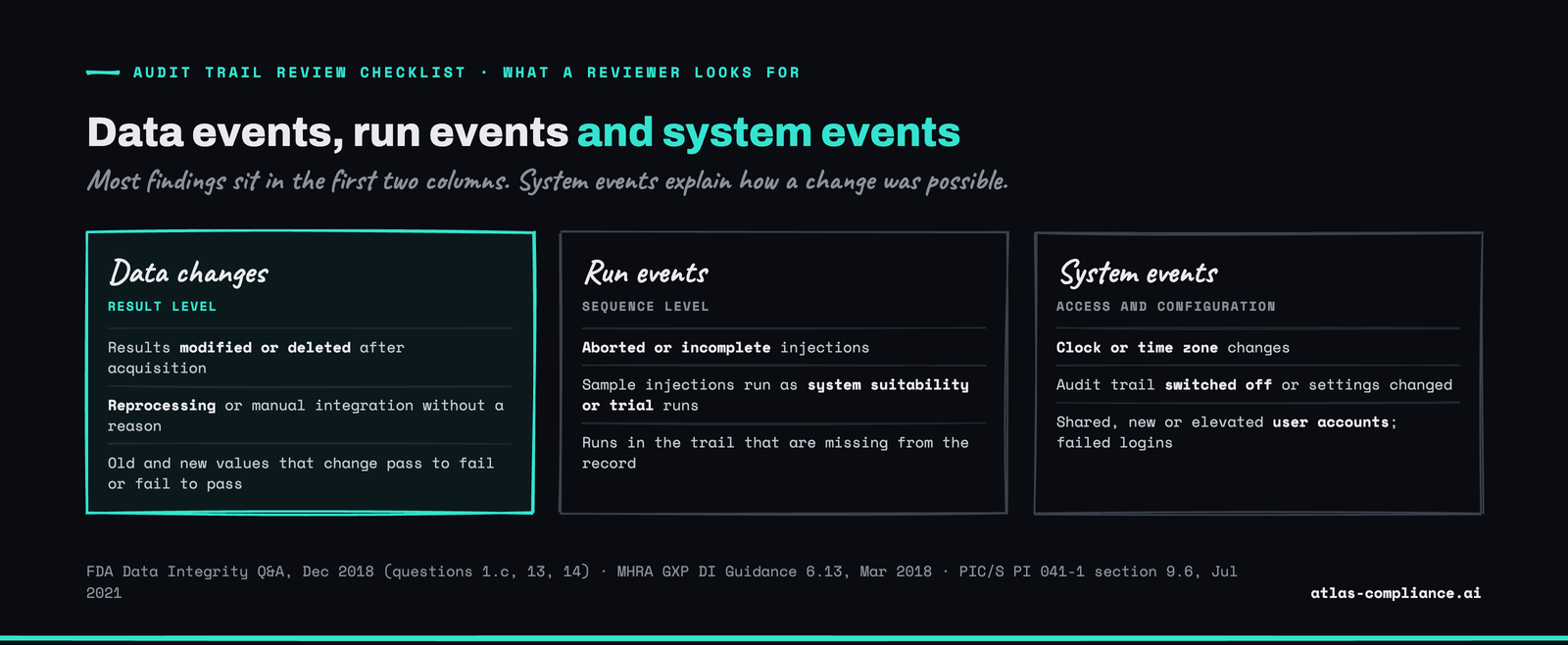
- Deleted results: any result, file or injection deleted after acquisition, and whether a reason and approval exist.
- Reprocessing: integration or calculation changes, how many times data was reprocessed, and whether the reported result is the first or a later version.
- Changed values: old and new values that move a result from fail to pass, or close to a limit.
- Aborted or incomplete runs: injections stopped before completion, and whether each one is investigated as FDA's Q&A expects.
- Trial or test injections: actual samples run as system suitability, test, prep or equilibration injections, which FDA's Q&A question 13 says it has cited in warning letters.
- Time changes: system clock or time zone changes, and entries whose timestamps do not match the sequence of work.
- Audit trail status: any point where the trail was disabled or its configuration changed.
- User access: shared or generic accounts, new or elevated privileges, and repeated failed logins near the time of a change.
Keep one checklist per system, written by the department that runs it.
What should an audit trail review SOP include?
An audit trail review SOP should name the systems in scope, the trails to review, the reviewer, the timing, the search method and what to do with findings, at the level of detail PIC/S PI 041-1 asks for.
- A system inventory with criticality and review frequency per trail.
- Roles in the originating department and the quality unit.
- The method: full review or validated exception reports, with their filters.
- A checklist per system, like the one above.
- Where review evidence is kept.
- When a finding becomes a deviation, and who is told.
- Reviewer training on real examples of suspicious entries.
The ALCOA principles give the test each finding is judged against: whether the data stays attributable, contemporaneous, original and accurate.
How often does FDA cite audit trail failures on Form 483s?
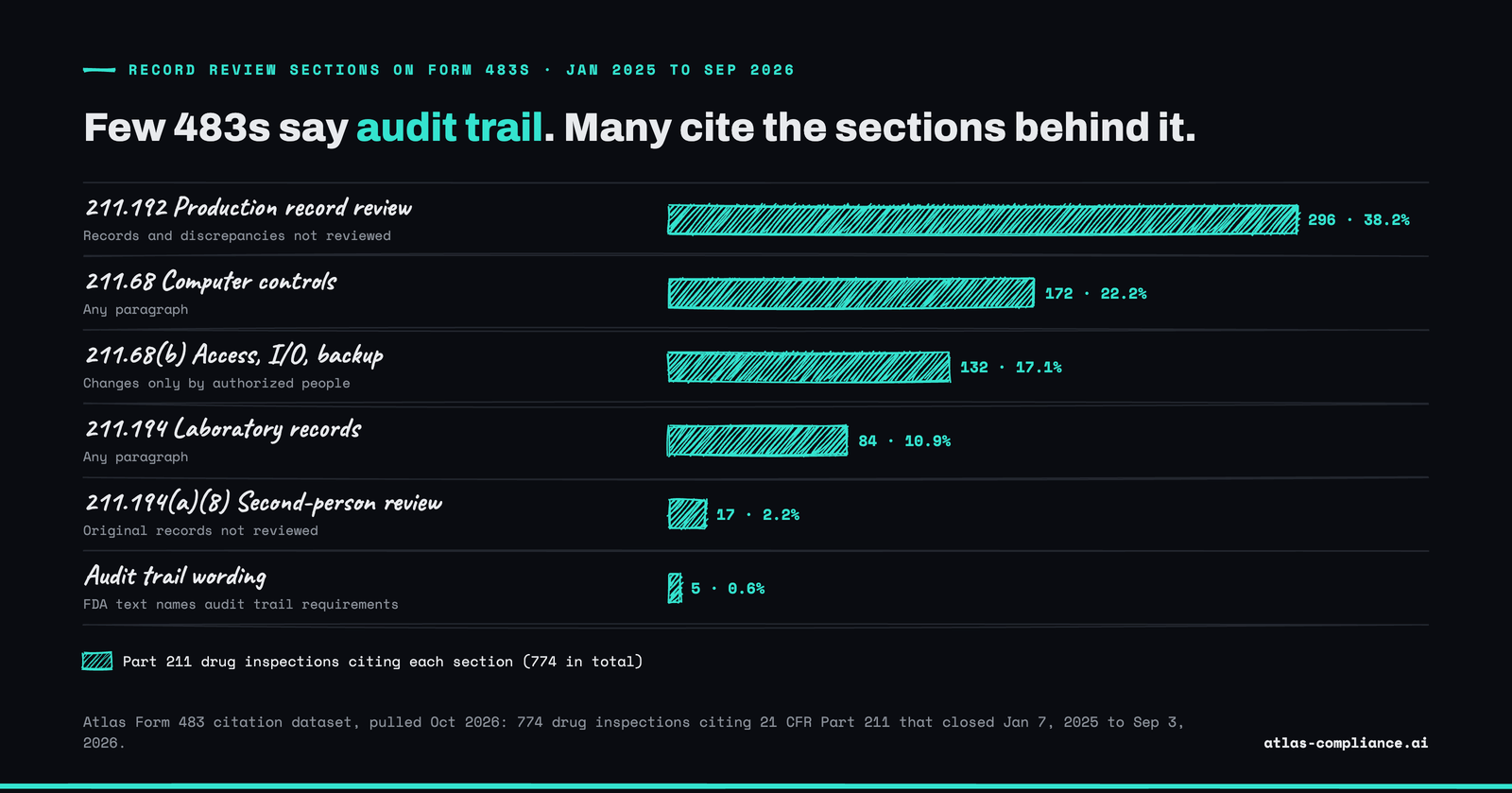
FDA rarely writes the words "audit trail" into the citation text it publishes, but it often cites the sections behind them. In the Atlas Form 483 citation dataset (pulled October 2026), 132 of 774 drug inspections citing Part 211 (17.1%) cited 211.68(b), and 84 (10.9%) cited 211.194, between January 7, 2025 and September 3, 2026.
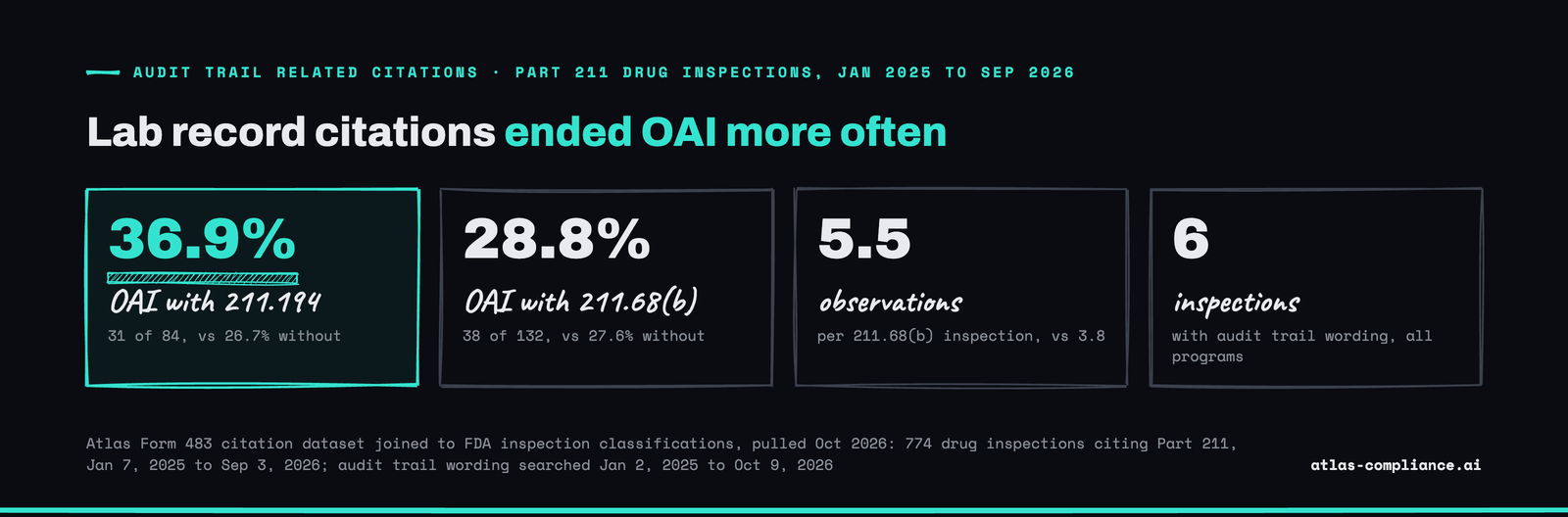
The standard text that names audit trails says electronic records "do not meet audit trail requirements to ensure that they are trustworthy, reliable and generally equivalent to paper records." Across all FDA program areas from January 2, 2025 to October 9, 2026, it appeared in 7 observations at 6 inspections, attached to 211.68(b) twice and once each to 211.194(a), 211.160(a), 211.22(d), 211.166(a) and Part 11. Four ended Voluntary Action Indicated (VAI), one No Action Indicated and one Official Action Indicated (OAI): APIPHARMA in Croatia, March 2025, with ten observations.
The wider sections show how outcomes shift. Of the 84 inspections citing 211.194, 31 (36.9%) ended OAI, against 26.7% of Part 211 drug inspections without it. For 211.68(b) the gap was small: 28.8% OAI (38 of 132) against 27.6%. Inspections citing 211.68(b) averaged 5.5 observations against 3.8 for the rest. Second-person review under 211.194(a)(8), the line that covers reviewing original laboratory records, appeared at 17 inspections (2.2%). Production record review under 211.192 led all record sections at 296 inspections (38.2%).
The table lists recent forms from the FDA Form 483s directory that cited audit trail wording or the review sections, with the final classification.
| Form 483 | Issued | Observations | Audit trail related citation | Classification |
|---|---|---|---|---|
| Eurofins SF Analytical Laboratories, Horsham, US | Jun 3, 2026 | 5 | 211.68(b) computer control; 211.194(a)(8) second person sign off | OAI |
| Gasco Industrial, Gurabo, US | Feb 27, 2026 | 13 | 211.194(a)(8) person reviewing lab records not identified | OAI |
| PTI Georgia, Royston, US | Jan 16, 2026 | 9 | Audit trail wording under 211.194(a) and 211.160(a) | VAI |
| RNA Corporation, Blue Island, US | Dec 19, 2025 | 1 | Audit trail wording under 211.22(d) | VAI |
| Laboratorios Jaloma, Guadalajara, Mexico | Dec 19, 2025 | 4 | 211.68(b) computer control; 211.194(a) complete test data | OAI |
Eurofins SF Analytical, a contract testing laboratory, drew both the access control and the second-person review citation on a five-observation form that ended OAI, and RNA Corporation's only observation was the audit trail one. Investigators differ in how far they read into electronic data, so check what your assigned investigator has cited at comparable facilities before the inspection opens.
 Atlas
See what the FDA knows about your next investigator.
30 minutes with the founder. No pitch deck.
Where should a team start?
Start with the systems that feed batch release: chromatography data systems, LIMS and electronic batch records. Confirm each trail is on and locked, write a checklist per system, and move the review in front of approval. Our analysis of data integrity Form 483 citations shows which record sections FDA cites most, and new observations under 211.68 and 211.194 arrive in the digest below as FDA posts them.
AtlasFDA Inspection Intelligence Digest
We track every 483, EIR, and warning letter the moment it happens. Get the signals before they hit the FDA website.
Frequently asked questions
21 CFR 11.10(e) requires the audit trail to exist, be retained and be available for FDA review; it does not set a review schedule. The duty to review comes from the predicate rules, such as 211.192, 211.188(b) and 211.194(a)(8), which require production and laboratory records to be reviewed. FDA's 2018 Q&A says audit trails are part of those records.

Written by
Bhavish Agarwal
Founder, Atlas
Bhavish Agarwal is the founder of Atlas and previously worked at Google and Microsoft. He has spent the past several years building regulatory data infrastructure for the pharmaceutical industry.