
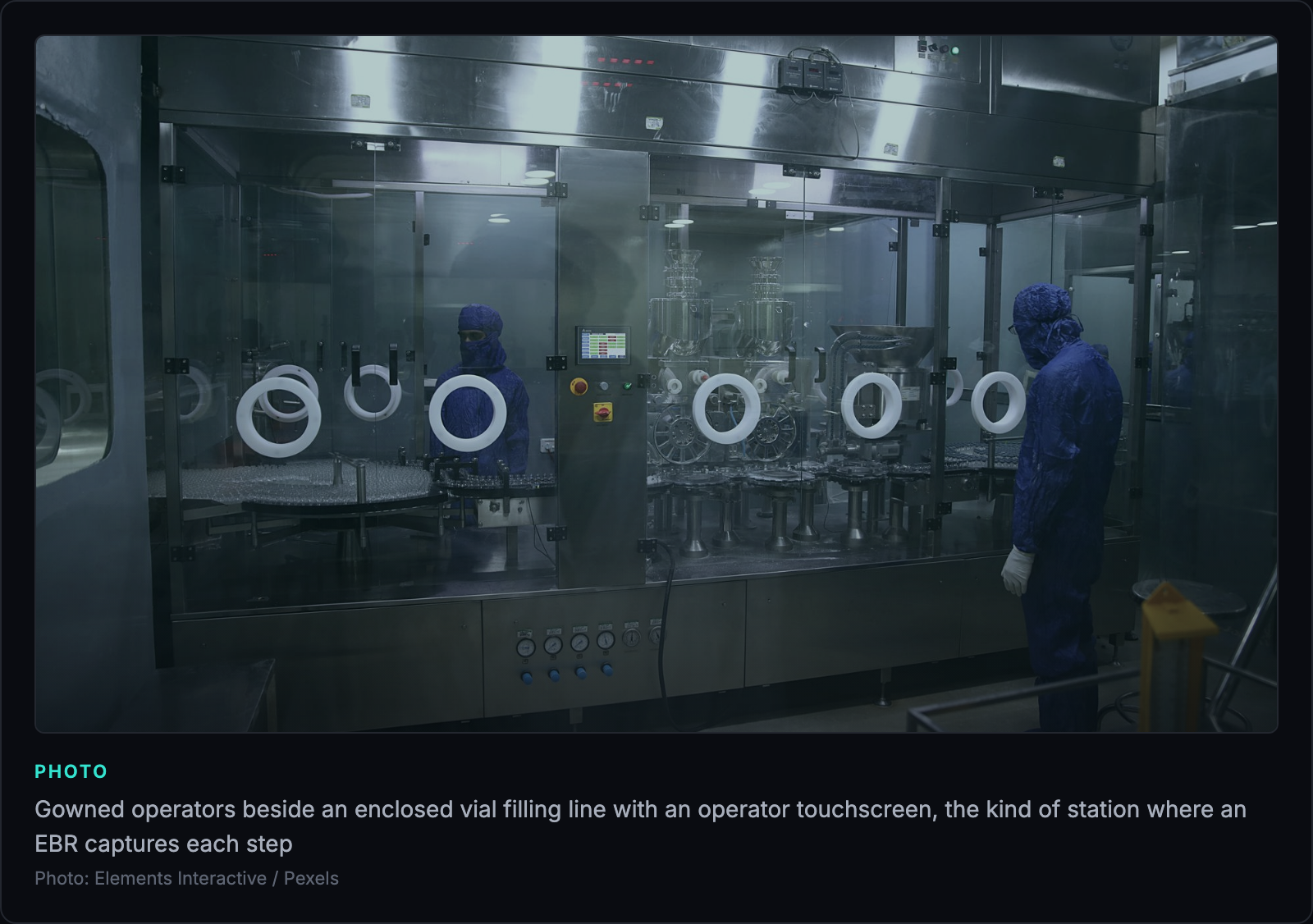
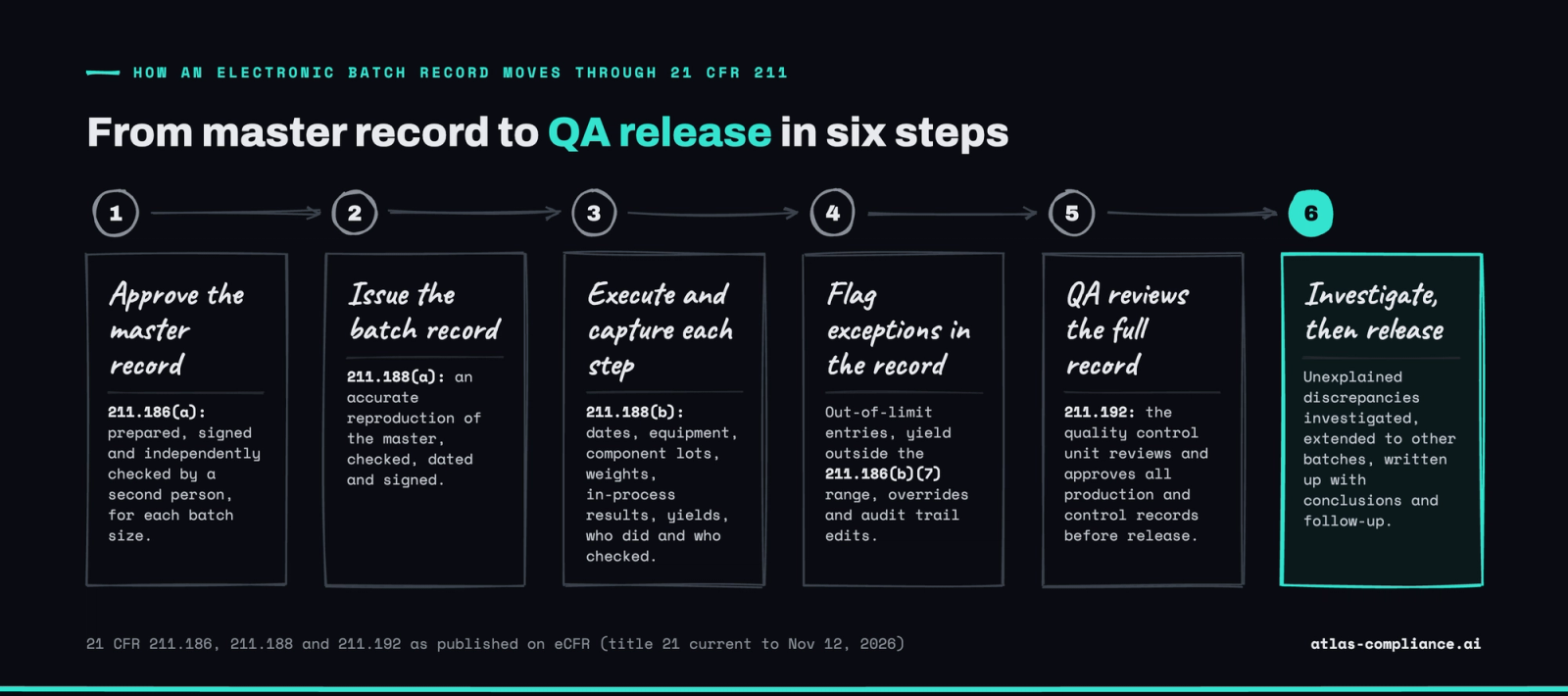
An electronic batch record (EBR) is a computerized batch production and control record that documents how one batch of drug product was made, checked and released, in place of the paper record 21 CFR 211.188 requires for each batch. An EBR system issues the record from an approved master, captures each step as operators perform it, and routes the finished record to the quality unit.
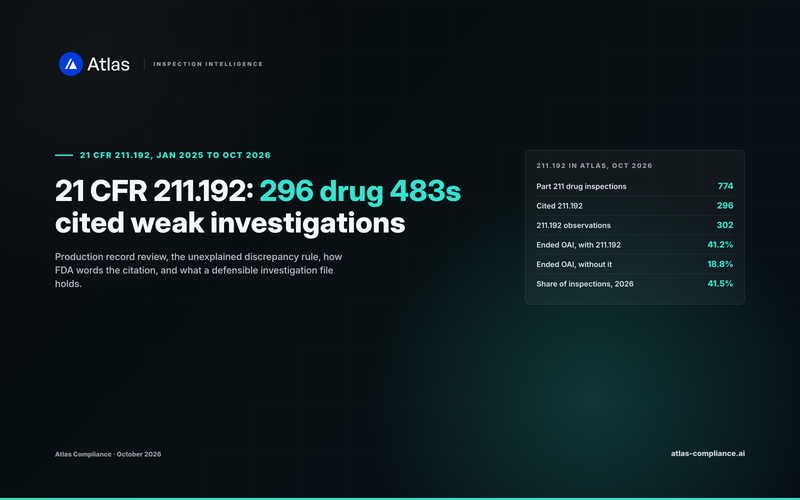
This guide adds data the EBR pages leave out: how often FDA investigators cited the batch record sections of Part 211 at 774 drug inspections that closed between January 2, 2025 and October 9, 2026. The counts come from the FDA inspection citation records Atlas tracks, pulled October 21, 2026 (November 2026 edition).
Key facts:
- 21 CFR 211.188 requires a batch production and control record for each batch, starting with an accurate reproduction of the approved master production record.
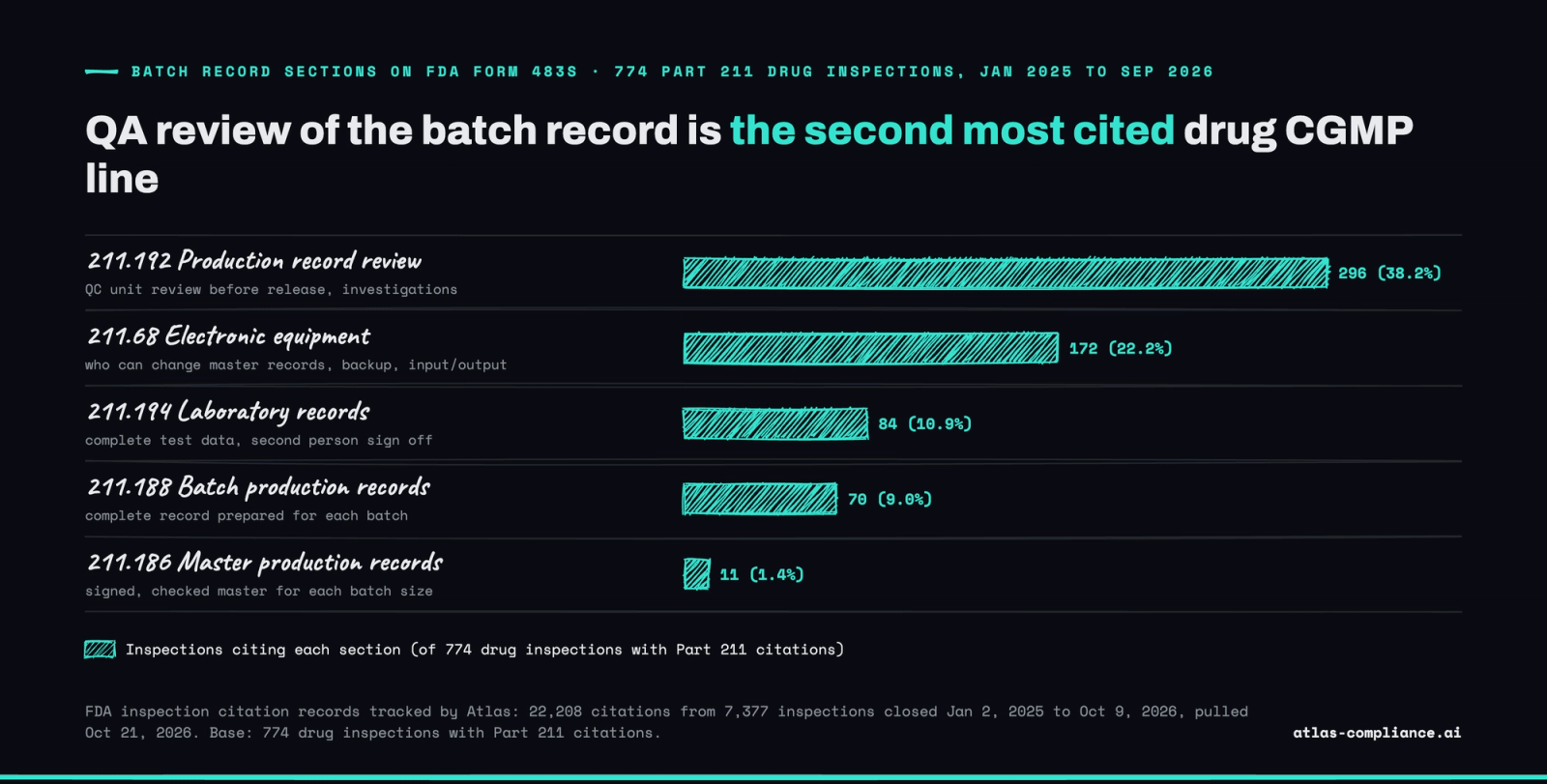
- FDA cited 21 CFR 211.192, the quality unit's review of production records, at 296 of 774 Part 211 drug inspections (38.2%), the second most cited Part 211 section.
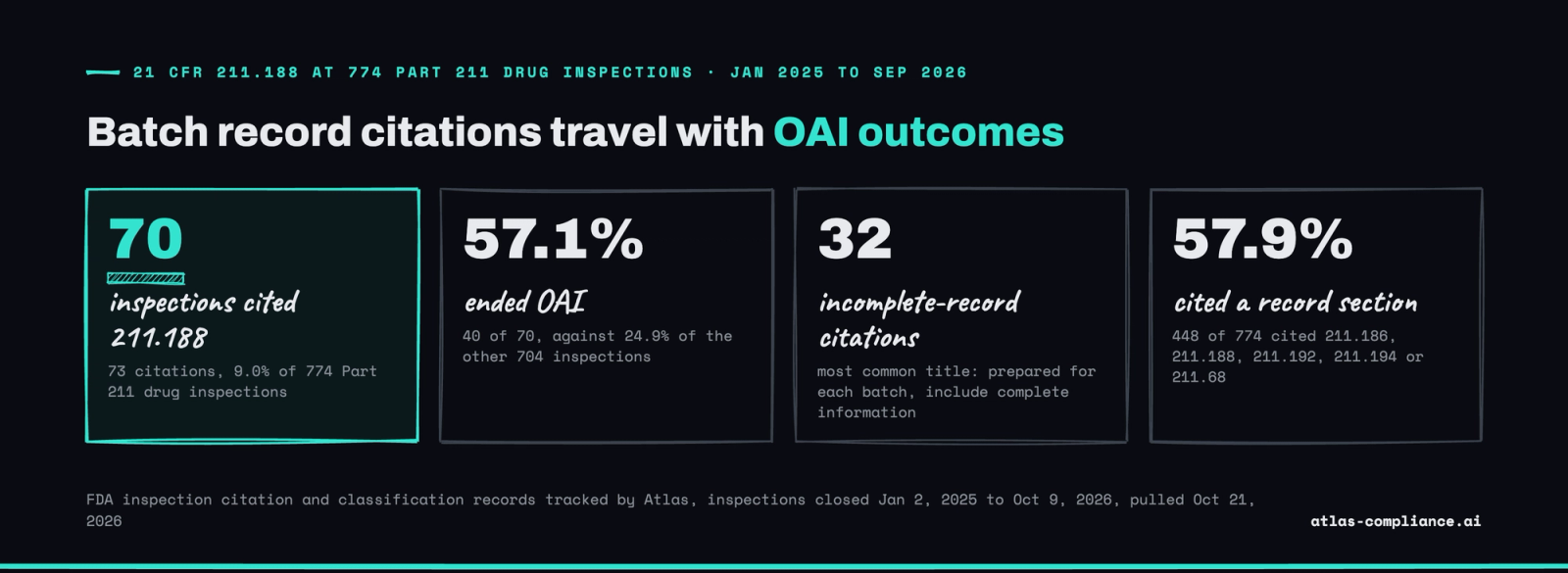
- FDA cited 211.188 at 70 of the 774 inspections (9.0%), and 40 of those 70 inspections (57.1%) ended Official Action Indicated (OAI), against 24.9% of the other 704.
- 448 of the 774 inspections (57.9%) cited at least one record section: 211.186, 211.188, 211.192, 211.194 or 211.68.
- FDA's December 2018 data integrity guidance says electronic signatures with appropriate controls can stand in for the handwritten signature 211.186(a) requires on master records.
What is the difference between a master production record and a batch production record?
A master production record is the approved template for making a drug product, and a batch production record is the filled-in copy for one batch. 21 CFR 211.186 governs the master record and 21 CFR 211.188 governs the batch record. An EBR holds both: the master as a locked, versioned recipe, and each batch record as an executed instance of it.
| Feature | Master production and control record (211.186) | Batch production and control record (211.188) |
|---|---|---|
| Scope | One per drug product and per batch size | One per batch produced |
| Who signs | Prepared and signed by one person, independently checked and signed by a second | Reproduction checked, dated and signed; each significant step signed by the person who did it and the person who checked it |
| Content | Formula, component list and weights, theoretical yield with limits, labeling specimens, full instructions and specifications | Dates, equipment and lines, component lots, weights, in-process and lab results, actual yield, labeling records, sampling, investigations |
| When written | Before the product goes into production | During the batch, at the time each step happens |
| Regulatory hook | 211.186(b)(7) yield limits trigger investigation under 211.192 | 211.188(b)(12) attaches any 211.192 investigation to the batch |
The two records connect at 211.188(a): each batch record starts as an accurate reproduction of the master, checked for accuracy. In an EBR the software generates that reproduction, so your check moves from proofreading a photocopy to proving the system issued the right master version. FDA's 2018 data integrity guidance treats creation of an electronic master record as an intended use that validation must cover.
Electronic batch record vs paper: what changes?
An electronic batch record changes how a facility captures and checks batch evidence, and leaves the CGMP content unchanged. 211.188(b) lists the same thirteen items whether operators write in ink or type at a terminal.
| Control | Paper batch record | Electronic batch record |
|---|---|---|
| Signature | Handwritten initials and date beside each entry | Unique electronic signature showing printed name, date and time, and meaning (11.50, 11.100(a)) |
| Corrections | Single line through the entry, initialed, dated, reason given | Secure, time-stamped audit trail that keeps the prior value (11.10(e)) |
| Step order | Operator follows the page sequence | System checks enforce permitted sequencing of steps (11.10(f)) |
| Out-of-limit values | Operator compares the reading with the printed range | Entry checked against master limits and flagged or blocked |
| Second-person check | A second person co-signs critical steps | Automated equipment can satisfy the check under 211.68(c) if one person verifies the step |
| Access | Controlled issuance of numbered forms | Access limited to authorized individuals (11.10(d)); master changes only by authorized personnel (211.68(b)) |
| Retention | Paper archive, at least 1 year after batch expiration (211.180(a)) | Same period, with records retrievable and readable for the whole period (11.10(c)) |
| QA review | Page-by-page reading of every entry | Full record, with exceptions and audit trail entries presented to the reviewer |
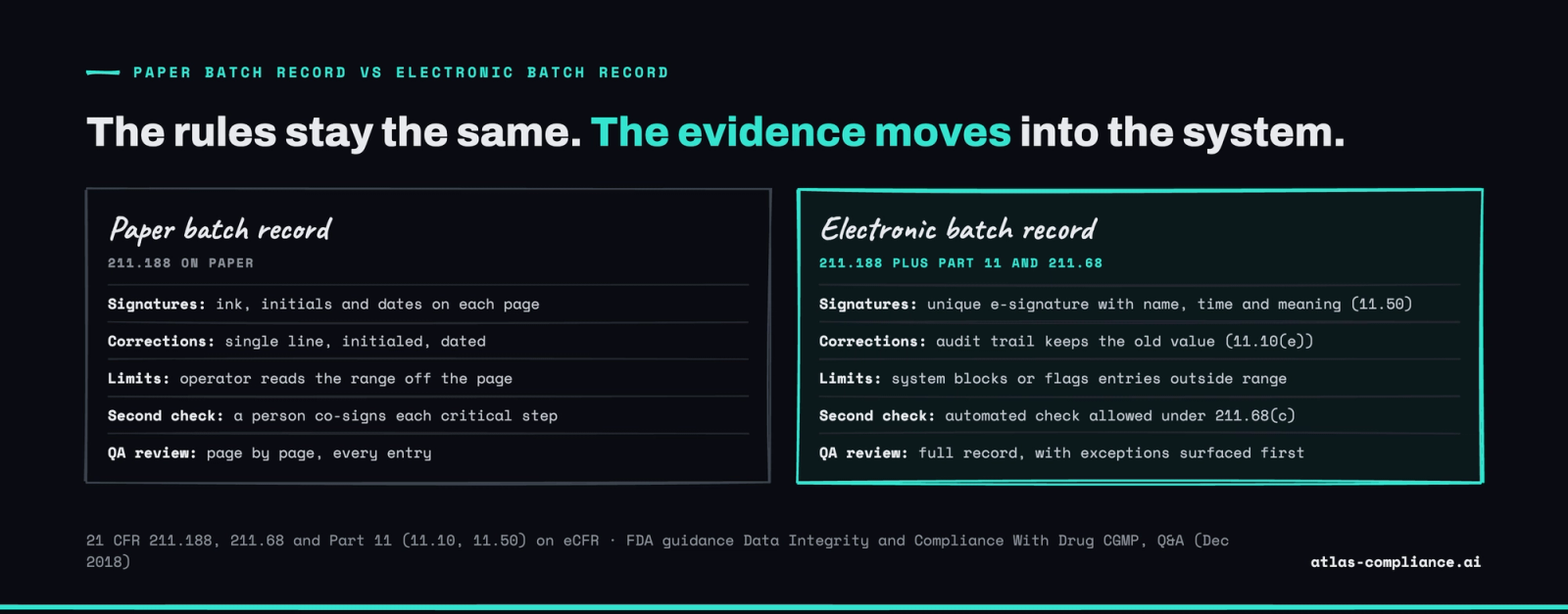
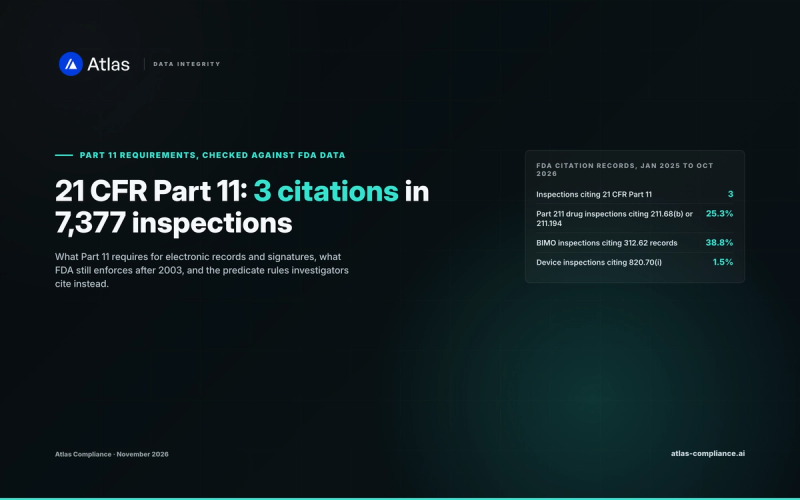
No FDA regulation requires a facility to use an EBR. 21 CFR 11.2(a) lets you use electronic records in place of paper "in whole or in part", provided you meet Part 11. A facility can run a hybrid record, for example weighing on an electronic system and line clearance on paper, and each part has to meet the rules for its own format.
What do Part 11 and 21 CFR 211.68 require of an EBR?
Part 11 and 21 CFR 211.68 require an EBR system to be validated, to limit access to authorized people, to keep a secure audit trail, to link signatures to records, and to keep backup data exact and complete. Part 11 sets the criteria under which FDA treats electronic records and signatures as equivalent to paper, and 211.68 sets the drug CGMP rules for computers used in production.
For a closed system, 21 CFR 11.10 lists the controls an EBR has to carry:
- Validation for accuracy, reliability, consistent intended performance and the ability to discern invalid or altered records (11.10(a)).
- Accurate and complete copies in human readable and electronic form for FDA inspection (11.10(b)).
- Access limited to authorized individuals, with authority checks on who can sign, alter a record or perform an operation (11.10(d) and (g)).
- Computer-generated, time-stamped audit trails of entries and changes that do not obscure earlier values (11.10(e)).
- Operational checks that enforce the permitted sequence of steps (11.10(f)).
- Signatures linked to their records so no one can excise or copy them by ordinary means (11.70).
21 CFR 211.68(b) adds three drug-specific duties: only authorized personnel may change master production and control records, input to and output from the system must be checked for accuracy, and backup data must stay exact, complete and secure from alteration or loss. Paragraph (c) is the one most EBR projects use. It lets automated equipment stand in for the second-person check that 211.188(b)(11) would otherwise require, provided one person checks that the equipment performed the step.
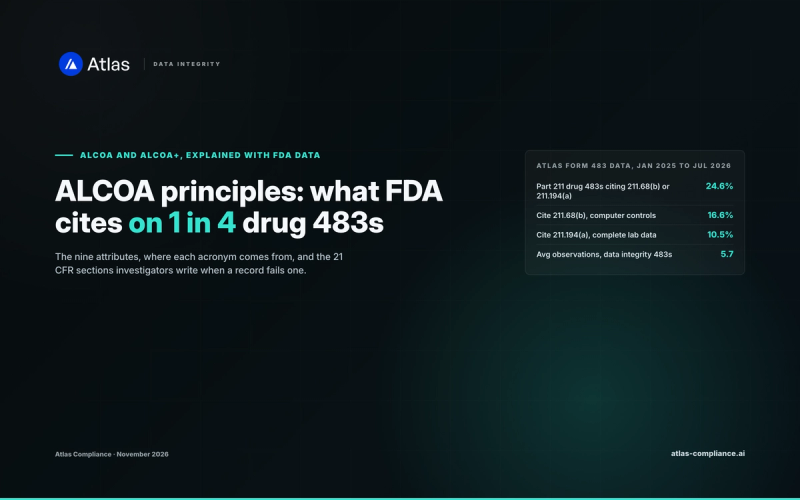
Signatures need one extra step. 211.186(a) asks for a "full signature, handwritten" on the master record. FDA's December 2018 guidance, Data Integrity and Compliance With Drug CGMP, Questions and Answers, states that an electronic signature with appropriate controls fulfills that requirement. Under 11.100(c), your firm must also certify to FDA that its electronic signatures are the legally binding equivalent of handwritten ones. Our guide to 21 CFR Part 11 covers the full rule, and the ALCOA principles explain the attributable, contemporaneous and original record standards an audit trail has to support.
Does review by exception satisfy 21 CFR 211.192?
Review by exception satisfies 21 CFR 211.192 only when the quality unit can show it reviewed and approved the complete batch record before release. 211.192 says all drug product production and control records "shall be reviewed and approved by the quality control unit." Review by exception changes how your reviewer reads the record. The scope of the review stays the same.
Review by exception is an industry practice that no FDA regulation names. The EBR checks routine entries against master limits as operators make them and shows the reviewer the exceptions: out-of-limit values, deviations, overrides, late entries and audit trail changes. If validation never tested whether a yield outside the 211.186(b)(7) limits gets flagged, your reviewer cannot rely on the absence of a flag.
FDA's 2018 data integrity guidance ties audit trail review to the same points. Its answer on audit trail frequency says 211.188(b) requires review after each significant step and 211.22 requires data review before batch release, and that your audit trail review should follow the same frequency. A reviewer approving an EBR therefore needs, at minimum:
- Every exception the system raised, with its disposition.
- The audit trail entries for critical data in that batch, with a reason for each change.
- Any investigation under 211.192, attached to the batch as 211.188(b)(12) requires, including whether it extended to other batches.
- Confirmation that the batch ran on the approved master version and validated system release.
Our post on 21 CFR 211.192 covers the investigation file.
How do you validate an electronic batch record system?
You validate an electronic batch record system by testing it against its intended use: each master recipe it issues, each calculation it performs, each limit it enforces and each signature and audit trail control it carries. FDA's 2018 guidance uses this example: qualifying the manufacturing execution system platform does not show that a given master record contains the correct calculations, so the workflow itself needs validation.
A sequence that covers what 211.68 and Part 11 ask for:
- Write user requirements that map to each 211.188(b) item and each Part 11 control you rely on.
- Qualify the platform and its infrastructure, then validate each master recipe as a configured workflow.
- Test calculations, yield limits and unit conversions with values at, inside and outside each limit.
- Challenge access: shared logins, role changes, master record edits by unauthorized users.
- Test the audit trail and signature manifestation, including printouts and exported copies.
- Prove backup and restore, and retrieval of a closed batch record within the retention period.
- Put master recipe changes under change control, with revalidation scaled to the risk of each change.
Test scripts for steps 4 and 5 are in our guide to computerized system validation and OQ audit trail tests.
How often does FDA cite batch records on Form 483s?
FDA cites batch record sections often: 448 of 774 drug inspections that cited Part 211 (57.9%) included at least one of 211.186, 211.188, 211.192, 211.194 or 211.68, according to the FDA inspection citation records Atlas tracks for inspections closed January 2, 2025 to October 9, 2026 (pulled October 21, 2026).
| Section | What it covers | Inspections citing | Share of 774 | Citations |
|---|---|---|---|---|
| 211.192 | Production record review and investigations | 296 | 38.2% | 302 |
| 211.68 | Computers and automated equipment | 172 | 22.2% | 183 |
| 211.194 | Laboratory records | 84 | 10.9% | 93 |
| 211.188 | Batch production and control records | 70 | 9.0% | 73 |
| 211.186 | Master production and control records | 11 | 1.4% | 12 |
Within 211.188, investigators most often used the observation title "Prepared for each batch, include complete information" (32 of 73 citations); smaller groups covered missing step dates, equipment identification, labeling records, yields and who performed each step. Under 211.68, 104 of 183 citations carried the title "Computer control of master formula records", the access control an EBR depends on. Under 211.192, 9 citations used the title "Quality control unit review of records".
Inspections that cited 211.188 ended OAI at 57.1% (40 of 70), against 24.9% of the 704 Part 211 drug inspections without it. Read that as a marker of the whole inspection. Investigators rarely wrote 211.188 alone: 40 of the 70 also cited 211.22 on the quality unit, and 29 cited 211.192.
Three recent Form 483s in the FDA Form 483 database show the pattern:
| Facility | Form 483 issued | Batch record citations | Other citations |
|---|---|---|---|
| Pillar5 Pharma, Arnprior, Canada | June 5, 2026 | 211.188, 211.192 | 211.113(b), 211.42(c)(10)(v) |
| Almac Pharma Services, Craigavon, UK | November 28, 2025 | 211.188, 211.192, 211.68(b) | 211.100(a), 211.67(a) |
| Jubilant Cadista Pharmaceuticals, Salisbury, US | January 15, 2025 | 211.186(a), 211.188(b)(11) | 211.110(d), 211.180(c), FDCA 582(b)(4) |
The Pillar5 facility in Arnprior has 11 FDA inspections on record, 7 of them ending with a Form 483. At Almac's Craigavon facility, investigators paired an incomplete batch record with 211.68(b) control of master formula records on the same form. The Jubilant Cadista form cited the two-person signature rule on master records and the identification of who performed and checked each step, the two signature duties an EBR has to carry. The Fareva Amboise Form 483 of September 16, 2025 also cited 211.186(a), 211.188 and 211.68(b) together. Our analysis of data integrity citations on Form 483s covers 211.194 and 211.68 in more depth.
The investigators who write these lines differ in how often they cite batch record sections. Before your next inspection, check the batch record and 211.192 history of the investigator likely to visit your facility.
 Atlas
See what the FDA knows about your next investigator.
30 minutes with the founder. No pitch deck.
What should QA check before going live with an EBR?
QA should check that every 211.188(b) item has a field, every Part 11 control the facility relies on has test evidence, and the review procedure states what the reviewer must see before release. Then compare your validation package with the citation titles above. A package that never tests who can edit a master recipe, or whether the system flags a yield outside limits, leaves the most cited 211.68(b) and 211.188 lines without evidence when an investigator asks.
AtlasFDA Inspection Intelligence Digest
We track every 483, EIR, and warning letter the moment it happens. Get the signals before they hit the FDA website.
Frequently asked questions
An electronic batch record is not required by FDA. 21 CFR 211.188 requires a complete batch production and control record for each batch, and the facility chooses the format. 21 CFR 11.2(a) allows electronic records in place of paper "in whole or in part" when Part 11 is met. Paper, electronic and hybrid batch records are all acceptable, provided each format meets its own controls for signatures, corrections and retention.

Written by
Bhavish Agarwal
Founder, Atlas
Bhavish Agarwal is the founder of Atlas and previously worked at Google and Microsoft. He has spent the past several years building regulatory data infrastructure for the pharmaceutical industry.