
21 CFR Part 58 is the FDA regulation that sets good laboratory practice (GLP) for nonclinical laboratory studies, the animal and in vitro safety studies that support an application for a research or marketing permit for a drug, biologic, device, food additive or color additive. Part 58 tells a testing facility how to staff, run, record, report and archive those studies so FDA can trust the safety data.
This guide covers each subpart, the duties of the study director and the quality assurance unit, what FDA did with its 2016 proposal to rewrite the rule, and what investigators wrote up in practice. The inspection data comes from the Atlas Form 483 directory (release of August 15, 2026): 30 Form 483s that cited Part 58 between January 2025 and June 2026, pulled November 17, 2026.
Key facts
- 21 CFR Part 58 has 9 active subparts (A to G, J and K) and 2 reserved ones (H and I). The rule dates from a December 22, 1978 final rule, and its last amendment in the eCFR text is from 2002.
- The study director under 58.33 is the single point of study control; the quality assurance unit under 58.35 must be independent of the people who direct and conduct the study.
- 58.195 requires study records to be kept for the shortest of three periods: 2 years after FDA approves the application, 5 years after the study is submitted, or 2 years after the study ends if it is never submitted.
- FDA proposed a "GLP Quality System" rewrite on August 24, 2016 (81 FR 58342). As of November 2026, FDA has not published a final rule.
- In the Atlas Form 483 directory, 30 Form 483s issued January 16, 2025 to June 26, 2026 cited Part 58, with 109 observations. 19 of them (63.3%) cited 58.33, the study director.
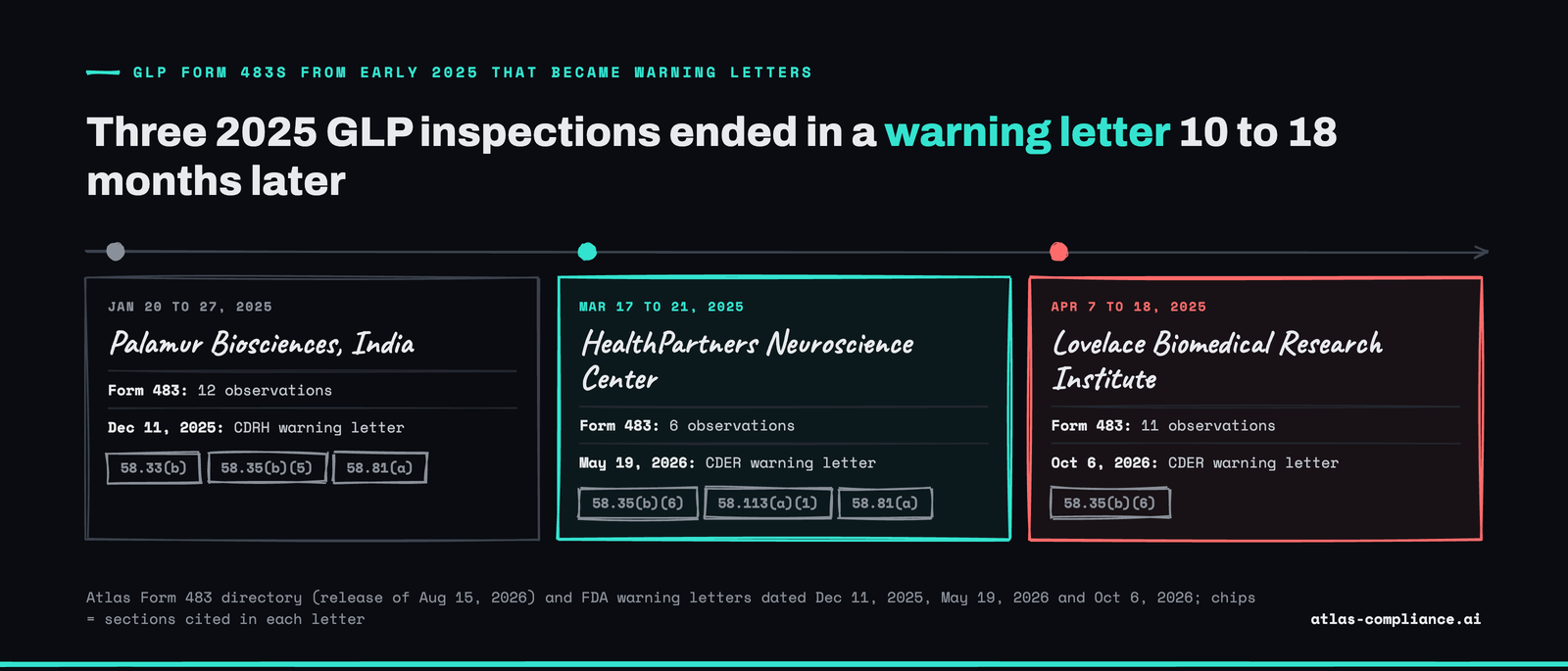
- FDA issued six GLP warning letters in 2025 and 2026; three followed Form 483s from early 2025 inspections in the Atlas directory.
What is 21 CFR Part 58?
21 CFR Part 58 is FDA's binding rule for how nonclinical laboratory studies are conducted, recorded and reported. Under 58.3(d), a nonclinical laboratory study is an in vivo or in vitro experiment that tests an article prospectively in a test system under laboratory conditions to determine its safety. Part 58 does not cover studies in people, clinical studies, field trials in animals, or basic exploratory work that checks whether a test article has any use.
Under 58.10, a sponsor that hands part of a study to a contract laboratory must tell that laboratory the work is part of a GLP study. Under 58.15, a testing facility must let FDA inspect the facility and copy study records; if it refuses, FDA will not consider the study in support of an application. For a drug, the link to the application is direct: 21 CFR 312.23(a)(8)(iii) requires every IND to state, for each nonclinical laboratory study subject to Part 58, that the study followed GLP, or to explain why it did not.
What are the subparts of 21 CFR Part 58?
21 CFR Part 58 has 11 subpart letters, A to K, of which H and I are reserved. The table below follows the eCFR text current as of November 12, 2026.
| Subpart | Title | Sections | What it requires |
|---|---|---|---|
| A | General Provisions | 58.1 to 58.15 | Scope, definitions, contract studies, FDA inspection access |
| B | Organization and Personnel | 58.29 to 58.35 | Trained staff, testing facility management, study director, quality assurance unit |
| C | Facilities | 58.41 to 58.51 | Building size and separation, animal care and supply areas, article handling areas, labs, specimen and data storage |
| D | Equipment | 58.61 to 58.63 | Equipment design, maintenance and calibration records |
| E | Testing Facilities Operation | 58.81 to 58.90 | Standard operating procedures, reagent labeling, animal care |
| F | Test and Control Articles | 58.105 to 58.113 | Characterization, handling, mixtures with carriers |
| G | Protocol for and Conduct of a Nonclinical Laboratory Study | 58.120 to 58.130 | Protocol content, conduct to protocol, data recording |
| H and I | Reserved | None | No requirements |
| J | Records and Reports | 58.185 to 58.195 | Final report content, archives, record retention |
| K | Disqualification of Testing Facilities | 58.200 to 58.219 | Grounds, hearing, final order, reinstatement |
The full text sits in 21 CFR Part 58 on eCFR. Subpart K is the sanction that GMP does not have: under 58.202, FDA may disqualify a testing facility when it finds noncompliance, finds that the noncompliance hurt the validity of the studies, and finds that lesser actions such as warning letters or rejecting single studies will not fix it.
What does the study director do under 58.33?
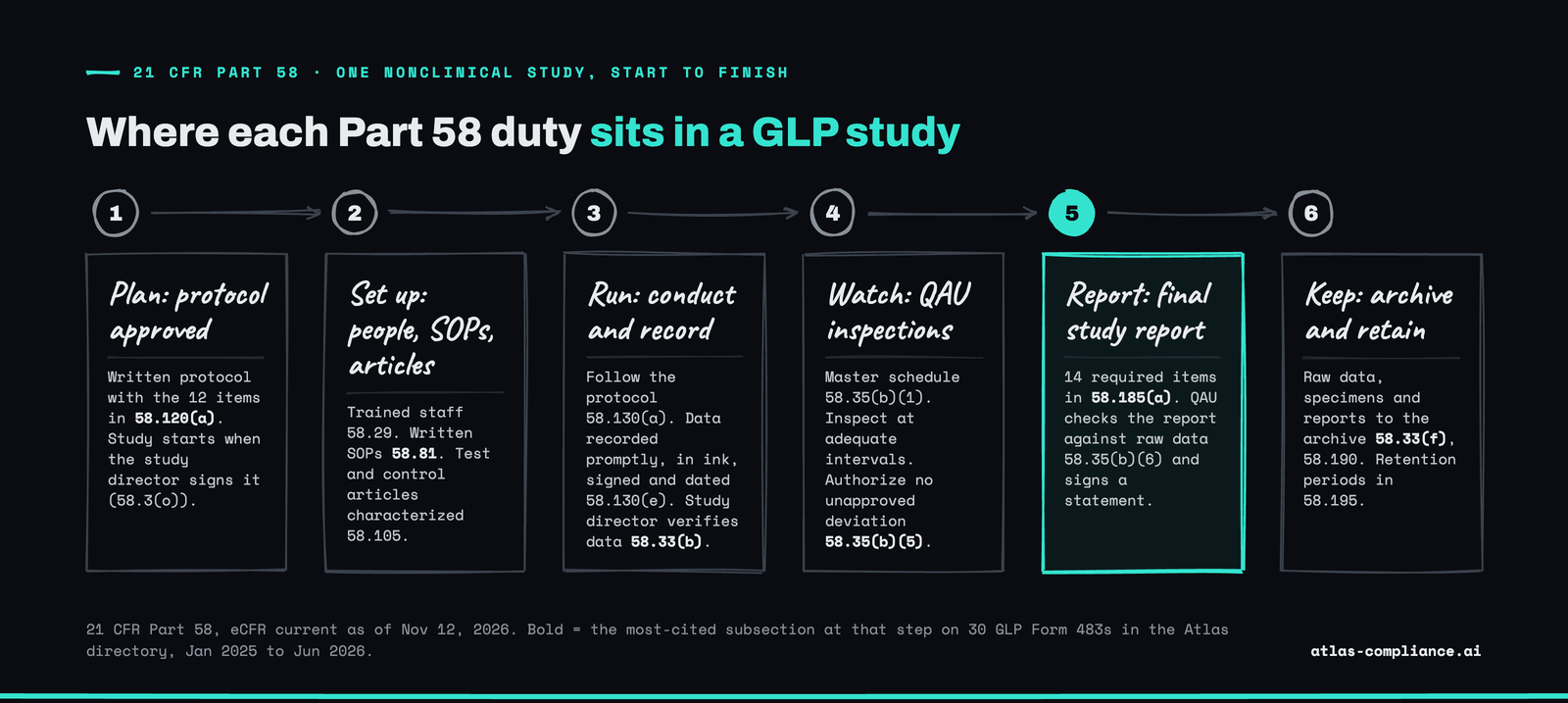
The study director is the one scientist or professional who carries overall responsibility for a nonclinical laboratory study: its technical conduct and the interpretation, analysis, documentation and reporting of its results. 58.33 calls the study director "the single point of study control". The study director must assure that:
- The protocol and every change to it are approved under 58.120 and followed (58.33(a)).
- All experimental data, including unexpected responses of the test system, are recorded accurately and verified (58.33(b)).
- Unforeseen circumstances that may affect study quality are noted when they occur, and corrective action is taken and documented (58.33(c)).
- Test systems match the protocol (58.33(d)).
- All applicable GLP regulations are followed (58.33(e)).
- All raw data, documentation, protocols, specimens and final reports go to the archives during or at the close of the study (58.33(f)).
Under 58.3, the study starts when the study director signs the protocol and ends when the study director signs the final report.
What does the quality assurance unit do under 58.35?
The quality assurance unit (QAU) monitors each study so that management knows the facilities, equipment, people, methods, records and controls meet Part 58. For any given study, the QAU must be independent of the people who direct and conduct it, and 58.3(l) excludes the study director from the QAU. 58.35(b) lists seven duties:
- Keep a master schedule of all studies, indexed by test article.
- Keep copies of all protocols.
- Inspect each study at adequate intervals, keep signed inspection records, and report problems to the study director and management at once.
- Send management and the study director periodic written status reports.
- Confirm that no one deviated from approved protocols or SOPs without authorization.
- Review the final study report against the raw data.
- Sign a statement for the final report giving inspection and reporting dates.
Under 58.15(a), QAU records of findings and actions taken are exempt from FDA copying, though FDA can see inspection dates and written procedures.
What must a GLP protocol and final report contain?
A GLP protocol must state the objectives and all methods of the study, and 58.120(a) lists 12 items to include as applicable, among them test article identity, the test system, the experimental design, each dose level and route, the planned statistical methods, and the sponsor's approval date with the study director's dated signature. Under 58.120(b), every protocol change must be documented with its reason, signed and dated by the study director.
A final report under 58.185(a) must contain 14 items, including the methods and test system, test article stability, the dosing regimen, "all circumstances that may have affected the quality or integrity of the data", the signed reports of each scientist, where the raw data are stored, and the QAU statement. The study director signs it, and any correction is a signed amendment (58.185(b) and (c)).
How long must GLP records be kept under 58.195?
58.195(b) requires GLP records, raw data and specimens to stay in the archive for whichever of three periods is shortest:
- At least 2 years after FDA approves the application the study supported. This period does not apply to studies that support only an IND or an IDE.
- At least 5 years after the study results are submitted to FDA in support of an application.
- At least 2 years after the study is completed, terminated or discontinued, when it is never submitted.
Fragile wet specimens are kept only as long as their quality allows evaluation (58.195(c)). QAU records and equipment records follow the same clock (58.195(d) and (f)). If a testing facility closes, its study records go to the sponsor's archive and FDA must be told in writing (58.195(h)).
GLP vs GMP: what is the difference?
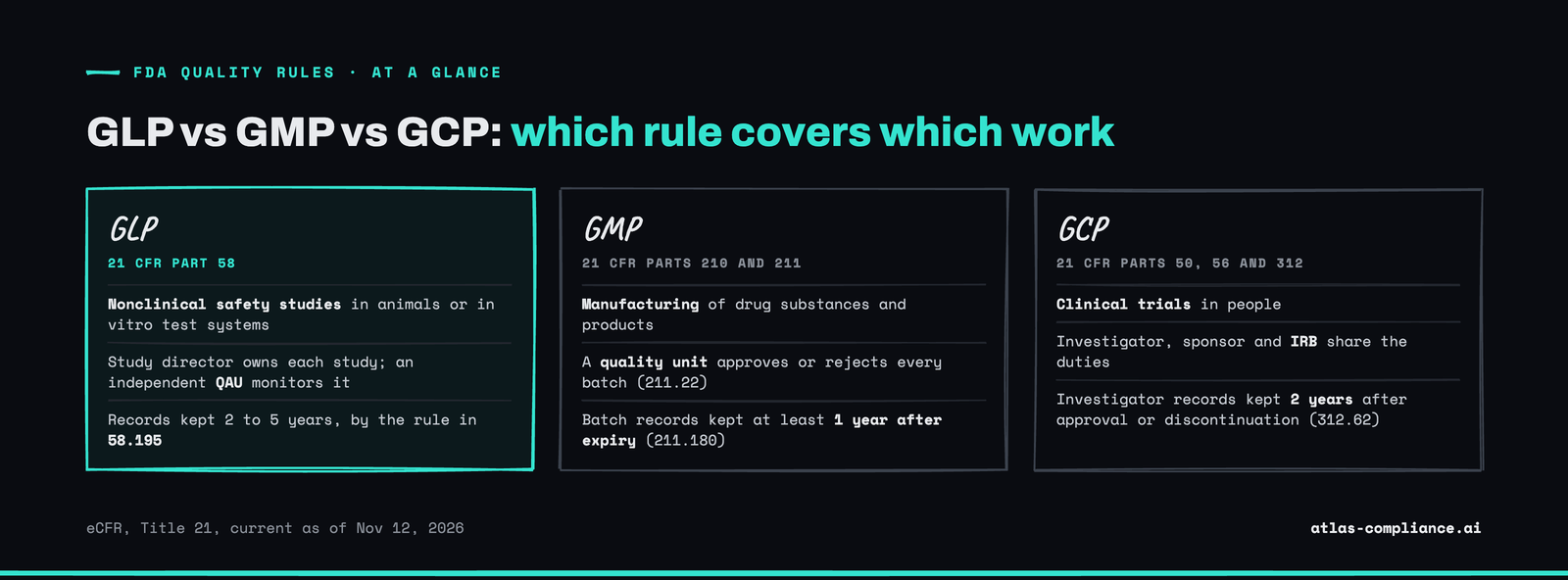
GLP governs how a nonclinical safety study is run and reported; GMP governs how a drug is manufactured. Good clinical practice (GCP) covers the trials in people that follow the GLP studies. The good clinical practice guide covers the trial stage, and the 21 CFR Part 211 guide covers drug GMP.
| Point | GLP, 21 CFR Part 58 | GMP, 21 CFR Parts 210 and 211 |
|---|---|---|
| What it covers | Nonclinical safety studies in animals or in vitro test systems | Manufacture, testing, packing and holding of drugs |
| Unit of work | One study, under one protocol | One batch, under a master production record |
| Who is accountable | Study director for each study; testing facility management | Quality unit with authority to approve or reject (211.22) |
| Independent oversight | QAU, separate from the study staff | Quality unit, which also releases product |
| Core record | Raw data, protocol, final study report | Batch production and control record (211.188) |
| Retention | Shortest of 2 years after approval, 5 years after submission, or 2 years after completion (58.195) | At least 1 year after batch expiry (211.180(a)) |
| Phase 1 flexibility | None; a study either falls under Part 58 or it does not | Phase 1 investigational drugs exempt from Part 211 (210.2(c)) |
| Ultimate sanction | Disqualification of the testing facility (Subpart K) | Warning letter, import alert, consent decree |
Is FDA's 2016 proposed GLP rule final?
No. FDA published a proposed rule, "Good Laboratory Practice for Nonclinical Laboratory Studies", on August 24, 2016 (81 FR 58342, Docket FDA-2010-N-0548), and as of November 17, 2026 no final rule appears in the Federal Register. The 1978 rule, last amended in 2002, remains in force.
The proposal would have required a "GLP Quality System" with more management duties and SOPs, revised the testing facility definition for multisite studies, and defined a principal investigator who runs a phase of a study under the study director. FDA extended the comment period to January 21, 2017 (81 FR 75351), and the proposed rule on the Federal Register remains the latest rulemaking text. FDA's April 30, 2026 notice renewing the Part 58 information collection (91 FR 23273) still describes the current rule and estimates 300 testing facilities, each preparing about 60 final study reports a year.
What do FDA GLP inspections cite most?
FDA cites the study director more than any other Part 58 role. In the Atlas Form 483 directory (release of August 15, 2026), 30 Form 483s issued January 16, 2025 to June 26, 2026 cited Part 58, with 109 observations. 19 of the 30 forms (63.3%) cited 58.33, and 14 (46.7%) cited 58.35, the QAU. Final report content under 58.185 followed at 10 forms.
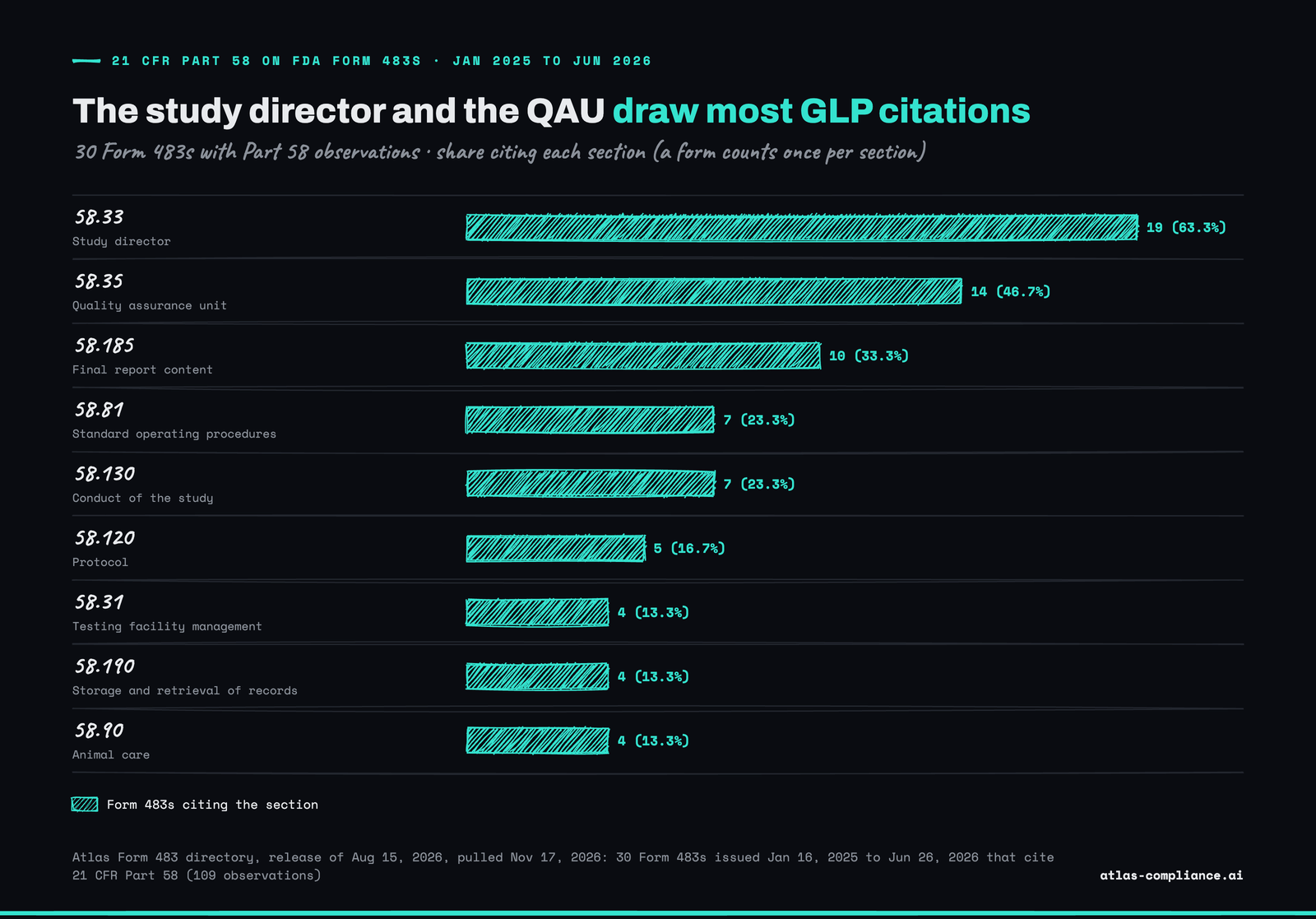
At the subsection level, the top citations were:
| Subsection | What FDA cited | Form 483s |
|---|---|---|
| 58.33(b) | Study director: all data recorded and verified | 10 |
| 58.33(f) | Study director: transfer of data to archives | 8 |
| 58.35(b)(1) | QAU: maintain a master schedule | 5 |
| 58.35(b)(5) | QAU: authorize deviations from protocols or SOPs | 5 |
| 58.33(a) | Study director: follow the study protocol | 4 |
| 58.81(b) | SOPs required | 4 |
| 58.185(a)(9) | Final report: circumstances affecting data quality and integrity | 4 |
21 forms were issued in 2025 (85 observations) and 9 from January to June 2026 (24 observations). The average form carried 3.6 observations, 21 of the 30 fell under human drugs, and only one, at Palamur Biosciences in India, was outside the US.
The Ibex Preclinical Research Form 483 of May 22, 2026 carried 11 observations across the protocol, the final report, the study director and the QAU, including 58.35(b)(7), the QAU statement. The BioReliance Form 483 of January 29, 2026 cited two study director duties, 58.33(a) and 58.33(c); the BioReliance Rockville facility record holds its wider history. Record retention itself rarely appears: the VetMed Consultants Form 483 of March 6, 2026 was the only form in the set to cite 58.195, for QAU records under 58.195(d). The Charles River Laboratories Form 483 of March 21, 2025 for the Reno facility paired 58.33(b) with two final report items under 58.185(a).
GLP outcomes are hard to count from public data. FDA's inspection classification export, as compiled by Atlas from records ending January 2025 to October 2026, does not tag GLP as its own inspection type, and only 3 of the 30 inspections behind these Form 483s appear in it, all classified VAI. Across all 1,934 bioresearch monitoring inspections in that export, 77.1% ended NAI, 21.8% VAI and 1.1% OAI; NAI, VAI and OAI explained covers what each class means. Every Form 483 in this set is searchable in the FDA Form 483 database.
Before a GLP inspection, the same records show who is likely to arrive and which Part 58 sections that investigator has cited at other testing facilities.
 Atlas
See what the FDA knows about your next investigator.
30 minutes with the founder. No pitch deck.
Which GLP inspections led to warning letters?
FDA issued six warning letters with the subject "Good Laboratory Practice (GLP) for Nonclinical Laboratory Studies" from June 2025 to October 2026, by Atlas's count of FDA's posted letters. Three of them followed Form 483s from early 2025 that sit in the Atlas directory, 10 to 18 months after the inspection closed: Palamur Biosciences (Form 483 January 27, 2025, letter December 11, 2025), HealthPartners Neuroscience Center Research and Innovation (Form 483 March 21, 2025, letter May 19, 2026) and Lovelace Biomedical Research Institute (Form 483 April 18, 2025, letter October 6, 2026). The other three went to Vedic Lifesciences in March 2026, Jiangsu Kerbio Medical Technology Group in July 2025 and CCIC Huatongwei International Inspection in June 2025.
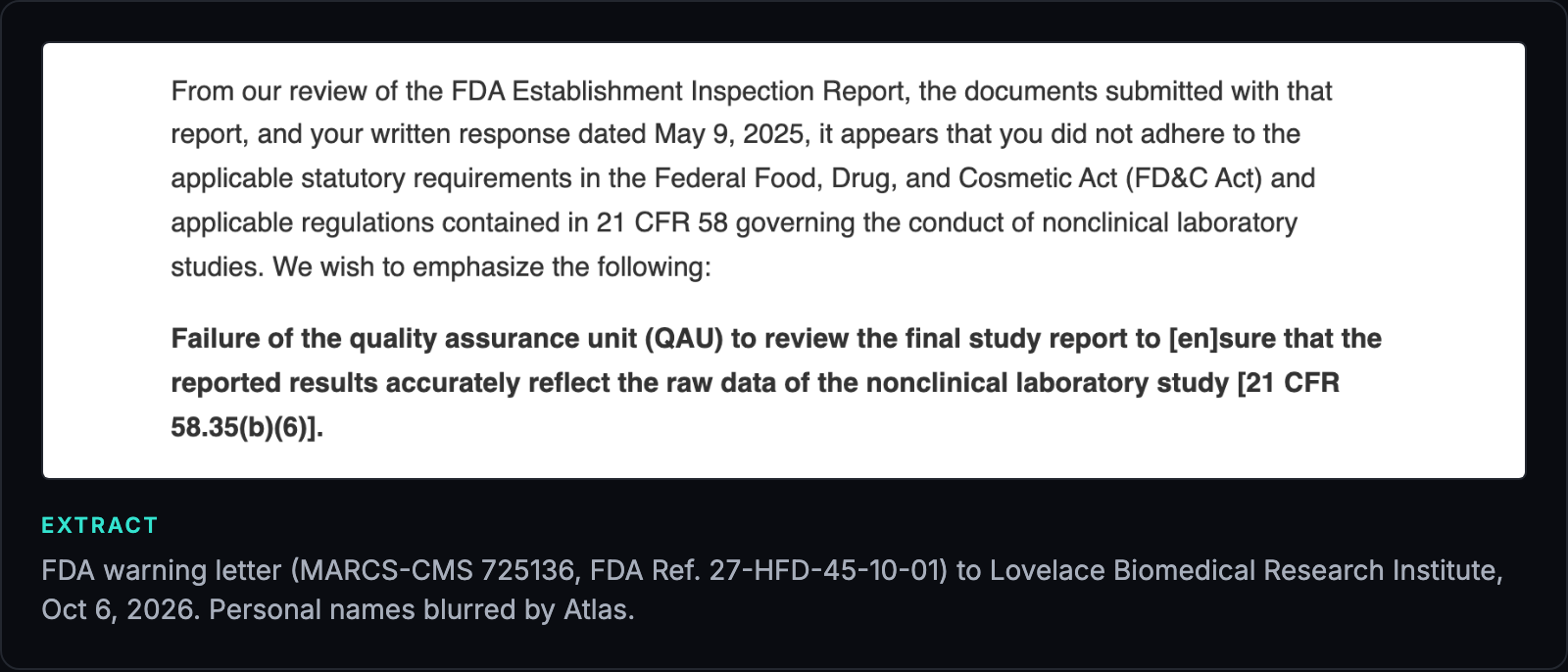
The Lovelace letter (MARCS-CMS 725136, dated October 6, 2026) cites one violation, 58.35(b)(6): the QAU did not make sure the final study reports reflected the raw data. FDA listed abnormal clinical observations and dosing problems recorded in the raw data for two studies but missing from the final reports. FDA also wrote that this finding was not on the Form 483, so the facility's response to the 483 had not addressed it. The Palamur letter warns that FDA could start disqualification proceedings under 58.202. The FDA warning letter database guide explains how to trace a letter back to its inspection.
How should a testing facility prepare for a GLP inspection?
Prepare in the order FDA cites, starting with the study director and the QAU:
- Reconcile raw data with the final report. For each recent study, check every clinical observation, dosing problem and deviation in the raw data against the final report. This covers 58.33(b), 58.185(a)(9) and the 58.35(b)(6) finding in the Lovelace letter.
- Audit the archive. Confirm raw data, specimens, protocols and reports reached the archive and are indexed (58.33(f), 58.190).
- Check the master schedule. Every study should appear with its test article, test system, status, sponsor and study director (58.35(b)(1)).
- Trace every deviation. Each SOP deviation needs the study director's authorization in the raw data (58.81(a)), the QAU must confirm it (58.35(b)(5)), and, for protocol changes, the study director's signed and dated amendment (58.120(b)).
- Confirm the retention clock. Map each study to its 58.195 period, including QAU and equipment records.

Form 483s and warning letters for GLP testing facilities are posted months apart, and the Atlas digest tracks both as FDA releases them.
AtlasFDA Inspection Intelligence Digest
We track every 483, EIR, and warning letter the moment it happens. Get the signals before they hit the FDA website.
Frequently asked questions
Yes. 21 CFR 58.3(d) defines a nonclinical laboratory study as an in vivo or in vitro experiment that tests an article prospectively in a test system under laboratory conditions to determine its safety. The rule excludes studies in human subjects, clinical studies, field trials in animals, and basic exploratory studies that check whether a test article has any potential use or measure its physical or chemical characteristics.

Written by
Bhavish Agarwal
Founder, Atlas
Bhavish Agarwal is the founder of Atlas and previously worked at Google and Microsoft. He has spent the past several years building regulatory data infrastructure for the pharmaceutical industry.