
21 CFR Part 314 is the FDA regulation that sets how a company applies to market a new drug under section 505 of the Federal Food, Drug, and Cosmetic Act, through a new drug application (NDA) or an abbreviated new drug application (ANDA), and what the holder must report once the drug is approved. Part 314 covers application content, supplements for changes, postmarketing reports, FDA review and refusal, hearings and accelerated approval.
This guide puts the subparts in one table, covers the sections teams look up most, and adds what other Part 314 pages leave out: the Part 314 sections FDA wrote on Form 483s, from FDA citation data compiled by Atlas (pulled October 21, 2026), and the facility findings behind complete response letters as of October 2026.
Key facts
- An NDA or ANDA holder must send a field alert report to the FDA district office for the facility involved within 3 working days of learning of a mix-up, contamination, deterioration or failed batch in a distributed product (21 CFR 314.81(b)(1)).
- Each serious and unexpected adverse drug experience goes to FDA within 15 calendar days of initial receipt (21 CFR 314.80(c)(1)(i)).
- The NDA annual report is due within 60 days of the anniversary of US approval (21 CFR 314.81(b)(2)).
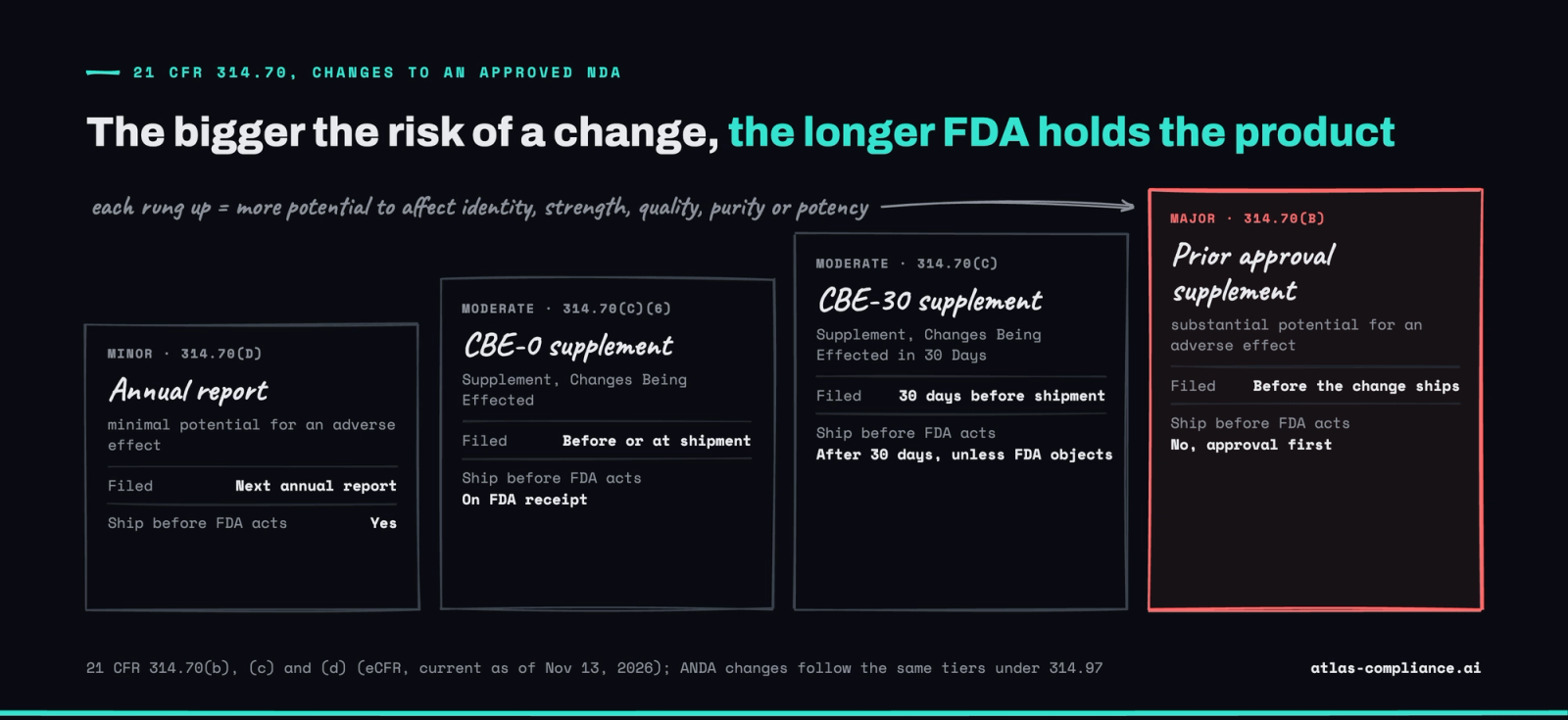
- 21 CFR 314.70 sorts changes to an approved NDA into four routes: prior approval supplement, CBE-30, CBE-0 and annual report.
- FDA cited Part 314 at 22 inspections ending January 16, 2025 to July 23, 2026; 13 of them cited 314.80(b), missing written adverse event procedures, and 4 cited a field alert report that was not sent in time.
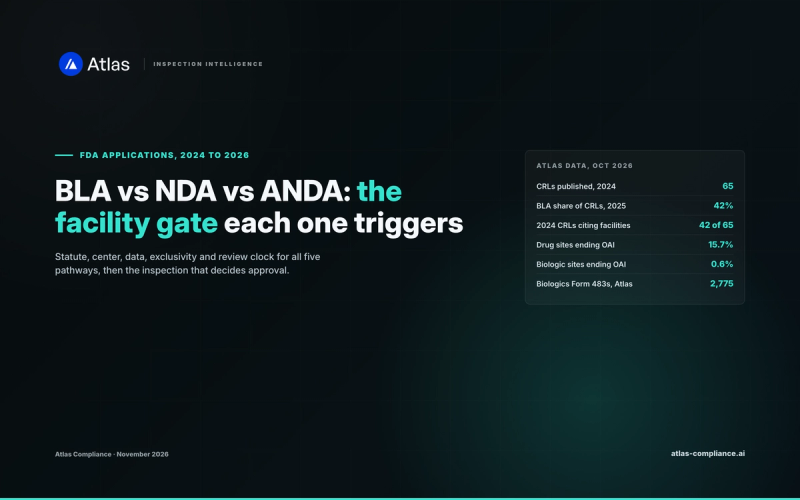
- Facility inspection problems appeared in 42 of the 65 complete response letters FDA issued in 2024, in the Atlas analysis of published letters (October 14, 2026).
What is 21 CFR Part 314?
21 CFR Part 314 is Title 21, Chapter I, Subchapter D, Part 314 of the Code of Federal Regulations, titled "Applications for FDA Approval to Market a New Drug." Part 314 applies to NDAs, 505(b)(2) applications and ANDAs, and to their amendments, supplements and postmarketing reports (314.1(a)). It does not apply to biologics licensed under the Public Health Service Act, which follow Part 601 (314.1(b)). The current text is on eCFR, 21 CFR Part 314.
Part 314 has nine subparts. Subpart F is reserved and holds no sections.
| Subpart | eCFR title | Sections | What it covers |
|---|---|---|---|
| A | General Provisions | 314.1 to 314.3 | Scope, purpose, definitions |
| B | Applications | 314.50 to 314.90 | NDA content (314.50), patents, 505(b)(2), amendments, supplements (314.70), postmarketing reports (314.80, 314.81), waivers |
| C | Abbreviated Applications | 314.92 to 314.99 | Which drugs qualify for an ANDA, suitability petitions, ANDA content (314.94), ANDA supplements (314.97) and reports (314.98) |
| D | FDA Action on Applications and Abbreviated Applications | 314.100 to 314.170 | Review timeframes, filing, approval (314.105), exclusivity, complete response letters (314.110), refusal grounds (314.125, 314.127), withdrawal |
| E | Hearing Procedures for New Drugs | 314.200 to 314.235 | Notice of opportunity for hearing, hearing procedure, judicial review |
| F | Reserved | None | No current sections |
| G | Miscellaneous Provisions | 314.410 to 314.445 | Imports and exports, drug master files (314.420), public disclosure, addresses |
| H | Accelerated Approval of New Drugs for Serious or Life-Threatening Illnesses | 314.500 to 314.560 | Approval on a surrogate endpoint, restricted distribution, withdrawal, promotional review |
| I | Approval of New Drugs When Human Efficacy Studies Are Not Ethical or Feasible | 314.600 to 314.650 | The animal rule: approval based on efficacy studies in animals |
Part 314 picks up where the IND rules in Part 312 stop. Our BLA vs NDA guide compares the NDA and ANDA routes in this part with the BLA and biosimilar routes in Part 601.
What must an NDA contain under 21 CFR 314.50?
An NDA under 21 CFR 314.50 contains a signed application form, an index, a summary, the technical sections, case report tabulations and forms, samples and labeling, patent information, any claimed exclusivity, and financial certification or disclosure for clinical investigators. 314.50 also requires reports of every investigation the applicant sponsored and all other information pertinent to the evaluation, from any source.
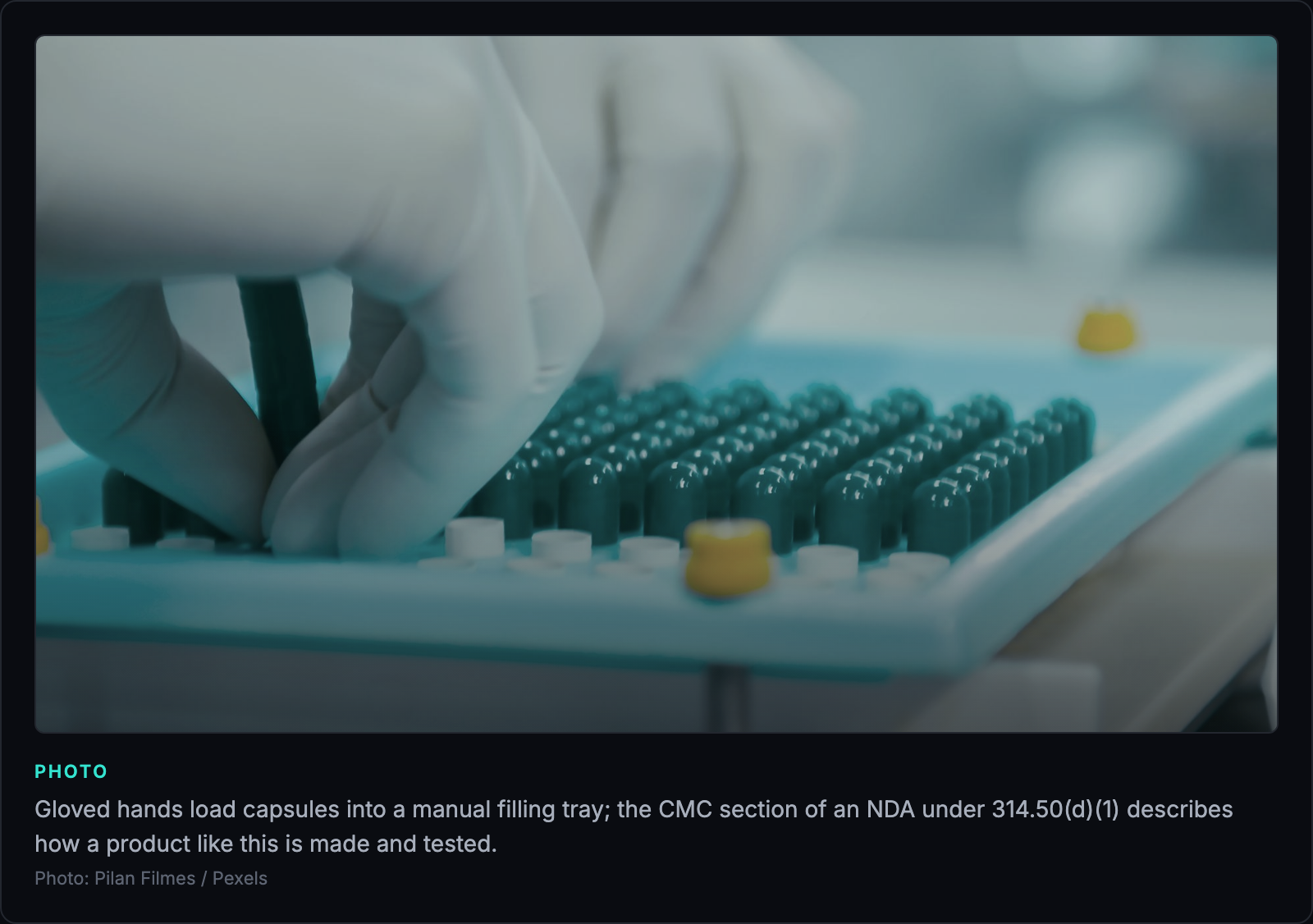
The technical sections in 314.50(d) are seven: chemistry, manufacturing and controls (CMC); nonclinical pharmacology and toxicology; human pharmacokinetics and bioavailability; microbiology; clinical data; statistics; and pediatric use. The CMC section names the facilities that make and test the drug, and FDA plans any pre-approval inspection from that list.
FDA has 60 days from receipt to decide whether to file an NDA (314.101(a)). Under 314.100, the initial review cycle is 180 days from receipt, though the user fee goals that set the actual PDUFA date run on a separate schedule.
What does an ANDA need under 21 CFR 314.94?
An ANDA under 21 CFR 314.94 must refer to a listed drug and show that the generic matches it. The required parts are the application form, a table of contents, the basis for the ANDA submission, conditions of use, active ingredients, route of administration, dosage form and strength, bioequivalence, labeling, chemistry, manufacturing and controls, samples, and financial certification.
The ANDA leaves out the clinical safety and efficacy studies an NDA carries, so bioequivalence and CMC data carry the file. 314.98 applies the same adverse event and field alert duties of 314.80 and 314.81 to ANDA holders, and 314.97 routes ANDA changes through the same supplement tiers as 314.70.
What are PAS, CBE-30 and CBE-0 under 21 CFR 314.70?
21 CFR 314.70 sorts changes to an approved NDA by their potential to affect identity, strength, quality, purity or potency. A major change needs a prior approval supplement (PAS) before product made with it ships. A moderate change goes in a CBE-30 supplement, or a CBE-0 for categories FDA designates. A minor change is reported in the next annual report.
| Route | Section | Risk of the change | When the product can ship | Label on the supplement |
|---|---|---|---|---|
| Prior approval supplement | 314.70(b) | Substantial | After FDA approves | Prior approval supplement |
| CBE-30 | 314.70(c) | Moderate | 30 days after FDA receives it, unless FDA objects | Supplement, Changes Being Effected in 30 Days |
| CBE-0 | 314.70(c)(6) | Moderate, in a category FDA designates | When FDA receives it | Supplement, Changes Being Effected |
| Annual report | 314.70(d) | Minimal | At once | Reported under 314.81(b)(2) |
314.70(b) lists formulation changes, changes that need new bioequivalence studies under Part 320, and changes that may affect sterility assurance, such as a new sterilization method or an added or removed aseptic processing step, as major. 314.70(c)(6) covers tightened specifications and safety labeling updates that add or strengthen a warning. If FDA disapproves a CBE supplement, 314.70(c)(7) lets it order the holder to stop distributing product made with the change.
What are the 21 CFR 314.80 and 314.81 reporting deadlines?
The postmarketing clocks in 21 CFR 314.80 and 314.81 are 3 working days for a field alert report, 15 calendar days for a serious and unexpected adverse drug experience, 30 days after each quarter for periodic safety reports in the first 3 years, and 60 days after the approval anniversary for the annual report.
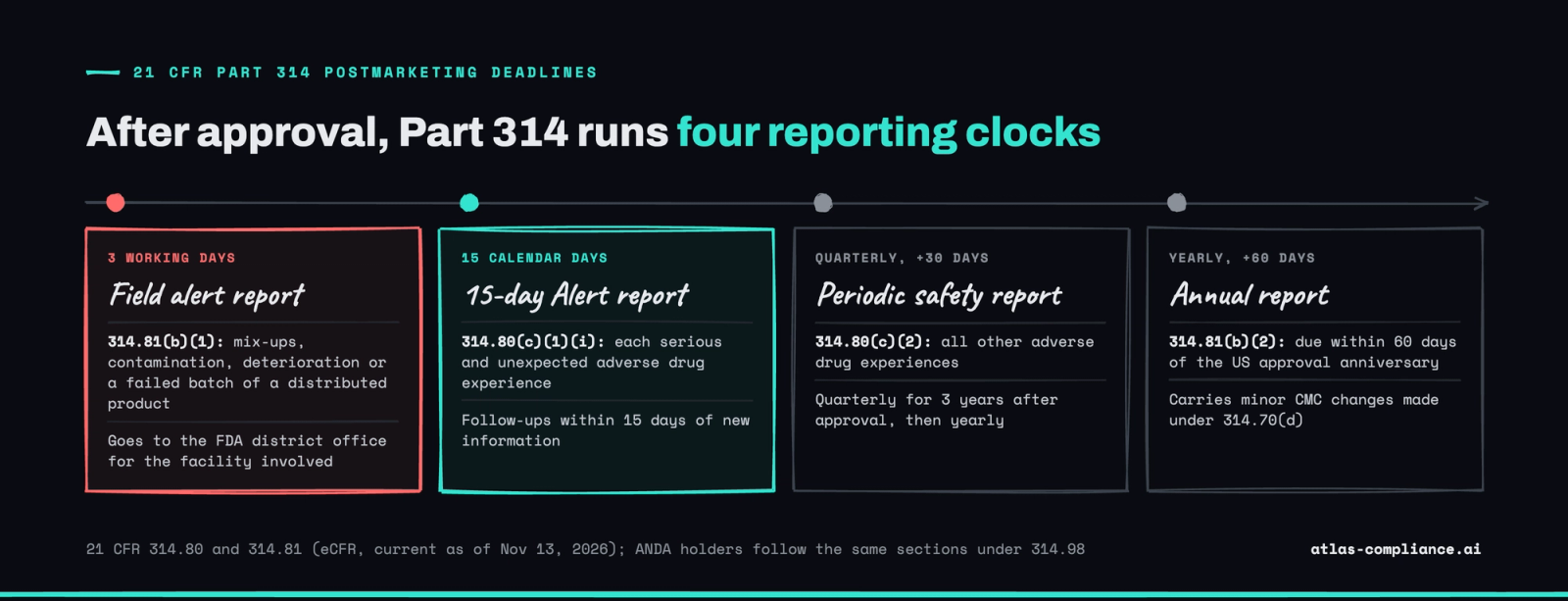
314.80, adverse drug experiences. The applicant reports each serious and unexpected adverse drug experience within 15 calendar days of first receipt, with follow-ups within 15 days of new information (314.80(c)(1)). Other adverse drug experiences go in periodic reports: quarterly for 3 years from approval, each due within 30 days of the quarter's close, then yearly within 60 days of the anniversary (314.80(c)(2)). 314.80(b) requires written procedures for surveillance, receipt, evaluation and reporting.
314.81(b)(1), field alert reports. The applicant tells the FDA district office responsible for the facility within 3 working days of receiving information about a mix-up of the product or its labeling, bacteriological contamination, a significant chemical, physical or other change or deterioration in distributed product, or a distributed batch that fails its approved specification. The first notice can go by phone, with prompt written follow-up. The clock runs from receipt of the information, not from the end of the firm's investigation.
314.81(b)(2), annual reports. Within 60 days of the US approval anniversary, the applicant files an annual report with Form FDA 2252. It carries a summary of significant new safety information, distribution data, labeling, CMC changes reported under 314.70(d), nonclinical and clinical data, and the status of postmarketing study commitments.
Why can FDA refuse to approve an NDA or ANDA?
FDA can refuse to approve an NDA for any reason listed in 21 CFR 314.125(b), and an ANDA for any reason in 314.127. Three of the NDA grounds concern facilities directly: inadequate methods, facilities and controls (314.125(b)(1)), an applicant that does not permit an adequate inspection (314.125(b)(12)), and methods or facilities that do not comply with the CGMP rules in Parts 210 and 211 (314.125(b)(13)). 314.127(a)(1) is the matching ANDA ground.
FDA delivers these findings in a complete response letter under 314.110, which lists every deficiency. In the Atlas analysis of letters FDA published through openFDA (data as of October 14, 2026), facility inspection problems appear in 42 of the 65 complete response letters FDA issued in 2024, second to clinical deficiencies at 56. FDA issued 48 letters in 2025 and 17 from January to June 2026; NDAs drew 44 of the 2024 letters, 28 of the 2025 letters and 10 of the 2026 letters.
Reviewers reuse four facility sentences. The most common asks the applicant for the dates of each facility's Form 483 response (27 letters); others require the facility to answer its Form 483 first (22), require a satisfactory pre-approval and CGMP inspection (13), and warn of reinspection (10). Our complete response letter and facility readiness guide walks through each one.
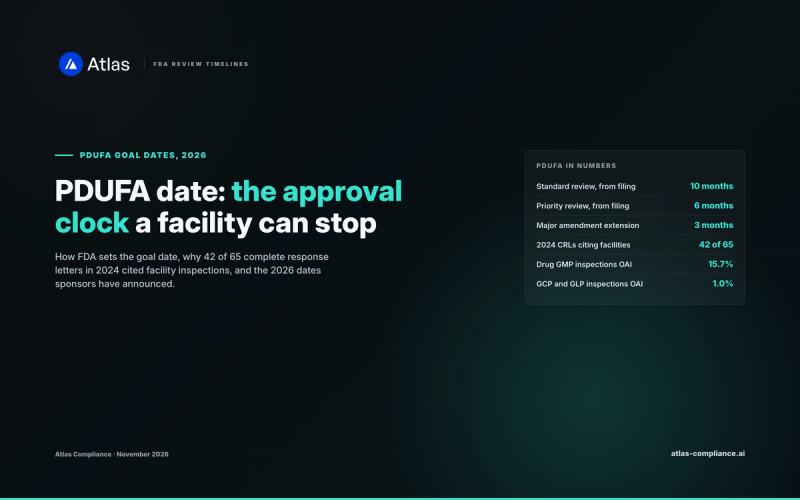
The inspection data points the same way. Drug quality (GMP) inspections of drug and biologic facilities ending January 2, 2025 to October 14, 2026 were classified Official Action Indicated (OAI) 15.7% of the time (310 of 1,974), against 1.0% for bioresearch monitoring inspections (14 of 1,452), as reported in our PDUFA date guide.
Which 21 CFR Part 314 sections does FDA cite on Form 483s?
FDA cites 21 CFR 314.80(b) most often: written procedures for postmarketing adverse drug experiences were missing or incomplete at 13 of the 22 inspections that carried a Part 314 citation. The figures come from FDA inspection citation data compiled by Atlas, covering inspections that ended January 2, 2025 to October 9, 2026, pulled October 21, 2026. The 22 inspections, ending January 16, 2025 to July 23, 2026, carried 34 Part 314 citations.
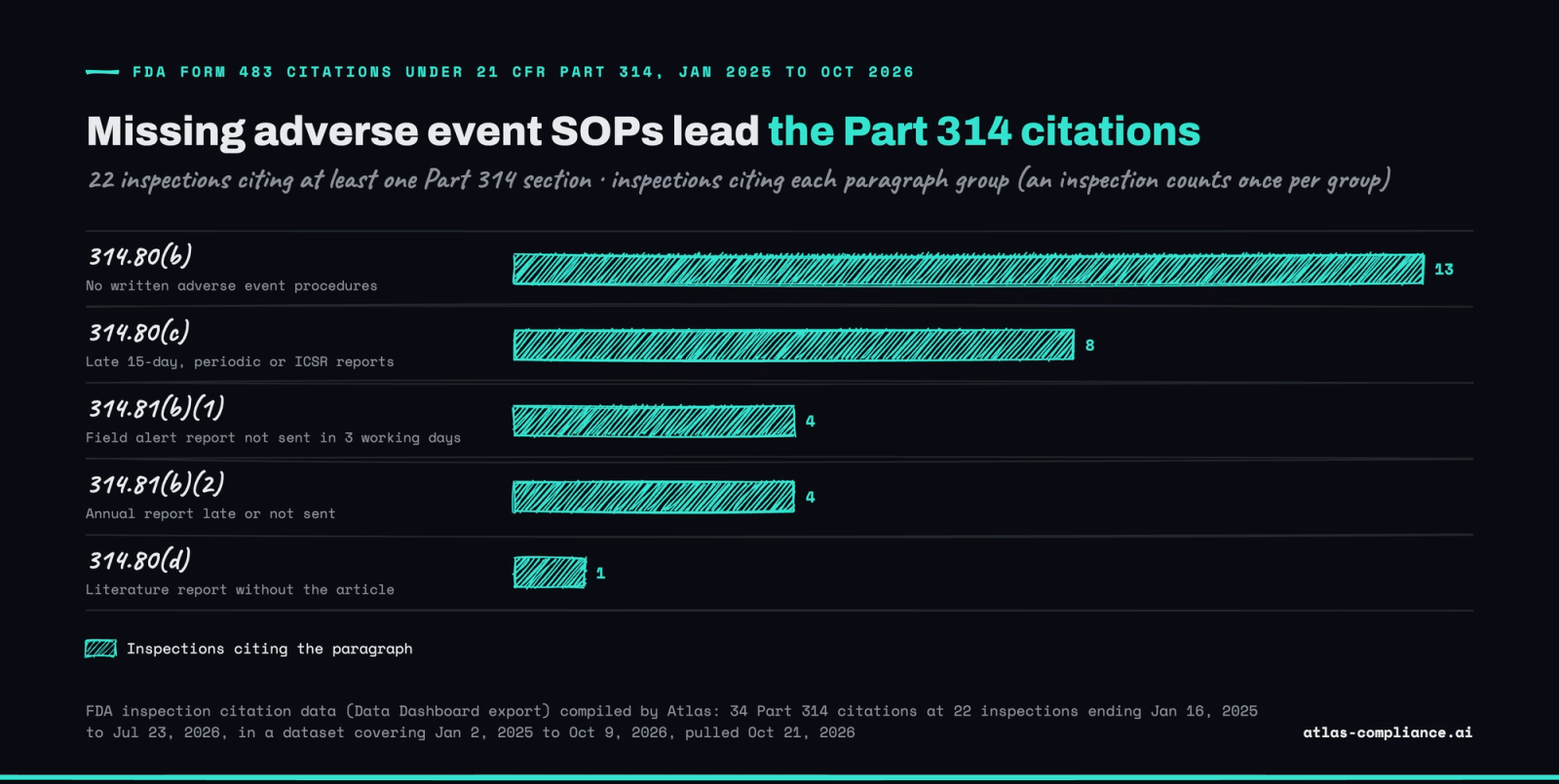
| Paragraph | FDA short description | Inspections |
|---|---|---|
| 314.80(b) | Failure to develop written procedures | 13 |
| 314.80(c)(2) | Late annual or quarterly periodic safety reports | 5 |
| 314.81(b)(2) | Annual report not submitted on time | 4 |
| 314.80(c)(1)(i) | Late submission of 15-day report | 3 |
| 314.81(b)(1)(ii) | Field alert not sent: contamination, change or deterioration | 3 |
| 314.81(b)(1)(i) | Field alert not sent: mix-up | 1 |
| 314.80(c)(1)(ii) | Failure to investigate serious, unexpected events | 1 |
| 314.80(c)(2)(ii)(B) | Late submission of an individual case safety report | 1 |
| 314.80(d) | 15-day literature report sent without the article | 1 |
Part 314 is a small share of drug findings: the same dataset holds 862 drug inspections with published citations, 774 of them citing Part 211. FDA filed 17 of the 22 Part 314 inspections under its bioresearch monitoring program area, 4 under drug quality and 1 under cell and gene therapies, and classified 18 Voluntary Action Indicated, 3 OAI and 1 No Action Indicated.
The OAI case in the adverse event group is Novo Nordisk Inc. in Plainsboro, New Jersey. Its Form 483 of February 7, 2025 cites four 314.80 paragraphs: written procedures, late 15-day reports, failure to investigate serious and unexpected events, and a late individual case safety report. A recent single-item case is the Scilex Pharmaceuticals Form 483 of May 20, 2026, which cites 314.80(b) alone.
Which Form 483s cite missed field alert reports?
Four inspections in the period cited 21 CFR 314.81(b)(1), and FDA wrote all four during drug quality inspections, not safety reporting audits. Two of the four were classified OAI. Four cases are too few for a rate, but in each one FDA found the late field alert while it was inspecting manufacturing.
| Inspection end | Firm and city | Paragraph | Classification |
|---|---|---|---|
| Jan 16, 2025 | Medline Industries, LP, Waukegan, Illinois | 314.81(b)(1)(ii) | OAI |
| Sep 17, 2025 | Division of Nuclear Medicine PET Radiopharmaceutical Production Program, Ann Arbor, Michigan | 314.81(b)(1)(ii) | OAI |
| Jun 12, 2026 | Epic Pharma, LLC, Laurelton, New York | 314.81(b)(1)(i) | VAI |
| Jun 30, 2026 | Meridian Medical Technologies, LLC, Saint Louis, Missouri | 314.81(b)(1)(ii) | VAI |
The Epic Pharma record shows how the citation sits among GMP findings. The Epic Pharma Form 483 of June 12, 2026 lists four observations: 211.22(d) on quality unit procedures, 211.67(a) on equipment cleaning, 211.68(b) on computer control of master formula records, and 314.81(b)(1)(i), a mix-up that did not reach FDA within 3 working days. The Epic Pharma facility record holds 20 FDA inspections, 7 of which ended with a Form 483, and a 2018 Form 483 there cited 314.80(b).
A field alert usually starts as a complaint, an out-of-specification result or a deviation on a released batch, so a missed 3-day clock points to a gap between the quality unit's investigations and regulatory reporting. Our guide to what a Form 483 is explains how to read these records, and the full set is searchable in the FDA Form 483 database.
If a facility named in your NDA or ANDA has a Form 483 like these on file, the investigator who wrote it is likely to read your records the same way.
 Atlas
See what the FDA knows about your next investigator.
30 minutes with the founder. No pitch deck.
What changes to Part 314 take effect in 2027?
The next change is a wording change. FDA's "Nonclinical Testing Terminology" direct final rule, published in the Federal Register on September 22, 2026 (91 FR 59988), replaces "animal" and "preclinical" with "nonclinical" across Parts 312, 314, 315, 361 and 601. In Part 314 it amends 314.50 and 314.81, takes effect February 4, 2027, and adds no new requirements, though SOPs that quote the old wording will need updating.
Atlas tracks new Form 483s and warning letters each week, including Part 314 citations at application holders and their facilities.
AtlasFDA Inspection Intelligence Digest
We track every 483, EIR, and warning letter the moment it happens. Get the signals before they hit the FDA website.
Frequently asked questions
21 CFR Part 314 does not apply to biological products licensed under the Public Health Service Act. 314.1(b) excludes them, and BLAs follow 21 CFR Part 601 instead. Some protein products, such as insulins, were approved under NDAs until March 23, 2020, when FDA deemed those applications to be BLAs. Peptides of 40 amino acids or fewer are still drugs and use Part 314.

Written by
Bhavish Agarwal
Founder, Atlas
Bhavish Agarwal is the founder of Atlas and previously worked at Google and Microsoft. He has spent the past several years building regulatory data infrastructure for the pharmaceutical industry.