
21 CFR Part 210 is the FDA regulation that sets the legal status, the reach and the vocabulary of the current good manufacturing practice (CGMP) rules for drugs. It has three sections: 210.1 says what happens when a firm breaks the CGMP rules, 210.2 says which products and operations they cover, and 210.3 defines 22 terms that Part 211 uses.
FDA almost never cites Part 210 by number. This guide quotes the definitions from the eCFR (current as of November 13, 2026) and counts how often FDA cited the requirements built on them, using the FDA Data Dashboard citations export compiled by Atlas (downloaded October 21, 2026): 774 drug inspections that ended between January 7, 2025 and September 3, 2026 with a posted Part 211 citation.
Key facts:
- 21 CFR Part 210 has three sections, 210.1, 210.2 and 210.3, and its source is a final rule published September 29, 1978 (43 FR 45076).
- Under 21 CFR 210.1(b), a drug made without following Part 210 or Parts 211, 213, 225 and 226 is adulterated under section 501(a)(2)(B) of the FD&C Act.
- Section 210.3(b) lists 22 definitions, from "act" to "gang-printed labeling", and they apply to Parts 210, 211, 225 and 226 only.
- FDA posted zero Part 210 citations between January 2025 and October 2026, against 3,139 Part 211 citations across 774 drug inspections.
- The "quality control unit" defined in 210.3(b)(15) was cited under 211.22 in 352 of those 774 inspections (45.5%), more than any other Part 211 section.
- Section 210.2(c) exempts phase 1 investigational drugs from Part 211 until the drug is used in a phase 2 or phase 3 study or is lawfully marketed.
What is 21 CFR Part 210?
21 CFR Part 210 is the general part of the drug CGMP regulations, titled "Current Good Manufacturing Practice in Manufacturing, Processing, Packing, or Holding of Drugs; General". Part 210 holds no operating requirements. It tells you that the CGMP parts are binding, who they bind, and what their key words mean. The detailed rules for finished drugs sit in 21 CFR Part 211, which our separate guide covers subpart by subpart.
| Section | Title | What it does | Last amended |
|---|---|---|---|
| 210.1 | Status of current good manufacturing practice regulations | Makes Parts 210, 211, 213, 225 and 226 the minimum CGMP; ties failure to adulteration; adds Part 1271 for HCT/Ps that are drugs | June 18, 2024 (89 FR 51769) |
| 210.2 | Applicability of current good manufacturing practice regulations | Says how the parts stack, limits a firm to the operations it performs, exempts phase 1 drugs from Part 211 | June 18, 2024 (89 FR 51769) |
| 210.3 | Definitions | Defines 22 terms used in Parts 210, 211, 225 and 226 | December 10, 2009 (74 FR 65431) |
The full text is on the eCFR, Part 210. For the wider CGMP picture across drugs, devices and food, see our FDA CGMP overview.
What does 21 CFR 210.1 say about the status of CGMP regulations?
21 CFR 210.1 says that Parts 210, 211, 213, 225 and 226 contain the minimum current good manufacturing practice for the methods, facilities and controls used to make, process, pack or hold a drug. Paragraph (b) adds the consequence: a drug made without complying is adulterated under section 501(a)(2)(B), and both the drug and the person responsible face regulatory action.
Three details in 210.1 matter in practice:
- "Minimum" is the regulation's own word. Meeting the text of Part 211 is the floor, and FDA reads the "current" in CGMP against what a reasonable manufacturer does today.
- Adulteration attaches to how the batch was made. A batch that meets its specification can still be adulterated if the firm did not follow CGMP while making it.
- Paragraph (b) names "the person who is responsible for the failure to comply". The regulation reaches people as well as products.
Section 210.1(c) covers human cells, tissues, and cellular and tissue-based products (HCT/Ps) regulated as drugs. Those firms must also follow the donor eligibility rules in Part 1271 Subpart C and the current good tissue practice rules in Subpart D, and a failure under either one makes the HCT/P adulterated.
Who does 21 CFR 210.2 apply to?
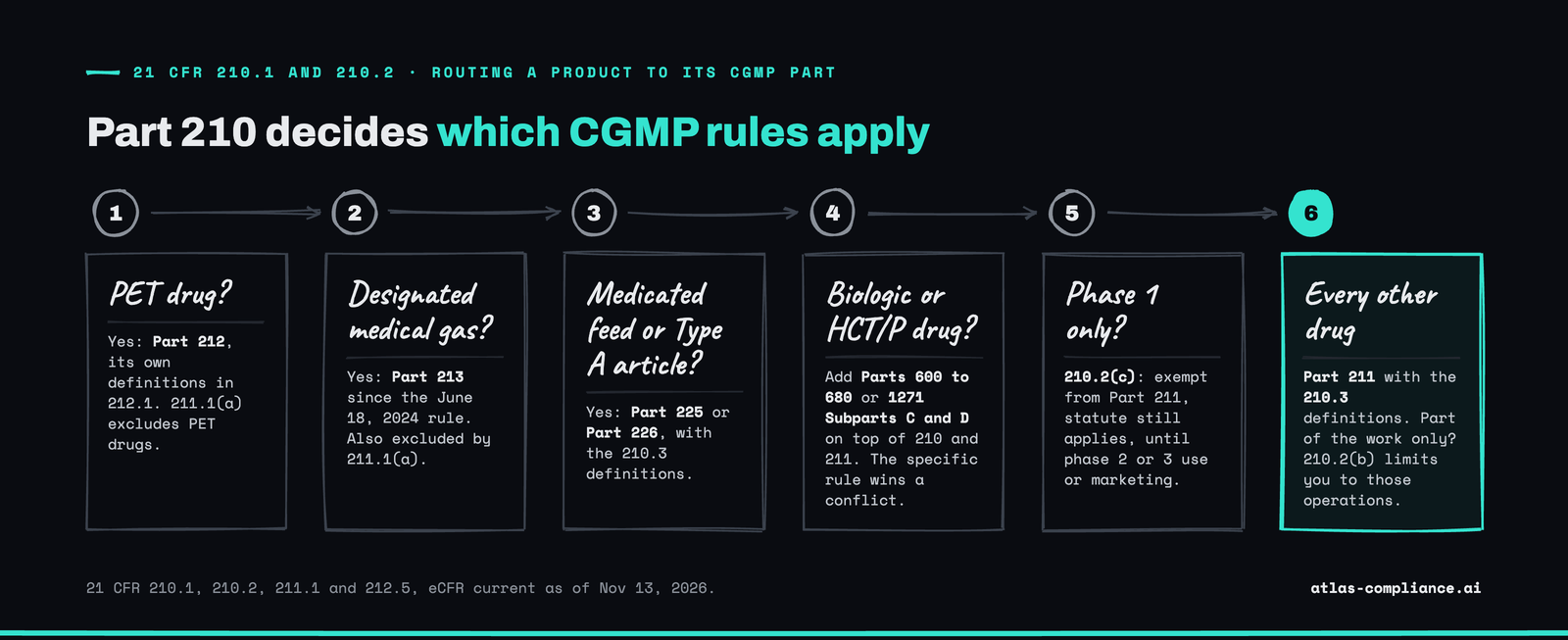
21 CFR 210.2 applies the CGMP rules to drugs under Parts 210, 211, 213, 225 and 226, to human biological products under Parts 600 to 680, and to HCT/Ps regulated as drugs under Part 1271. These parts supplement each other. When two of them conflict, the regulation written for that specific product wins over the general one.
Paragraph (b) is the one contract organizations quote. A firm that performs only some regulated operations, a testing laboratory or a packager for example, "need only comply with those regulations applicable to the operations in which the person is engaged." A contract laboratory still meets every Subpart I requirement for the testing it does.
Paragraph (c) handles early clinical supplies. A drug made for a phase 1 study is subject to the statutory CGMP requirement in 21 U.S.C. 351(a)(2)(B) but exempt from Part 211. The exemption ends once the drug is made available for a phase 2 or phase 3 study, or is lawfully marketed, and from then on even the phase 1 supply must comply with Part 211.
Part 210 does not route PET drugs. That happens in Part 212: section 212.5(a) says Part 212 applies only to positron emission tomography drugs and sends every other human drug to Parts 210 and 211, and section 211.1(a) excludes PET drugs and designated medical gases from Part 211.
What are the key definitions in 21 CFR 210.3?
21 CFR 210.3 defines the terms that Part 211 relies on, and section 211.3 says so in one line: "The definitions set forth in § 210.3 of this chapter apply in this part." Paragraph (a) also imports the definitions in section 201 of the FD&C Act. The table quotes the definitions QA teams use most, word for word from the eCFR.
| Term | 210.3(b) | Definition (quoted) |
|---|---|---|
| Batch | (2) | "a specific quantity of a drug or other material that is intended to have uniform character and quality, within specified limits, and is produced according to a single manufacturing order during the same cycle of manufacture." |
| Component | (3) | "any ingredient intended for use in the manufacture of a drug product, including those that may not appear in such drug product." |
| Drug product | (4) | "a finished dosage form, for example, tablet, capsule, solution, etc., that contains an active drug ingredient generally, but not necessarily, in association with inactive ingredients." The term includes placebos. |
| In-process material | (9) | "any material fabricated, compounded, blended, or derived by chemical reaction that is produced for, and used in, the preparation of the drug product." |
| Lot | (10) | "a batch, or a specific identified portion of a batch, having uniform character and quality within specified limits," or for a continuous process "a specific identified amount produced in a unit of time or quantity." |
| Lot number, control number, or batch number | (11) | "any distinctive combination of letters, numbers, or symbols, or any combination of them, from which the complete history of the manufacture, processing, packing, holding, and distribution of a batch or lot of drug product or other material can be determined." |
| Quality control unit | (15) | "any person or organizational element designated by the firm to be responsible for the duties relating to quality control." |
| Theoretical yield | (17) | "the quantity that would be produced at any appropriate phase of manufacture, processing, or packing of a particular drug product, based upon the quantity of components to be used, in the absence of any loss or error in actual production." |
| Acceptance criteria | (20) | "the product specifications and acceptance/rejection criteria, such as acceptable quality level and unacceptable quality level, with an associated sampling plan, that are necessary for making a decision to accept or reject a lot or batch (or any other convenient subgroups of manufactured units)." |
| Representative sample | (21) | "a sample that consists of a number of units that are drawn based on rational criteria such as random sampling and intended to assure that the sample accurately portrays the material being sampled." |
The other 12 entries define act, fiber, nonfiber releasing filter, active ingredient, inactive ingredient, the "manufacture, processing, packing, or holding" phrase (which includes packaging, labeling, testing and quality control), medicated feed, medicated premix, strength, actual yield, percentage of theoretical yield and gang-printed labeling.
Two definitions carry extra weight. "Component" includes ingredients that never reach the product, such as a granulation solvent, so those materials need identity testing under 211.84 as well. And "quality control unit" names whoever the firm designates, so a small firm can meet the definition with one qualified person. FDA's 211.22(a) citations show the opposite case, where an investigator found no designated unit at all.
How often do the 210.3 definitions show up on FDA Form 483s?
The 210.3 definitions show up on almost every drug Form 483, because the Part 211 sections FDA cites most are built on them. In the FDA Data Dashboard citations export compiled by Atlas (downloaded October 21, 2026), FDA posted 3,139 Part 211 citations across 774 drug inspections that ended between January 7, 2025 and September 3, 2026, and zero citations to Part 210 itself.
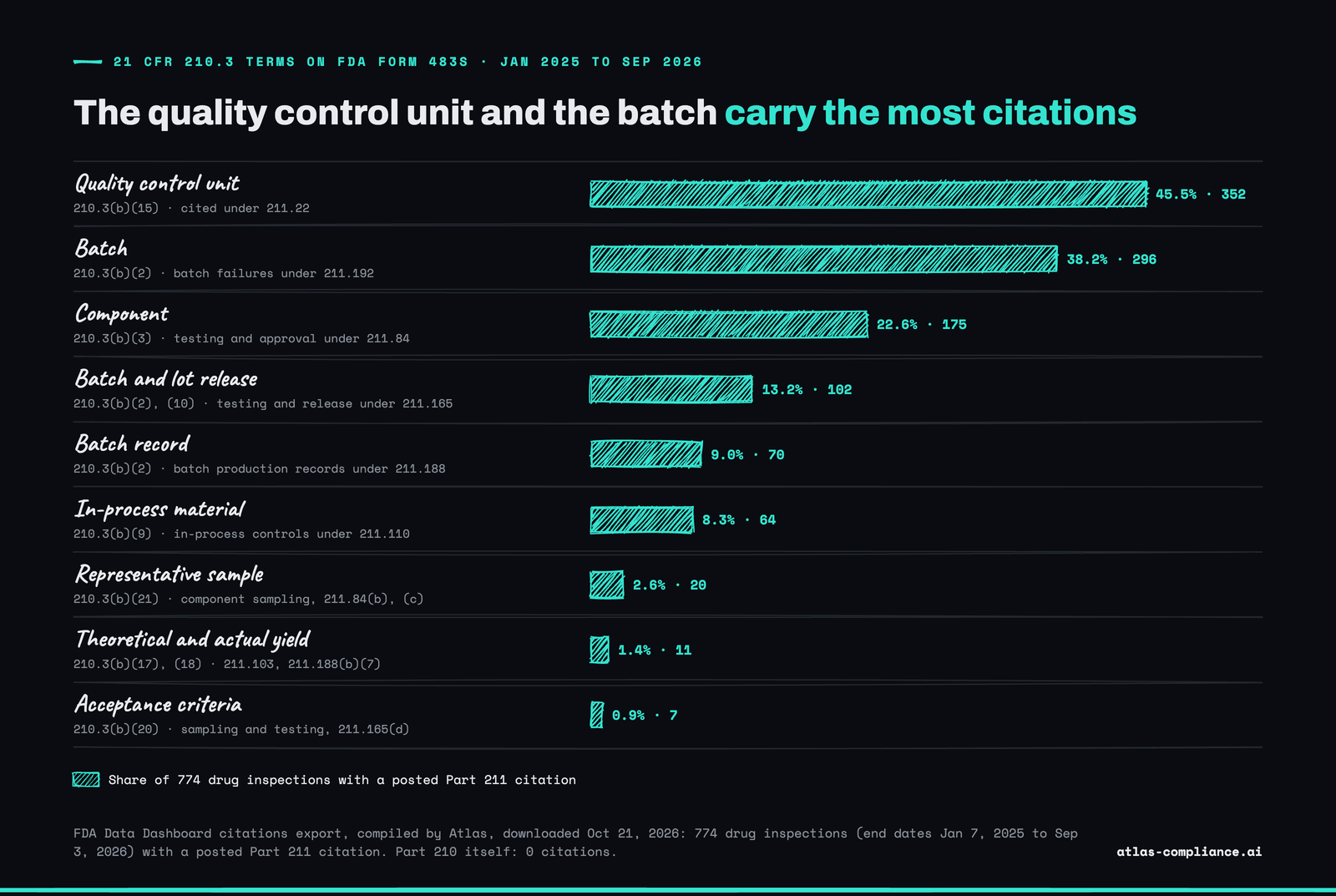
The quality control unit leads. FDA cited 211.22 in 352 of the 774 inspections (45.5%): paragraph (d), procedures "not in writing, fully followed", in 292, and paragraph (a) in 64, half of them written as "lack of quality control unit". Batch failures and discrepancies under 211.192 came second at 296 inspections (38.2%), and component testing under 211.84 third at 175 (22.6%).
FDA's own citation wording shows the same thing. Across the 774 inspections, the phrase "quality control unit" appears in citation text for 371 (47.9%), "batch" or "lot" for 381 (49.2%), and "component" for 352 (45.5%). The narrow definitions surface less often: acceptance criteria under 211.165(d) in 7 inspections, and theoretical or actual yield under 211.103 and 211.188(b)(7) in 11.
Named records in the Atlas Form 483 database show the definitions at work:
- Omega Tech Labs, Boise, Idaho, July 30, 2025: 10 observations, including 211.22(a) "Lack of quality control unit", 211.84(d)(1) identity testing of each component, and 211.188 batch records.
- Chartwell Pharmaceuticals Congers, New York, November 18, 2025: 15 observations, among them 211.22(d), 211.188 complete batch records, 211.192, 211.160(b)(2) in-process sample representation and 211.180(e)(1) review of a representative number of batches.
- Unither Manufacturing, Rochester, May 15, 2026: nine observations, including 211.165(d) acceptance criteria for sampling and testing, and 211.22(d).
- Health Pharma USA, Rahway, New Jersey, November 18, 2025: 19 observations split between Part 111 (dietary supplements) and Part 211, a reminder that "component" and "batch" carry different definitions depending on which CGMP part governs the product.
Each record links to the facility's inspection history, as on the Omega Tech Labs facility page, and to the investigators who wrote it. Before your next inspection, check which of these sections your assigned investigator has cited before.
 Atlas
See what the FDA knows about your next investigator.
30 minutes with the founder. No pitch deck.
How does Part 210 relate to Parts 211, 212, 213, 600 to 680 and 1271?
Part 210 is the hub that connects the drug CGMP parts. It names Parts 211, 213, 225 and 226 as CGMP, layers Parts 600 to 680 and 1271 on top for biologics and HCT/Ps, and lends its definitions to Parts 211, 225 and 226. Part 212 for PET drugs and Part 213 for medical gases carry their own definitions instead.
| Part | Covers | Uses 210.3 definitions? | Inspections citing it, Jan 2025 to Oct 2026 |
|---|---|---|---|
| 210 | Status, applicability, definitions | Yes, its own | 0 |
| 211 | Finished pharmaceuticals | Yes, through 211.3 | 774 |
| 212 | PET drugs | No, 212.1 | 56 |
| 213 | Designated medical gases (from June 18, 2024) | No, 213.3 | 0 |
| 225 and 226 | Medicated feeds and Type A medicated articles | Yes | 26 and 3 |
| 600 to 680 | Biological products, on top of 210 and 211 | Own terms in 600.3; 210.3 through Part 211 | 152 |
| 1271 | HCT/Ps; Subparts C and D apply to HCT/P drugs | Own terms in 1271.3; 210.3 through Part 211 | 103 |
Source: FDA Data Dashboard citations export compiled by Atlas, downloaded October 21, 2026, inspections ending January 2, 2025 to October 9, 2026. Counts are inspections with at least one posted citation to the part.
The overlaps are small. Only 6 inspections cited both Part 211 and Parts 600 to 680, and 4 cited both Part 211 and Part 1271. No inspection cited both Part 211 and Part 212, which fits the exclusion in 211.1(a).
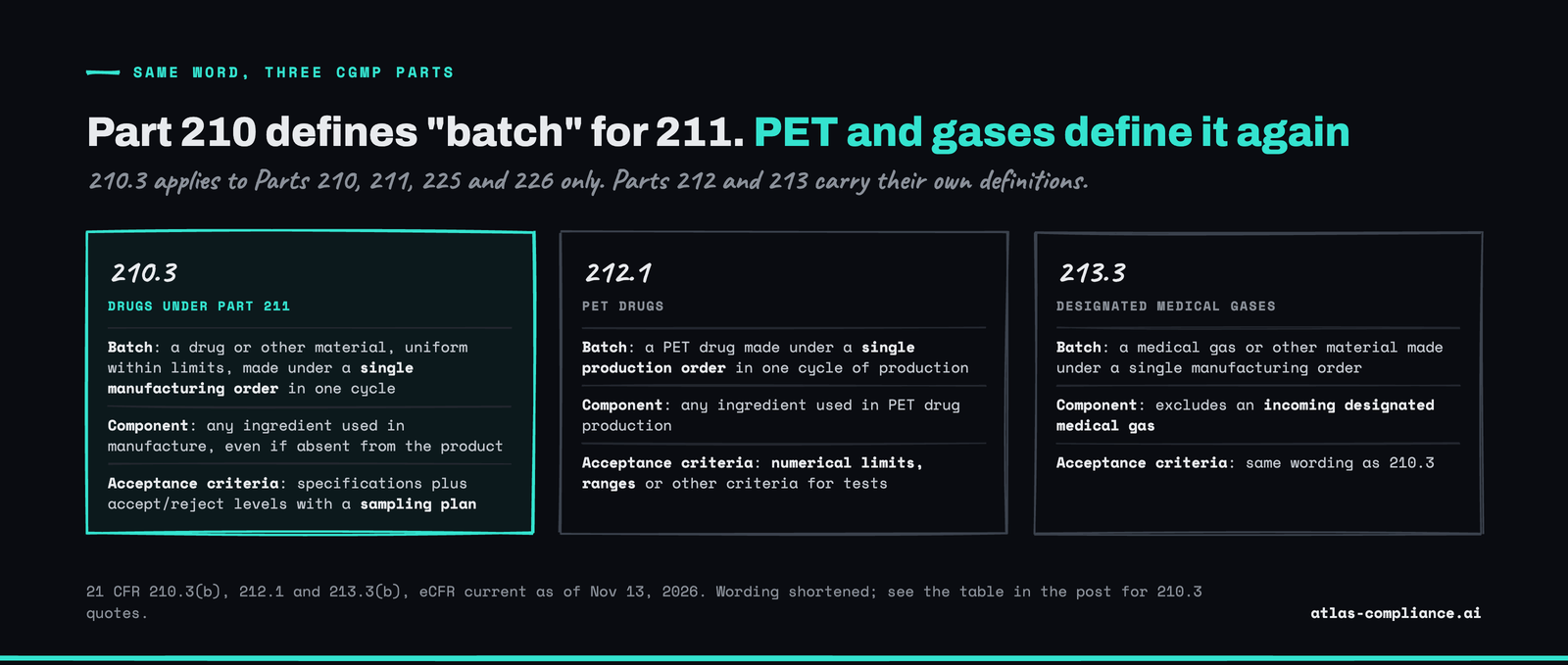
The definitions differ in ways an auditor will notice. A PET "batch" comes from a single "production order", and PET "acceptance criteria" means "numerical limits, ranges, or other criteria for tests", with no sampling plan in the definition. A medical gas "component" excludes an incoming designated medical gas. If your facility runs under more than one part, check that each SOP cites the definition from the part that governs that product.
How should a QA team use Part 210?
A QA team uses Part 210 to settle scope and vocabulary, then tests its procedures against the Part 211 sections FDA cites most:
- Write down who your quality control unit is. The 210.3(b)(15) definition lets the firm designate it, and 211.22(a) findings start when nobody can show that designation and its authority.
- Match your batch and lot numbering to 210.3(b)(11). The number must let you trace the complete history of manufacture, holding and distribution.
- List every component, including processing aids that leave the product, and confirm each has a specification and identity test under 211.84.
- Record the scope basis for contract work. If you rely on 210.2(b), name the operations you perform and the Part 211 sections that follow from them.
- Track phase 1 status. When a phase 1 product enters phase 2, the 210.2(c) exemption ends for every lot, including supplies still used in phase 1.
For the section FDA cites second most, read our guide to 21 CFR 211.192 investigations. Firms that make APIs rather than finished drugs should start with the API manufacturer Form 483 analysis, since Part 211 does not cover APIs directly.

FDA posts new Form 483 citations every month, and the quality control unit and batch sections keep leading them. The digest below sends the drug CGMP citations as FDA publishes them.
AtlasFDA Inspection Intelligence Digest
We track every 483, EIR, and warning letter the moment it happens. Get the signals before they hit the FDA website.
Frequently asked questions
21 CFR Part 210 is a binding regulation. FDA issued it under the FD&C Act, and section 210.1(b) makes a drug adulterated under section 501(a)(2)(B) when its manufacturer fails to follow Part 210 or Parts 211, 213, 225 and 226. Guidance documents explain FDA's current thinking, but they do not carry the legal force of the regulation.

Written by
Bhavish Agarwal
Founder, Atlas
Bhavish Agarwal is the founder of Atlas and previously worked at Google and Microsoft. He has spent the past several years building regulatory data infrastructure for the pharmaceutical industry.