
Pharmaceutical serialization is the practice of giving each saleable package of a drug a unique serial number, encoded with the product's NDC, lot and expiration date in a 2D barcode, so that trading partners can verify and trace that package. In the United States, the Drug Supply Chain Security Act (DSCSA) calls this code the product identifier and makes it mandatory for prescription drugs.
This guide covers what the product identifier holds, who must serialize and by when, the exemptions FDA granted after November 27, 2023, and how the US rules compare with the EU Falsified Medicines Directive. It adds one thing other serialization guides do not: Atlas counted every FDCA section 582 citation in FDA's Form 483 citation data, downloaded October 21, 2026.
Key facts:
- The DSCSA defines the product identifier as the standardized numerical identifier (the NDC plus a unique alphanumeric serial number of up to 20 characters), the lot number and the expiration date, in human-readable and machine-readable form (21 U.S.C. 360eee).
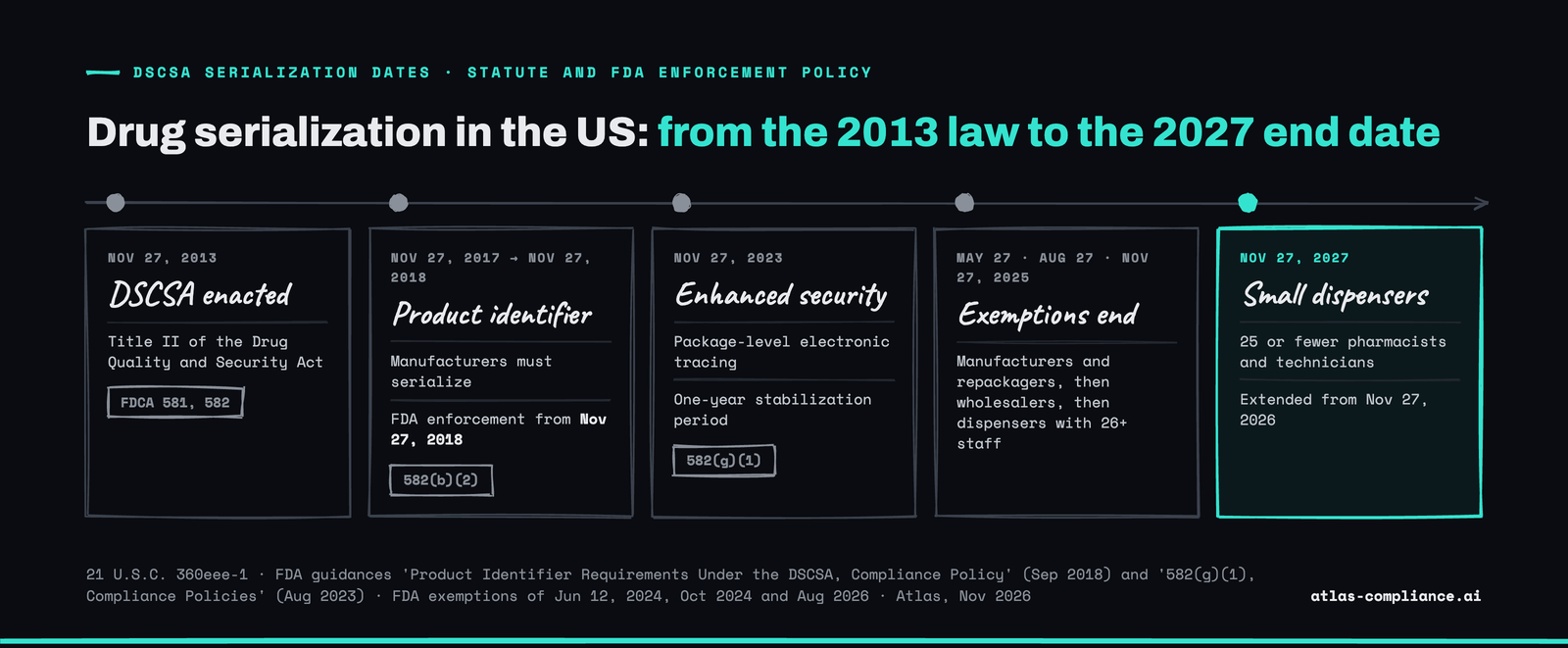
- The statute required manufacturers to serialize each package and homogeneous case from November 27, 2017, and FDA said in its September 2018 compliance policy that it would not take action for products packaged before November 27, 2018.
- Enhanced drug distribution security under FDCA 582(g)(1), meaning interoperable electronic tracing at the package level, took effect on November 27, 2023, followed by a one-year stabilization period to November 27, 2024.
- FDA exemptions for eligible trading partners ended on May 27, 2025 for manufacturers and repackagers, August 27, 2025 for wholesale distributors and November 27, 2025 for dispensers with 26 or more full-time employees, and the small dispenser exemption now runs to November 27, 2027.
- In FDA's Data Dashboard citation export (downloaded October 21, 2026), 21 citations under FDCA 582 appear in 17 inspections, and the first ended on May 15, 2024.
What is serialization in pharma?
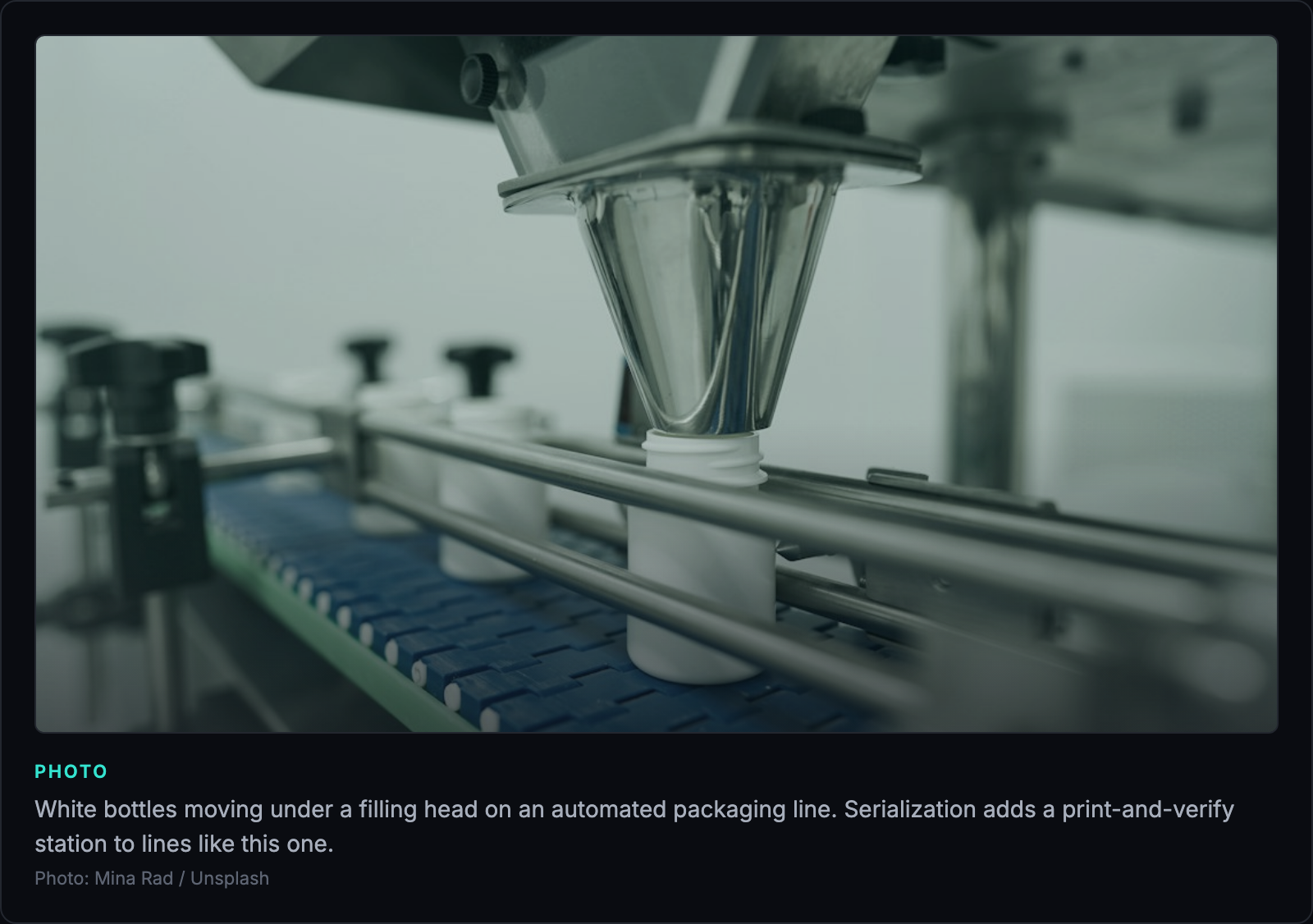
Serialization in pharma is the assignment of a unique, traceable identity to each saleable package of a drug, so a manufacturer, distributor, pharmacy or regulator can confirm that one specific package is genuine. Under the DSCSA, serialization means affixing or imprinting a product identifier on every package and homogeneous case that a manufacturer or repackager introduces into commerce.
The law sits in sections 581 and 582 of the Federal Food, Drug, and Cosmetic Act (FDCA), codified at 21 U.S.C. 360eee and 360eee-1. Congress enacted it on November 27, 2013. Our DSCSA overview covers the wider law: transaction information, licensing and product tracing. This post stays on serialization.
The DSCSA applies to "product", which the statute defines as a prescription drug in finished dosage form for administration to a patient. For section 582 purposes it excludes blood and blood components for transfusion, certain radioactive drugs, imaging drugs, certain intravenous products, medical gases, homeopathic drugs and drugs compounded under sections 503A or 503B. Over-the-counter drugs fall outside the definition.
Two packaging terms decide where the code goes. A package is the smallest individual saleable unit a manufacturer or repackager intends for sale to a dispenser. A homogeneous case is a sealed case holding product with a single NDC from a single lot.
What does a DSCSA product identifier contain?
A DSCSA product identifier contains four data elements: the National Drug Code, a serial number, the lot number and the expiration date. The NDC and serial number together form the standardized numerical identifier, which must be unique to each package or homogeneous case. FDCA 582(a)(9) requires the data in a 2D Data Matrix barcode on a package and in a linear or 2D Data Matrix barcode on a homogeneous case.
| Element | What the statute says | Where it comes from |
|---|---|---|
| National Drug Code | The NDC for the specific product, including the package configuration | FDA drug listing |
| Serial number | Unique alphanumeric serial number of up to 20 characters | Assigned by the manufacturer or repackager |
| Lot number | Lot of the product | Batch record |
| Expiration date | Expiration date of the product | Labeling |
The statute also requires the product identifier in human-readable form, and it lets trading partners verify it by human-readable or machine-readable methods. FDA's guidance "Product Identifiers Under the Drug Supply Chain Security Act: Questions and Answers" (June 2021) explains how the 2D code relates to the older linear NDC barcode under 21 CFR 201.25 (eCFR, 21 CFR 201.25).
The NDC inside every product identifier is about to change shape. FDA's final rule "Revising the National Drug Code Format and Drug Label Barcode Requirements" (Federal Register, March 5, 2026) moves all FDA-assigned NDCs to a uniform 12-digit format, with a 6-digit labeler code, a 4-digit product code and a 2-digit package code, effective March 7, 2033. FDA noted in the rule that a 2D Data Matrix encoding the product identifier could satisfy both the 201.25 and DSCSA barcode requirements.
What are the DSCSA serialization requirements by trading partner?
The DSCSA serialization requirements differ by trading partner: manufacturers and repackagers apply the product identifier, while wholesale distributors and dispensers may only trade product that carries one. The statute set those dates at four, five, six and seven years after enactment. Each sector also has verification duties tied to suspect and illegitimate product.
| Trading partner | Serialization duty | Statutory date | Verification duty in the statute |
|---|---|---|---|
| Manufacturer | Affix a product identifier to each package and homogeneous case; keep the data 6 years | Nov 27, 2017 | Answer a verification request within 24 hours; verify saleable returns before redistribution |
| Repackager | Affix its own product identifier; keep the data 6 years | Nov 27, 2018 | Answer a verification request within 24 hours |
| Wholesale distributor | Trade only product encoded with a product identifier | Nov 27, 2019 | Verify suspect product and saleable returns |
| Dispenser | Trade only product encoded with a product identifier | Nov 27, 2020 | Verify suspect product: at least 3 packages or 10%, whichever is greater |
FDA moved the manufacturer date in practice. Its guidance "Product Identifier Requirements Under the Drug Supply Chain Security Act: Compliance Policy" (announced in the Federal Register on September 20, 2018) said FDA did not intend to act against manufacturers for packages and cases packaged before November 27, 2018.
When a manufacturer finds illegitimate product, FDCA 582(b)(4)(B) requires it to quarantine and disposition the product, keep a sample, and notify FDA and its immediate trading partners within 24 hours. It must keep disposition records for at least 6 years after the disposition ends.
What changed on November 27, 2023?
On November 27, 2023, the enhanced drug distribution security requirements of FDCA 582(g)(1) took effect. Trading partners must now exchange transaction information electronically and interoperably, the transaction information must include the product identifier for each package, and systems must verify product at the package level, using the standardized numerical identifier.
FDA did not enforce the date immediately. Its guidance "Enhanced Drug Distribution Security Requirements Under Section 582(g)(1) of the Federal Food, Drug, and Cosmetic Act: Compliance Policies" (August 2023) set a one-year stabilization period from November 27, 2023 to November 27, 2024 for trading partners to troubleshoot their systems.
After that, FDA used its authority under FDCA 582(a)(3) to issue exemptions instead of another blanket delay:
- June 12, 2024: small dispensers, meaning the owning company has 25 or fewer full-time employees licensed as pharmacists or qualified as pharmacy technicians, exempted from certain 582(g)(1) and 582(d)(4) requirements until November 27, 2026.
- October 2024: eligible trading partners, those who completed or made documented efforts to complete data connections with their immediate trading partners, exempted until May 27, 2025 (manufacturers and repackagers), August 27, 2025 (wholesale distributors) and November 27, 2025 (dispensers with 26 or more full-time employees). FDA said they did not need to notify the agency.
- August 2026: the small dispenser exemption extended to November 27, 2027, for dispensers that meet the 25-employee test as of November 27, 2026.
FDA's exemptions page, last updated August 26, 2026, lists only the small dispenser exemption. Manufacturers, repackagers, wholesale distributors and larger dispensers now carry the full 582(g)(1) requirements unless FDA granted them an individual waiver or exemption.
Serialization vs aggregation: what is the difference?
Serialization gives each package its own product identifier; aggregation records which serialized packages sit inside which case, tote or pallet. Serialization is a statutory duty under FDCA 582(b)(2) and 582(e)(2). Aggregation is a data relationship that 582(g)(1)(C) allows: package-level verification systems "may include the use of aggregation and inference as necessary."
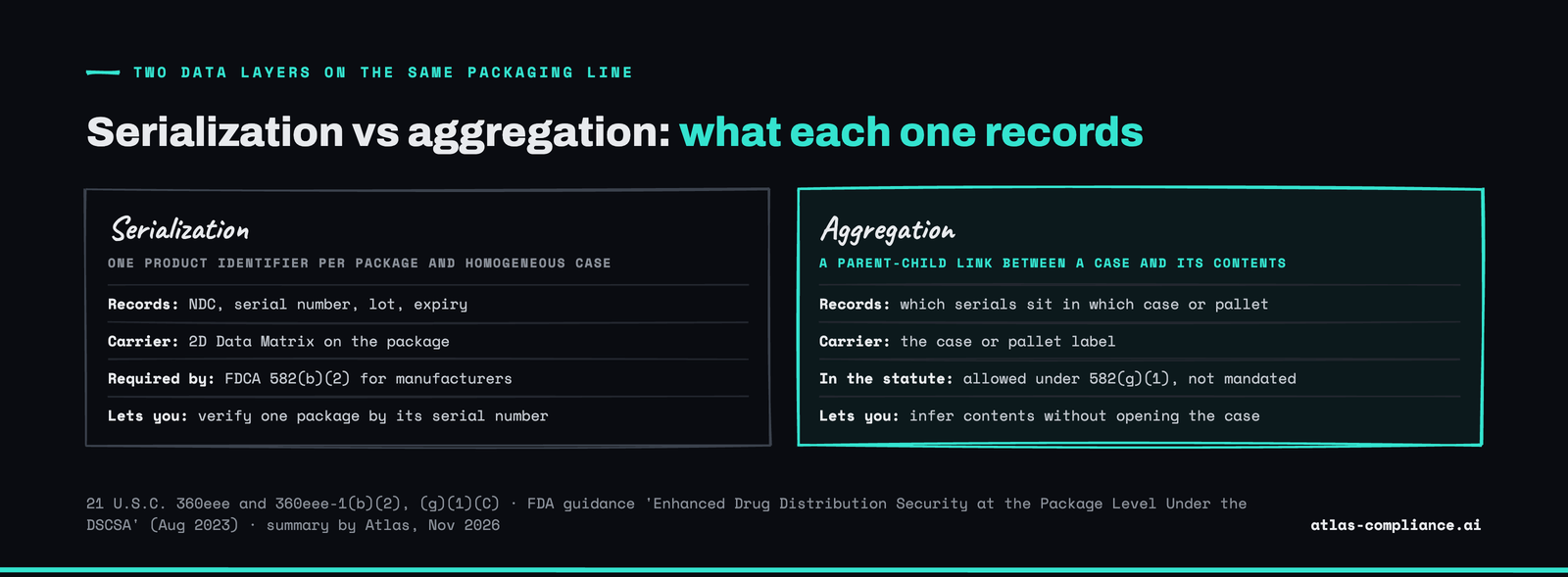
In the statute, inference means identifying the packages inside a case or pallet from the aggregate's product identifier without opening it. Inference only works if the parent-child record is accurate. When a packer reworks a case or a distributor splits a pallet, the aggregation data must change with it. FDA's guidance "Enhanced Drug Distribution Security at the Package Level Under the Drug Supply Chain Security Act" (August 2023) covers verification, inference and aggregation as system attributes.
How does DSCSA serialization compare with the EU FMD?
DSCSA serialization and the EU Falsified Medicines Directive both put a unique serial number, lot or batch, and expiry in a 2D Data Matrix on each pack. They differ in where the check happens. The EU rules, set out in Commission Delegated Regulation (EU) 2016/161 and applied from February 9, 2019, make the pharmacy verify and decommission each pack against a central repositories system at the point of supply.
| US: DSCSA | EU: Delegated Regulation 2016/161 | |
|---|---|---|
| Name of the code | Product identifier | Unique identifier |
| Data elements | NDC, serial number, lot, expiration date | Product code, serial number, batch, expiry, plus a national reimbursement number where a member state requires it |
| Serial number | Alphanumeric, up to 20 characters | Up to 20 characters from a randomization algorithm; chance of guessing below 1 in 10,000 |
| Barcode | 2D Data Matrix on packages; linear or 2D on homogeneous cases | Data Matrix, ISO/IEC 16022:2006 presumed to comply |
| Tamper evidence | Not part of the product identifier | Anti-tampering device required on the pack |
| Who checks routinely | Trading partners on suspect product, illegitimate product and saleable returns | Pharmacies verify and decommission at supply; wholesalers verify returns and some purchases |
| Data model | Transaction information exchanged between trading partners | Manufacturer uploads to the repositories system |
| Applies from | 2017 (product identifier), 2023 (enhanced security) | February 9, 2019; February 9, 2025 for member states with earlier national systems |
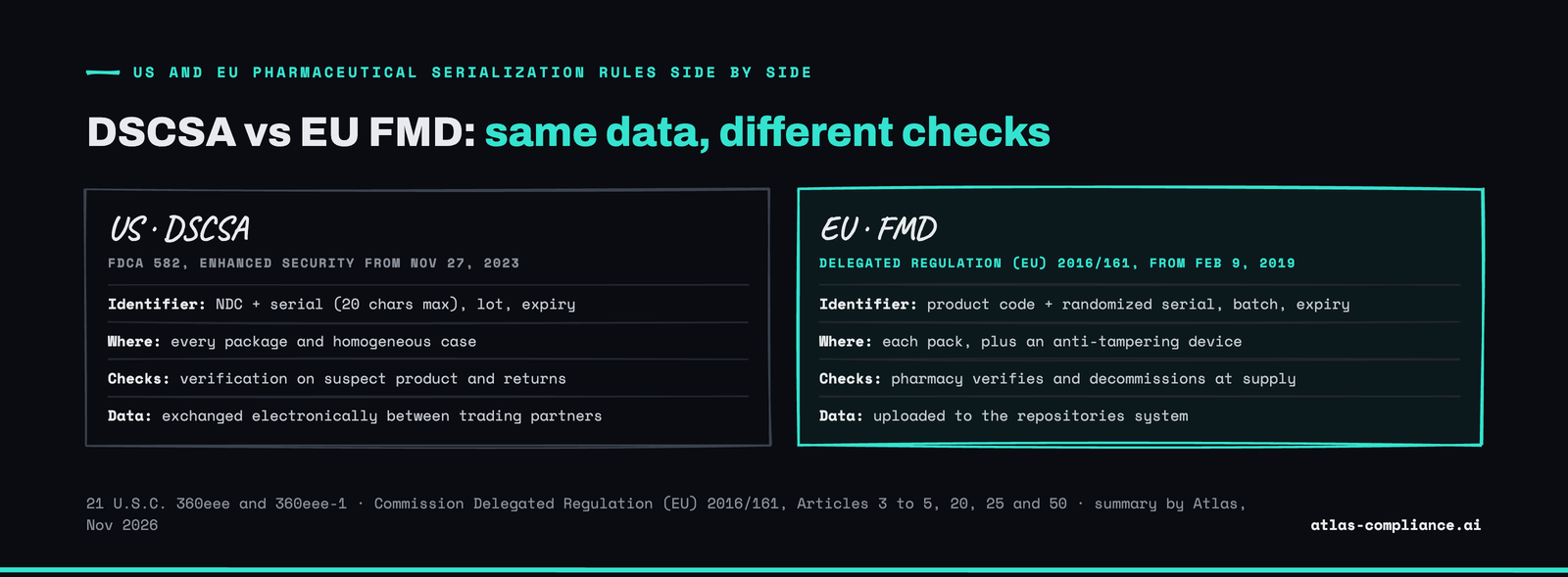
The EU randomization and anti-tampering requirements have no counterpart in the DSCSA statute. The DSCSA's package-level data exchange between trading partners has no direct counterpart in the EU model, where verification runs through the repositories system.
What does FDA cite under the DSCSA on Form 483s?
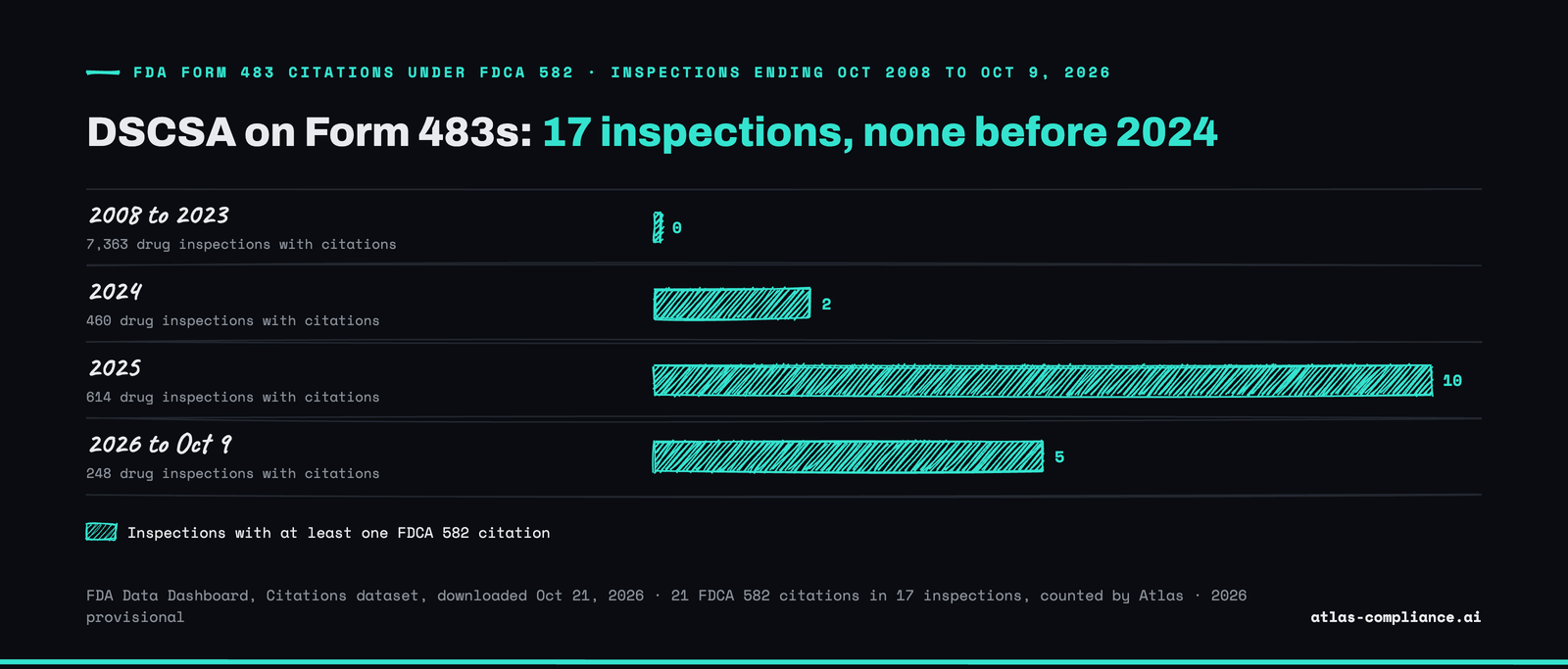
FDA has cited DSCSA requirements on Form 483s only since 2024. In FDA's Data Dashboard citation export, downloaded October 21, 2026 and covering inspections that ended between October 1, 2008 and October 9, 2026, Atlas found 21 citations under FDCA 582 in 17 inspections. All 21 sit in the Drugs program area. The first inspection with one ended on May 15, 2024.
Seventeen of the 21 citations fall under FDCA 582(b)(4) and carry the same short description: the firm failed to have systems in place to enable compliance with the verification requirements of the DSCSA. The other four are one each under 582(b)(2)(A) for not keeping product identifier information for 6 years, 582(g)(1) and 582(g)(1)(C) for missing package-level electronic systems, and 582(b)(4)(B)(ii)(I) for not notifying FDA within 24 hours of finding illegitimate product.
The numbers stay small against all drug inspections. In 2025, 10 of the 614 drug inspections with posted citations included a 582 citation, about 1.6%. In 14 of the 17 inspections, the DSCSA observation sat next to Part 211 CGMP citations, most often 211.67 (7 inspections) and 211.192 (6). So far, DSCSA findings reach a Form 483 mostly as one observation among CGMP findings, not as the subject of a separate inspection.
| Inspection end | Firm | FDCA 582 citation | Other sections on the Form 483 |
|---|---|---|---|
| May 15, 2024 | Aurobindo Pharma USA, East Windsor | 582(b)(4); 582(b)(4)(B)(ii)(I), 24-hour notice | None |
| Apr 9, 2025 | Kavis Pharma, Sugar Land | 582(b)(4) | 211.113(a), 211.68(b) |
| May 16, 2025 | Evaric Pharmaceuticals, Hauppauge | 582(b)(4) | 211.110(a), 211.42(c), 211.67(a) |
| Jan 23, 2026 | Benuvia Operations, Round Rock | 582(b)(4) | 211.194(a), 211.67(a) |
| Mar 20, 2026 | The Harvard Drug Group, La Vergne | 582(b)(4) | 211.192, 211.22(d) |
Each linked record in the FDA Form 483 database shows the full observation list and the inspection team. Our guide to the FDA Data Dashboard explains how the citation export is built and why 2026 counts are provisional.
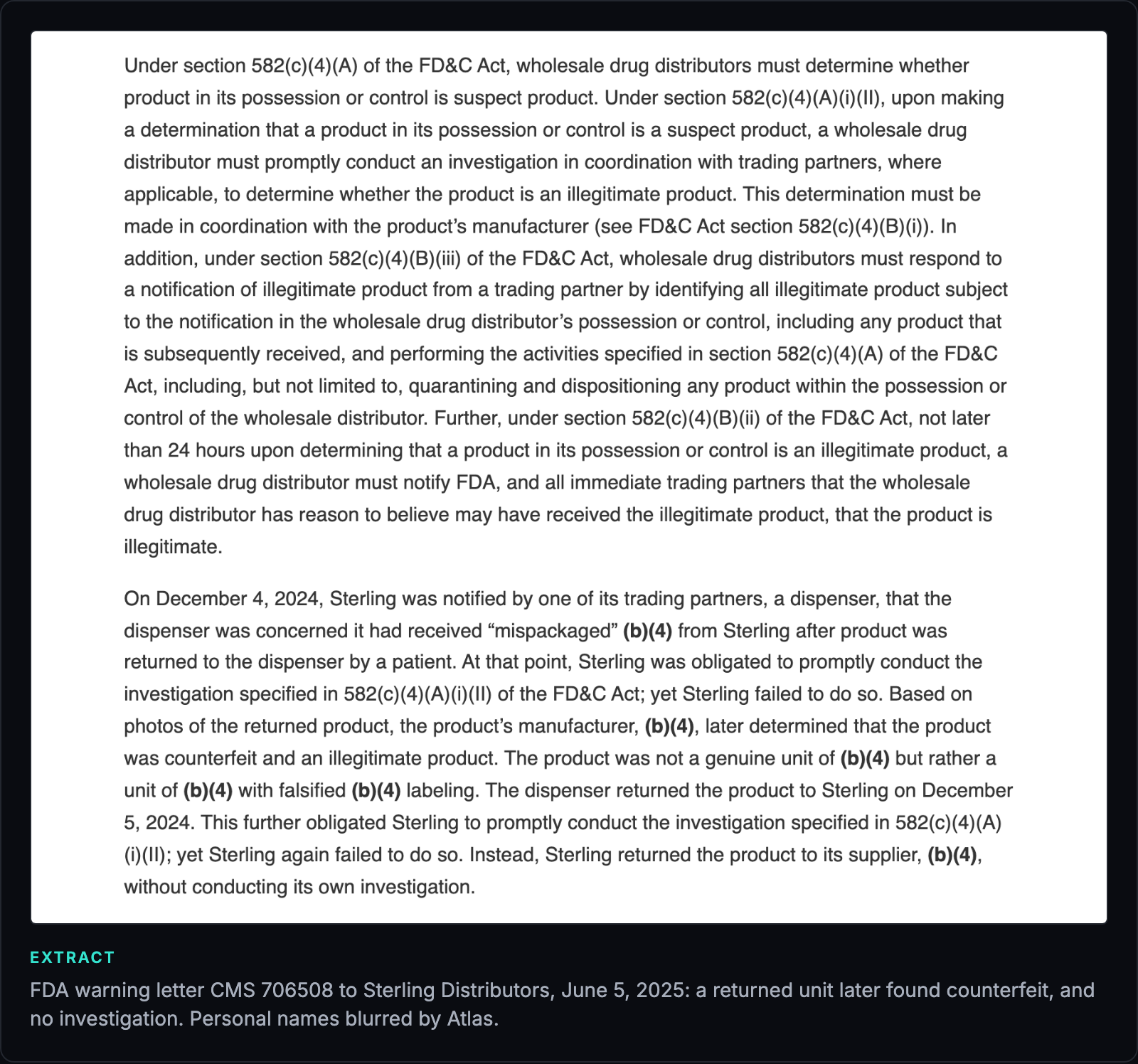
Warning letters are rarer still. FDA's warning letter table for letters dated January 4, 2021 to October 14, 2026 holds 3,768 letters, and 2 carry the subject "Drug Supply Chain Security Act (DSCSA) Violations." FDA wrote to Sterling Distributors, a wholesale distributor in Coral Springs, Florida, on June 5, 2025 (CMS 706508), after a March 4 to 6, 2025 inspection. Among other findings, the letter cites a returned unit that the manufacturer later found counterfeit and that the firm did not investigate.
The second letter, dated April 1, 2026 (CMS 723267), went to a medical spa in Southlake, Texas, that dispenses prescription drugs. It cites 582(d)(3) for failing to show that it bought only from authorized trading partners and 582(d)(2) for an unlabeled vial of botulinum toxin with no product identifier. Both letters came from CDER's Office of Drug Security, Integrity and Response, and neither was sent to a manufacturer. Our warning letter database guide shows how to search the full table by subject.
If your facility has a drug CGMP inspection coming, the 17 records above show what investigators ask for on DSCSA: a written verification procedure and evidence that it runs. You can see which sections your likely investigator has cited at similar facilities before the inspection starts.
 Atlas
See what the FDA knows about your next investigator.
30 minutes with the founder. No pitch deck.
How do you prepare a serialization program for an FDA inspection?
You prepare a serialization program for an FDA inspection by showing written procedures and working records for each DSCSA duty an investigator can test. The 582(b)(4) citations above all describe missing systems, so start there:
- Write a verification SOP that covers suspect product, illegitimate product, verification requests answered within 24 hours, and the 24-hour notice to FDA and trading partners.
- Keep product identifier data, including serial numbers and the lot and expiry they map to, for at least 6 years after each transaction.
- Verify the product identifier of saleable returns before you redistribute them, at the sealed homogeneous case or package level.
- Test your package-level electronic exchange and verification with each immediate trading partner now that the 2025 exemptions have ended.
- Check aggregation records after any rework, relabel or repack so case data matches the packages inside.
- Map NDC fields in your serialization and labeling systems ahead of the 12-digit NDC rule effective March 7, 2033.
Serialization data also belongs in supplier qualification when a contract packager or third-party logistics provider handles your product. The DSCSA citations above appeared on the same Form 483s as laboratory, cleaning and investigation findings under 21 CFR Part 211, so the inspection team reviewing your serialization file is often the CGMP team.
FDA posts new Form 483 citations and warning letters every week, and the digest below sends the drug letters, DSCSA ones included, when they post.
AtlasFDA Inspection Intelligence Digest
We track every 483, EIR, and warning letter the moment it happens. Get the signals before they hit the FDA website.
Frequently asked questions
DSCSA serialization does not apply to over-the-counter drugs. The statute defines "product" as a prescription drug in finished dosage form for administration to a patient. It also leaves out blood for transfusion, certain radioactive drugs, imaging drugs, medical gases, certain intravenous products, homeopathic drugs and compounded drugs.

Written by
Bhavish Agarwal
Founder, Atlas
Bhavish Agarwal is the founder of Atlas and previously worked at Google and Microsoft. He has spent the past several years building regulatory data infrastructure for the pharmaceutical industry.