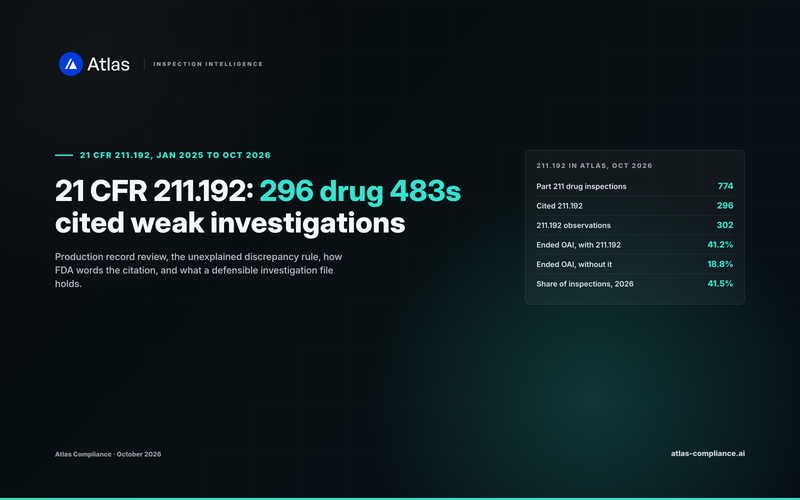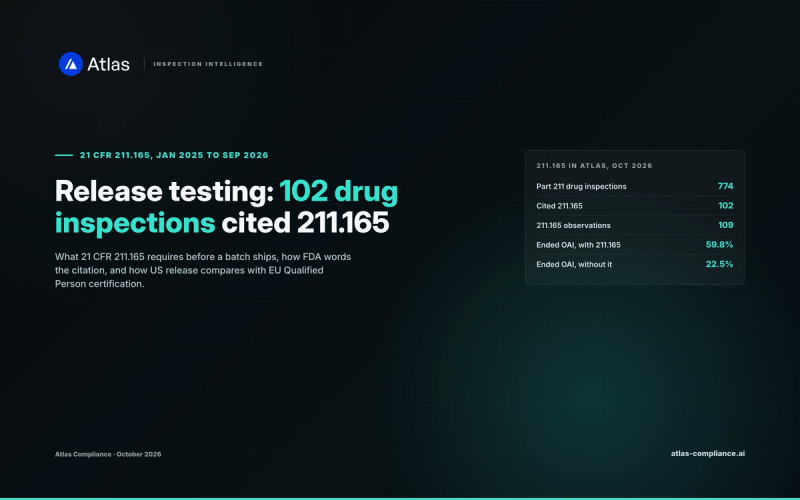

OOS vs OOT is the difference between a test result that falls outside its approved specification (out of specification) and a result that stays inside the specification but breaks from the expected pattern of earlier data (out of trend). An OOS result triggers a mandatory investigation under 21 CFR 211.192 and can reject the batch. An OOT result is an early warning that no FDA regulation defines.
This guide covers both, plus the OOS investigation FDA expects, and adds Atlas data you will not find on other pages: 1,525 drug inspections between October 2008 and September 2026 where FDA cited an OOS-related failure, from the Atlas Form 483 citation dataset (pulled October 21, 2026) joined to FDA's inspection classifications.
Key facts:
- 21 CFR 211.192 requires a thorough, written investigation of any failure of a batch or its components to meet a specification, extended to other batches that may be affected.
- FDA's OOS guidance splits the work into Phase I, a laboratory investigation, and Phase II, a full-scale investigation led by the quality unit.
- No FDA regulation or FDA guidance defines OOT; the working definitions come from the MHRA's OOS and OOT guidance and from PhRMA stability papers.
- In the Atlas dataset, 1,525 of 8,123 drug inspections citing 21 CFR Part 211 (18.8%) carried an OOS-related citation.
- 521 of those 1,525 inspections (34.2%) ended Official Action Indicated (OAI), against 14.9% of the other 6,598.
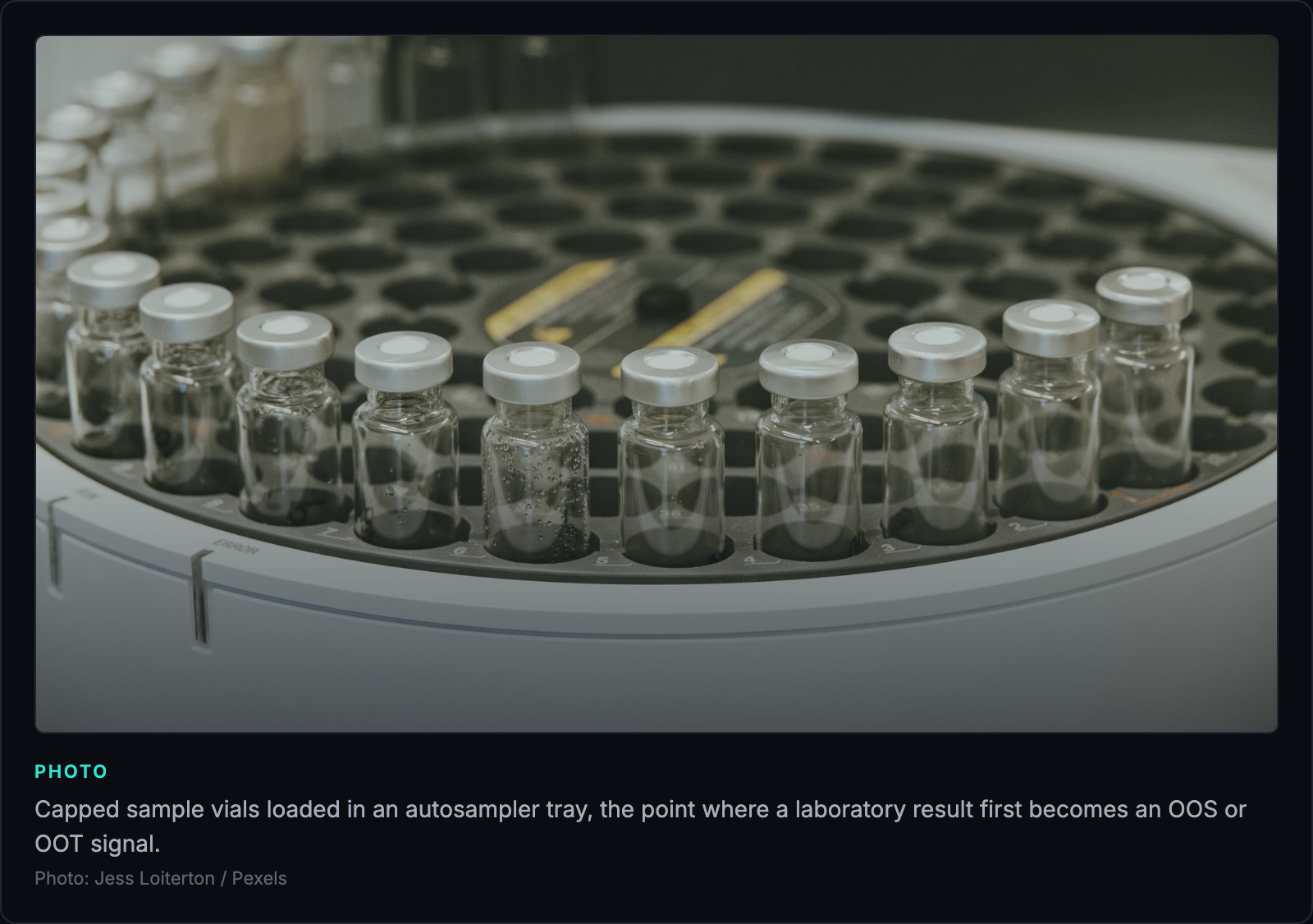
What is OOT and OOS in pharma?
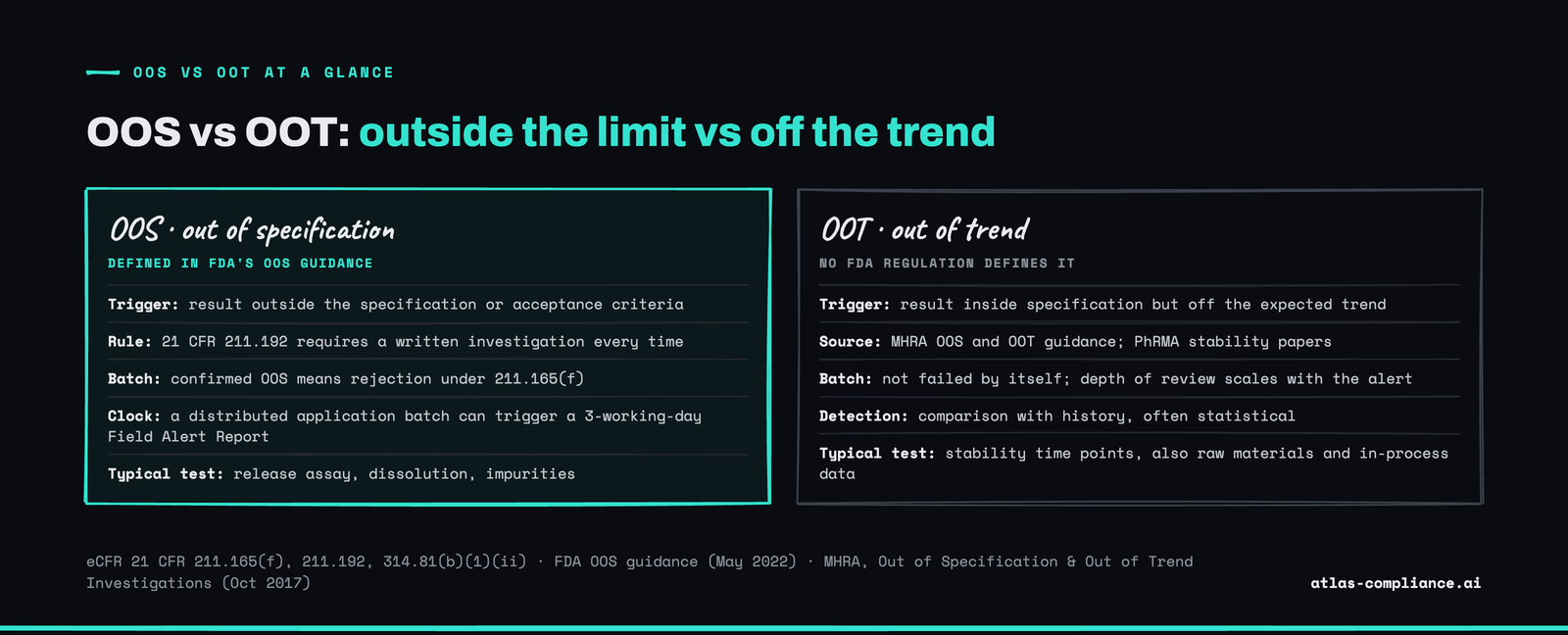
OOS and OOT in pharma are two kinds of laboratory signal. OOS, out of specification, is a result outside the specification or acceptance criteria set in a drug application, drug master file, official compendium or by the manufacturer. OOT, out of trend, is a result that still meets the specification but does not follow the trend of earlier results for that product or study.
FDA's OOS guidance also applies the OOS term to in-process laboratory tests that fall outside established specifications. The MHRA describes an OOT result as "generally a stability result" off the expected trend, and adds that starting material and in-process data can also trend out. Some firms' SOPs add a third label, OOE (out of expectation), for odd results that are neither. The basic definitions sit in our explainer on OOS meaning in pharma; the table below sets the three side by side.
| OOS | OOT | OOE | |
|---|---|---|---|
| Full form | Out of specification | Out of trend | Out of expectation |
| What it means | Result outside the approved specification or acceptance criteria | Result inside specification but off the expected trend | Result inside specification but unusual, such as an unexpected peak |
| Who defines it | FDA OOS guidance; 21 CFR 211.192 and 211.165 apply | MHRA OOS and OOT guidance; PhRMA stability papers; no FDA regulation | Company SOPs; the MHRA calls these atypical, aberrant or anomalous results |
| Investigation | Required every time, in writing | Scaled to the alert level | Set by the firm's SOP |
| Effect on the batch | A confirmed OOS means rejection under 211.165(f) | The batch does not fail on the OOT result alone | No direct effect unless the review finds a cause |
| Typical place it shows up | Release assay, dissolution, impurities, stability | Stability time points, raw material and in-process trends | Chromatograms, replicate behavior, stability points |
What is OOS in pharma with an example?
An OOS result in pharma is any reportable test result outside its specification, for example an assay of 89.5% against an approved range of 90.0% to 110.0%. FDA's OOS guidance uses that exact case. The 89.5% result has to be investigated before the quality unit can release or reject the batch.
The guidance then walks the example forward. Phase I finds no laboratory error. Seven retests of the original sample give results between 98.8% and 99.1%. Production records show no unusual variation, and content uniformity and dissolution agree with the passing retests. In that case the quality unit "might" conclude the 89.5% did not reflect the batch, and only after a full investigation.
A second example in the guidance shows why averaging is restricted. An assay with a 90% to 110% specification gives an initial 89%, then retests of 90% and 91%. The average is 90%, inside the limit, yet the retests tend to confirm the failure. FDA says the individual results, not the average, decide product quality.
What are the phases of an OOS investigation?
An OOS investigation has two phases in FDA's guidance, Investigating Out-of-Specification (OOS) Test Results for Pharmaceutical Production (May 2022). Phase I is a laboratory investigation by the analyst and supervisor. Phase II is a full-scale investigation by the quality unit when Phase I finds no clear laboratory error. The investigation then ends with the result invalidated, confirmed or inconclusive.
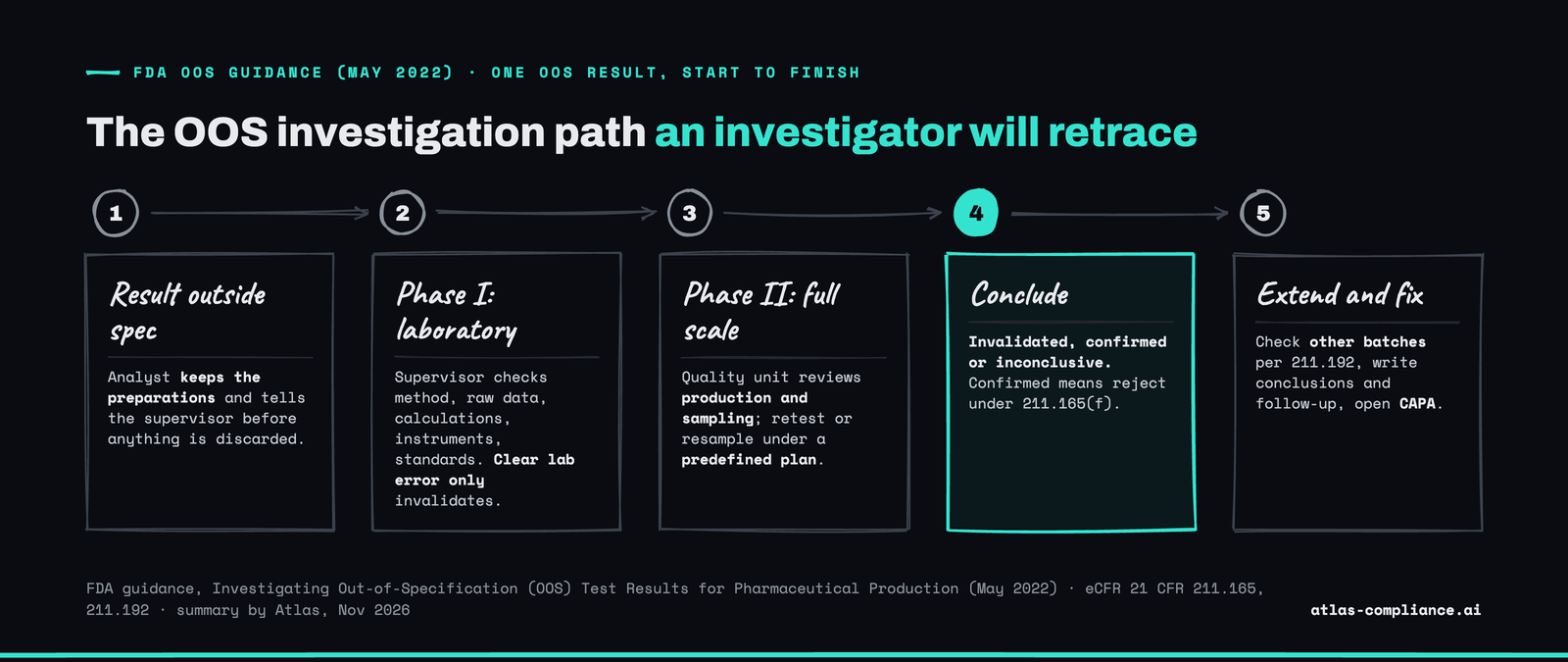
- The analyst keeps the test preparations, if stable, and informs the supervisor before discarding anything.
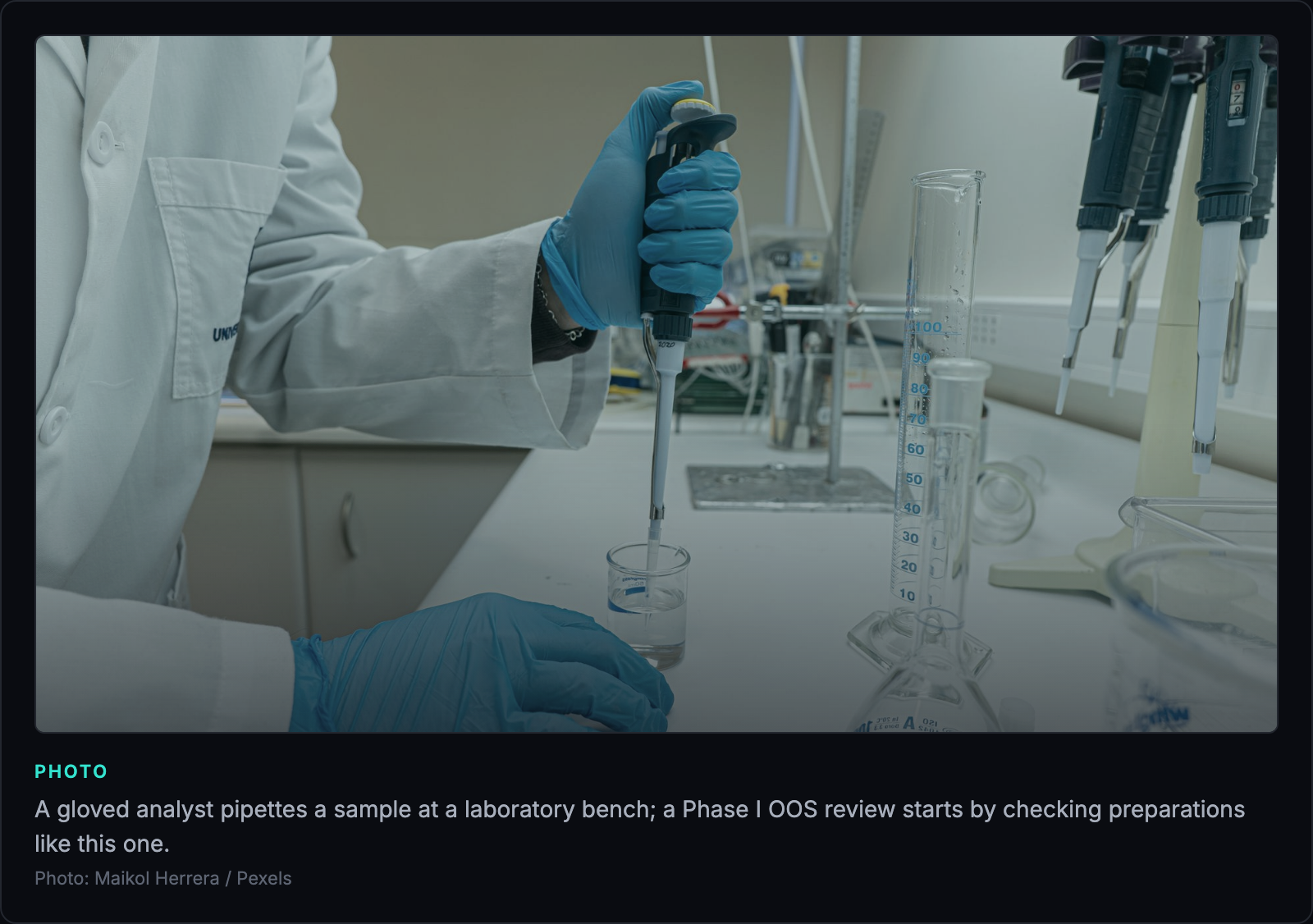
- Phase I: the supervisor discusses the method with the analyst, examines raw data such as chromatograms, verifies calculations, confirms instrument performance, checks standards and reagents, and compares method performance with validation and historical data. Only clear evidence of laboratory error invalidates the result.
- Phase II: the quality unit reviews production and sampling with manufacturing, process development, maintenance and engineering, including other sites when manufacturing is off-site. The written record states the reason, the possible process causes, the documentation review, whether the problem happened before, and the corrective actions.
- Conclusion: an invalidated result drops out; a confirmed OOS means the batch fails under 211.165(f); an inconclusive result still gets "full consideration" in the disposition decision.
- A confirmed OOS becomes a batch failure investigation that 211.192 requires extending to other batches and products.
Contract laboratories run Phase I and pass their data to the manufacturer, whose quality unit starts Phase II. The MHRA's version splits the same work into Phase Ia, Ib, II and III, with Phase III reviewing the completed manufacturing and laboratory investigations before batch disposition.
Phase II often adds laboratory testing, and this is where investigators look hardest. The guidance sets these limits:
| Practice | What FDA's OOS guidance allows | What it calls objectionable |
|---|---|---|
| Retesting | A portion of the same homogeneous original sample, under an SOP that fixes the maximum number of retests in advance, often by a second analyst at least as qualified | "Testing into compliance": retesting until a pass appears, or changing the retest count after seeing results |
| Resampling | A new sample only under predetermined procedures, for example when the original sample proves unrepresentative | Collecting a new sample because the first one failed |
| Averaging | Only when the approved method defines the reportable result as an average and the same approach was used in the original test | Averaging an OOS result with retests, and averaging for blend or content uniformity |
| Outlier tests | Biological assays with high variability, as USP describes | Invalidating a chemical assay; any use for content uniformity, dissolution or release rate |
FDA's guidance cites the 1993 Barr Laboratories court opinion for the point that outlier tests should not invalidate chemical assays. For approved drugs there is also a clock: 21 CFR 314.81(b)(1)(ii) requires a Field Alert Report within 3 working days when a distributed batch fails a specification in the application, unless the OOS result is found invalid within that time.
Where does OOT guidance come from if FDA does not define it?
OOT guidance comes from outside FDA regulations. The MHRA's Out of Specification and Out of Trend Investigations guidance (October 2017 version, gov.uk page updated February 2018) defines OOT results and sets investigation expectations. The PhRMA CMC Statistics and Stability Expert Teams published the statistical groundwork in Pharmaceutical Technology in 2003 and 2005.
FDA's guidance touches OOT in a single footnote, saying much of its OOS advice "may be useful" for out-of-trend results. It also tells laboratory management to watch for developing trends. The CGMP hook is indirect: 21 CFR 211.180(e) requires records that allow an evaluation, at least annually, of each drug product's quality standards, and 211.166 requires a written stability program.
The MHRA guidance sorts OOT stability alerts into three levels, with deeper investigation at each step:
- An analytical alert: a single result that is aberrant but within specification.
- A process control alert: the middle level; the PhRMA Part II paper names a slope control chart as one way to detect it.
- A compliance alert: an OOT result that suggests an OOS could occur before expiry, in the same study or others on the product.
The PhRMA teams define OOT stability data as a result or sequence of results within specification but unexpected, given normal analytical and sampling variation and normal change over time. Their Part II paper also reports that participants at a 2003 workshop with FDA saw no need for separate FDA guidance on OOT, because the OOS guidance should suffice.
A compliance alert is the OOT case that turns urgent, because it predicts a future OOS on product already in the market.
What is OOS and CAPA?
OOS and CAPA connect through 21 CFR 211.192. An OOS investigation finds the root cause; corrective and preventive action (CAPA) fixes it and stops it recurring. FDA's OOS guidance states that the objective of a Phase II investigation is to identify the root cause and "take appropriate corrective action and preventive action."
The regulation says it in fewer words. Section 211.192 requires that the written record "shall include the conclusions and followup," and the guidance adds that implicit in that requirement is the need to implement CAPA, consistent with ICH Q10. The full text is on eCFR, 21 CFR 211.192, and our 21 CFR 211.192 guide covers each clause.
CAPA applies even when Phase I finds a laboratory error. The guidance says laboratory error "should be relatively rare," and frequent errors point to training, equipment or careless work that the firm must correct and document. A confirmed OOS also ties back to release: under 21 CFR 211.165, a product that fails its specification is rejected, a step our release testing guide places in the batch release path.
To check whether those corrective actions work, track repeat OOS results by test and product, the share of investigations invalidated as laboratory error, and time to closure. Our post on CAPA effectiveness metrics sets out how to measure them.
What does FDA cite when an OOS investigation falls short?
FDA cites a weak OOS investigation mainly under 21 CFR 211.192, using standard wording that the firm failed to thoroughly review "the failure of a batch or any of its components to meet any of its specifications." A batch released despite a failing result draws 211.165(f), "Drug products failing to meet established specifications are not rejected."
In the Atlas Form 483 citation dataset, 1,525 drug inspections that closed between October 2008 and September 2026 carried either citation: 1,429 with the 211.192 specification-failure wording, 176 with 211.165(f), and 80 with both. Of the 2,547 inspections that cited 211.192 at all, 1,429 (56.1%) used the specification-failure wording.
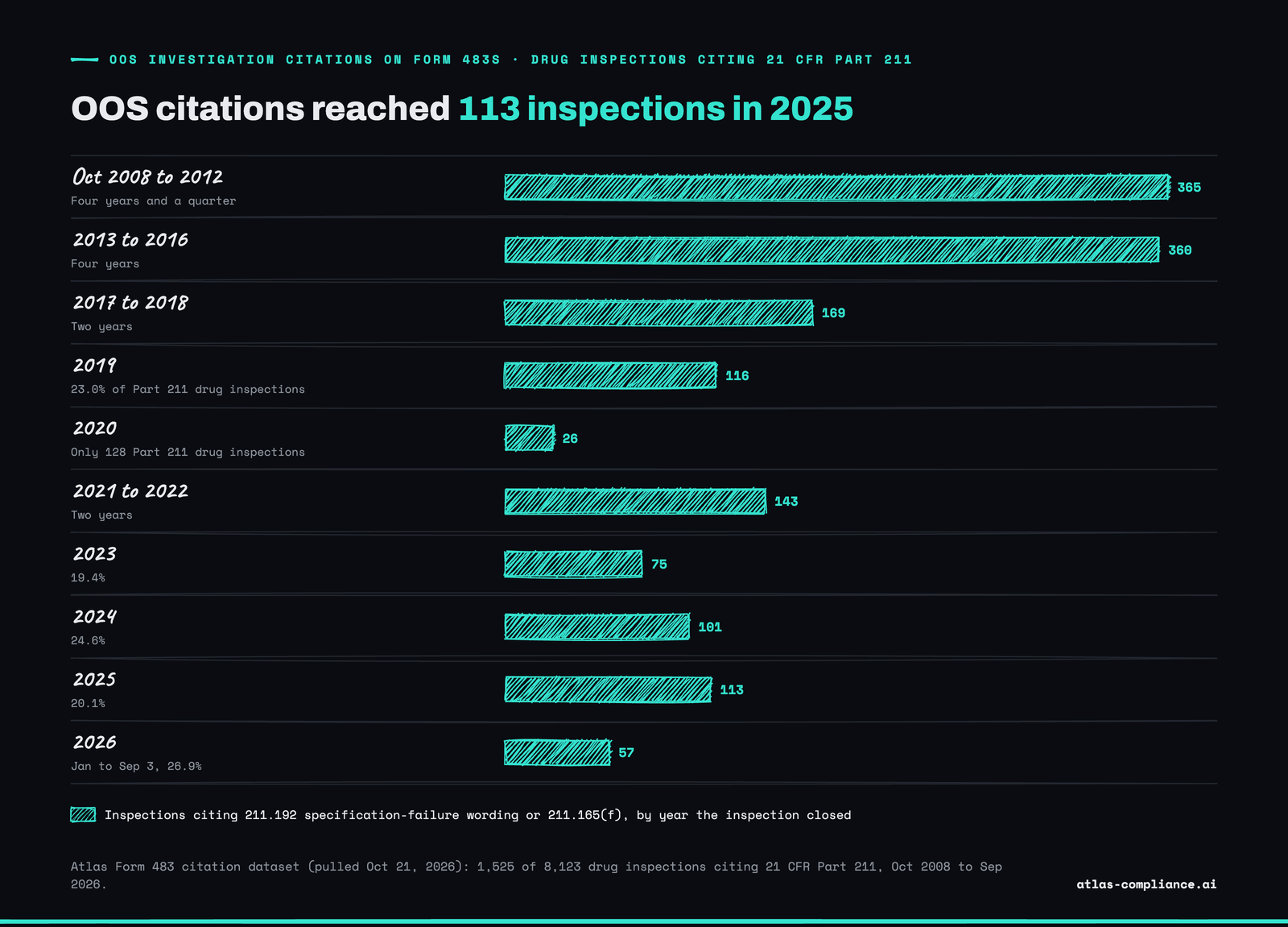
The citation has held steady over time. In 2025, 113 of 562 Part 211 drug inspections (20.1%) carried it; in 2024, 101 of 411 (24.6%). The low count for 2020 reflects fewer inspections: only 128 Part 211 drug inspections closed that year. Of the 1,525, 1,207 were at US facilities and 78 in India.

An OOS citation rarely stands alone. The 1,525 inspections averaged 6.8 distinct Part 211 sections against 4.4 for the rest, and 521 of them (34.2%) ended OAI, against 14.9% of the other 6,598. The most common companions were 211.22(d), quality unit procedures, at 521 inspections; 211.100(a), written production procedures, at 423; and 211.160(b), scientifically sound laboratory controls, at 415. Across January 2025 to September 2026, 88 of 170 OOS-cited inspections (51.8%) were classified OAI as of the October 21, 2026 pull, against 21.0% of the other 604, though recent classifications can still change. The guide to NAI, VAI and OAI classifications explains what OAI sets in motion.
Recent examples in the FDA Form 483 database, each citing 211.192 with the specification-failure wording:
| Facility | Inspection closed | Other Part 211 sections cited | Classification |
|---|---|---|---|
| Ajanta Pharma, Paithan, India | Apr 21, 2026 | 211.22(d), 211.63, 211.67(a), 211.100(b) | VAI |
| Baxter Healthcare, Round Lake, US | Apr 2, 2026 | 211.165(d), 211.160(a), 211.113(b) and five more | OAI |
| Jubilant HollisterStier, Kirkland, Canada | Nov 3, 2025 | 211.160(b), 211.22(d), 211.188(b) and four more | OAI |
| Lupin, Pithampur, India | Jul 17, 2025 | 211.110(a), 211.113(b), 211.42(c)(10)(iii) | OAI |
| Eurofins Lancaster Laboratories, Portage, US | May 30, 2025 | 211.160(a), 211.160(b), 211.63, 211.68(b) | VAI |
| Shiva Analyticals, Hoskote, India | Jan 24, 2025 | 211.160(b), 211.22(d), 211.198(a) | OAI |
Two of the six are contract testing laboratories, which FDA's guidance holds to the same OOS responsibilities as a manufacturer. The Baxter form pairs the OOS citation with 211.165(d), acceptance criteria for sampling and testing, the section the guidance invokes for outlier rules.
Each Form 483 page lists the investigators who wrote it, so you can see which sections your next investigator has cited at other laboratories before the opening meeting.
 Atlas
See what the FDA knows about your next investigator.
30 minutes with the founder. No pitch deck.
New Form 483s that cite OOS investigations arrive every month, and the digest below sends the ones that matter for QC laboratories as FDA records them.
AtlasFDA Inspection Intelligence Digest
We track every 483, EIR, and warning letter the moment it happens. Get the signals before they hit the FDA website.
Frequently asked questions
OOS in GMP is a test result that fails a specification or acceptance criterion during work governed by current good manufacturing practice, on components, in-process materials, finished product or stability samples. Under 21 CFR 211.192 every such failure needs a thorough written investigation with conclusions and follow-up, whether or not the batch has already been distributed.

Written by
Bhavish Agarwal
Founder, Atlas
Bhavish Agarwal is the founder of Atlas and previously worked at Google and Microsoft. He has spent the past several years building regulatory data infrastructure for the pharmaceutical industry.