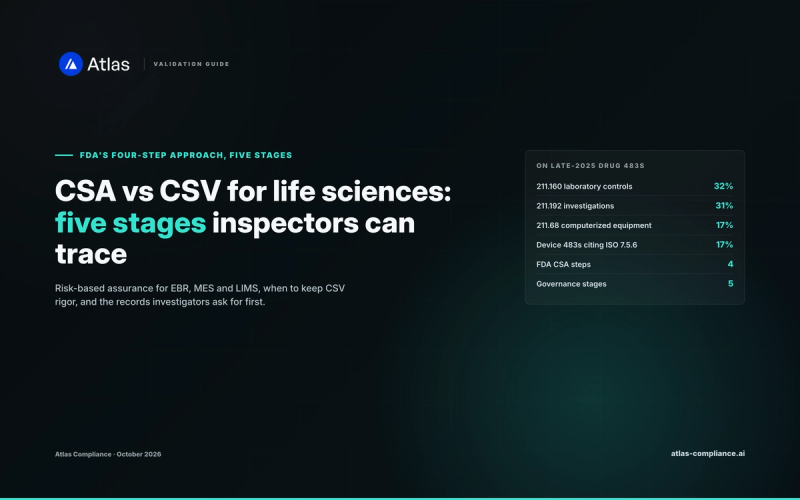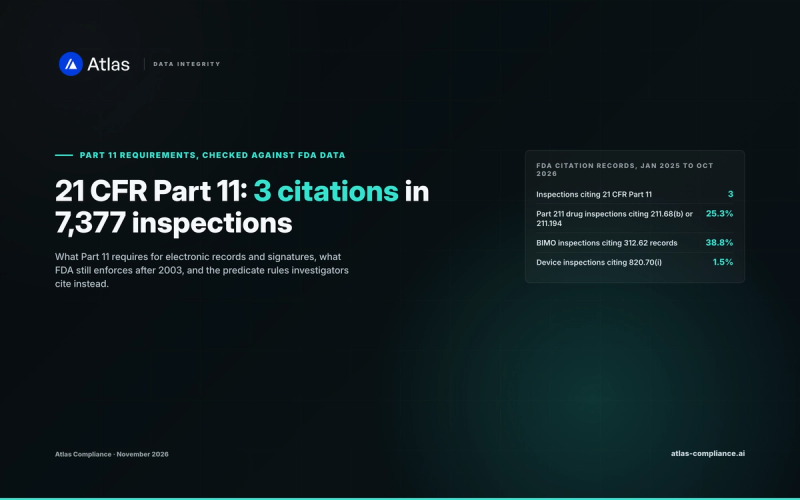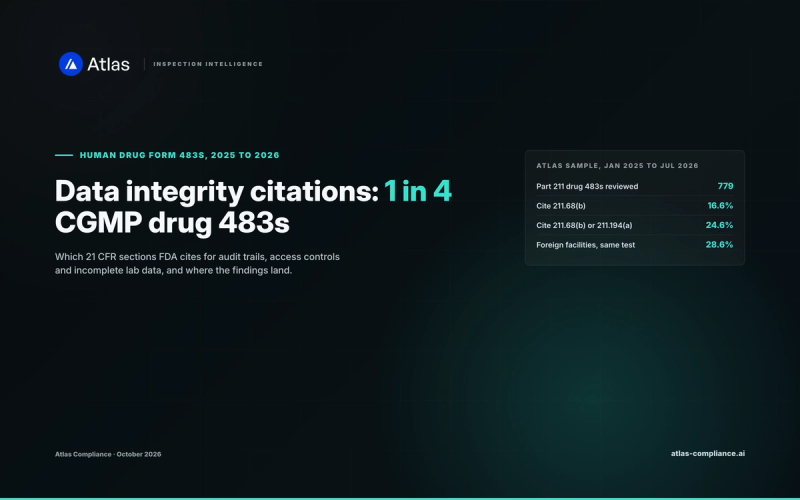

GAMP 5 is ISPE's risk-based guide for validating computerized systems used in GxP work, and its second edition, published in July 2022, sorts software into categories 1, 3, 4 and 5 by how much of the code is new to your use. The category tells you where defects are likely to sit; your risk assessment decides how much testing that justifies.
This guide adds what the GAMP pages leave out: what FDA investigators wrote under 21 CFR 211.68, the drug CGMP rule for computerized equipment, at 774 drug inspections that cited Part 211 and closed between January 2, 2025 and October 9, 2026. The counts come from the FDA inspection citation records Atlas tracks, pulled October 21, 2026, joined to FDA's inspection classifications.
Key facts:
- GAMP 5 Second Edition (ISPE, July 2022, 404 pages) keeps software categories 1, 3, 4 and 5, and ISPE describes the category as only one factor in a risk-based approach.
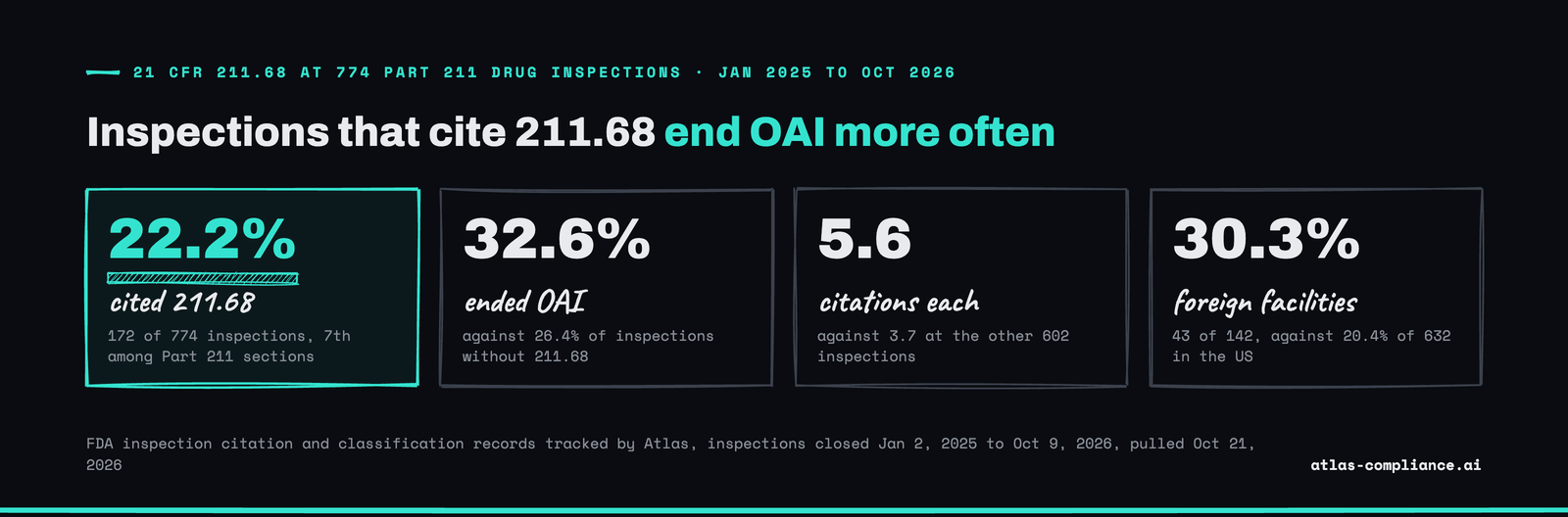
- 21 CFR 211.68 appeared at 172 of 774 Part 211 drug inspections (22.2%), the seventh most cited Part 211 section in the period.
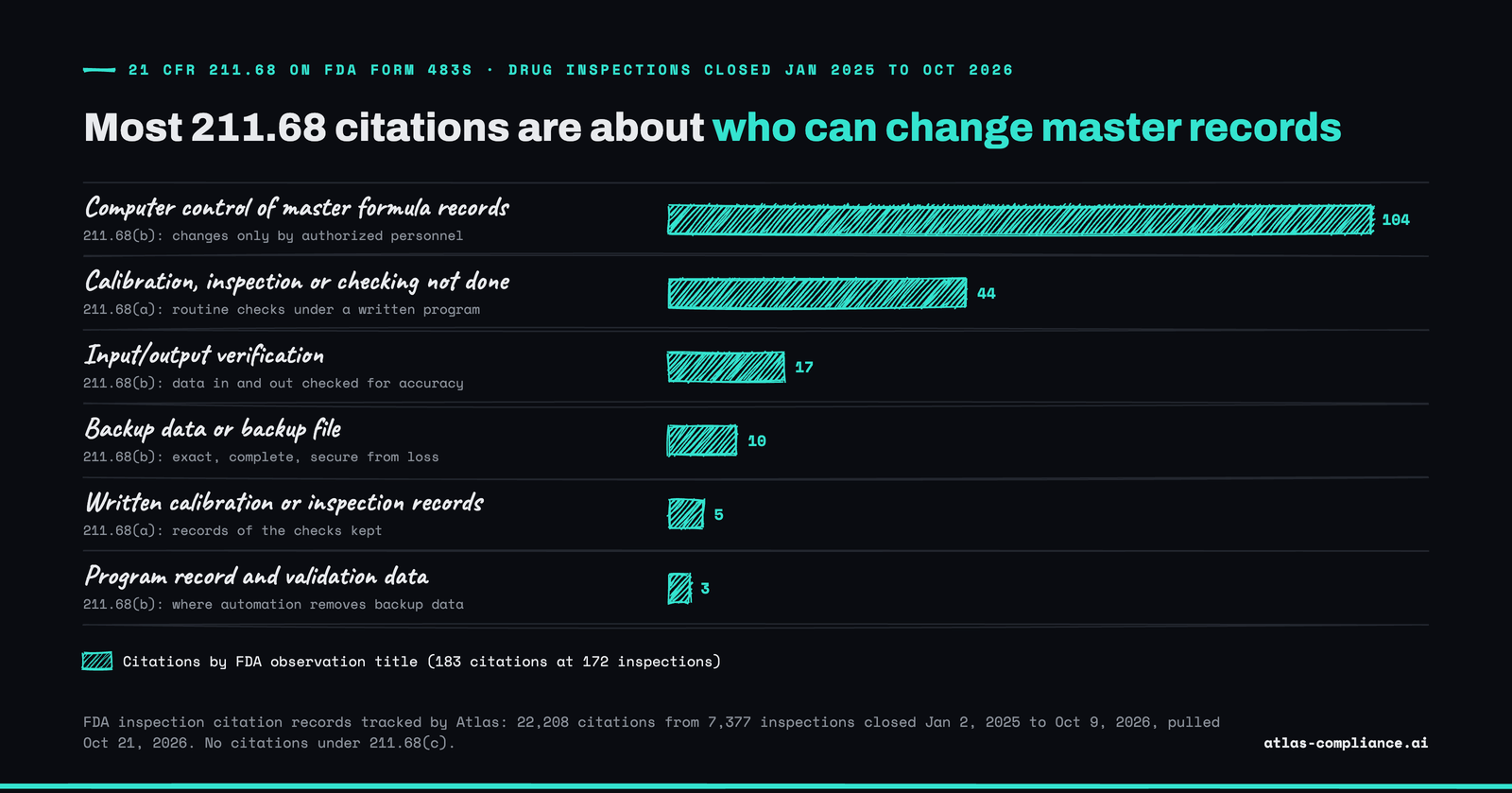
- 104 of the 183 citations under 211.68 carried FDA's title "Computer control of master formula records", a failure to limit record changes to authorized people.
- 32.6% of inspections that cited 211.68 ended Official Action Indicated (OAI), against 26.4% of the 602 Part 211 drug inspections that did not.
- FDA wrote no citation under 211.68(c) in the period and 3 citations under 21 CFR Part 11 across all programs.
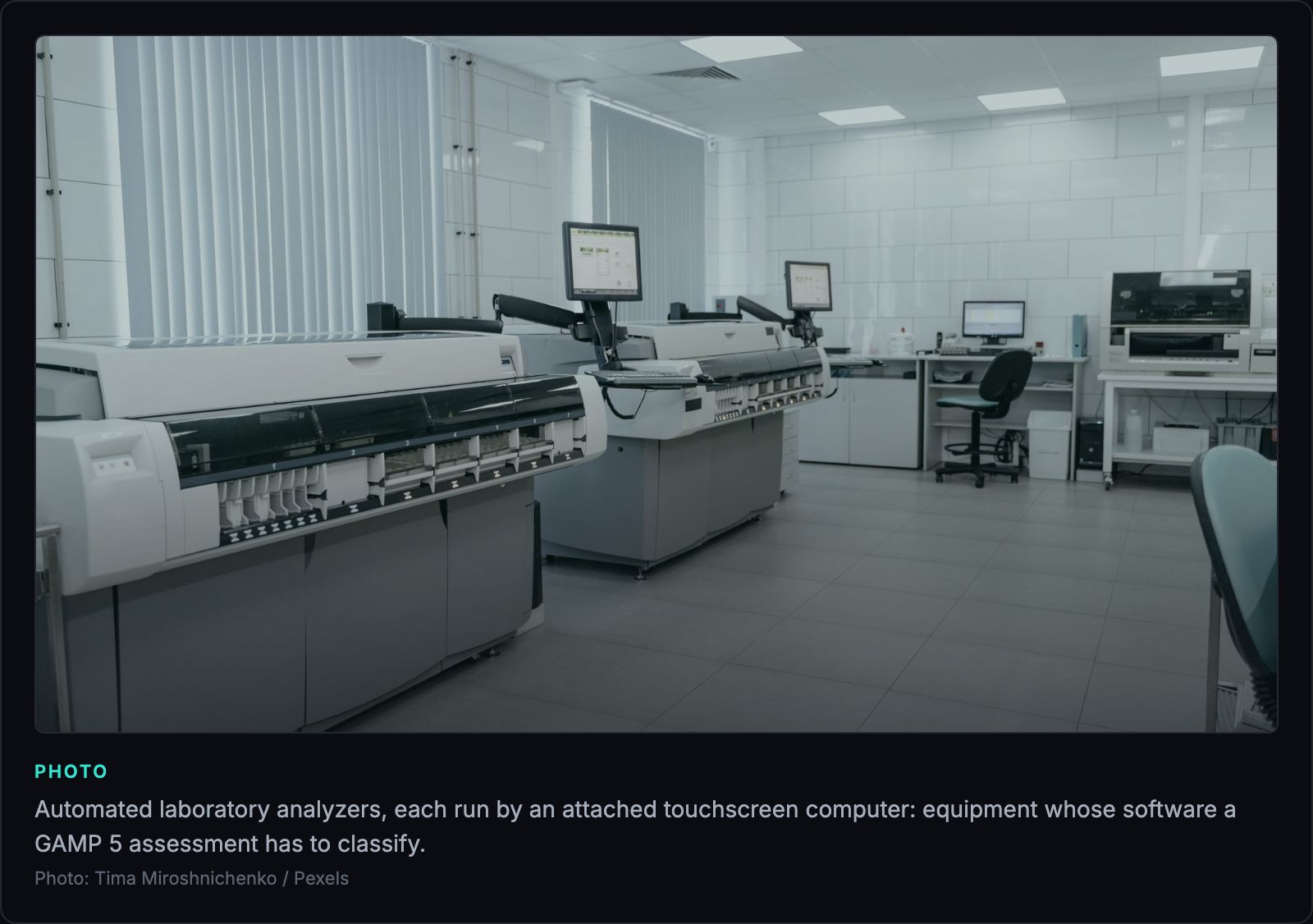
What are the GAMP 5 software categories?
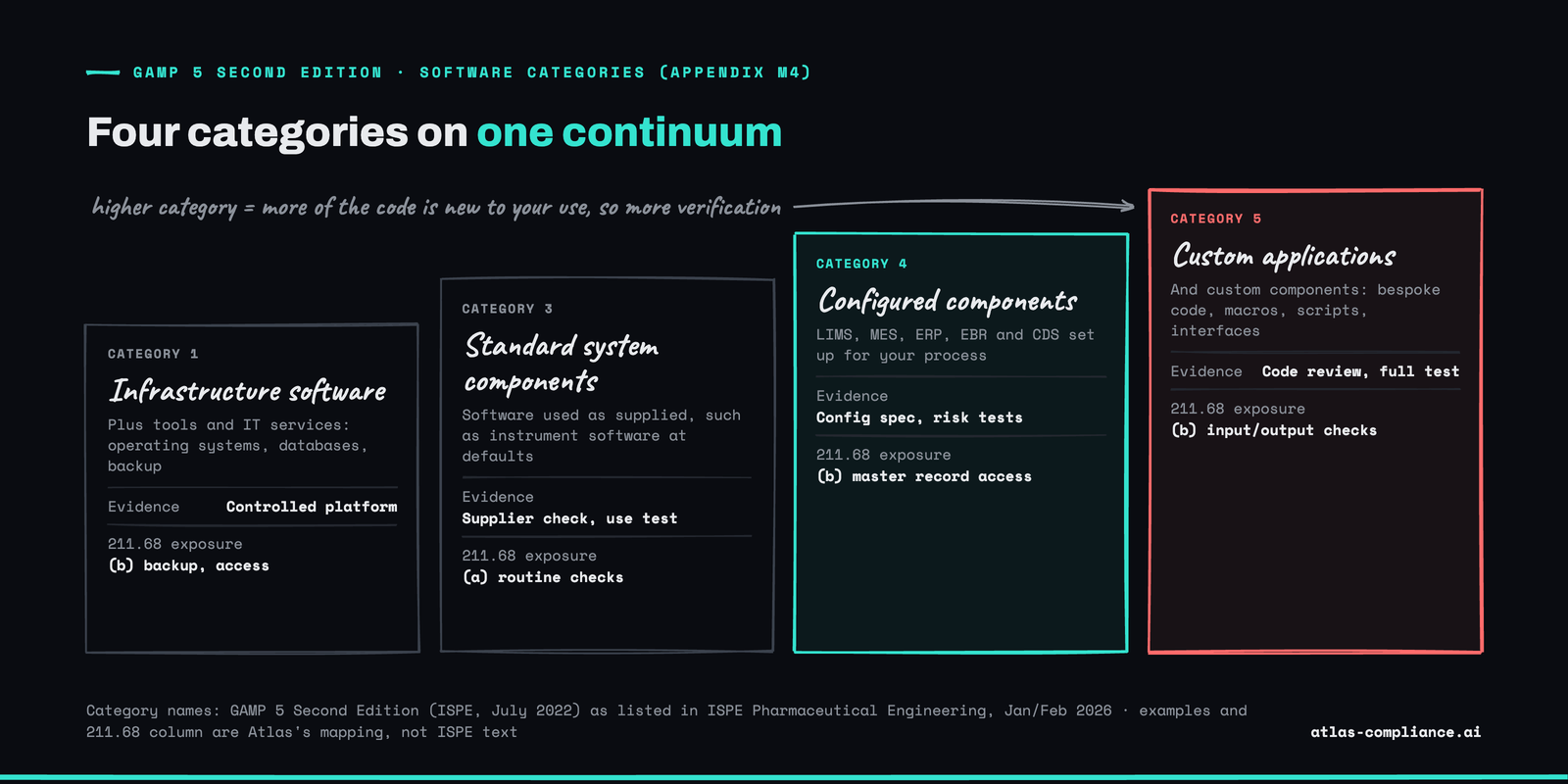
The GAMP 5 software categories are four labels, numbered 1, 3, 4 and 5, that describe how much of a software component is standard, configured or written for you. ISPE defines them in Appendix M4 of the guide. Number 2 is not used: GAMP 4, released in late 2001, had five categories, and the second of them was firmware, according to ISPE's Pharmaceutical Engineering magazine. ISPE published GAMP 5 in 2008.
| Category | Second edition name | Examples (Atlas) | Usual validation focus (Atlas) |
|---|---|---|---|
| 1 | Infrastructure software, tools and IT services | Operating systems, databases, network services, backup tools | Qualify and control the platform; record versions and configuration |
| 3 | Standard system components | Instrument software run at supplier defaults, simple calculation tools | Supplier assessment, then tests of your intended use |
| 4 | Configured components | LIMS, MES, ERP, electronic batch records, chromatography data systems | Configuration specification, risk-based testing of configured functions |
| 5 | Custom applications and components | Bespoke code, macros, scripts, interfaces and custom reports | Design specification, code review, full functional testing |
The category names are the second edition's, as ISPE's Pharmaceutical Engineering magazine listed them in January 2026; the example and focus columns are Atlas's reading, not ISPE text.
A real system mixes categories. A configured LIMS (category 4) runs on a database and operating system (category 1) and often carries a custom report or an interface to the ERP (category 5). ISPE's public articles on the second edition describe categories 3 to 5 as a continuum, apply categorization to the components of a system rather than the whole, and warn against using it as a checklist for validation.
What changed in the GAMP 5 second edition?
The GAMP 5 second edition, published by ISPE in July 2022, replaced the 2008 first edition and moved the guide toward critical thinking, supplier evidence and risk-based effort, with less paper for its own sake. ISPE lists these changes on its publication page:
- More weight on service providers, including IT and cloud service providers.
- Support for iterative and incremental development, alongside the classic specification and verification model.
- More use of software tools and automation to control quality and lower risk.
- Critical thinking by experienced subject matter experts as the basis for deciding how much validation a system needs.
- A discussion of FDA's work on Computer Software Assurance (CSA), and links to ISPE's data integrity guidance.
- New or expanded appendices on artificial intelligence and machine learning, blockchain, cloud computing and open-source software.
The second edition kept the categories and narrowed their role. ISPE describes the software category as one factor in a risk-based approach, and says the second edition recommends categorizing a whole system only when defining the approach to supplier assessment. ISPE's summary of the edition also adds data integrity considerations for end-user applications, spreadsheets included.
Is GAMP 5 a regulatory requirement?
GAMP 5 is not a regulatory requirement. ISPE publishes it as industry guidance, and no FDA regulation names it. FDA investigators cite the regulation itself: for drug manufacturers that is 21 CFR 211.68 for computerized equipment and 211.194(a) for complete laboratory data, and only rarely 21 CFR Part 11.
Firms use GAMP 5 because it gives a defensible, widely recognized method for showing that a system is fit for its intended use. FDA's own risk-based thinking points the same way. FDA announced the final guidance Computer Software Assurance for Production and Quality System Software in the Federal Register on September 24, 2025. That guidance comes from the device and biologics centers, and our comparison of CSA vs CSV covers how it changes test evidence. For the electronic records side, see our guide to 21 CFR Part 11.
What does 21 CFR 211.68 require of computerized systems?
21 CFR 211.68 requires drug manufacturers to calibrate, inspect or check automatic, mechanical and electronic equipment, including computers, under a written program, and to control who can change computerized records. Paragraph (b) carries four duties:
- Only authorized personnel institute changes to master production and control records or other records.
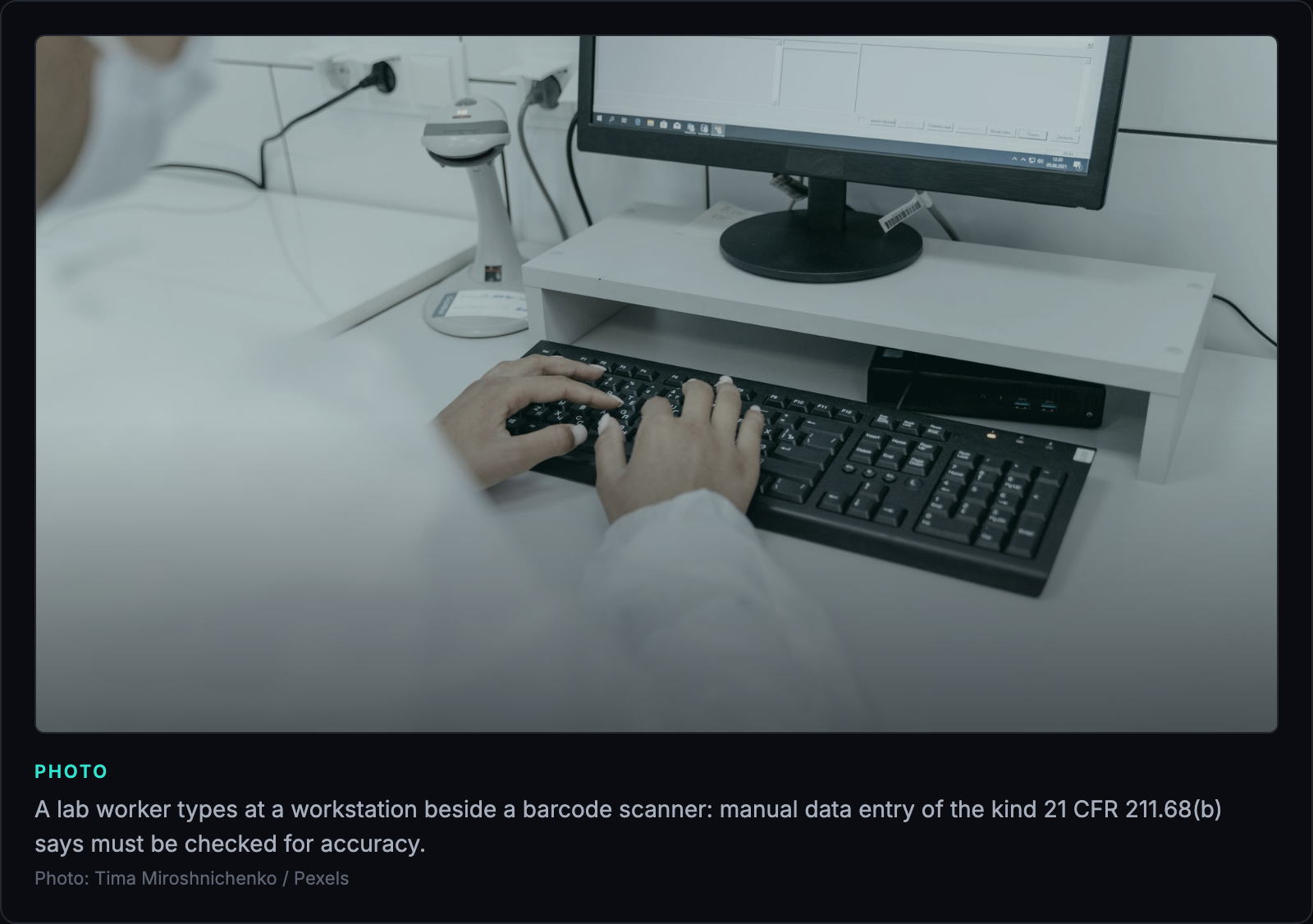
- Staff check input to and output from the computer for accuracy.
- The firm keeps a backup file of data entered into the system, or, where automation eliminates that data, a written record of the program with validation data.
- Backup data stays exact, complete and secure from alteration, erasure or loss.
One sentence in 211.68(b) links the rule to GAMP thinking: "The degree and frequency of input/output verification shall be based on the complexity and reliability of the computer or related system." That is the regulatory basis for scaling verification by category. Paragraph (c) lets a checked automated system stand in for a second person's check on certain operations, such as weighing components under 211.101(c).
How often does FDA cite 21 CFR 211.68 on Form 483s?
FDA cited 21 CFR 211.68 at 172 of 774 drug inspections that cited Part 211 and closed between January 2, 2025 and October 9, 2026 (22.2%), according to the FDA inspection citation records Atlas tracks (pulled October 21, 2026). Only six Part 211 sections appeared more often: 211.22, 211.192, 211.67, 211.100, 211.160 and 211.84.
Investigators wrote 183 citations under the section: 134 under 211.68(b) and 49 under 211.68(a). The rate held steady across both years, at 21.7% of Part 211 drug inspections in 2025 (122 of 562) and 23.6% in 2026 so far (50 of 212).
| 211.68 measure, Part 211 drug inspections | 2025 to Oct 2026 |
|---|---|
| Inspections citing 211.68 | 172 of 774 (22.2%) |
| Citations under 211.68(b) | 134 |
| Citations under 211.68(a) | 49 |
| Citations under 211.68(c) | 0 |
| OAI rate, inspections citing 211.68 | 32.6% (56 of 172) |
| OAI rate, inspections without 211.68 | 26.4% (159 of 602) |
| Average citations per inspection, with 211.68 | 5.6 |
| Average citations per inspection, without 211.68 | 3.7 |
| Foreign facilities citing 211.68 | 30.3% (43 of 142) |
| US facilities citing 211.68 | 20.4% (129 of 632) |
Investigators rarely wrote 211.68 alone. Of the 172 inspections, 81 also cited 211.192 on investigations and 78 cited 211.22 on the quality unit. Those broader quality system findings likely account for part of the higher OAI rate, so read 32.6% as a marker of the whole inspection. Our analysis of data integrity citations on Form 483s pairs 211.68(b) with 211.194(a) on laboratory records.
Investigators differ in how often they write each of these lines. You can look up the 211.68 history of the investigator likely to inspect your facility before the inspection starts.
 Atlas
See what the FDA knows about your next investigator.
30 minutes with the founder. No pitch deck.
How do GAMP 5 categories map to 211.68 citations?
GAMP 5 categories map to 211.68 citations through the component that failed: master record access sits in configured category 4 systems and the category 1 platform under them, routine checks sit with category 3 instruments, and input/output errors cluster in category 5 custom code. The mapping below is Atlas's reading of the observation titles, not ISPE text.
| FDA observation title (211.68) | Citations | Where it usually sits | Evidence that answers it |
|---|---|---|---|
| Computer control of master formula records, 211.68(b) | 104 | Category 4 application roles, category 1 accounts and domain | Role matrix, unique logins, change control on master records, access reviews |
| Calibration, inspection or checking not done, 211.68(a) | 44 | Category 3 instruments and equipment software | Written check program, schedule, executed records |
| Input/output verification, 211.68(b) | 17 | Category 5 code, interfaces, macros, data transfers | Verification scaled to complexity, interface and calculation tests |
| Backup data or backup file, 211.68(b) | 10 | Category 1 servers, storage, cloud services | Backup procedure plus a tested restore |
| Written calibration or inspection records, 211.68(a) | 5 | Category 3 equipment | Retained calibration and check records |
| Program record and validation data, 211.68(b) | 3 | Category 4 and 5 calculations that replace raw data | Program record and validation data on file |
Category labels do the least to prevent the largest row. A category 4 system validated to its configuration specification still fails 211.68(b) if analysts share a login or if production staff can edit a master record without change control. An investigator checking 211.68(b) asks who could change the record and where the approval sits.
Four recent Form 483s in the FDA Form 483 database show the pattern:
| Form 483 | Issued | Observations | 211.68 citation |
|---|---|---|---|
| EMSL Analytical (MPL Laboratories), Sparta, US | May 21, 2026 | 3 | 211.68(a) checking not done; 211.68(b) master record control |
| Emergent BioSolutions Canada, Winnipeg, Canada | May 12, 2026 | 9 | 211.68(a) and 211.68(b), alongside 211.192 and 211.22(a) |
| American Regent, Shirley, US | Apr 21, 2026 | 10 | 211.68(b) master record control, alongside sterile and investigation citations |
| Kavis Pharma, Sugar Land, US | Apr 9, 2025 | 3 | 211.68(b) backup data not assured as exact and complete |
EMSL is a contract testing laboratory where three observations were enough to cite both paragraphs of 211.68 plus 211.165(e) on test methods. The American Regent facility in Shirley has 22 FDA inspections on record, 13 ending with a Form 483. One of the four investigators on its April 2026 form also wrote the 211.68(b) master record citation at Epic Pharma in June 2026.
How do you apply GAMP 5 categories without over-validating?
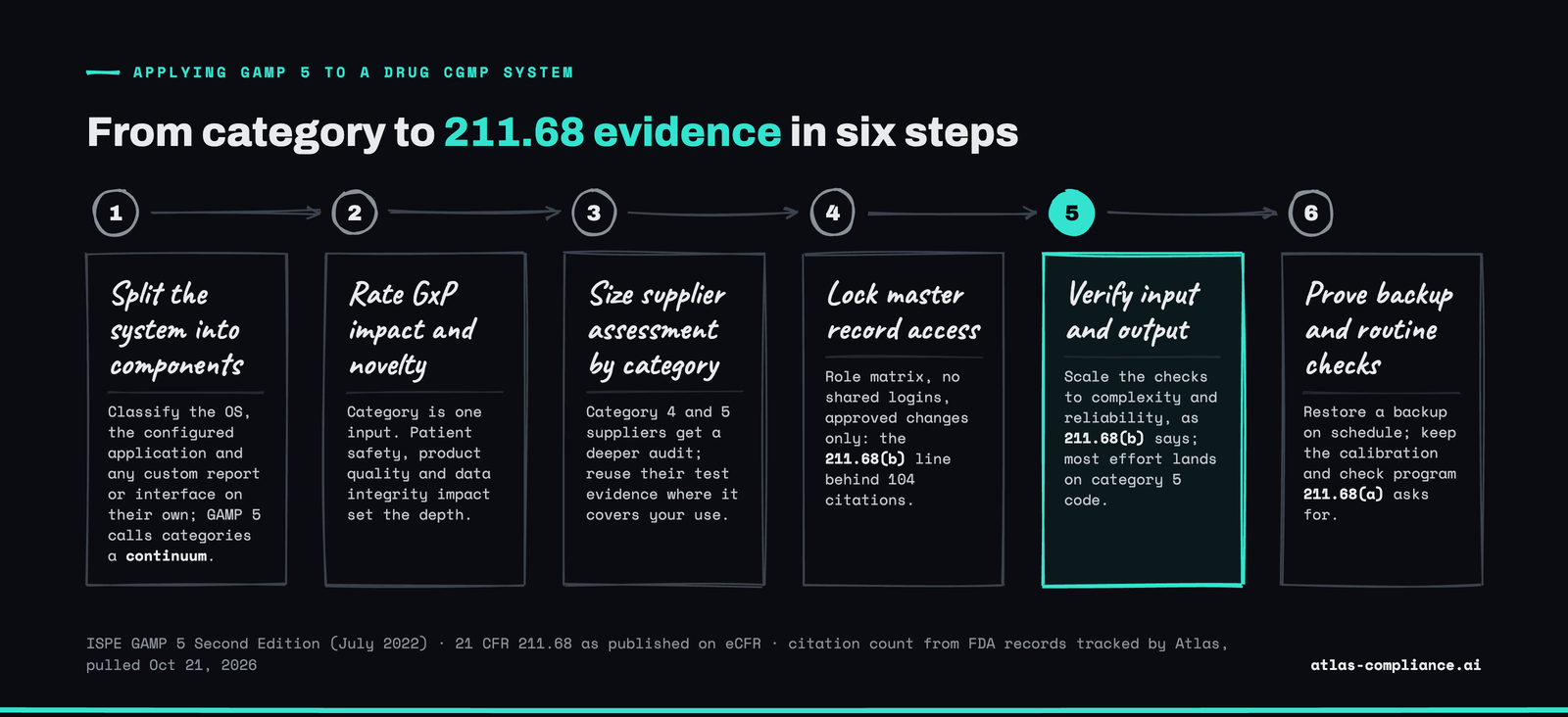
You apply GAMP 5 categories well by classifying each component, rating its GxP risk separately, and spending test effort where 211.68 citations come from: access, input/output and backup. A six-step sequence keeps the category in its place:
- Split the system into components and classify each one, since ISPE applies categories to components rather than whole systems.
- Rate GxP impact, complexity and novelty for each function; the category is one input.
- Size supplier assessment by category, and reuse supplier test evidence where it covers your configuration and use.
- Lock master record access with a role matrix, unique logins and approved changes only.
- Verify input and output in proportion to complexity and reliability, as 211.68(b) says, with most effort on category 5 code and interfaces.
- Restore a backup on a schedule, and keep the routine check program 211.68(a) asks for.
Equipment software also needs qualification of the hardware it runs on. Our guide to IQ, OQ and PQ covers 211.63 and 211.68(a) from the equipment side, and our post on computerized system validation and OQ audit trail tests gives test cases for the access and audit trail controls in step 4.
Before your next inspection, pull the 211.68 citations at facilities like yours and compare their wording with your own risk assessments. A validation package that never mentions shared accounts or a restore test leaves the two most cited 211.68(b) lines without evidence.
AtlasFDA Inspection Intelligence Digest
We track every 483, EIR, and warning letter the moment it happens. Get the signals before they hit the FDA website.
Frequently asked questions
GAMP stands for Good Automated Manufacturing Practice. It is the name of ISPE's community of practice for computerized systems in regulated life sciences and of the guidance it publishes. ISPE published GAMP 5 in 2008 and its second edition in July 2022. ISPE also publishes GAMP good practice guides on specific topics, such as laboratory systems and data integrity.

Written by
Bhavish Agarwal
Founder, Atlas
Bhavish Agarwal is the founder of Atlas and previously worked at Google and Microsoft. He has spent the past several years building regulatory data infrastructure for the pharmaceutical industry.