
A drug master file (DMF) is a confidential submission to FDA in which a manufacturer, the DMF holder, files detailed information about a drug substance, packaging, excipient or reference data so that other companies can rely on it in their applications without seeing it. FDA defines the DMF and its four current types in 21 CFR 314.420.
This guide covers the rules, the letter of authorization, the Generic Drug User Fee Amendments (GDUFA) fee for fiscal year 2027, and the part most DMF explainers leave out: Atlas data from November 2026 on how FDA inspections end at the API facilities that stand behind Type II files.
Key facts:
- 21 CFR 314.420(a) recognizes four drug master file types today: Type II (drug substance), Type III (packaging), Type IV (excipients) and Type V (FDA-accepted reference information).
- FDA removed Type I DMFs, which covered manufacturing sites, facilities, operating procedures and personnel, in a final rule published January 12, 2000 (65 FR 1776).
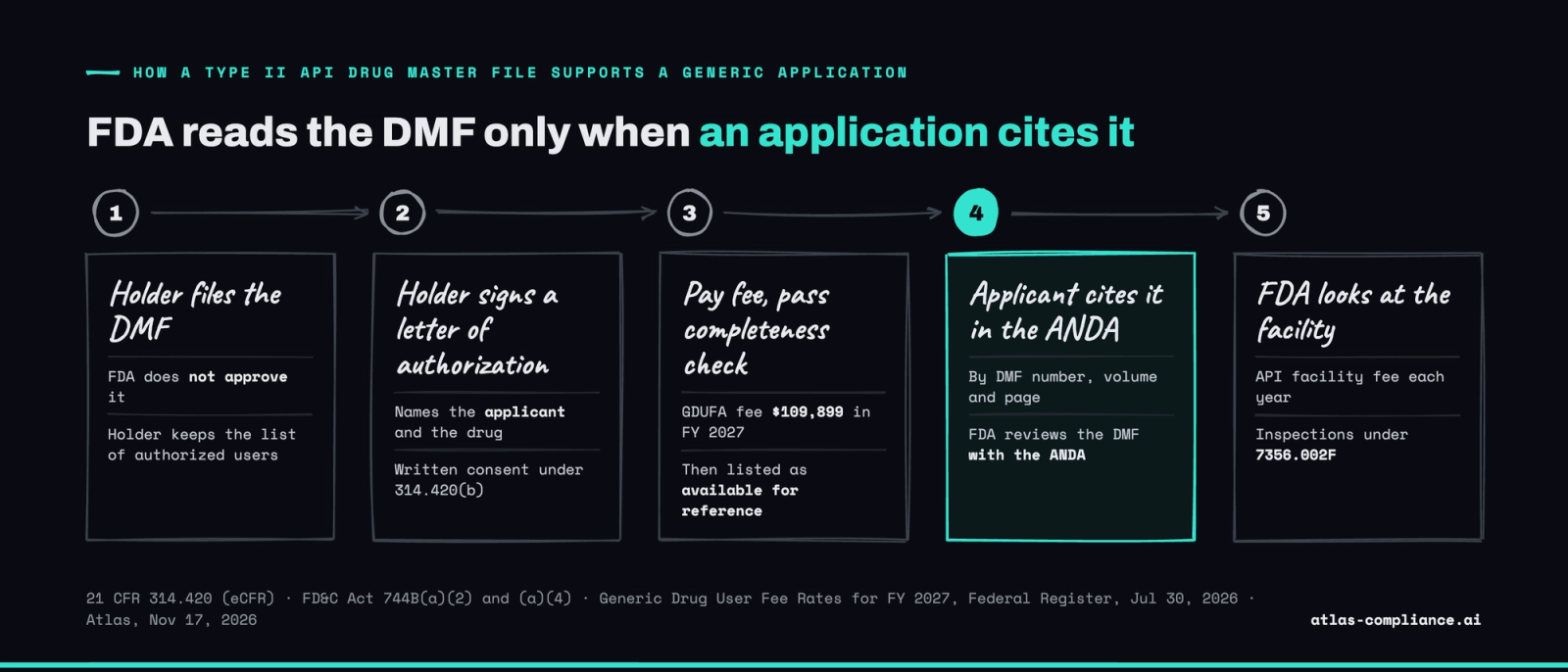
- FDA "ordinarily neither independently reviews drug master files nor approves or disapproves" them, and reads a DMF in the context of an application that cites it.
- The GDUFA fee for a Type II API DMF is $109,899 for fiscal year 2027 (October 1, 2026 to September 30, 2027), up from $102,584 in fiscal year 2026.
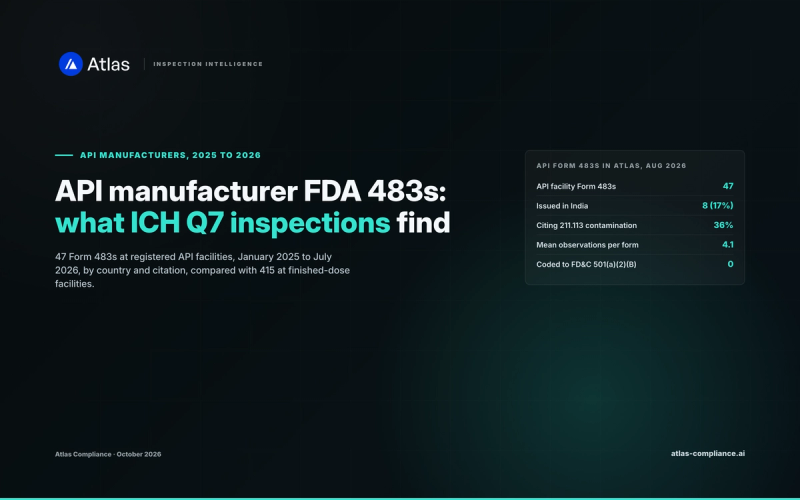
- In the Atlas Form 483 database (release of August 15, 2026), 47 Form 483s from January 2025 to July 2026 went to facilities whose FDA registration lists API manufacture.
What is a drug master file?
A drug master file is a submission that lets a DMF holder do one of two things under 21 CFR 314.420(a): incorporate the information by reference in its own IND, NDA, ANDA, amendment or supplement, or authorize other companies to rely on the information without disclosing it to them. The typical holder is an API manufacturer that sells to several finished-dose companies.
The regulation sets four holder duties:
- Submit the DMF, and any later addition, change or deletion, in two copies (314.420(c)).
- Notify in writing every company authorized to reference information that the holder adds, changes or deletes (314.420(c)).
- Keep a complete list of each person authorized to incorporate the file by reference, naming the drug product and application number when the authorization is limited to particular products (314.420(d)).
- Accept that public disclosure of DMF data is decided under 21 CFR part 20 and section 314.430 (314.420(e)).
Filing a DMF is the holder's choice; a manufacturer that will not share its process with each buyer files one instead.
What are the DMF types?
The DMF types are Type II, Type III, Type IV and Type V, listed in 21 CFR 314.420(a)(2) to (a)(5). Paragraph (a)(1) is reserved: it held Type I until FDA's final rule of January 12, 2000 removed it. The Federal Register text of that rule explains that FDA review divisions did not rely on Type I files, and FDA now points facility information toward a Type V file.
| DMF type | What it covers (21 CFR 314.420) | Typical holder | GDUFA fee |
|---|---|---|---|
| Type I (removed 2000) | Manufacturing site, facilities, operating procedures and personnel | None; no longer accepted | Not applicable |
| Type II | Drug substance, drug substance intermediate, materials used in their preparation, or drug product | API manufacturer, intermediate maker, contract manufacturer | One-time fee when a Type II API DMF supports a generic submission |
| Type III | Packaging materials | Bottle, closure, blister or film supplier | None |
| Type IV | Excipient, colorant, flavor, essence, or materials used in their preparation | Excipient or flavor supplier | None |
| Type V | FDA-accepted reference information not covered by Types II to IV | Holder whose reference data FDA agreed to accept after a letter of intent | None |
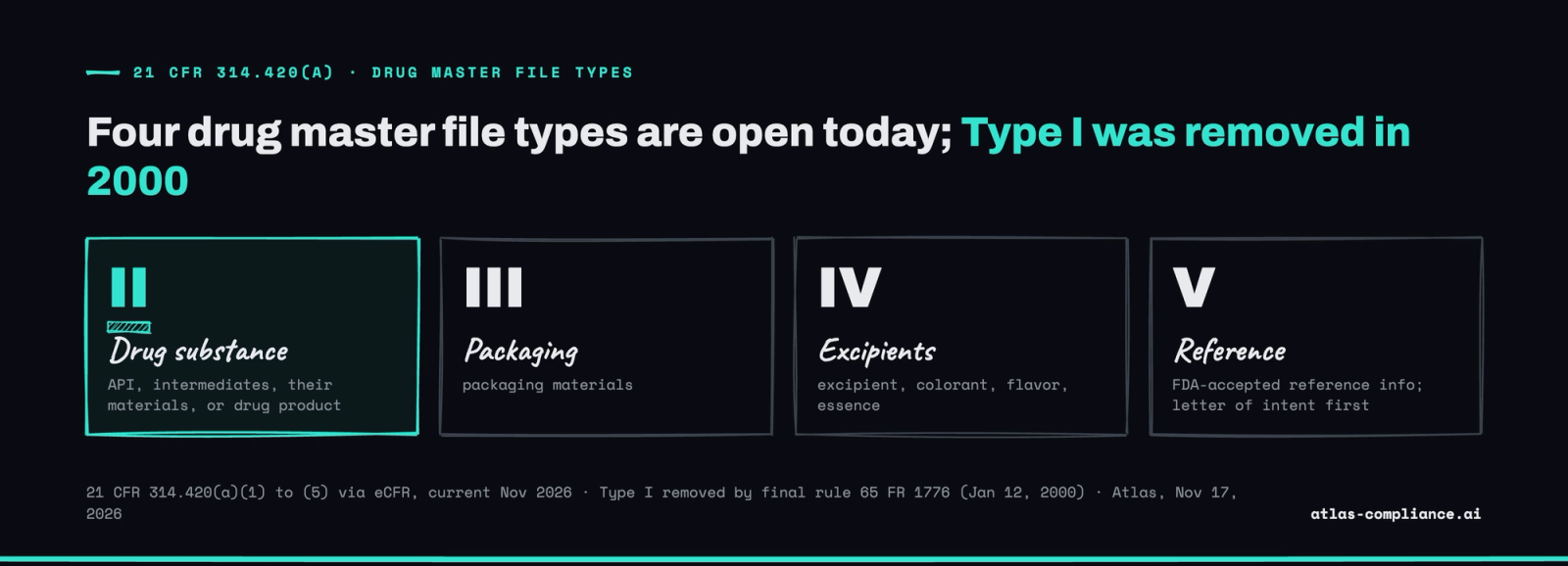
A Type V file needs agreement first. Section 314.420(a)(5) tells anyone who wants to file information outside Types II to IV to send a letter of intent to FDA's Drug Master File staff, after which FDA contacts them to discuss the submission.
What is a letter of authorization for a DMF?
A letter of authorization (LOA) is the DMF holder's written permission for a named company to incorporate all or part of the drug master file by reference in a submission to FDA. Section 314.420(b) makes the written authorization a condition, and the holder's list under 314.420(d) records every company and, where limited, every drug product and application number the authorization covers.
FDA's 1989 guideline "Drug Master Files: Guidelines" and its October 2019 draft guidance "Drug Master Files" describe the mechanics: the holder sends the LOA to the DMF itself and gives a copy to the authorized party, which then cites the DMF number in its own application. The applicant cites the file through the LOA and never sees the process detail inside it.
When a holder withdraws an authorization, the list under 314.420(d), which names only the persons currently authorized, must drop that company.
How does an ANDA or NDA reference a DMF?
An ANDA, NDA, IND, amendment or supplement references a DMF by incorporation: under 314.420(b), each reference must describe the incorporated material by name, DMF number, volume and page number, and the holder must have authorized it in writing. FDA then reviews the DMF content in the context of that application, which is the only time FDA ordinarily reads a DMF.
A generic applicant that puts API manufacturing data straight into its ANDA, instead of citing a Type II DMF, owes an extra GDUFA fee equal to the DMF fee for each such API, under FD&C Act section 744B(a)(3)(F). Changes work the other way: the holder must tell each authorized customer in writing.
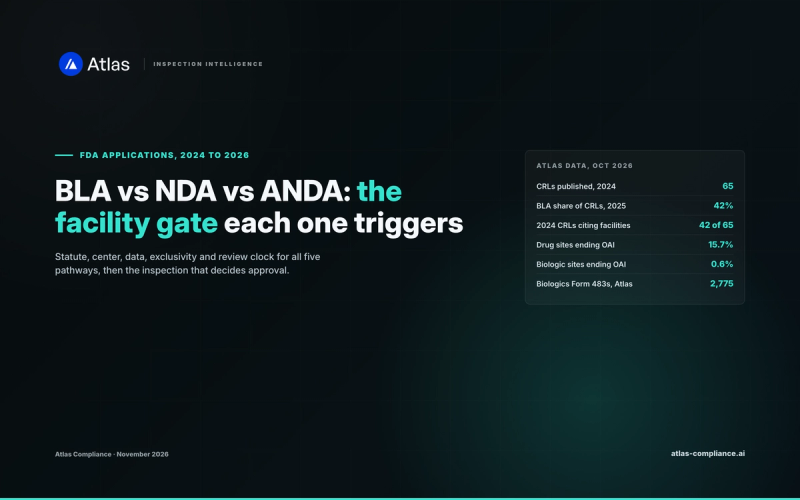
NDAs, ANDAs and INDs reference DMFs under parts 312 and 314. Our comparison of BLA vs NDA vs ANDA pathways covers which application type a product uses and the facility inspection each one triggers.
What is the GDUFA DMF completeness assessment?
The GDUFA completeness assessment is FDA's initial check that a Type II API DMF contains the information an ANDA review needs, done against criteria FDA publishes in the guidance "Completeness Assessments for Type II API DMFs Under GDUFA". A Type II API DMF passes when the holder has paid the DMF fee and the file has not failed that initial assessment; FDA then deems it available for reference, under FD&C Act section 744B(a)(2)(D).
The FY 2027 generic drug user fee notice, published in the Federal Register on July 30, 2026, sets the numbers:
| GDUFA item | Rule | FY 2027 amount |
|---|---|---|
| Who pays the DMF fee | Owner of a Type II API DMF referenced on or after October 1, 2012 in a generic drug submission by an initial LOA | $109,899 |
| How often | One time per DMF; later references by other ANDAs cost nothing more | One-time |
| When it is due | The earlier of the first generic submission that references the DMF or the holder's request for the initial completeness assessment | At that date |
| Late payment | Not paid within 20 calendar days of the due date: the DMF is not deemed available for reference | Not applicable |
| Public list | FDA posts the numbers of DMFs that passed the initial assessment and are available for reference | Not applicable |
| API facility fee | Annual fee for each facility named in a Type II API DMF that an approved generic submission references | $39,680 domestic, $54,680 foreign |
FDA set the FY 2027 fee by dividing $33,299,300, the 5% DMF share of GDUFA revenue, by 303 expected fee-paying DMFs. The FY 2026 fee, from the notice of July 30, 2025, was $102,584, and the domestic API facility fee was $43,549.
Why does FDA inspect a DMF holder's facility?
FDA inspects a DMF holder's facility because the DMF describes how and where the API is made, and an approved generic or new drug depends on that facility running the process as filed, which a paper review cannot confirm. The GDUFA statute ties the two together: once an approved generic submission references a Type II API DMF, each facility named in the file owes the annual API facility fee.
FDA reaches a DMF holder's facility on three routes:
- Before approval, under the preapproval inspection program (Compliance Program 7346.832), when an application names the API facility.
- For surveillance, under Compliance Program 7356.002F, the API process inspection program in effect since September 2, 2025, which judges API facilities against ICH Q7.
- For cause, after a complaint, recall or data integrity signal.
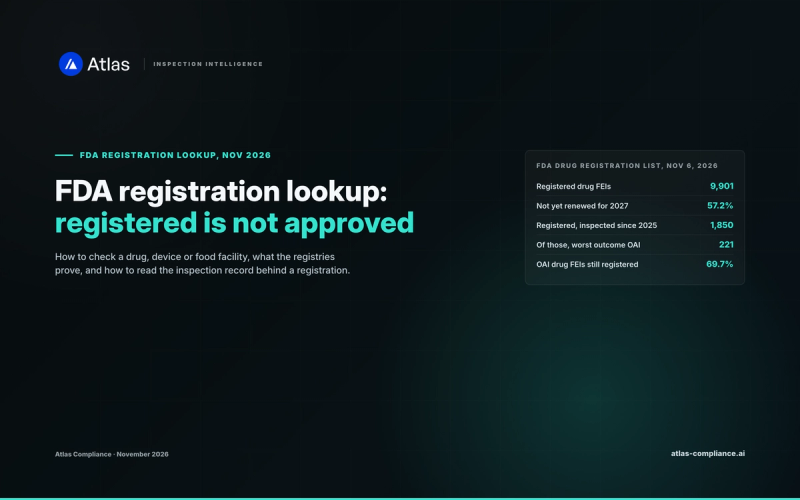
Every API facility that ships to the US must also register with FDA under FD&C Act section 510 and list its APIs; our FDA registration lookup guide shows how to confirm a facility's FEI number and declared operations.
Global Calcium in Hosur, India shows the cost of a failed inspection. FDA inspected the facility from July 29 to August 2, 2024 and issued warning letter 320-25-30 on January 16, 2025, citing quality unit failures, poor building maintenance and no impurity profile for identified and unidentified impurities. The Global Calcium facility record in Atlas lists five FDA inspections since 2015, and all five ended with a Form 483.
How do API manufacturers fare in FDA inspections?
API manufacturers received 47 FDA Form 483s with observation detail from January 1, 2025 to July 10, 2026, according to the Atlas Form 483 database (release of August 15, 2026), set against 415 Form 483s at finished-dose facilities. Our breakdown of FDA Form 483s at API manufacturers explains the method: a facility counts as API when its FDA registration lists API manufacture.
- India received 8 of the 47 API Form 483s (17%), against 29 of 415 finished-dose 483s (7%).
- The most cited sections on API Form 483s were 21 CFR 211.113 (contamination control, 36% of forms), 211.22 (quality unit, 34%), 211.84 (testing of incoming components, 32%) and 211.192 (investigations, 32%).
- The average API Form 483 carried 4.1 observations, against 4.4 at finished-dose facilities.
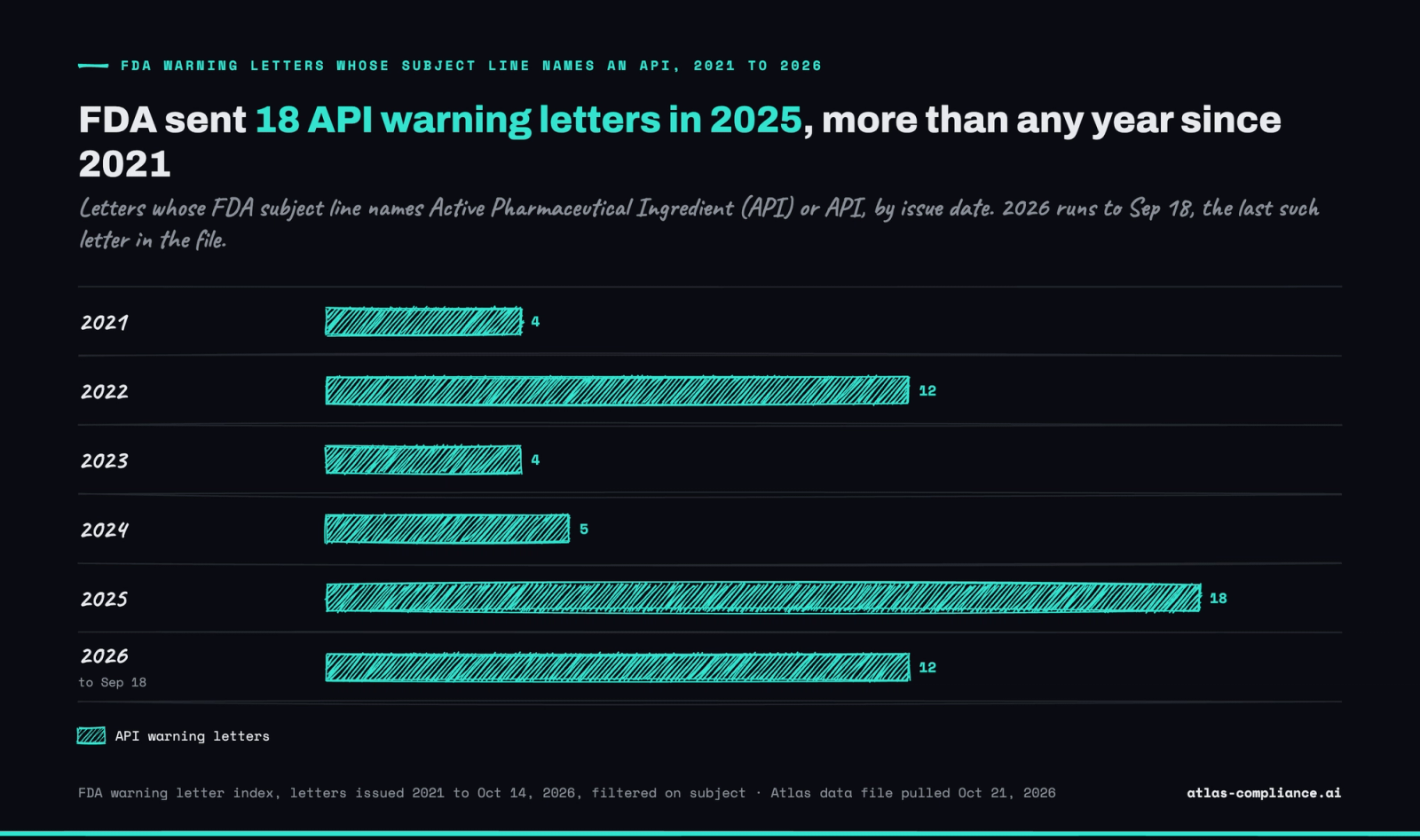
Warning letters climbed in 2025. In the FDA warning letter index held in the Atlas data files (pulled October 21, 2026), FDA issued 18 letters whose subject line names an API in 2025, up from 5 in 2024 and the highest yearly count in a file that starts in 2021. Another 12 followed in 2026 through September 18.
Six API facilities that received an API warning letter in 2025 or 2026 have 39 FDA inspections on record in Atlas (release of August 15, 2026, pulled November 17, 2026), and 29 of those inspections (74%) ended with a Form 483:
| Facility | Country | Inspections on record | Form 483s | Warning letter date |
|---|---|---|---|---|
| Scientific Protein Laboratories, Waunakee | United States | 12 | 7 | Oct 10, 2025 |
| Curia New York, Rensselaer | United States | 9 | 5 | Sep 18, 2026 |
| Alchymars ICM SM, Alathur | India | 7 | 7 | May 21, 2026 |
| Global Calcium, Hosur | India | 5 | 5 | Jan 16, 2025 |
| Hubei Gedian Humanwell, Ezhou | China | 4 | 4 | Jun 3, 2026 |
| Tyche Industries, Kakinada | India | 2 | 1 | Feb 6, 2025 |
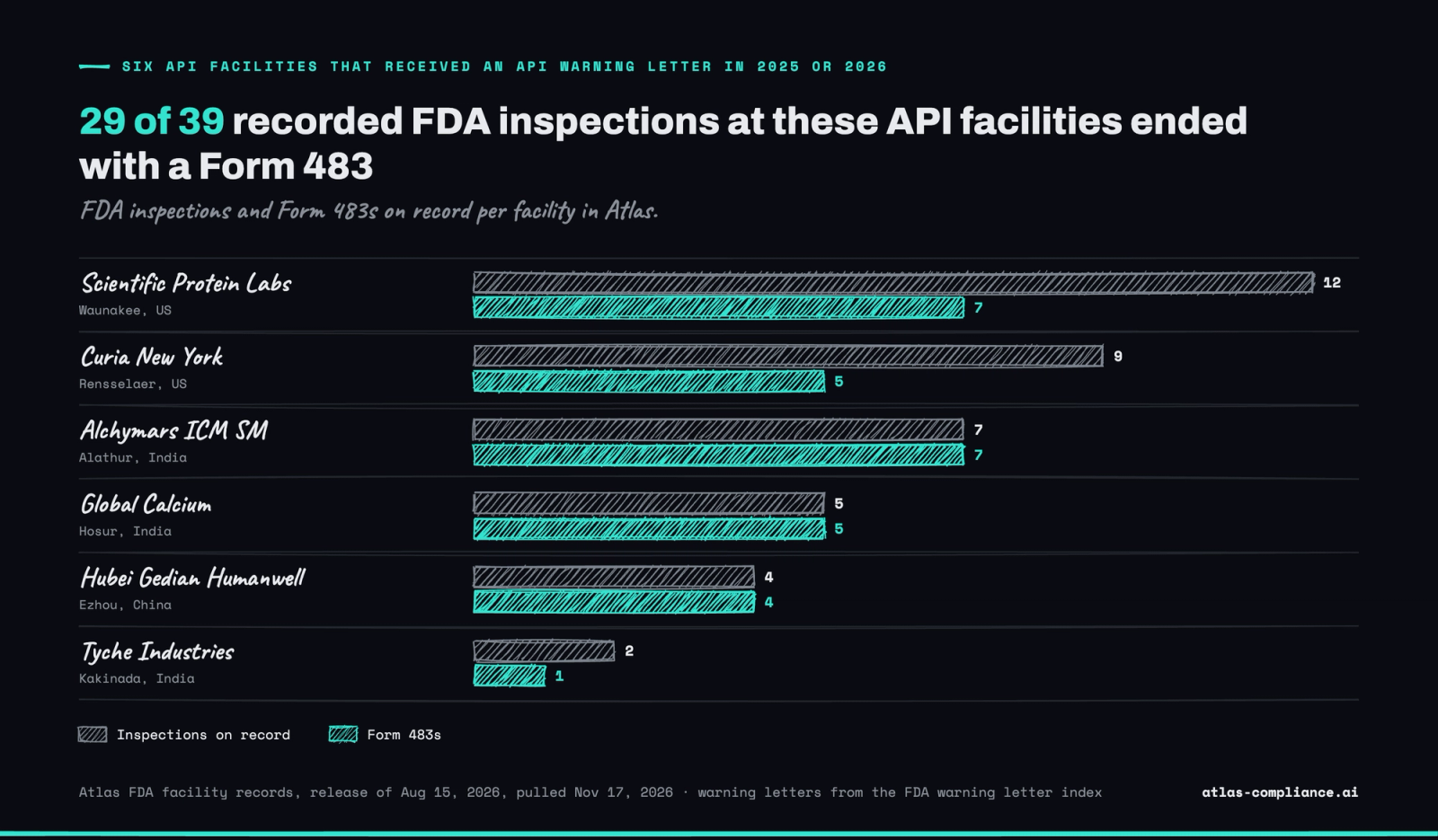
At Alchymars, Global Calcium and Hubei Gedian, every recorded inspection ended with a Form 483. Before a warning letter, FDA classifies the inspection Official Action Indicated; our explainer on NAI, VAI and OAI classifications covers what that classification sets in motion. Not every API Form 483 comes from a small firm: the Eli Lilly Form 483 of May 20, 2025 at Indianapolis, a registered API facility, carried 5 observations, including 211.84(d)(2) on component testing.
If your ANDA or NDA cites a supplier's DMF, that supplier's inspection history and the investigators who wrote its last forms are part of your approval risk, and you can look both up before the next audit.
 Atlas
See what the FDA knows about your next investigator.
30 minutes with the founder. No pitch deck.
What should a DMF holder check before an application references the file?
A DMF holder should check that the file, the facility and the fee all stand up before the first letter of authorization goes out, because FDA reviews the DMF and may inspect the facility on the customer's timeline. Five checks follow from 314.420, GDUFA and the 2025 to 2026 inspection record:
- Confirm that the authorized-party list under 314.420(d) names every customer, drug product and application number, and that the LOA cites the right DMF number.
- For a Type II API DMF that supports generics, pay the GDUFA fee and request the completeness assessment early, so the DMF appears on FDA's available-for-reference list before the customer files.
- Send written notice of every change to each authorized party, as 314.420(c) requires.
- Test the facility against the sections FDA cites most at API facilities: quality unit authority, incoming component testing, contamination control and investigations.
- Check that the impurity profile and process validation in the DMF match what the facility does today; Global Calcium's letter charged a missing impurity profile.
You can search any API facility by name or FEI number in the FDA Form 483 database. The digest below sends new Form 483s and warning letters, API facilities included, as FDA posts them.
AtlasFDA Inspection Intelligence Digest
We track every 483, EIR, and warning letter the moment it happens. Get the signals before they hit the FDA website.
Frequently asked questions
No. Filing a drug master file is voluntary under 21 CFR 314.420, and no regulation requires a supplier to submit one. An applicant may put the same manufacturing information straight into its own application. A supplier that wants to keep its process confidential from customers files a DMF instead, and for generic APIs, GDUFA charges an extra fee when an ANDA includes API data without citing a Type II DMF.

Written by
Bhavish Agarwal
Founder, Atlas
Bhavish Agarwal is the founder of Atlas and previously worked at Google and Microsoft. He has spent the past several years building regulatory data infrastructure for the pharmaceutical industry.