
Deviation management is the quality system process that records, contains, classifies, investigates and closes any departure from an approved procedure, specification or batch instruction in GMP manufacturing. For US drug makers, two rules set the floor: 21 CFR 211.100(b) says record and justify the deviation, and 21 CFR 211.192 says investigate any unexplained discrepancy.
This guide adds what FDA investigators wrote when those rules were missed. We counted the citations on 774 drug inspections that cited Part 211 and closed between January 7, 2025 and September 3, 2026, from the Atlas Form 483 citation dataset (pulled October 21, 2026) joined to FDA's inspection classifications.
Key facts:
- 324 of 774 Part 211 drug inspections (41.9%) cited 211.100(b), 211.192, or both.
- 38.9% of the inspections citing either deviation rule ended Official Action Indicated (OAI), against 19.1% of the 450 inspections citing neither.
- 211.100(b) appeared at 43 inspections; 22 of its 43 observations (51.2%) say written procedures were not followed.
- 15 inspections cited 211.100(b) and 211.192 together, about one in three of the 211.100(b) inspections.
- Part 211 sets no deviation classes and no closure deadline; the minor, major and critical tiers and the closure target come from each firm's own SOP.
What is deviation management in GMP?
Deviation management in GMP is the written system a manufacturer uses to catch a departure from an approved instruction, record it when it happens, judge its effect on product, find its cause, and decide what happens to the batch. In US drug manufacturing the legal basis is 21 CFR 211.100(b), with 211.192 governing the investigation.
The text of 21 CFR 211.100 is short. Paragraph (b) reads:
Written production and process control procedures shall be followed in the execution of the various production and process control functions and shall be documented at the time of performance. Any deviation from the written procedures shall be recorded and justified.
That gives an investigator four things to test: did your staff follow the procedure, did they document each step at the time, did they record the deviation, and did someone justify it. 211.192 then requires a thorough, written investigation of any unexplained discrepancy, extended to other batches that may be affected. Our 21 CFR 211.192 guide covers that section's text and citation data in full.
Three other Part 211 sections tie the deviation file to the batch. 211.188(b)(12) puts "any investigation made according to § 211.192" in the batch production record. 211.22(a) gives the quality control unit authority to review records and make sure errors "have been fully investigated". 211.180(e)(2) requires the annual product review to cover the 211.192 investigations for each drug product, which is where trending lives.
For active pharmaceutical ingredients, ICH Q7 section 2.16 sets the same expectation in its own words: any deviation from established procedures should be documented and explained, and critical deviations should be investigated with the investigation and conclusions documented. FDA has adopted the ICH Q7 guideline as guidance for API manufacturing.
What are the steps in the deviation management process?
A deviation management process has seven steps: detect and record, contain, classify, investigate, assess impact, run CAPA, and close with quality unit approval and trending. Part 211 does not number the steps. They follow from what 211.100(b), 211.192 and 211.22(a) require the record to show.
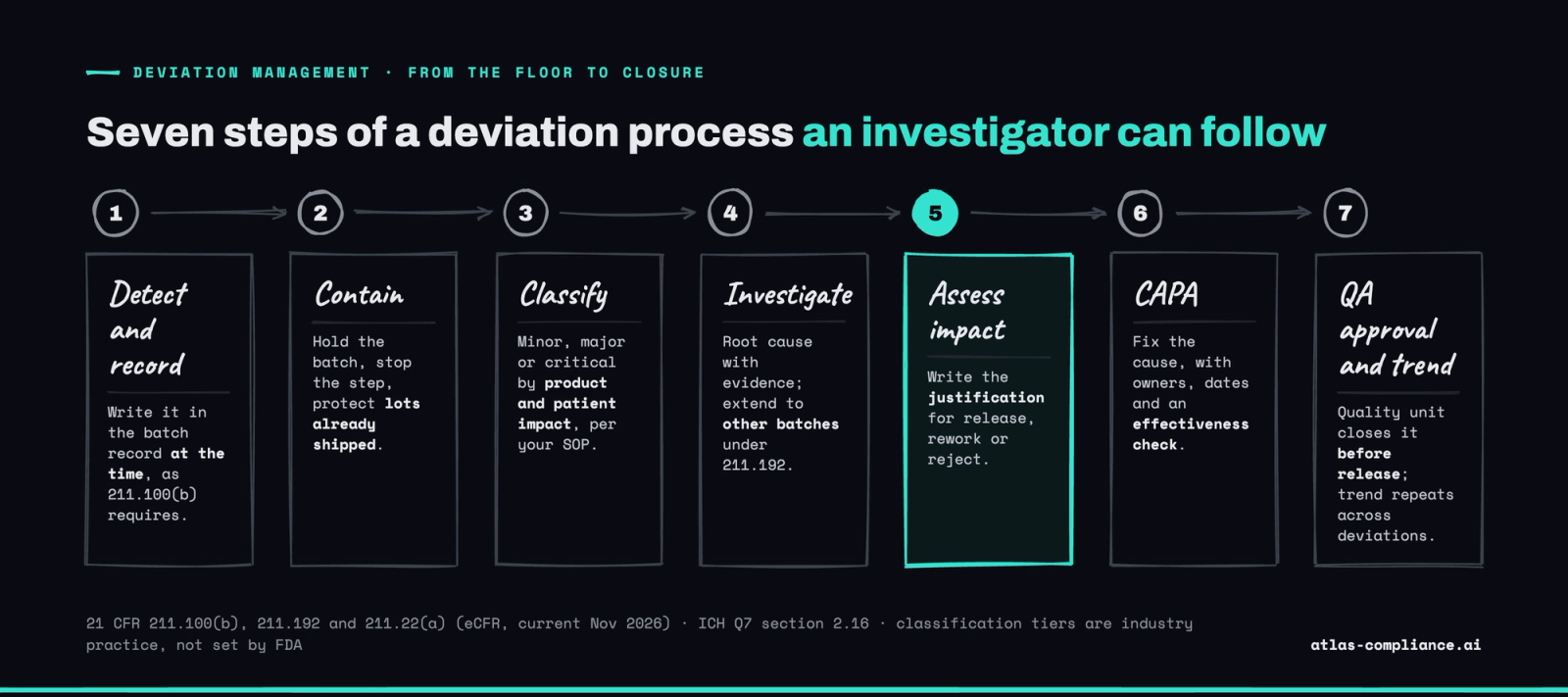
- Detect and record. The operator or analyst who sees the departure writes it in the batch record or logbook at the time: what the procedure said, what happened, the batch, the time, and who found it.
- Contain. Production stops the step or holds the batch. If related lots have shipped, the quality unit assesses those lots too, since 211.192 applies "whether or not the batch has already been distributed".
- Classify. Quality assurance assigns a class (minor, major or critical) by the possible effect on product quality and patients, using the criteria in your SOP.
- Investigate. The investigation team lists candidate causes, tests each against evidence, and searches other batches, products and equipment that share the cause. A major or critical deviation needs a written root cause or, if none is proven, the most probable cause and what was ruled out.
- Assess impact. QA decides release, rework, reprocess or reject, and writes the justification that 211.100(b) asks for.
- CAPA. The CAPA owner fixes the cause with named owners, dates and an effectiveness check.
- Approve and trend. The quality unit approves the closed deviation before it releases the batch, and the team trends deviations by product, area and cause for the annual product review.
Steps 1 and 5 carry the 211.100(b) duties. Steps 4 and 7 carry 211.192. When FDA writes up a deviation system, the observation usually names the step that broke.
How are deviations classified: minor, major and critical?
Deviation classification sorts each deviation by its possible effect on product quality, patient safety and data reliability, and the class sets how deep the investigation goes. FDA's Part 211 does not define minor, major or critical. ICH Q7 uses "critical deviations" without defining tiers. Each firm writes its own criteria into its deviation SOP.
| Class | Typical criteria in firm SOPs | Investigation depth | CAPA |
|---|---|---|---|
| Minor | No credible effect on quality, safety or data; for example a late signature corrected the same shift | Short assessment, often by the area and QA reviewer | Usually none; trended |
| Major | Possible effect on quality or a GMP requirement, no direct patient risk shown; for example a process parameter briefly outside its range | Full root cause investigation with impact on related batches | Required |
| Critical | Likely effect on product quality or patient safety, or on data integrity; for example a sterility assurance breach | Full investigation, management escalation, field action review | Required, with effectiveness check |
Planned deviations sit outside this scale. A planned deviation is a one-time departure that QA approves before it happens, such as using a qualified alternate piece of equipment for one batch. Part 211 does not use the term. The approval record is what makes a planned deviation "recorded and justified" in advance. If the same planned deviation repeats, the procedure itself needs a change through change control.
The classes matter most when they are wrong. A deviation filed as minor never reaches a root cause investigation, and an investigator who reads the log can question the class in the observation text. In the Atlas dataset, 220 of the 302 observations citing 211.192 (72.8%) sit under the heading "Investigations of discrepancies, failures", the citation a thin investigation draws.
How does FDA word 211.100(b) observations on a Form 483?
FDA writes 211.100(b) observations under two standard headings: "SOPs not followed / documented" and "Procedure Deviations Recorded and Justified". In the Atlas dataset, 43 observations cited 211.100(b), one per inspection, and the standard sentence underneath tells you which duty failed.
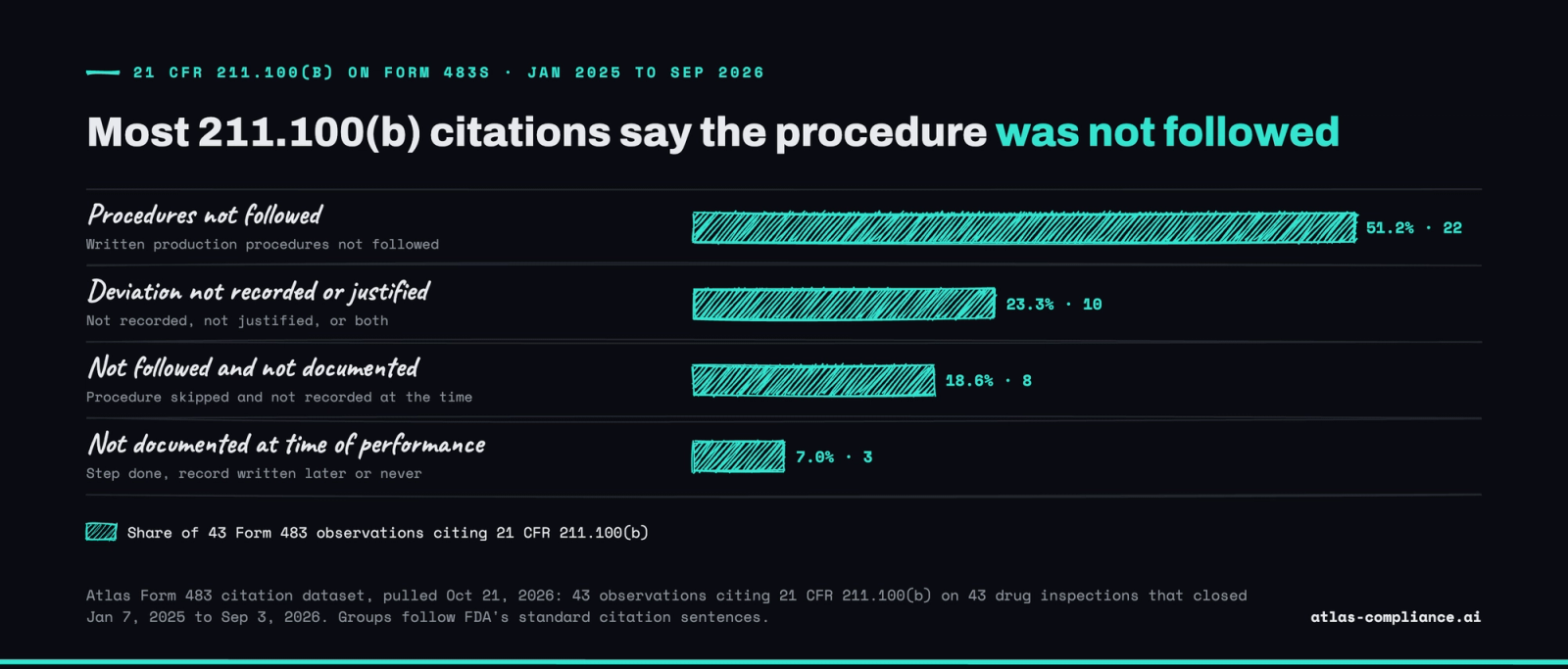
The most common sentence, used 22 times, reads: "Written production and process control procedures are not followed in the execution of production and process control functions." Eight observations add "and documented at the time of performance", and three cite the timing alone. The ten observations under the deviation heading say the deviation was "not justified" (4), "not recorded and justified" (3) or "not recorded" (2), with one truncated sentence.
The split shows where deviation systems break. Over half the citations say staff departed from the procedure, a failure on the floor rather than in the deviation paperwork. Fewer than a quarter (10 of 43) fault the deviation record itself: not recorded, not justified, or both. For a quality team, the first group points at training and supervision; the second points at the deviation form and the QA reviewer.
Investigators rarely cite 211.100(b) alone: only 5 of the 43 inspections cited it as the sole Part 211 section. Of the 43, 17 also cited 211.67 (equipment cleaning and maintenance), 15 cited 211.192 and 15 cited 211.22, the quality unit section. A departure nobody recorded leaves no deviation to investigate, so the 211.192 citation for the same event often follows.
The companion section, 211.100(a), requires the written procedures themselves and drew far more citations: 189 inspections in the same sample, mostly under "Absence of Written Procedures". A firm can only fail 211.100(b) for a step it has a procedure for.
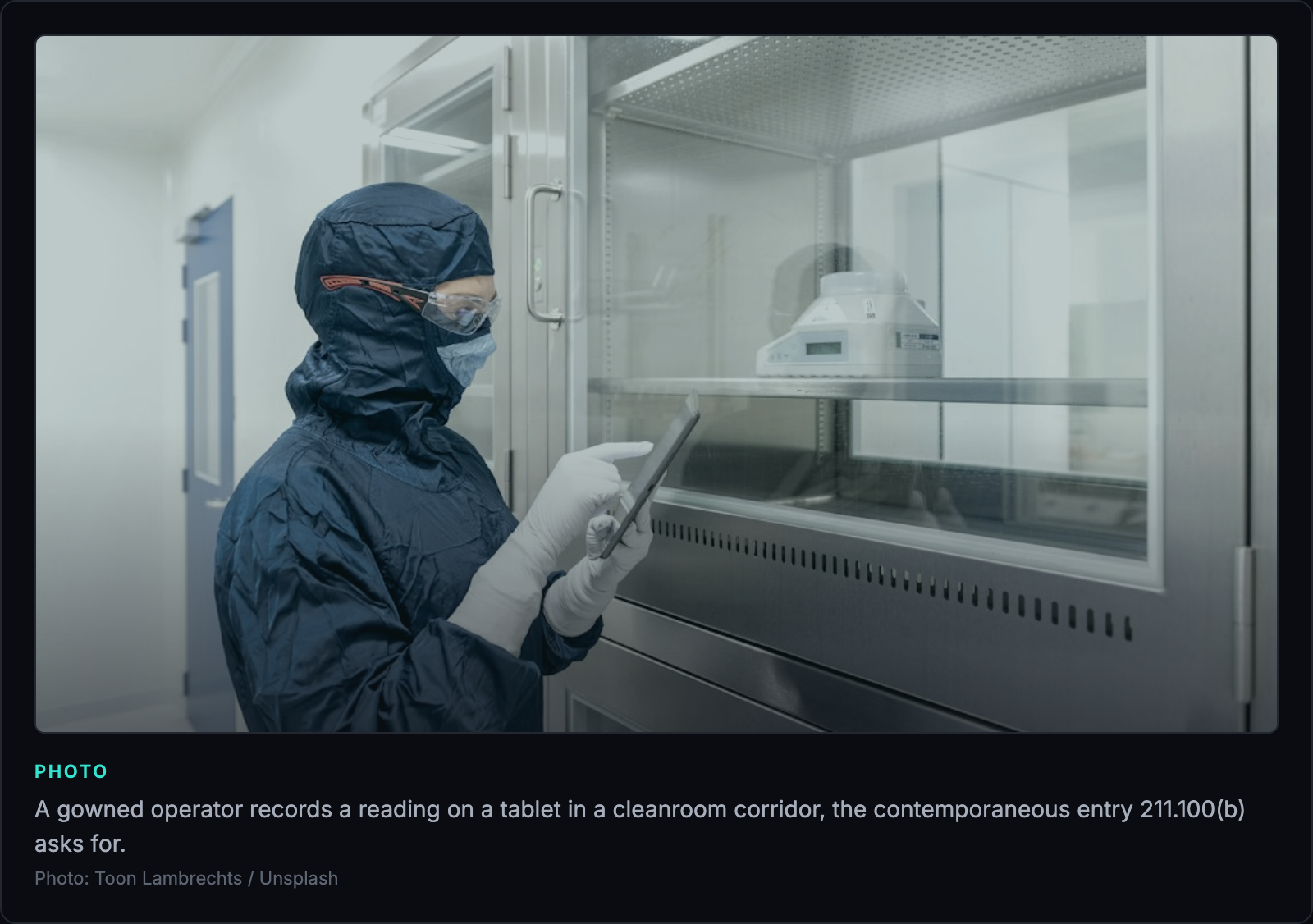
Which firms were cited for deviation failures in 2025 and 2026?
FDA cited 211.100(b) at sterile drug makers, plasma products manufacturers, contract testing laboratories and consumer health facilities in the sample. The table shows six recent forms from the FDA Form 483s directory, with the 211.100(b) heading, whether 211.192 was cited on the same form, and the final classification.
| Form 483 | Issued | 211.100(b) heading | Also cited 211.192 | Classification |
|---|---|---|---|---|
| Viatris Pharmaceuticals, Vega Baja, US | May 18, 2026 | SOPs not followed / documented | Yes | VAI |
| Sciegen Pharmaceuticals, Hauppauge, US | May 15, 2026 | SOPs not followed / documented | No | VAI |
| Catalent Massachusetts, Chelsea, US | Apr 7, 2026 | SOPs not followed / documented | No | VAI |
| Baxter Healthcare, Round Lake, US | Apr 2, 2026 | Procedure Deviations Recorded and Justified | Yes | OAI |
| ONY Biotech, Amherst, US | Feb 5, 2026 | Procedure Deviations Recorded and Justified | Yes | OAI |
| Grifols Therapeutics, Clayton, US | Feb 5, 2026 | SOPs not followed / documented | Yes | VAI |
Both OAI forms in the table carry the deviation heading: the Baxter form says deviations "are not recorded", and the ONY form says they "are not recorded and justified". Both forms also cite 211.192 and 211.113(b), the sterile contamination control section. The Catalent form cited 211.100(b) as its only Part 211 observation and ended VAI.
Most 211.100(b) inspections in the sample were at US facilities: 35 of 43. India and Canada account for most of the rest, with three and two.
Do deviation citations lead to OAI?
Deviation citations come with worse outcomes on average, but the two rules differ. Of the 324 Part 211 drug inspections citing 211.100(b) or 211.192, 126 (38.9%) ended Official Action Indicated, against 86 of 450 (19.1%) that cited neither. Inspections citing either rule averaged 5.2 observations, against 3.2.
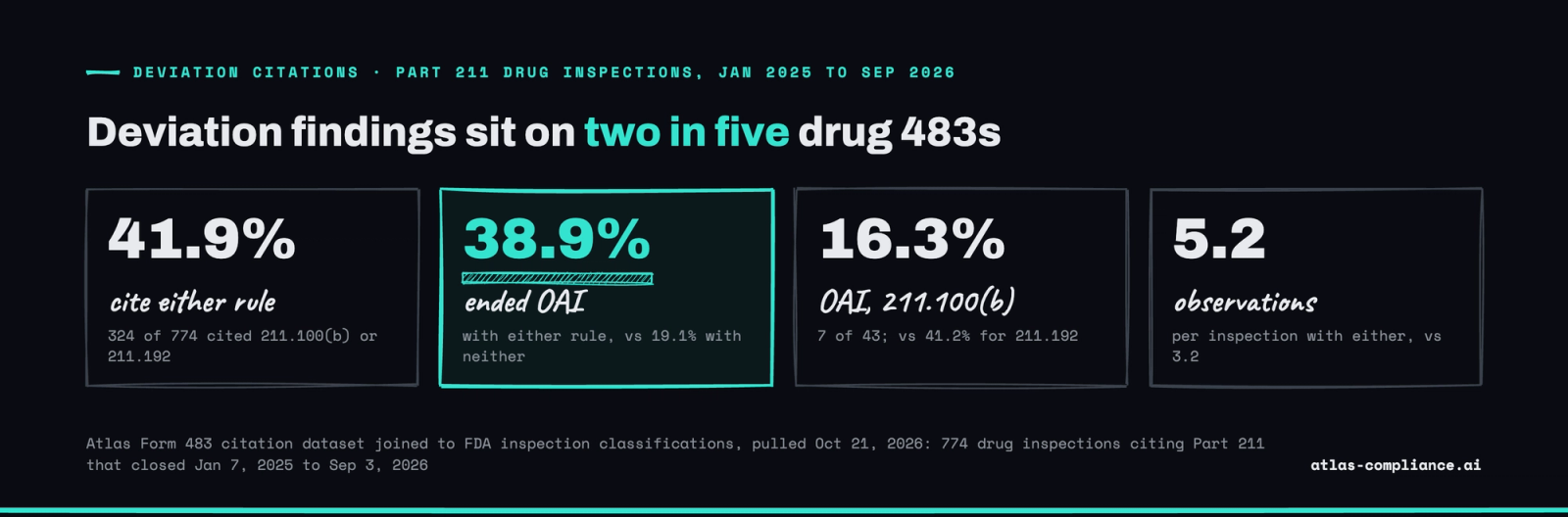
The investigation rule drives most of that gap. Inspections citing 211.192 ended OAI 41.2% of the time (122 of 296). Inspections citing 211.100(b) ended OAI 16.3% of the time (7 of 43), below the 27.4% rate for all 774 inspections. A deviation that was missed or poorly recorded draws a VAI more often; a deviation that was raised and then investigated badly draws an OAI more often. Neither section causes the outcome alone, since FDA classifies on the whole inspection. Our explainer on NAI, VAI and OAI classification covers how that decision is made.
The share has moved up. Either deviation rule appeared at 228 of 562 Part 211 drug inspections in 2025 (40.6%) and 96 of 212 in January to September 2026 (45.3%). Individual investigators also lean on some sections more than others, so the deviation citations a given investigator wrote at peer facilities are worth reading before an inspection opens.
 Atlas
See what the FDA knows about your next investigator.
30 minutes with the founder. No pitch deck.
How is a deviation different from an OOS result or a change control?
A deviation is a departure from an approved instruction during manufacturing or testing. An out-of-specification (OOS) result is a test result outside its acceptance criteria. A change control is a planned, permanent change to a validated process or document, approved before it takes effect. All three can end in a 211.192 investigation or a CAPA.
| Record | What triggers it | Governing text | Typical Form 483 finding |
|---|---|---|---|
| Deviation | Procedure not followed as written | 21 CFR 211.100(b); 211.192 if unexplained | Not recorded, not justified, or not investigated |
| OOS investigation | Test result outside specification | 21 CFR 211.192; FDA OOS guidance | Result invalidated without an assignable cause |
| Change control | Planned permanent change to a process, method or document | 21 CFR 211.100(a) for procedure changes | Change made without QCU review and approval |
OOS results follow FDA's guidance "Investigating Out-of-Specification (OOS) Test Results for Pharmaceutical Production" (October 2006, Revision 1 May 2022), which splits the work into a laboratory phase and a full-scale phase. Our OOS explainer covers that path. If your team opens a deviation and an OOS record for the same event, link the two and let one investigation own the root cause.
The digest below sends new Form 483s and warning letters that cite deviation and investigation failures as FDA posts them, with the sections cited.
AtlasFDA Inspection Intelligence Digest
We track every 483, EIR, and warning letter the moment it happens. Get the signals before they hit the FDA website.
Frequently asked questions
No federal rule sets a number of days. Part 211 requires the investigation to be thorough and written, and 211.192 requires the quality unit to review it before batch release. Firms set a closure target and an extension procedure in their deviation SOP. An investigator will check that extensions were approved with a reason and that no batch was released while its investigation stayed open.

Written by
Bhavish Agarwal
Founder, Atlas
Bhavish Agarwal is the founder of Atlas and previously worked at Google and Microsoft. He has spent the past several years building regulatory data infrastructure for the pharmaceutical industry.