
Chlorthalidone 25 mg tablets were recalled twice in 2026 for the same reason: failed dissolution specifications. Both recalls cover tablets made by Inventia Healthcare Limited in Maharashtra, India, and distributed in the US by Rising Pharma Holdings. The first, initiated on June 5, covered 11,460 bottles; the second, initiated on September 3, covered 13,567 more. FDA classified both as Class II.
A failed dissolution result means tablets from that batch did not release their drug within the time the approved specification requires. It does not mean every tablet was ineffective, and patients should not stop the medicine without talking to their pharmacist or doctor. For quality teams, the question is different: what does a second recall for the same failure, three months after the first, say about the investigation behind the first one? The manufacturer's FDA inspection history is part of the answer.

The two recalls
| June 2026 | September 2026 | |
|---|---|---|
| Product | Chlorthalidone Tablets USP, 25 mg | Chlorthalidone Tablets USP, 25 mg |
| Manufacturer | Inventia Healthcare Limited, India | Inventia Healthcare Limited, India |
| Distributor | Rising Pharma Holdings, Inc. | Rising Pharma Holdings, Inc. |
| Initiated | June 5, 2026 | September 3, 2026 |
| Classified | Class II, June 22, 2026 | Class II, September 17, 2026 |
| Bottles | 11,460 | 13,567 |
| Lots | RISA24001 (100-count), RISB24002 (1,000-count) | RISA24002 (100-count) |
| Expiry | April 2027 | April 2027 |
| Reason | Failed dissolution specifications | Failed dissolution specifications |
Together the two recalls cover 25,027 bottles. The NDC on the 100-count bottles is 64980-599-01. Recall details are from FDA's enforcement report as reported in coverage of both actions; check the report itself for the authoritative lot list. Some coverage names the manufacturing site as Ambernath and some as Kalyan; both are in Thane district, Maharashtra.
All three lots share the April 2027 expiry, which suggests they were made close together. The September recall was not a new manufacturing problem discovered in September. It was a lot from the same period that failed later, most likely on stability testing.
What failed dissolution means
Dissolution testing measures how much of the drug a tablet releases into a standard medium in a set time. For an immediate-release product like chlorthalidone, the specification typically requires a minimum percentage dissolved within a fixed number of minutes. A failure means the batch released too little, too slowly, and the tablets may not deliver the dose the label promises at the expected rate.
Three regulations govern it, and they are among the most cited on drug Form 483s:
| Section | What it requires | Share of recent human-drug 483s citing it |
|---|---|---|
| 21 CFR 211.160 | Laboratory controls: scientifically sound specifications, standards and test procedures | 32% |
| 21 CFR 211.192 | Thorough investigation of any unexplained discrepancy or batch failure, extended to other batches | 31% |
| 21 CFR 211.165 | Testing and release: each batch tested against specifications before release | 13% |
| 21 CFR 211.166 | A written stability program that shows the product stays within specification through expiry | 10% |
Shares are from 90 human-drug Form 483s issued in late 2025 in the FDA Form 483 database. Our Form 483 explainer covers the full list.
The important one for a repeat recall is 211.192. When a batch fails dissolution, the investigation is supposed to find the cause, whether it is the formulation, the granulation, the compression, the coating or the test itself, and then check every other batch that could share it. A second recall of a lot from the same production period three months later is exactly the outcome that requirement exists to prevent.
The manufacturer's FDA inspection record
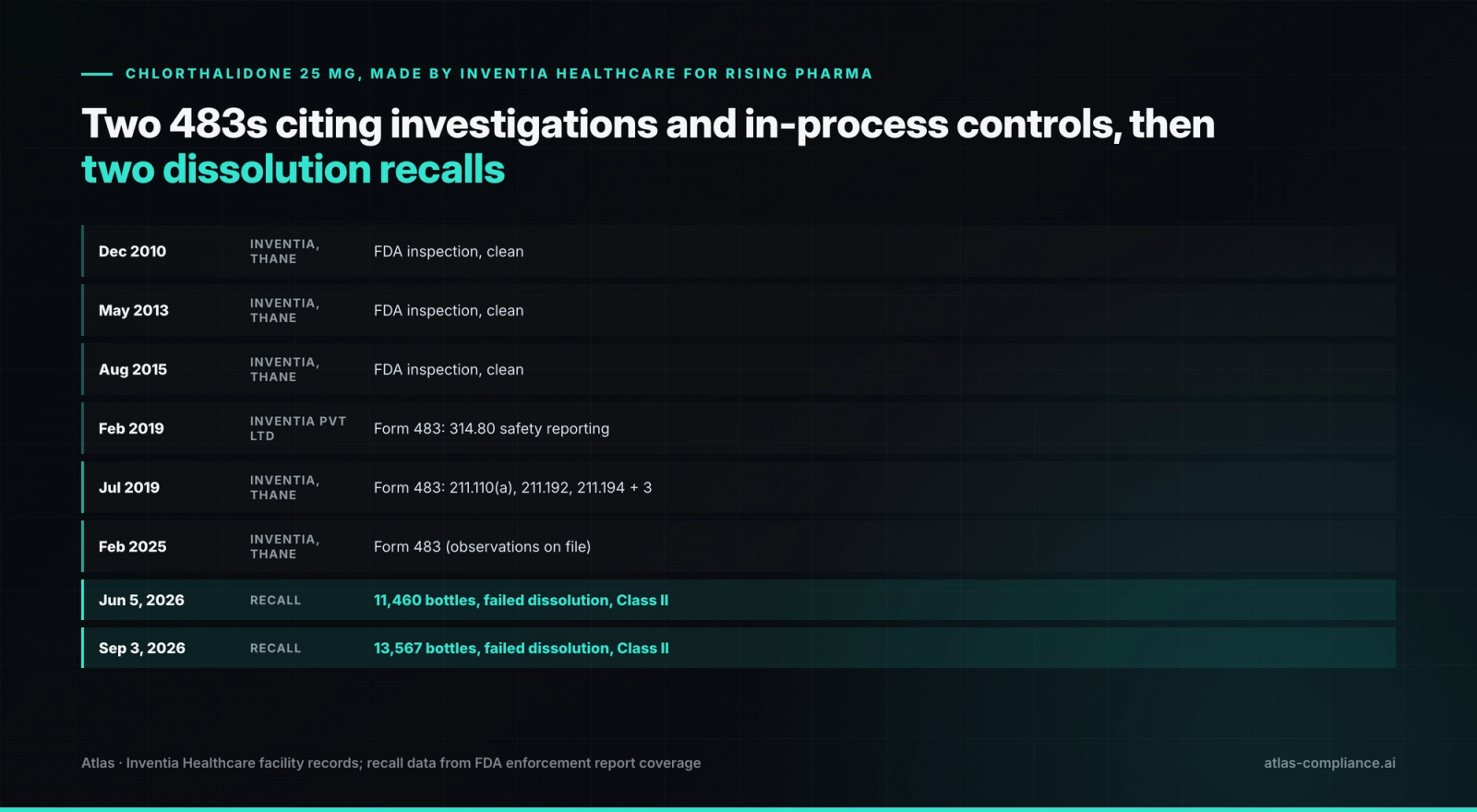
The Inventia Healthcare Limited facility record for its Thane-district site shows five FDA inspections:
| Inspection | Category | Outcome | Sections cited |
|---|---|---|---|
| February 3 to 12, 2025 | Human drugs | Form 483 (on file) | Observation detail not yet public |
| July 1 to 5, 2019 | Human drugs | Form 483 | 211.110(a), 211.192, 211.194(a), 211.194(d), 211.25(a), 211.68(b) |
| August 17 to 21, 2015 | Human drugs | Clean | |
| May 6 to 10, 2013 | Human drugs | Clean | |
| December 2010 | Not recorded | Clean |
The July 2019 Form 483 is the useful one. Its six observations, issued by investigators Nicole E Knowlton and Jose A Lopez Rubet, include 211.110(a), in-process controls to monitor the output and validate the performance of manufacturing processes, and 211.192, investigations of discrepancies and failures. Those are the two controls that sit closest to a dissolution failure: in-process controls are where variability in granulation or compression should be caught, and the investigation is where a failed batch should be traced to its cause. Two further observations, 211.194(a) and 211.194(d), concern complete laboratory records and equipment calibration records.
The facility was inspected again in February 2025 and received another Form 483; the observations from that inspection are on file but not yet in the public record. The tablets in both 2026 recalls carry an April 2027 expiry, which for a product with a typical two- or three-year shelf life puts their manufacture around the time of that inspection or shortly after.
A separate Inventia entity at the same Thane location, Inventia Healthcare Pvt Ltd, received a Form 483 in February 2019 under 21 CFR 314.80, for postmarketing adverse drug experience reporting: written procedures and late submission of individual safety reports. That is a pharmacovigilance finding, not a manufacturing one.
 Atlas
AtlasSee what the FDA knows about your next investigator.
30 minutes with the founder. No pitch deck.
What it means for quality teams
If you distribute or buy this product. Check the lot numbers against stock, quarantine any match, and follow Rising Pharma's recall instructions. Record both recalls in the supplier file with the manufacturer named, not only the distributor: the distributor's name is on the label, but the failure is in the manufacturer's process.
If you source from contract manufacturers in general. A repeat recall for the same failure mode is a signal about the investigation system, not only the product. The supplier questions worth asking after the first recall are the ones 211.192 implies: what was the root cause, which other lots were assessed and how, and what stability data covers the lots still in distribution. A second recall three months later means one of those answers was incomplete. Our piece on how to address and prevent Form 483 observations covers how strong investigations are written.
Check the manufacturer, not the label. Generic tablets are often made by one company and marketed by another. The manufacturer's FDA inspection history is public, and each facility's page in the FDA facility lookup shows its inspections, Form 483s and the regulations cited. The same discipline drove the Fresenius cases this year, where the warning letters followed 483s that had cited the investigation requirement years earlier.
Dissolution failures often surface on stability. If your own product fails dissolution late in shelf life, the investigation should look at the stability data trend for every lot made in the same window, not only the failing lot. That is the scope FDA expects under 211.166 and 211.192 together.
What happens next
Class II recalls do not by themselves trigger an inspection, but two recalls for the same failure from one facility within a year is the kind of signal that moves a facility up FDA's surveillance list. If FDA inspects again, the dissolution investigations and the stability program will be the first records requested. The outcome of the February 2025 inspection, and whether it is classified VAI or OAI, will also become public in time; our guide to NAI, VAI and OAI explains what each would mean.
AtlasFDA Inspection Intelligence Digest
We track every 483, EIR, and warning letter the moment it happens. Get the signals before they hit the FDA website.
Frequently asked questions
Two lots in June and one in September of chlorthalidone 25 mg tablets failed dissolution testing, meaning the tablets did not release the drug within the time the approved specification requires. The tablets were made by Inventia Healthcare Limited in India and distributed by Rising Pharma Holdings. FDA classified both recalls Class II.

Written by
Bhavish Agarwal
Founder, Atlas
Bhavish Agarwal is the founder of Atlas and previously worked at Google and Microsoft. He has spent the past several years building regulatory data infrastructure for the pharmaceutical industry.