
A 510(k) is a premarket notification that clears a medical device by showing it is substantially equivalent to a legally marketed predicate, while a PMA (premarket approval application) is the application that approves a Class III device on valid scientific evidence that it is safe and effective. De Novo sits between them: it classifies a new, lower-risk device that has no predicate into Class I or II.
This comparison puts all three pathways in one table, with review goals from the MDUFA V commitment letter and FY2027 fees from the Federal Register, then adds what device teams rarely see side by side: Atlas analysis of 3,930 FDA device inspections that ended from January 2, 2025 to October 14, 2026.
Key facts:
- A 510(k) leads to clearance under 21 CFR 807.100; a PMA leads to approval under 21 CFR 814.44; a De Novo request leads to a grant that creates a new classification under 21 CFR 860.260.
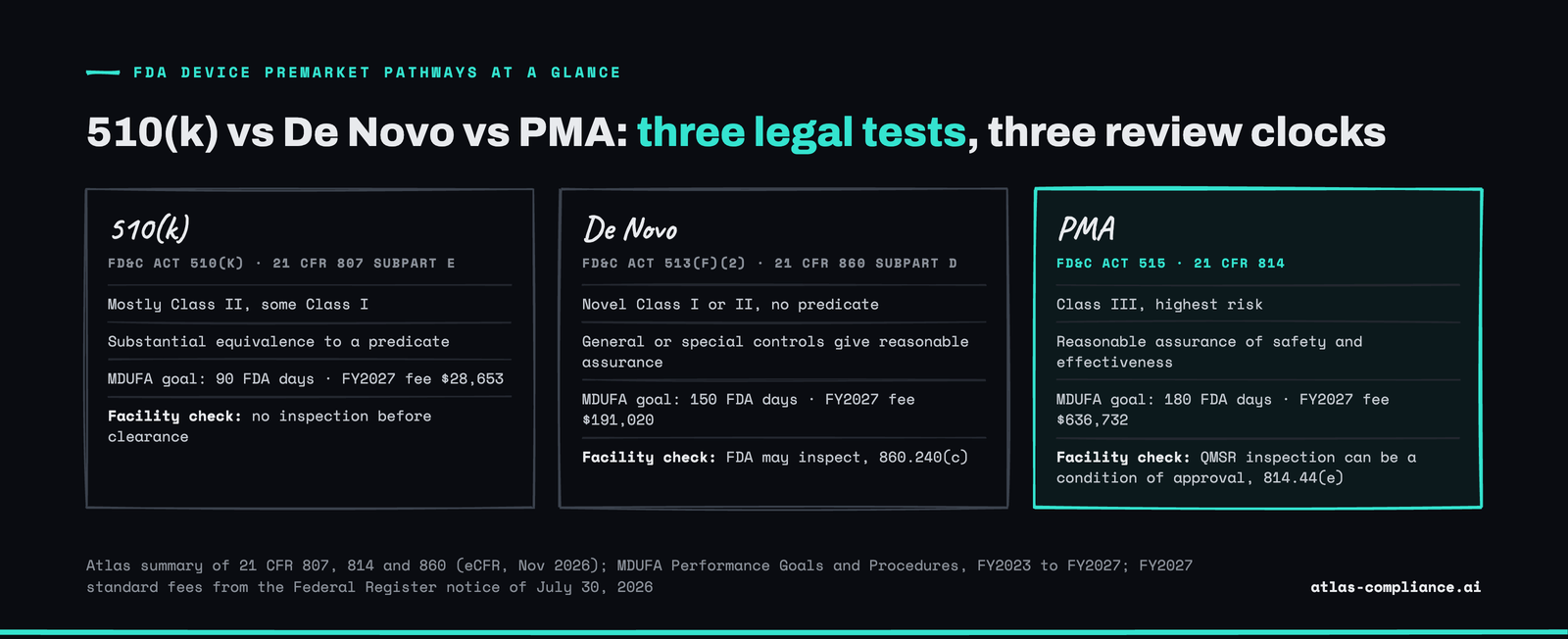
- FDA's MDUFA V goals are 90 FDA days for a 510(k), 150 FDA days for a De Novo request and 180 FDA days for an original PMA without an advisory committee.
- FY2027 standard user fees, effective October 1, 2026, are $28,653 for a 510(k), $191,020 for a De Novo request and $636,732 for a PMA.
- Part 814 lets FDA make a facility inspection under Part 820 a condition of PMA approval; Part 807 sets no inspection before 510(k) clearance.
- Of 2,005 device quality system inspections in FDA's classification data for January 2025 to October 2026, 56.5% ended VAI or OAI (Atlas analysis, pulled October 21, 2026).
What is the difference between a 510(k) and a PMA?
The difference between a 510(k) and a PMA is the legal question FDA answers. A 510(k) asks whether a device is as safe and effective as a predicate already on the market, so FDA compares two devices. A PMA asks whether valid scientific evidence gives reasonable assurance that this device, on its own, is safe and effective, so FDA judges the device against its claims.
That split drives everything else. A 510(k) submitter names a predicate under 21 CFR 807.92(a)(3): a device marketed before May 28, 1976, a device reclassified from Class III to Class II or I, or a device already found substantially equivalent. A PMA applicant names no predicate and relies on the evidence types listed in 21 CFR 860.7, which for effectiveness means "principally" well-controlled investigations.
FDA clears a 510(k) device and approves a PMA device; 21 CFR 807.97 says a substantial equivalence order does not denote official approval. Our 510(k) submission guide covers eSTAR, the three 510(k) types and the Additional Information hold, so this post does not repeat them.
How do 510(k), De Novo and PMA compare?
510(k), De Novo and PMA differ on device class, legal standard, evidence, review clock, user fee and facility check. The table sets the three FDA device pathways side by side, using the regulation text on eCFR, the MDUFA V commitment letter and the FY2027 fee notice.
| 510(k) | De Novo | PMA | |
|---|---|---|---|
| Regulation | 21 CFR 807 Subpart E | 21 CFR 860 Subpart D | 21 CFR 814 |
| Device class | Mostly Class II, some Class I, a few preamendments Class III types | New Class I or II type with no predicate | Class III |
| Legal standard | Substantial equivalence to a predicate | General controls, or general and special controls, give reasonable assurance of safety and effectiveness | Reasonable assurance of safety and effectiveness from valid scientific evidence |
| Clinical data | Sometimes; 807.87(j) covers submissions supported by clinical data | Often, when bench data cannot show the controls work | Usually, from well-controlled investigations (860.7(e)) |
| Regulatory clock | Submit at least 90 days before marketing (807.81) | Order within 120 days of acceptance (860.240(a)) | Action within 180 days of filing (814.40) |
| MDUFA V decision goal | 90 FDA days for 95% | 150 FDA days for 70% | 180 FDA days for 90%, or 320 with an advisory committee |
| Shared total time to decision goal | 112 calendar days (FY2025 to FY2027) | None set | 285 calendar days (FY2025 to FY2027) |
| FY2027 standard fee | $28,653 | $191,020 | $636,732 |
| FY2027 small business fee | $7,163 | $47,755 | $159,183 |
| Fee-paying submissions, FY2025 | 4,087 | 62 | 36 full-fee applications |
| Facility inspection before decision | None set in Part 807 | FDA may inspect (860.240(c)) | Can be a condition of approval (814.44(e)(1)(iii)) |
| Outcome | Clearance (SE order) | Grant, which creates a classification | Approval order |
| Later changes | New 510(k) for significant changes (807.81(a)(3)) | New 510(k) once the type is classified | PMA supplement, 30-day notice or annual report (814.39, 814.84) |
FDA's fee notice in the Federal Register of July 30, 2026, Medical Device User Fee Rates for Fiscal Year 2027, sets the PMA fee and prices the others as shares of it: 30% for a De Novo request and 4.5% for a 510(k). Its FY2025 counts show the volume gap: 4,087 fee-paying 510(k)s against 62 De Novo requests and 36 full-fee premarket applications, a category that also covers premarket reports and BLAs reviewed under MDUFA.
The review goals come from MDUFA Performance Goals and Procedures, Fiscal Years 2023 Through 2027. FDA days stop while a file waits on the sponsor, so calendar time runs longer than each goal.
When does a device need a De Novo request instead of a 510(k) or PMA?
A device needs a De Novo request when no legally marketed predicate exists and the device is low or moderate enough in risk for general controls, or general and special controls, to give reasonable assurance of safety and effectiveness. 21 CFR 860.200(b) allows the request after a not substantially equivalent (NSE) decision on a 510(k), or directly when the sponsor finds no predicate.
21 CFR 860.230 gives FDA 15 days to accept the request and 860.240(a) sets a 120-day review window after acceptance. FDA can decline under 860.260(c) for 11 reasons, including a device that belongs in Class III, a type already classified, or clinical investigations not run under Parts 50 and 56 and the good clinical practice rules in 812.28(a).
A grant has a second effect. Under 860.260(a)(2), FDA publishes the classification order, with its special controls, in the Federal Register within 30 days. The device type is then classified, so a competitor with the same intended use can file a 510(k) and cite the granted device as its predicate.
Can a Class III device go through a 510(k)?
A Class III device can go through a 510(k) only if it is a preamendments type for which FDA has not yet issued a regulation under section 515(b) calling for PMAs. 21 CFR 814.1(c) applies Part 814 to Class III devices that are new after May 28, 1976 and not substantially equivalent, or that a 515(b) regulation covers.
For those remaining types, 21 CFR 807.94 adds a Class III certification and summary to the 510(k): the submitter certifies a reasonable search of the known safety and effectiveness problems of that device type. Once FDA calls for PMAs, the 510(k) route closes for that type. Every other Class III device, including any new high-risk device with no Class III predicate, needs a PMA.
Which pathway does my device need?
Your device's pathway follows from its classification, so start with the classification regulation, then answer the predicate question. The five checks below follow 21 CFR 807.81, 814.1 and 860.200.
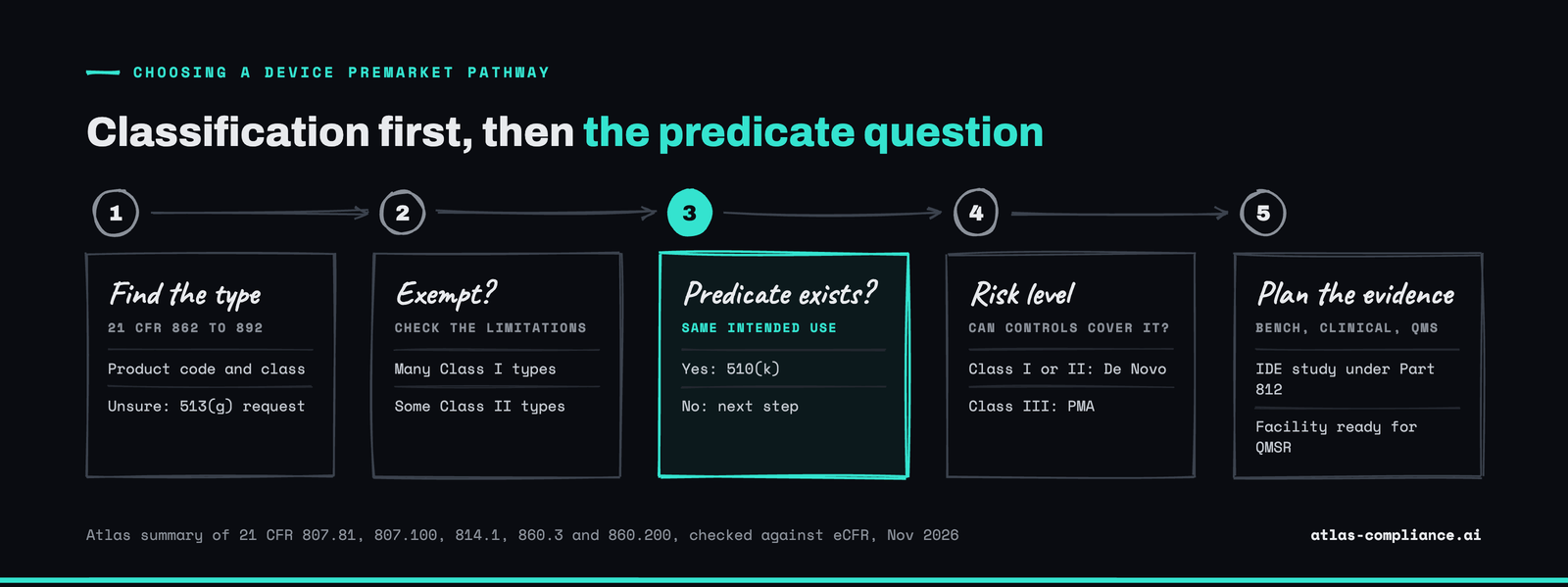
- Find the device type and class in 21 CFR 862 to 892. If the class is unclear, a 513(g) request for classification information gets FDA's written view; its FY2027 fee is $8,596, or $4,298 for a small business.
- Check whether the type is exempt from 510(k), and read the limitations in its classification regulation. A device that exceeds them is not exempt.
- Look for a predicate with the same intended use. If one exists and the technological differences raise no new questions of safety and effectiveness, file a 510(k).
- With no predicate, decide whether controls can manage the risk. If yes, file a De Novo request. If the device is life-supporting, life-sustaining or presents a potential unreasonable risk, the Class III definition in 860.3 points to a PMA.
- Plan the evidence. A clinical study of a significant risk device runs under an investigational device exemption (Part 812), and a PMA facility has to be ready for a Part 820 inspection before approval.
Does FDA inspect a facility before clearance or approval?
FDA can inspect a facility before PMA approval and before a De Novo grant, but Part 807 sets no facility inspection before 510(k) clearance. For a PMA, 21 CFR 814.44(e)(1)(iii) lists an FDA inspection that finds the manufacturing facilities, methods and controls in compliance with Part 820 as a condition FDA can attach to approval.
Part 814 backs that with consequences. Under 814.45(a)(3), FDA may deny a PMA if the applicant does not let an FDA employee inspect the facilities and records, and under 814.82(b) an approved PMA holder must allow inspection of all manufacturing facilities. Since February 2, 2026, Part 820 is the QMSR, which incorporates ISO 13485:2016; our QMSR guide covers what changed for inspections.
For De Novo, 860.240(c) lets FDA inspect relevant facilities to check how clinical or nonclinical data were collected, or whether QMSR controls can make devices with critical or novel processes to specification. Refusing that inspection counts as withdrawing the request under 860.250(a)(3).
All three pathways can also bring a clinical data inspection. 814.45(a)(5) and 860.260(c)(9) let FDA deny a PMA or decline a De Novo request when a clinical investigation did not protect subjects or produced unreliable data. FDA checks that through Bioresearch Monitoring (BIMO) inspections of investigators, institutional review boards and sponsors.
What do FDA device inspections find?
FDA device inspections end with action indicated far more often in the quality system program than in postmarket or clinical study programs. In FDA's inspection classification data for product type Devices, inspections ending January 2, 2025 to October 14, 2026 (Atlas analysis, pulled October 21, 2026), 2,005 Compliance: Devices inspections ended 50.9% VAI and 5.6% OAI.
| FDA program (device inspections) | Inspections | NAI | VAI | OAI |
|---|---|---|---|---|
| Compliance: Devices | 2,005 | 43.5% | 50.9% | 5.6% |
| Postmarket Assurance: Devices | 1,492 | 81.0% | 16.3% | 2.7% |
| Bioresearch Monitoring | 378 | 81.0% | 18.0% | 1.1% |
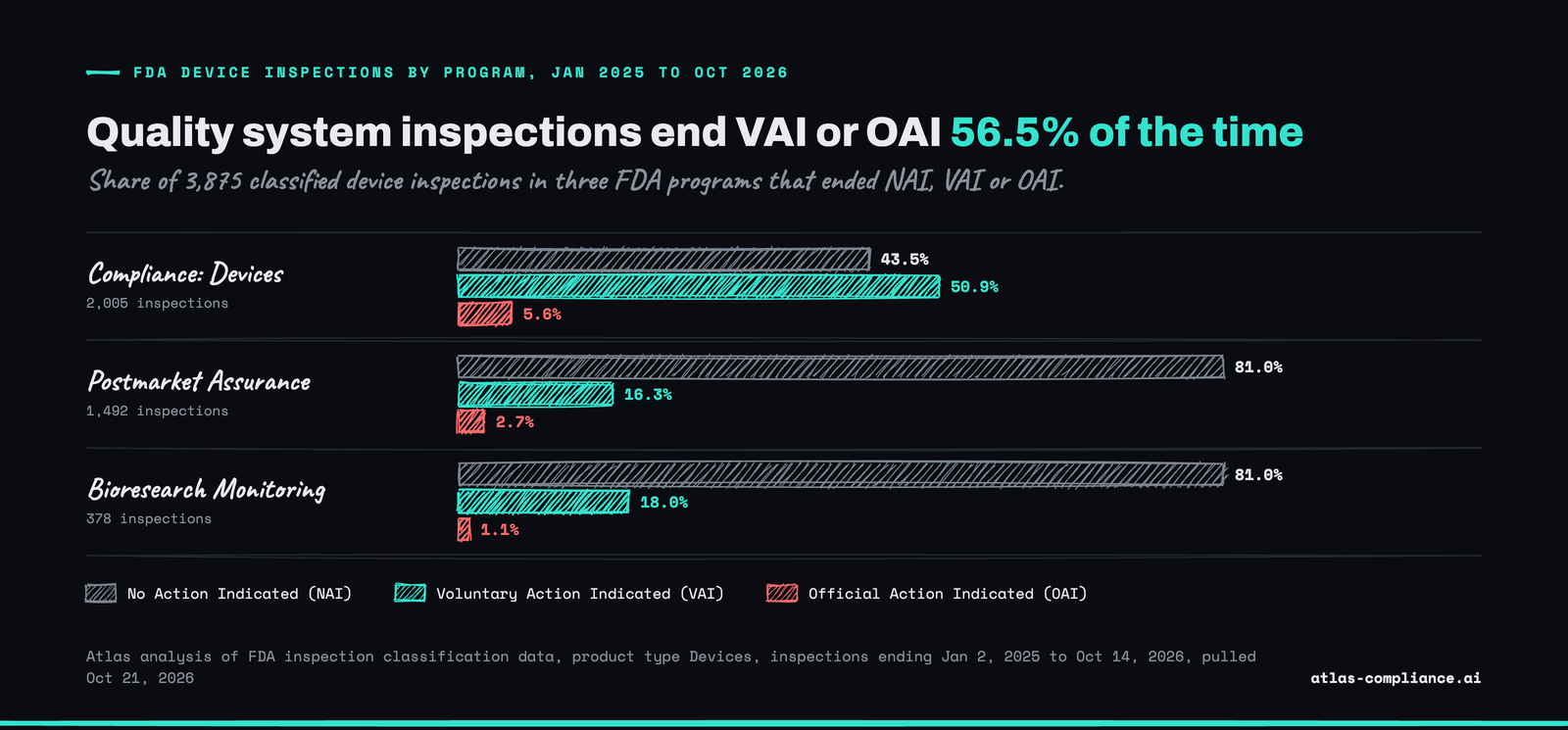
The 378 BIMO inspections are the ones that test the clinical data behind a PMA or De Novo request. Clinical investigators accounted for 235 of them (44 VAI, none OAI), IRBs for 90 (13 VAI) and sponsors or contract research organizations for 53. All four BIMO inspections classified OAI were at sponsors or CROs.
The citations point the same way. In FDA's published citation data for device inspections ending January 2, 2025 to October 9, 2026 (Atlas analysis, same pull), Part 820 appeared at 699 inspections and Part 812, the investigational device rule, at 55. Part 814 appeared at none, and Part 807 at 3, all for registration or listing rather than a missing 510(k). Investigators cite how a firm runs its quality system and its studies; the premarket file itself rarely shows up on a Form 483. Our 21 CFR Part 820 guide lists the clauses cited most.
Four sponsor Form 483s in the Atlas FDA Form 483 database (release of August 15, 2026) show what a sponsor inspection finds:
- Synergy Spine Solutions, Louisville, November 24, 2025: three observations under 812.40 (sponsor responsibilities), 812.46(a) (securing investigator compliance) and 812.140(b)(6) (study records).
- MedAlliance, Irvine, February 20, 2026: one observation under 812.40, proper monitoring not ensured.
- Synaptic Medical Corporation, Carlsbad, March 31, 2026: one observation under 812.40, issued by a two-person inspection team.
- GRAIL, Menlo Park, May 18, 2026: one observation under 812.40, filed in the Medical Devices & Rad Health category.
In all four, FDA's citation text says the sponsor did not ensure proper monitoring of an investigational study. Before a PMA or De Novo filing, a sponsor can check which investigators have inspected sponsors like it and what they cited.
 Atlas
See what the FDA knows about your next investigator.
30 minutes with the founder. No pitch deck.
What changes after clearance or approval?
After clearance, a 510(k) holder files a new 510(k) for any change that could have a significant effect on safety or effectiveness or that is a major change in intended use, under 21 CFR 807.81(a)(3). After approval, a PMA holder must get FDA approval of a PMA supplement before most changes that affect safety or effectiveness, under 814.39(a).
The PMA side has more channels, each with its own fee and clock:
- 180-day PMA supplement: MDUFA V sets a decision goal of 180 FDA days for 95%, and the FY2027 fee is $95,510.
- Real-time PMA supplement: the goal is 90 FDA days for 95%, and the fee is $44,571.
- 30-day notice: covers changes to manufacturing procedures or methods that affect safety or effectiveness, and must state the change was made under Part 820 (814.39(f)). The fee is $10,188; if FDA finds the notice inadequate, it becomes a 135-day supplement.
- Periodic report: under 814.84 it identifies the changes made since the last report, and the FY2027 annual fee for periodic reporting on a Class III device is $22,286.
814.39(a)(3) also lists use of a different facility to make, process or package the device as a change that needs a supplement when it affects safety or effectiveness. For a contract manufacturer, that puts its own inspection history inside the PMA holder's change file. Investigators read the change records behind each of these decisions; our NAI, VAI and OAI guide explains how FDA then classifies the inspection. The Atlas digest sends new device Form 483s, including sponsor and QMSR citations, as FDA releases them.
AtlasFDA Inspection Intelligence Digest
We track every 483, EIR, and warning letter the moment it happens. Get the signals before they hit the FDA website.
Frequently asked questions
Most 510(k)s rely on bench, performance and biocompatibility testing, but some include clinical data. 21 CFR 807.87(j) sets what a 510(k) supported by clinical data must state about compliance with Parts 50, 56 and 812. FDA asks for clinical data when nonclinical testing cannot show that a device with different technological characteristics is as safe and effective as its predicate.

Written by
Bhavish Agarwal
Founder, Atlas
Bhavish Agarwal is the founder of Atlas and previously worked at Google and Microsoft. He has spent the past several years building regulatory data infrastructure for the pharmaceutical industry.