
An EDMS (electronic document management system) is software that stores, versions, routes for approval and controls access to an organization's documents across their full lifecycle, from first draft to retirement. In pharma, biotech and medical devices, a GxP EDMS also has to meet 21 CFR Part 11 and EU GMP Annex 11, because the documents it holds are the procedures and records FDA inspects.
That second requirement is where most of the inspection risk sits. In the Atlas Form 483 directory (release of August 15, 2026, counted October 22, 2026), 29% of 779 human drug Form 483s issued from January 2025 to July 10, 2026 that cite 21 CFR Part 211 cited 211.100, the written procedures section. This guide explains what an EDMS is, the types, the controls a regulated one needs, and what those 483s say about where document control fails.
Key facts:
- EDMS stands for electronic document management system; in regulated life sciences it controls SOPs, specifications, master records, protocols and reports.
- 21 CFR 11.10 lists 11 controls for closed systems, labeled (a) to (k), including validation, secure time-stamped audit trails and limiting access to authorized individuals.
- 21 CFR 11.50 requires every signed electronic record to show the signer's printed name, the date and time, and the meaning of the signature.
- 21 CFR 211.100(a) requires written production procedures, and any changes to them, to be drafted, reviewed and approved by the appropriate units and approved by the quality control unit.
- In 779 Part 211 human drug Form 483s (January 2025 to July 10, 2026), 211.100 appeared on 29%, 211.68 on 21% and 211.22 on 45%.
- Of 319 medical device Form 483s citing ISO 13485 after the QMSR took effect on February 2, 2026, 19 cited clause 4.2.4, control of documents.
What does EDMS stand for, and what does an EDMS do?
EDMS stands for electronic document management system. An EDMS replaces paper binders and shared folders with one controlled repository where every document has an owner, a version number, an approval history and a status (draft, effective, retired). Users find the current version by search, and superseded versions stay retrievable but cannot be used by mistake.
The core functions are the same in every industry:
- Capture: create documents in the system or import them, with metadata such as document type, owner and department.
- Version control: each revision gets a new number, and the system keeps every prior version with who changed it and when.
- Workflow: route a draft to reviewers and approvers in a fixed order, with electronic signatures at each step.
- Access control: limit who can read, edit, approve or print, by role.
- Retrieval and retention: full-text and metadata search, plus retention rules that keep records for the period the regulation sets.
In pharma, "EDMS" often means the system that holds controlled GMP documents: SOPs, master batch records, specifications, validation protocols and training material. Teams searching for a "GMP document management system" usually mean the same thing.
What are the types of EDMS?
The types of EDMS fall into five groups by purpose and deployment: document-centric systems, records management systems, enterprise content management (ECM) platforms, GxP-validated EDMS, and the split between cloud and on-premise hosting. A regulated company usually runs a GxP-validated EDMS for controlled documents and something lighter for everything else.
| Type | Main job | Typical content | Part 11 / Annex 11 ready out of the box? | Fits |
|---|---|---|---|---|
| Document-centric EDMS | Create, version and share working documents | Drafts, reports, presentations | Usually not | Non-GxP teams, early-stage companies |
| Records management system | Retain and dispose of final records on a schedule | Signed records, contracts, correspondence | Partly: retention yes, approval workflow limited | Legal holds, archives |
| Content or enterprise content management (ECM) | Manage all unstructured content across the business | Documents, images, email, web content | Configurable, needs validation work | Large enterprises with many content types |
| GxP-validated EDMS | Control regulated documents through review, approval and periodic review | SOPs, master records, specifications, protocols | Designed for it, still validated by the user | Pharma, biotech, device manufacturing |
| Cloud vs on-premise | A deployment choice that applies to all of the above | Same | The regulated company stays responsible either way | Cloud: faster upgrades; on-premise: full infrastructure control |
Two points the table hides. A vendor can supply a system designed for Part 11, but validation for your intended use is always the regulated company's job. And cloud hosting does not move accountability: Annex 11 section 3 requires formal agreements with third-party service providers that state each party's responsibilities.
What must a GxP EDMS do under 21 CFR Part 11 and EU Annex 11?
A GxP EDMS must meet the 21 CFR 11.10 controls for closed systems, the electronic signature rules in 11.50 and 11.70, and, for products supplied to the EU, the matching sections of EU GMP Annex 11. The table maps the controls a document system is inspected against, using the current text of 21 CFR Part 11 on eCFR.
| Requirement | 21 CFR Part 11 | EU GMP Annex 11 (2011) | What it means in an EDMS |
|---|---|---|---|
| Validation | 11.10(a) | Section 4 | Documented evidence the system works for its intended use and can discern invalid or altered records |
| Readable copies | 11.10(b) | Section 8, printouts | Export accurate, complete copies for an inspector |
| Record protection and retention | 11.10(c) | Sections 7 and 17 | Records retrievable for the whole retention period, backed up and archived |
| Access limits | 11.10(d), (g) | Section 12 | Role-based permissions; only authorized people approve or change documents |
| Audit trail | 11.10(e) | Section 9 | Secure, computer-generated, time-stamped log of every create, modify and delete; changes do not obscure prior entries |
| Sequencing checks | 11.10(f) | No direct equivalent | Workflow enforces review before approval, approval before effective |
| Training | 11.10(i) | Section 2, personnel | Users, administrators and developers are trained for their roles |
| Signature manifestation | 11.50 | Section 14 | Signed documents show printed name, date and time, and meaning (review, approval) |
| Signature linking | 11.70 | Section 14 | A signature cannot be copied or moved to another record |
| Change control | 11.10(k) | Section 10 | Changes to the system and its configuration are controlled and documented |
| Periodic evaluation | Not stated | Section 11 | The system is reviewed periodically to confirm it remains valid |
Annex 11 is published by the European Commission in EudraLex Volume 4; a revised draft went to public consultation in 2025, and the 2011 text remains the version in force until a final revision is adopted.
One nuance changes how you read inspection findings. FDA rarely cites Part 11 itself on a drug 483. In the 1,059 human drug Form 483s in the Atlas directory from January 2025 to July 2026, none of the structured citations named Part 11; investigators wrote the findings under the predicate rules, mostly 21 CFR 211.68(b), which appeared on 16.6% of the 779 Part 211 forms. Our analysis of data integrity citations on FDA Form 483s covers that split in detail. An EDMS that passes a Part 11 checklist but lets someone edit an approved master record without a trace will be cited under 211.68(b), not Part 11.
What is the document lifecycle in an EDMS?
The document lifecycle in an EDMS is the controlled sequence every GxP document moves through: draft, review, approve, effective, periodic review and retire. 21 CFR 211.100(a) sets the minimum for drug production procedures: they "shall be drafted, reviewed, and approved by the appropriate organizational units and reviewed and approved by the quality control unit," and the same applies to changes.
- Draft. An author creates the document or a new revision from a controlled template; the EDMS assigns a number and version.
- Review. Subject matter experts and affected departments comment; the EDMS records each reviewer and keeps the comments.
- Approve. Approvers, always including the quality unit for GMP documents, sign electronically under 11.50, with the meaning of each signature shown.
- Effective. The document is released on a set date, usually after training is complete; the prior version is superseded and removed from use automatically.
- Periodic review. The owner confirms the document is still accurate at a fixed interval, commonly two or three years, set by the company's own procedure.
- Retire. Obsolete documents are withdrawn from use but kept for the retention period; under 21 CFR 211.180(a), drug batch records are kept at least one year after the batch's expiration date.
Where the lifecycle breaks, the 483 usually cites 211.100(a) with FDA's short title "Absence of Written Procedures." Two indexable 2026 examples: the Oxalis Labs Form 483 (Solan, India, April 24, 2026, 3 observations) opens with 211.100(a), and the Fresenius USA Manufacturing Form 483 (Ogden, Utah, March 6, 2026, 2 observations) pairs 211.100(a) with 211.192, the inspection that preceded the facility's August 2026 warning letter.
How often does FDA cite document control on Form 483s?
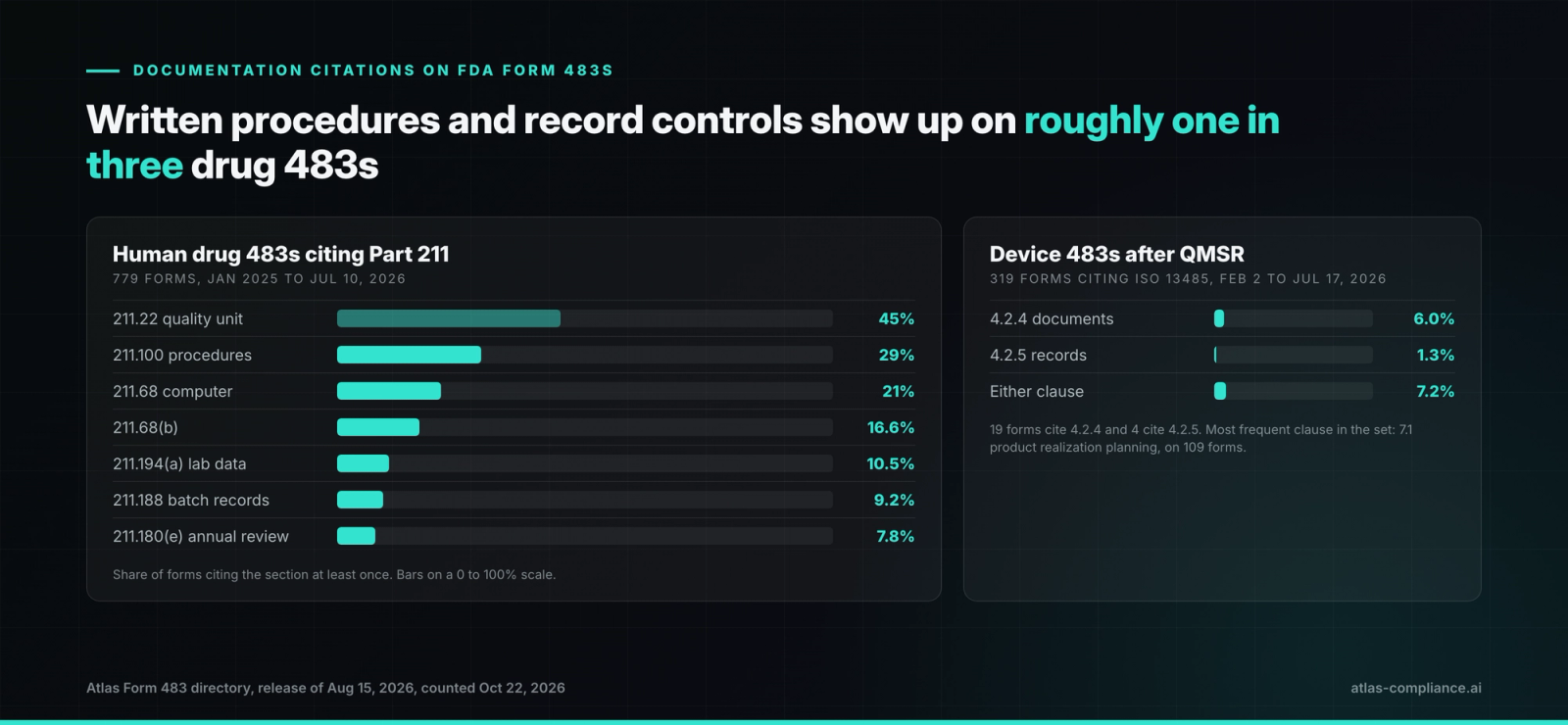
FDA cites document and procedure failures on roughly a third of drug Form 483s. In the Atlas Form 483 directory (release of August 15, 2026), counted October 22, 2026 across 779 human drug 483s issued January 2025 to July 10, 2026 that cite 21 CFR Part 211, 211.100 appeared on 29%, 211.68 on 21% and 211.22 (the quality unit, which owns document approval) on 45%.
| Section | What it covers | Share of 779 Part 211 drug 483s |
|---|---|---|
| 211.22 | Quality control unit responsibilities, including approving procedures | 45% |
| 211.100 | Written production procedures; deviations recorded | 29% |
| 211.68 | Automatic, mechanical and electronic equipment | 21% |
| 211.68(b) | Computer controls over master records, input and output checks, backups | 16.6% |
| 211.194(a) | Complete laboratory records | 10.5% |
| 211.188 | Batch production and control records | 9.2% |
| 211.180(e) | Annual review of records for each product | 7.8% |
The 2026 slice alone holds the pattern: 211.100 appears on 63 of the 201 Part 211 drug forms issued January to July 2026 (31.3%). Batch records show up too; the Safecor Health Form 483 (Columbus, June 12, 2026) has two observations, 211.188 incomplete batch records and 211.192 investigations.
Device manufacturers are inspected against ISO 13485 since the Quality Management System Regulation took effect on February 2, 2026. Of 349 device Form 483s issued from that date to July 17, 2026, 319 carry ISO 13485 clause citations; 19 cite clause 4.2.4, control of documents (6.0%), and 4 cite 4.2.5, control of records. The Light Age Form 483 (Somerset, New Jersey, May 15, 2026, 18 observations) cites 4.2.4 "Lack of document control" more than once, and the Surgical Theater Form 483 (Beachwood, Ohio, June 11, 2026) cites 4.2.4 "Document Control Procedure Inadequate" in a three-observation form. You can search the FDA Form 483 database by section to read how investigators word these findings at other facilities.
 Atlas
See what the FDA knows about your next investigator.
30 minutes with the founder. No pitch deck.
EDMS vs QMS vs LIMS: what is the difference?
An EDMS controls documents, a QMS (quality management system) software platform runs quality processes such as deviations, CAPA, change control and audits, and a LIMS (laboratory information management system) manages samples, tests and results in the lab. Many QMS platforms include a document module, which is why the terms blur, but an inspector will ask which system is the record of truth for each.
| EDMS | QMS software | LIMS | |
|---|---|---|---|
| Primary object | Controlled document (SOP, specification, master record) | Quality event (deviation, CAPA, change, complaint) | Sample and test result |
| Typical users | Every department; document control owns it | Quality assurance | QC laboratory |
| Key regulation (drugs) | 211.100, 211.186, 211.180 | 211.22, 211.192 | 211.160, 211.194 |
| Key clause (devices, ISO 13485) | 4.2.4, 4.2.5 | 8.5.2 corrective action, 8.2.2 complaints | 7.6, 8.2.6 |
| Part 11 scope | Yes, for signed documents | Yes, for signed records | Yes, for electronic lab data |
| Common 483 link | Missing or unapproved procedures | Incomplete investigations | Incomplete laboratory data, 211.194(a) |
The integration point matters most. A change control in the QMS should trigger the document revision in the EDMS, and the effective date should trigger training. When those links run on email, procedures go live before anyone is trained, which is one of the documentation failures FDA flagged in 2024 and 2025. For the regulation behind all three systems, see our overview of FDA current good manufacturing practices.
How do you validate an EDMS for GxP use?
An EDMS is validated by showing, with documented evidence, that it does what the company needs it to do for regulated documents, scaled to the risk of each function. 21 CFR 11.10(a) requires validation; FDA's Computer Software Assurance guidance, written for device production and quality system software and widely applied to GxP document systems, supports focusing testing on functions that affect product quality and record integrity rather than scripting every screen.
For a document system, the high-risk functions are the approval workflow, electronic signatures, version control, access roles and the audit trail. Low-risk functions, such as search filters or dashboard layout, need little more than vendor evidence and unscripted checks. Our comparison of CSA vs CSV for life sciences sets out how much evidence each approach expects, and our guide to audit trail tests for computerized system validation lists the OQ tests that prove an audit trail captures who changed what and when.
Three tests catch most problems before an investigator does. Try to approve your own document without a second reviewer. Edit an effective document and confirm the change forces a new version with a new audit trail entry. Print or export a signed document and confirm the printed name, date, time and meaning appear on the copy, as 11.50(b) requires.
AtlasFDA Inspection Intelligence Digest
We track every 483, EIR, and warning letter the moment it happens. Get the signals before they hit the FDA website.
Frequently asked questions
EDMS in pharma stands for electronic document management system. In a pharmaceutical company it is the validated system that controls GMP documents such as SOPs, master batch records, specifications and validation protocols. It manages versions, review and approval workflows, electronic signatures and audit trails so that only the current approved version is in use and every change is traceable.

Written by
Bhavish Agarwal
Founder, Atlas
Bhavish Agarwal is the founder of Atlas and previously worked at Google and Microsoft. He has spent the past several years building regulatory data infrastructure for the pharmaceutical industry.