
A SCAR, or Supplier Corrective Action Request, is a formal written request from a manufacturer to a supplier to investigate a nonconformance in material or a service it supplied, find the root cause, correct it and prove the fix works. The SCAR is the supplier's half of your CAPA system: the supplier owns the investigation, and you own the decision on whether the response is good enough.
FDA treats that decision as yours. Since the Quality Management System Regulation (QMSR) took effect on February 2, 2026, about one in four device Form 483s in our directory has cited a purchasing or supplier-control clause. On the drug side, the component testing rule, 21 CFR 211.84, shows up on one in ten 2026 Form 483s. The numbers, the regulations and a working SCAR process follow.
What a SCAR is, and when you issue one
You issue a SCAR when a nonconformance traces back to something a supplier controls: a component that fails incoming inspection, an API lot with an out-of-specification assay, a sterilization contractor that ran outside its validated cycle, a label printer that shipped the wrong revision. A nonconformance you caused yourself, such as damage in your warehouse, goes into your own nonconformance and CAPA system, not to the supplier.
Most quality systems set triggers in a procedure so the decision is not made case by case. Common triggers:
- A confirmed nonconformance on a critical or major characteristic, on any lot.
- Repeat minor nonconformances from the same supplier, for example three in 90 days.
- An out-of-specification result traced to the material, after a lab investigation rules out your own testing. Our guide to OOS results covers that investigation.
- A supplier audit finding that the supplier has not corrected by the agreed date.
- A complaint or field failure with a supplier-controlled root cause.
The SCAR process step by step
The steps below follow the 8D structure most suppliers already know, compressed into seven stages with an owner and a working time limit for each. The time limits are common industry practice, not regulation; set your own in the SCAR procedure and the quality agreement.
| Step | What happens | Owner | Typical time limit |
|---|---|---|---|
| 1. Identify and contain | Confirm the nonconformance, quarantine affected stock at your facility, check other lots in house | Manufacturer | 24 to 48 hours |
| 2. Issue the SCAR | Send the request: part number, lot, specification, evidence (test data, photos, NCR number), severity, response due date | Supplier quality engineer | Within 5 business days of confirmation |
| 3. Supplier containment | Supplier sorts or holds stock at its site and in transit, confirms what has shipped | Supplier | 2 to 3 business days |
| 4. Root cause investigation | 5 Whys, fishbone or fault tree, with data, covering why it happened and why the supplier's own controls did not catch it | Supplier | 10 to 30 days |
| 5. Corrective action plan | Actions that remove the root cause, with owners and dates, plus any change that needs your approval under the change notification clause | Supplier | With the root cause, or 30 days |
| 6. Review and approve | Manufacturer evaluates root cause and actions; rejects responses that stop at "operator retrained" | Manufacturer, often a supplier review board | 5 to 10 business days |
| 7. Verify effectiveness and close | Check the next lots, audit if needed, trend the supplier, then close | Manufacturer | 3 to 6 months or a set number of lots |
Step 6 is where most SCAR programs fail an inspection. An investigator reading your supplier file wants to see that you challenged the response, not that you filed it. Step 7 needs a defined measure decided before the action is taken: zero repeat defects across the next five lots, an incoming rejection rate below a set level, a clean follow-up audit. Our piece on CAPA effectiveness metrics covers how to pick a measure that proves something.
SCAR vs CAR vs CAPA
The three terms overlap and get used loosely. The differences are about who owns the problem and whether prevention is in scope.
| SCAR | CAR | CAPA | |
|---|---|---|---|
| Full form | Supplier Corrective Action Request | Corrective Action Request | Corrective and Preventive Action |
| Who investigates | The supplier | An internal department or process owner | Your quality system, across functions |
| Scope | One supplied material, component or service | One internal nonconformance | Corrections, corrective actions and preventive actions across the quality system |
| Trigger | Nonconformance traced to the supplier | Internal audit finding, deviation, NCR | Any quality data: complaints, trends, audits, deviations, SCARs |
| Regulatory home | 211.84 and 211.22 (drugs); ISO 13485 clause 7.4 (devices) | Internal procedure | 211.192 investigations (drugs); ISO 13485 clause 8.5.2 and 8.5.3 (devices) |
| Who closes it | The manufacturer, after verification | The quality unit | The quality unit, after an effectiveness check |
A SCAR does not replace your own CAPA. If a supplier's defect reached your production line, you still own a CAPA on why your incoming inspection, supplier monitoring or specification did not stop it. The CAPA guide linked above covers that internal half.
Which regulations require supplier control
There is no regulation called "SCAR". FDA requires the outcome: you control what you buy, you test it or justify why you rely on the supplier, and you act when it fails.
For drugs, 21 CFR 211.84 requires at least one identity test on each lot of every component, allows you to rely on a supplier's certificate of analysis for other attributes only after you have established the supplier's reliability by validating its results at appropriate intervals, and requires rejection of any lot that fails (full text on eCFR). 21 CFR 211.22 gives the quality control unit the responsibility to approve or reject components and to follow written procedures. A SCAR file is part of the evidence that your quality unit made that decision on data.
For devices, the QMSR incorporates ISO 13485:2016 by reference (21 CFR Part 820 on eCFR). Clause 7.4.1 requires documented criteria to evaluate and select suppliers, planned monitoring and re-evaluation, records of that work, and action proportionate to risk when a supplier fails requirements. Clause 7.4.2 requires purchasing information, including a written agreement that the supplier notifies you of changes. Clause 7.4.3 requires verification of purchased product. Clause 8.5.2 requires corrective action to eliminate the cause of nonconformities, which is where the SCAR outcome feeds your own quality system.
Supplier qualification comes before any of this. If you have not set acceptance criteria when you approved the supplier, you have nothing to measure a SCAR response against; our guide to supplier qualification covers that first step.
What 2026 Form 483s show about supplier control
We counted citations on every Form 483 in the Atlas FDA Form 483 database for the first seven months of 2026 (directory release of August 15, 2026).
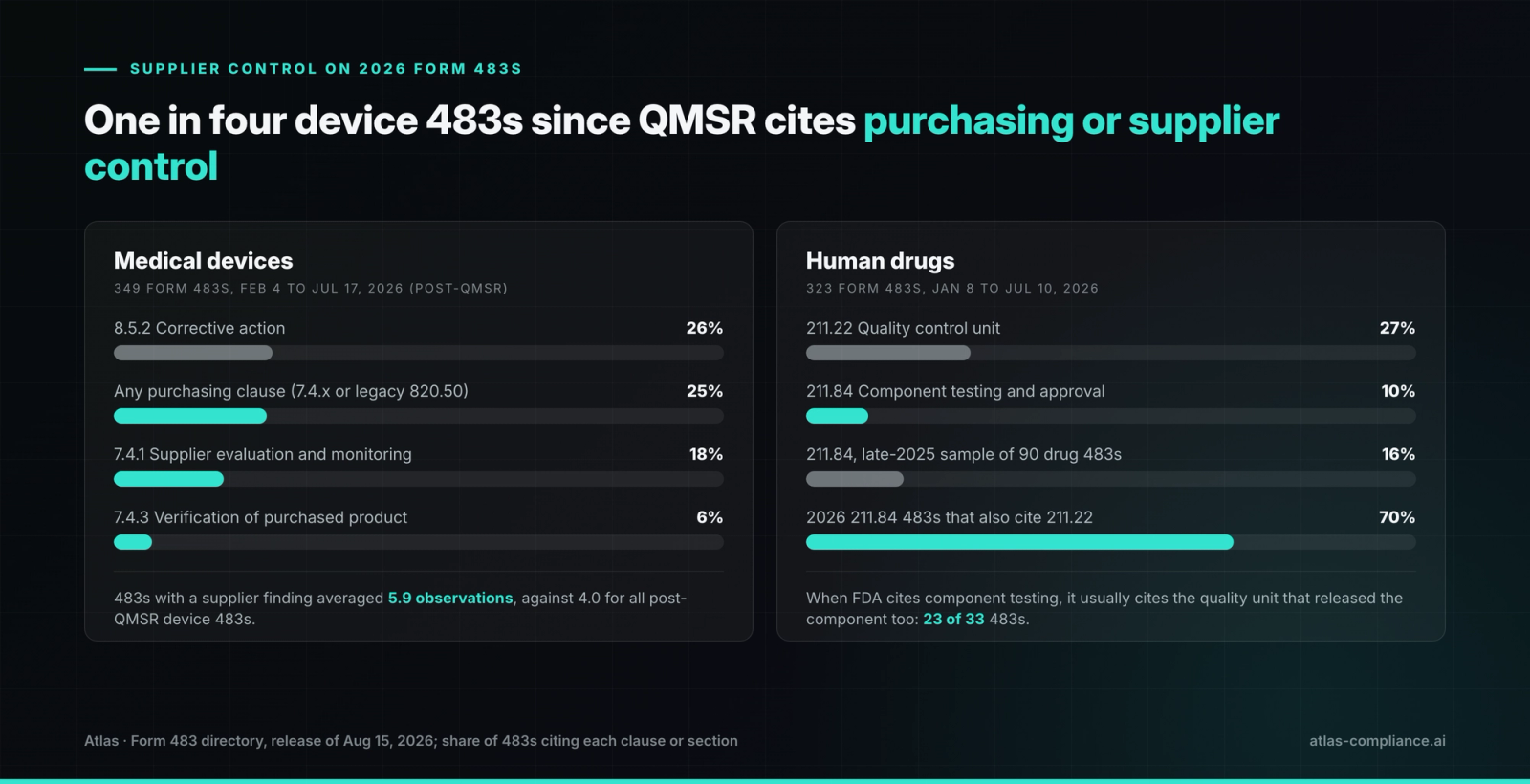
Devices. Of 349 device Form 483s issued from February 4 to July 17, 2026, after the QMSR took effect, 86 (25%) cited a purchasing clause (ISO 13485 clause 7.4.1, 7.4.2 or 7.4.3, or the legacy 820.50). Clause 7.4.1 alone appeared on 62 (18%), and 8.5.2 corrective action on 91 (26%). That matches the published sample of 96 device 483s from May to July 2026, where 7.4.1 was cited on 18% and 8.5.2 on 28% (our ISO clause analysis by industry). Device 483s with a supplier finding were also longer: 5.9 observations on average, against 4.0 for all post-QMSR device 483s. Supplier control rarely fails alone.
Drugs. Of 323 human drug Form 483s issued from January 8 to July 10, 2026, 33 (10%) cited 21 CFR 211.84. In a separate sample of 90 human drug 483s from late 2025, 211.84 appeared on 16%. The pairing is the useful part: 23 of the 33 2026 483s citing 211.84 also cited 211.22, the quality unit. When FDA finds a component problem, it usually also finds that the quality unit released the component.
Four indexable 2026 examples show what the observations look like in practice:
- iCRco, Inc., Goleta, California, July 17, 2026: two observations, one under clause 7.4.1 for records of supplier evaluation, selection and monitoring not maintained.
- Fresenius Medical Care Renal Therapies Group, Waltham, Massachusetts, June 3, 2026: six observations, including criteria for supplier evaluation and selection not established (7.4.1) and corrective action not taken (8.5.2).
- American Regent, New Albany, January 29, 2026: four observations, including 211.84(e) on rejecting components that fail specifications, alongside 211.22(d) and 211.192.
- Novel Laboratories, d.b.a. Lupin Somerset, Somerset, New Jersey, April 17, 2026: three observations, including 211.84(b) on representative sampling of components, with 211.22(d) and 211.192.
The pattern across all four: a supplier or component observation next to a quality system observation. FDA reads a weak SCAR program as a weak quality unit.
 Atlas
See what the FDA knows about your next investigator.
30 minutes with the founder. No pitch deck.
When to escalate a supplier
A SCAR is the first rung, not the only one. Formal SCARs fit major nonconformances and systemic issues; a minor one-off defect can go through direct contact with the supplier first, recorded in the supplier file. Write the ladder into the supplier procedure so the decision does not depend on the relationship.
In pharmaceutical manufacturing the ladder usually covers API makers, excipient suppliers, primary packaging component makers and contract manufacturers, and the quality agreement sets the SCAR response times and the change notification rules. A contract manufacturer that misses SCAR dates is a supplier control problem and a quality agreement problem at the same time.
| Level | Trigger | Action |
|---|---|---|
| 1. SCAR | Confirmed nonconformance with supplier root cause | Standard seven-step process |
| 2. Increased inspection | Missed SCAR due date, a rejected response, or a repeat of the same defect inside the next five lots | Tightened incoming testing; stop relying on the certificate of analysis for the affected attribute |
| 3. Conditional status | Two SCARs open at once, a repeat after a closed SCAR, or a failed effectiveness check inside the 3 to 6 month verification window | For-cause audit, supplier on probation, new orders need quality sign-off |
| 4. Disqualification | Failed for-cause audit, falsified data, a defect that reached patients, or a response that cannot fix the root cause | Remove from the approved supplier list, qualify an alternate, assess product already released |
Two signals should skip straight to level 3, bypassing level 2:
- A supplier with its own regulatory trouble: a Form 483 or warning letter at the supplier's facility citing the same system your SCAR is about.
- A supplier that cannot produce data, only statements, in its containment or root cause submission.
Checking a supplier's inspection history before you approve the response takes minutes and often explains a recurring defect.
If a supplier fails and you keep buying from it, the file needs to state why, such as a sole-source component held under increased testing. An investigator who finds open SCARs on an approved supplier with no documented risk decision will write it up under 7.4.1 or 211.22. Our guide to preventing Form 483 observations covers how to close that kind of gap before an inspection.
What a SCAR response should contain
Reject a response that is missing any of these:
- Containment evidence: quantities sorted, where, results, and confirmation of what is in transit.
- A root cause backed by data, explaining both why the defect occurred and why the supplier's own inspection missed it.
- Corrective actions that address that root cause, with owners and dates. Retraining alone is rarely accepted unless the root cause is a training gap and the supplier shows how it found that.
- Scope: other part numbers, lines or customers affected by the same cause.
- Any process change that triggers your change notification clause, so you can assess it before it ships.
- The supplier's own effectiveness check, which you then verify at your facility.
If you ever have to answer a Form 483 about supplier control, the same elements apply to your own response. Our guide to what a Form 483 is covers the document and the 15 business day response window.
AtlasFDA Inspection Intelligence Digest
We track every 483, EIR, and warning letter the moment it happens. Get the signals before they hit the FDA website.
Frequently asked questions
SCAR stands for Supplier Corrective Action Request. It is a formal document a manufacturer sends to a supplier after a nonconformance is traced to material or a service that supplier provided. The supplier must contain the problem, find the root cause, propose corrective actions and show they work, and the manufacturer approves or rejects the response before closing it.

Written by
Bhavish Agarwal
Founder, Atlas
Bhavish Agarwal is the founder of Atlas and previously worked at Google and Microsoft. He has spent the past several years building regulatory data infrastructure for the pharmaceutical industry.