
Human error in pharma is an unintended action or decision by a person, such as a wrong weight entered, a step skipped or a label mixed up, that causes a deviation in manufacturing or testing. Regulators treat it as the start of an investigation, because the error tells you a person failed and nothing yet about why the system let it happen.
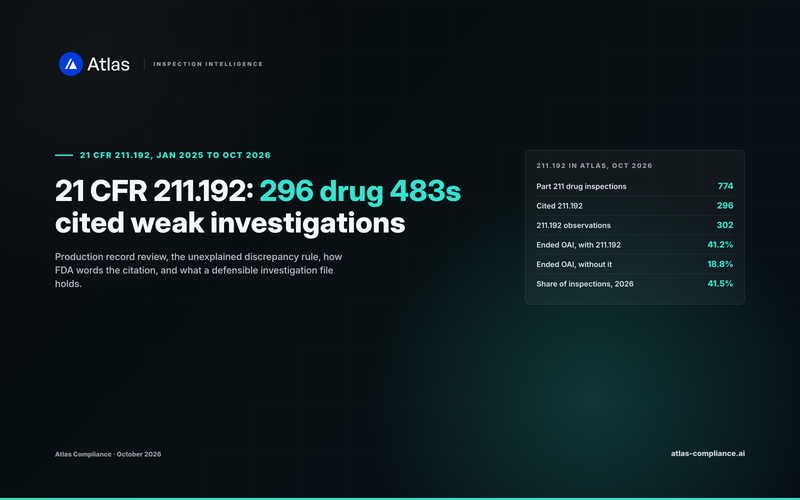
This guide adds data most pages on the topic lack: how often FDA cited investigation failures and training failures at 774 drug inspections that closed between January 2, 2025 and October 9, 2026, from the Atlas Form 483 citation dataset (pulled October 2026), with named examples.
Key facts:
- 21 CFR 211.192, the drug GMP section that requires thorough investigation of any unexplained discrepancy, appeared at 296 of 774 Part 211 drug inspections (38.2%) in the Atlas dataset.
- 21 CFR 211.25, the personnel training section, appeared at 82 of the same 774 inspections (10.6%), so FDA cited the investigation 3.6 times as often as the training.
- 41.2% of inspections that cited 211.192 ended Official Action Indicated (OAI), against 18.8% of Part 211 drug inspections without it.
- EU GMP Part I, Chapter 1, paragraph 1.4(xiv), in operation since January 31, 2013, says a human error conclusion "should be justified" after checking that process, procedural or system problems were not overlooked.
- The human factors literature splits human error into slips, lapses, mistakes and violations, and only a mistake caused by missing knowledge is fixed by training.
What does human error mean in a pharma deviation?
Human error in a pharma deviation is the label an investigation gives when a person's action, or failure to act, is the direct cause of the event: an analyst who used the wrong standard, an operator who charged the wrong lot, a reviewer who missed a blank field. The label describes what happened at the moment of failure, the proximate cause, and says nothing about the root cause.
The distinction matters because 21 CFR 211.192 asks for an investigation that is thorough and that extends to "other batches of the same drug product and other drug products that may have been associated with the specific failure or discrepancy." A conclusion that names one person cannot tell you which other batches share the cause. A conclusion that names a confusing batch record step can.
21 CFR 211.22(a) also gives the quality control unit the job of reviewing production records "to assure that no errors have occurred or, if errors have occurred, that they have been fully investigated." Fully investigated means the quality unit has looked past the operator.
Why does FDA criticize human error and retraining as a root cause?
FDA criticizes human error and retraining as a root cause because the pairing rarely removes the condition that produced the error, so the same deviation comes back. An investigation that ends with "operator error, operator retrained" usually has no evidence on why the step was error-prone, who else performs it, or whether the retraining changed anything measurable.
Investigators tend to find three gaps in that closure:
- The cause is asserted, not shown. No interview notes, no reconstruction of the task, no review of earlier deviations at the same step.
- The scope stops at one person. 211.192 requires the investigation to reach other batches and products, and a person-level cause gives no basis for that search.
- The CAPA cannot be checked. Training records prove attendance. They do not prove the error rate dropped, which is what a CAPA effectiveness check has to measure.
European inspectors have a written rule on this. EU GMP Part I, Chapter 1, paragraph 1.4(xiv) says: "Where human error is suspected or identified as the cause, this should be justified having taken care to ensure that process, procedural or system-based errors or problems have not been overlooked, if present." FDA's drug regulations contain no sentence that specific, but FDA investigators cite the same gap under 211.192 as a failure to investigate thoroughly. Our analysis of why companies still fail CAPA and investigation requirements covers the organizational side.
Retraining is a legitimate fix in one case: the investigation found that the person did not know the correct method, and the training record shows the gap. 21 CFR 211.25(a) requires training "in the particular operations that the employee performs," so a missing or out-of-date training record is a real cause with a real fix. Retraining someone already trained, for a step they have done correctly hundreds of times, leaves the task that produced the slip unchanged.
What are the types of human error?
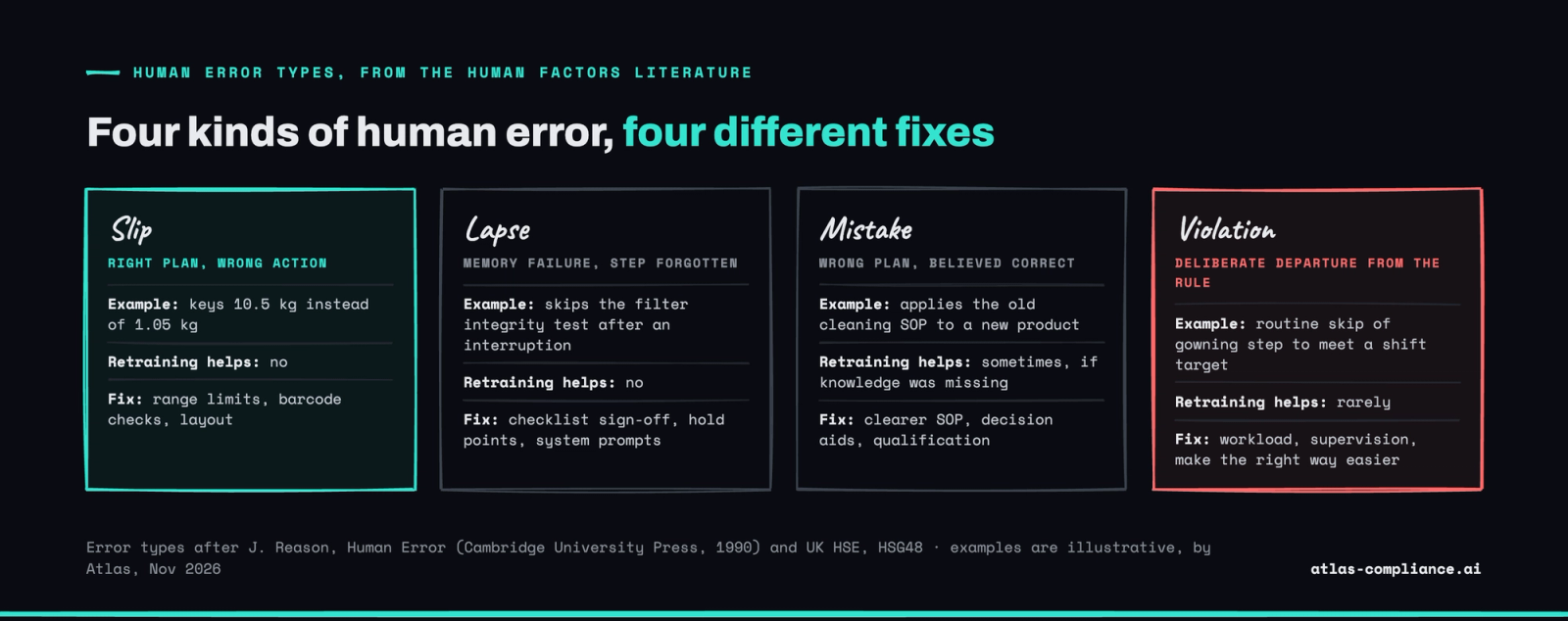
The types of human error, as classified in J. Reason's Human Error (Cambridge University Press, 1990) and in the UK Health and Safety Executive guidance HSG48, Reducing error and influencing behaviour, are slips, lapses, mistakes and violations. Slips, lapses and mistakes are unintended. A violation is a deliberate departure from a rule, usually made to get the job done rather than to cause harm.
| Error type | What happens | Pharma example | Does retraining fix it? | Fix that works |
|---|---|---|---|---|
| Slip | Right plan, action carried out wrongly | Operator keys 10.5 kg instead of 1.05 kg | No | Range limits, barcode or scale integration |
| Lapse | Memory failure, a step forgotten | Filter integrity test skipped after an interruption | No | Checklist sign-off, hold points, system prompts |
| Mistake | Wrong plan, believed to be correct | Old cleaning SOP applied to a new product | Sometimes, if knowledge was missing | Clearer SOP, decision aids, qualification |
| Violation | Deliberate departure from a rule | Gowning step skipped as routine to meet a shift target | Rarely | Workload, supervision, make the correct way easier |
The examples are illustrative. The point of the classification is diagnostic: a slip by a trained operator tells you the task design allowed the slip, and sending that operator to a classroom will not change the task.
Violations need care. HSG48 splits them further into routine violations, which have become normal in a work group, situational ones driven by the workplace, and exceptional ones made under unusual pressure. A routine violation found during a human error investigation is a supervision and culture finding, and it usually means more people than the one named in the deviation take the same shortcut.
How do you investigate human error in a pharma deviation?
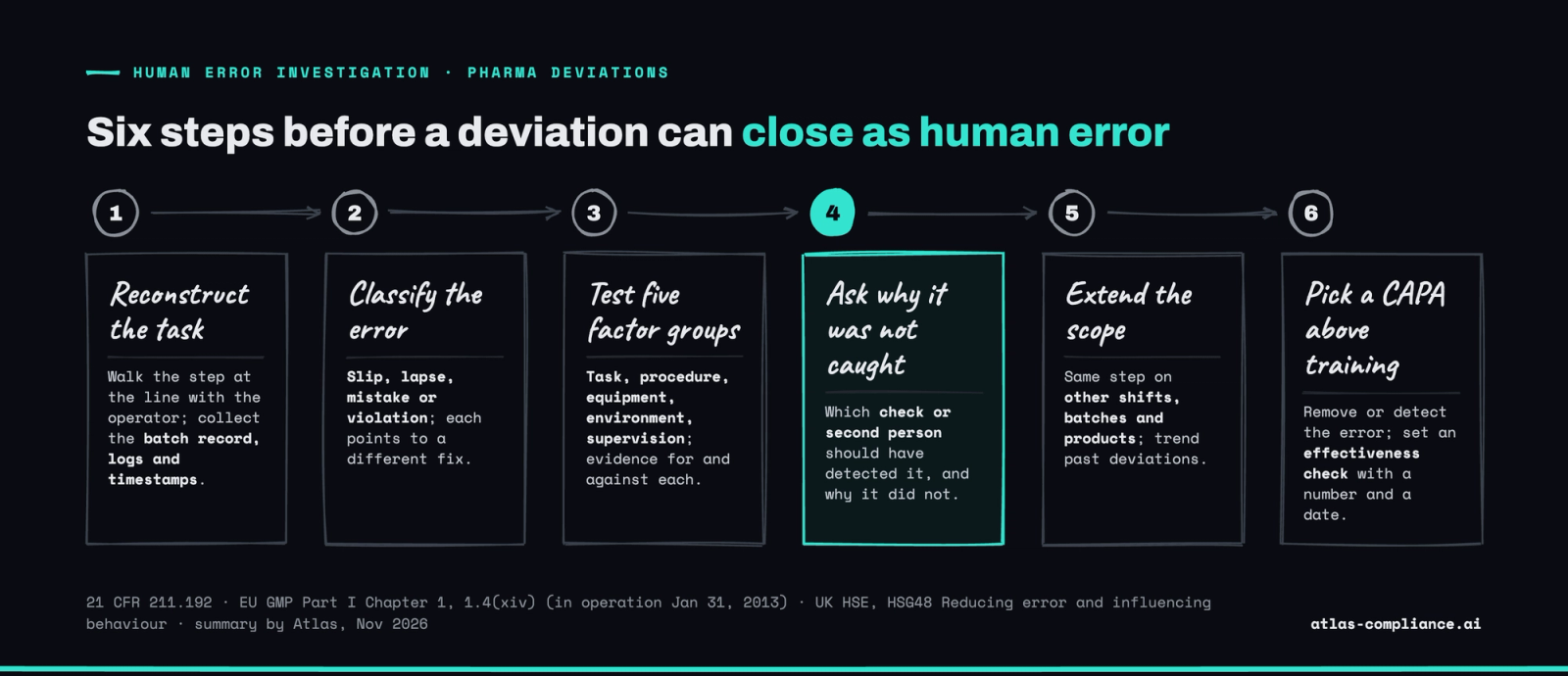
You investigate human error in a pharma deviation by reconstructing the task, classifying the error, testing the work conditions that made it likely, asking why no check caught it, and widening the scope before you pick a CAPA. The investigation is complete when the evidence explains why this error was possible at this step, and the CAPA removes or detects that condition.
- Reconstruct the task. Walk the step with the operator at the workstation. Collect the batch record, equipment logs, audit trail and timestamps, and write down what the person saw and did, in order.
- Classify the error as a slip, lapse, mistake or violation. The type points to the fix.
- Test five factor groups: the task, the procedure, the equipment, the environment and supervision. Record evidence for and against each.
- Ask why the error was not caught. Name the check, review or second person that should have detected it, and find out why it did not.
- Extend the scope. Look for the same step on other shifts, batches and products, and trend earlier deviations at that step.
- Choose a CAPA above training, with an effectiveness check that has a number and a date.
Step 3 is where most human error root cause work is won or lost. The table lists the questions an investigator can test with evidence:
| Factor group | Questions to test | Evidence to collect |
|---|---|---|
| Task | Was the step complex, repetitive, interrupted or time-pressured? Were similar items side by side? | Task observation, interruption log, line layout |
| Procedure | Was the instruction clear, current and at the point of use? Did it flag the critical step? | SOP version, batch record page, change history |
| Equipment | Did the display, scale or software make the wrong entry easy? Did an alarm or limit fail? | Equipment logs, audit trail, alarm settings |
| Environment | Lighting, noise, gowning, temperature, shift length, staffing on the day | Shift roster, overtime records, environmental data |
| Supervision | Was the person qualified for this task? Is the shortcut common on the shift? Were concerns reported before? | Training matrix, earlier deviations, interview notes |
Interview more than the operator who made the error. Others who perform the same step will tell you whether they have nearly made it too, and a near miss is evidence that the condition is shared.
What CAPA works better than retraining for human error?
The CAPA that works better than retraining for human error is one that removes the chance of the error or detects it before it reaches the product: an interlock, a barcode or weigh-scale integration, a system check, or a second-person verification at the critical step. A rewritten procedure sits between those and retraining.
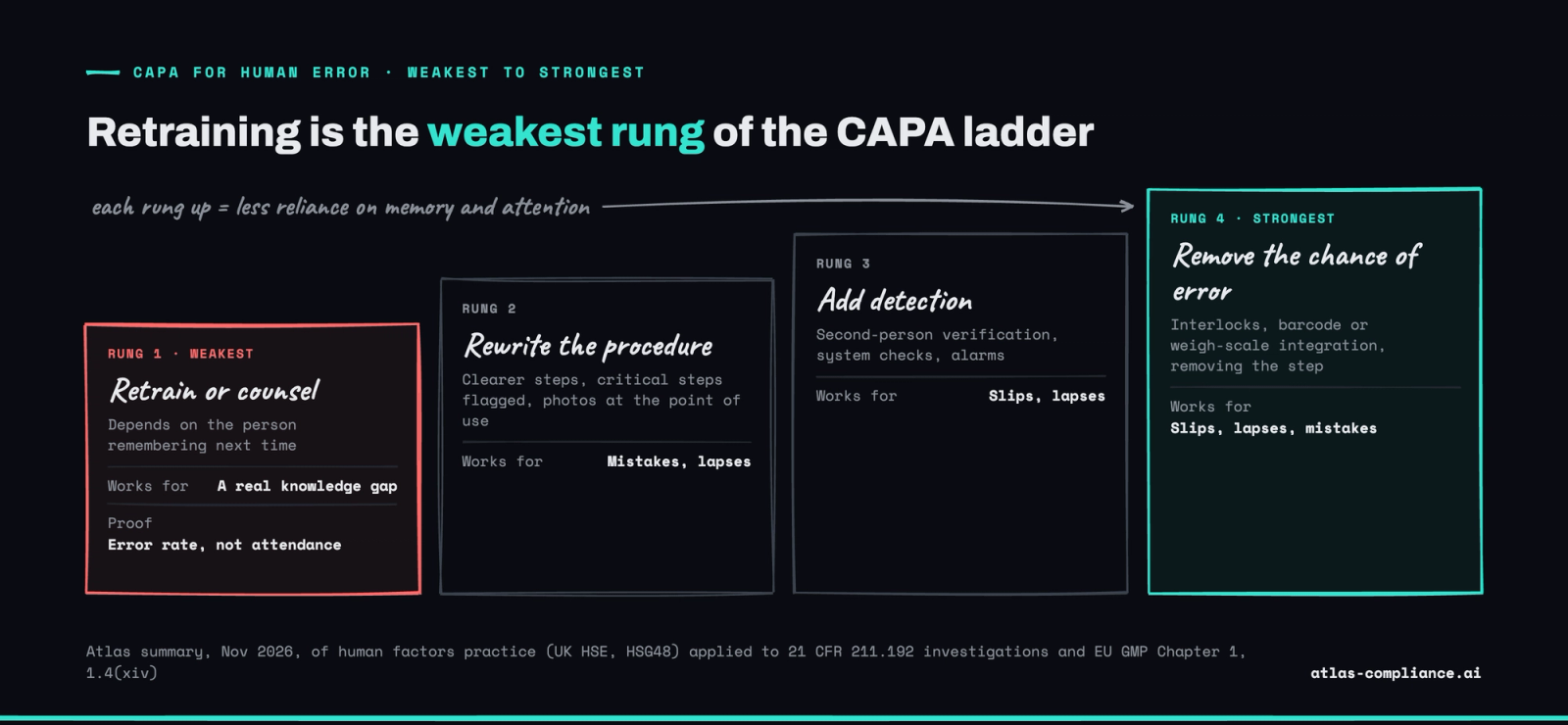
Match the rung to the error type. A slip or a lapse responds to detection and to design changes, because the person already knows the right action. A mistake from an unclear procedure responds to a rewrite, and to training on the new version. A routine violation responds to workload and supervision changes, because the people involved know the rule and chose to skip it.
Each CAPA needs an effectiveness check that measures the original failure: deviations at that step per 100 batches, for example, over a set window and against a target. Our guide to CAPA effectiveness metrics explains how to set one, and the corrective and preventive action guide covers the full CAPA process.
What does Atlas data show about investigation and training citations?
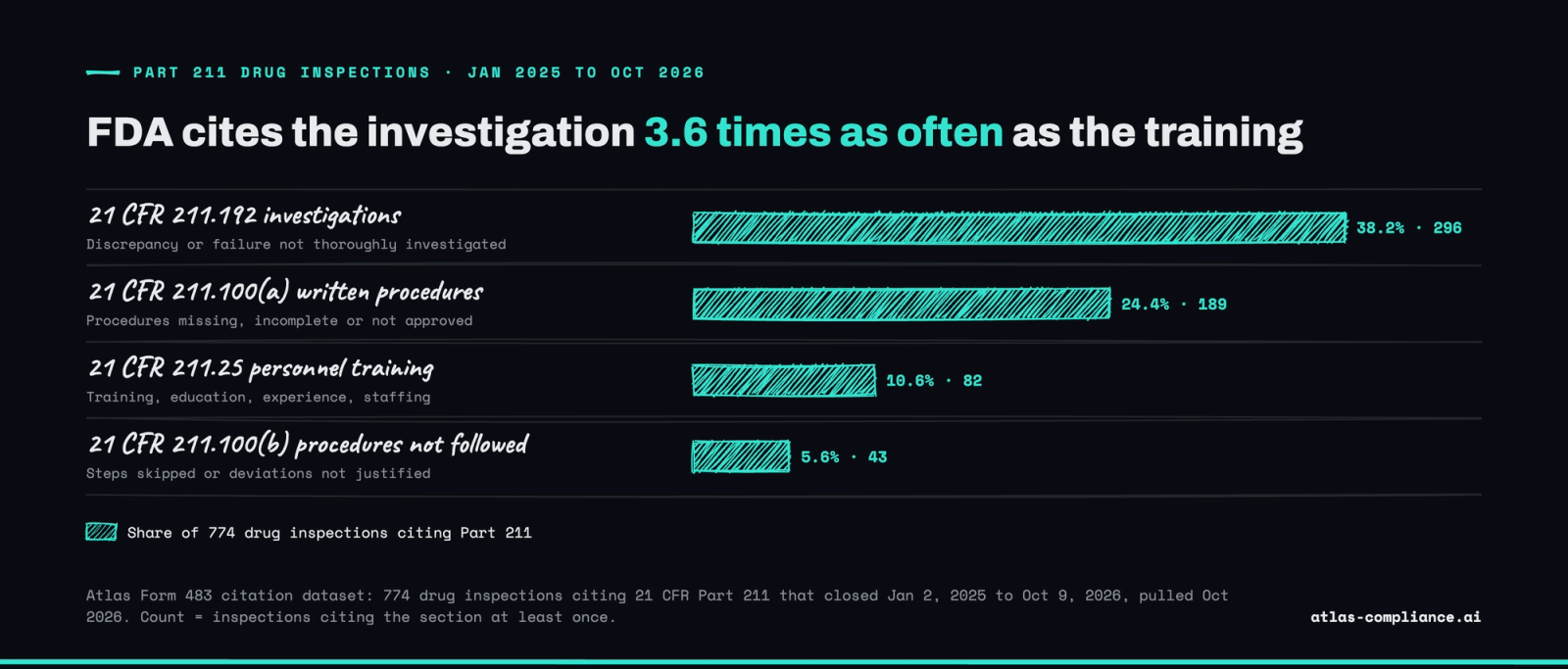
Atlas data show that FDA cites failed investigations far more often than failed training. In the Atlas Form 483 citation dataset (inspections closed January 2, 2025 to October 9, 2026, pulled October 2026), 21 CFR 211.192 appeared at 296 of 774 drug inspections that cited Part 211 (38.2%). The training section, 211.25, appeared at 82 (10.6%).
| Section | What FDA cites | Inspections | Share of 774 |
|---|---|---|---|
| 21 CFR 211.192 | Discrepancy or failure not thoroughly investigated | 296 | 38.2% |
| 21 CFR 211.100(a) | Written procedures missing or not approved | 189 | 24.4% |
| 21 CFR 211.25 | Training, education, experience or staffing | 82 | 10.6% |
| 21 CFR 211.100(b) | Procedures not followed, deviations not justified | 43 | 5.6% |
Two more numbers from the same dataset are worth knowing. Of the 296 inspections citing 211.192, 122 (41.2%) ended OAI, against 90 of 478 (18.8%) without it. And 211.25 shows up at almost the same rate whether or not 211.192 is cited: 32 of the 296 (10.8%) and 50 of the other 478 (10.5%). Firms whose investigations fail are, in this dataset, no more likely to be cited for training than firms whose investigations pass.
Some forms carry both citations. The table lists five from the FDA Form 483s directory where investigators cited 211.192 and 211.25(a) on the same form:
| Form 483 | Issued | Other Part 211 sections cited (selection) | Classification |
|---|---|---|---|
| Eugia Pharma Specialities, Sangareddy, India | Feb 6, 2026 | 211.22(d), 211.113(b), 211.160(a), 211.42(c)(10) | OAI |
| Baxter Healthcare, Round Lake, US | Apr 2, 2026 | 211.100(b), 211.113(b), 211.160(a), 211.67(b) | OAI |
| Altaire Pharmaceuticals, Aquebogue, US | Apr 21, 2026 | 211.22(d), 211.100(a), 211.113(b), 211.68(b) | OAI |
| Appco Pharma, Piscataway, US | May 14, 2026 | 211.22(d), 211.198(a) | VAI |
| Oakwood Laboratories, Solon, US | May 21, 2026 | 211.113(b) | OAI |
A limit on what these numbers show: the FDA citation data behind them carry standard citation text, not the investigator's firm-specific wording, so they cannot tell you how many observations used the words "human error" or "retraining." The Atlas warning letter dataset (3,768 letters posted January 5, 2021 to October 20, 2026) holds dates, issuing offices and subjects, not letter text, so this post does not count warning letters that use those words either. For what each 211.192 heading means, see our explainer on 21 CFR 211.192.
If your facility's deviations close as human error, the investigators who inspect you have cited this pattern before, and their past forms show which sections they write up most.
 Atlas
See what the FDA knows about your next investigator.
30 minutes with the founder. No pitch deck.
How should a Form 483 response handle a human error finding?
A Form 483 response to a human error finding should show the full investigation FDA said was missing: the task reconstruction, the factor analysis, the scope across other batches and products, and a CAPA above retraining with a dated effectiveness check. A response that repeats "operator retrained" invites a second citation, or a warning letter.
Write the response so each part can be checked against evidence. Attach the revised procedure, the design or system change, and the trend data you will use to prove the CAPA worked. Our guide to Form 483 response strategies shows the structure, with a before-and-after root cause example.
AtlasFDA Inspection Intelligence Digest
We track every 483, EIR, and warning letter the moment it happens. Get the signals before they hit the FDA website.
Frequently asked questions
Retraining is an acceptable CAPA when the investigation shows the person lacked the knowledge to do the task correctly: no training record for the current SOP version, a new task, or a changed method. Even then, pair it with a fix to whatever let an untrained person do the task, and measure the error rate afterward rather than training attendance.

Written by
Bhavish Agarwal
Founder, Atlas
Bhavish Agarwal is the founder of Atlas and previously worked at Google and Microsoft. He has spent the past several years building regulatory data infrastructure for the pharmaceutical industry.