
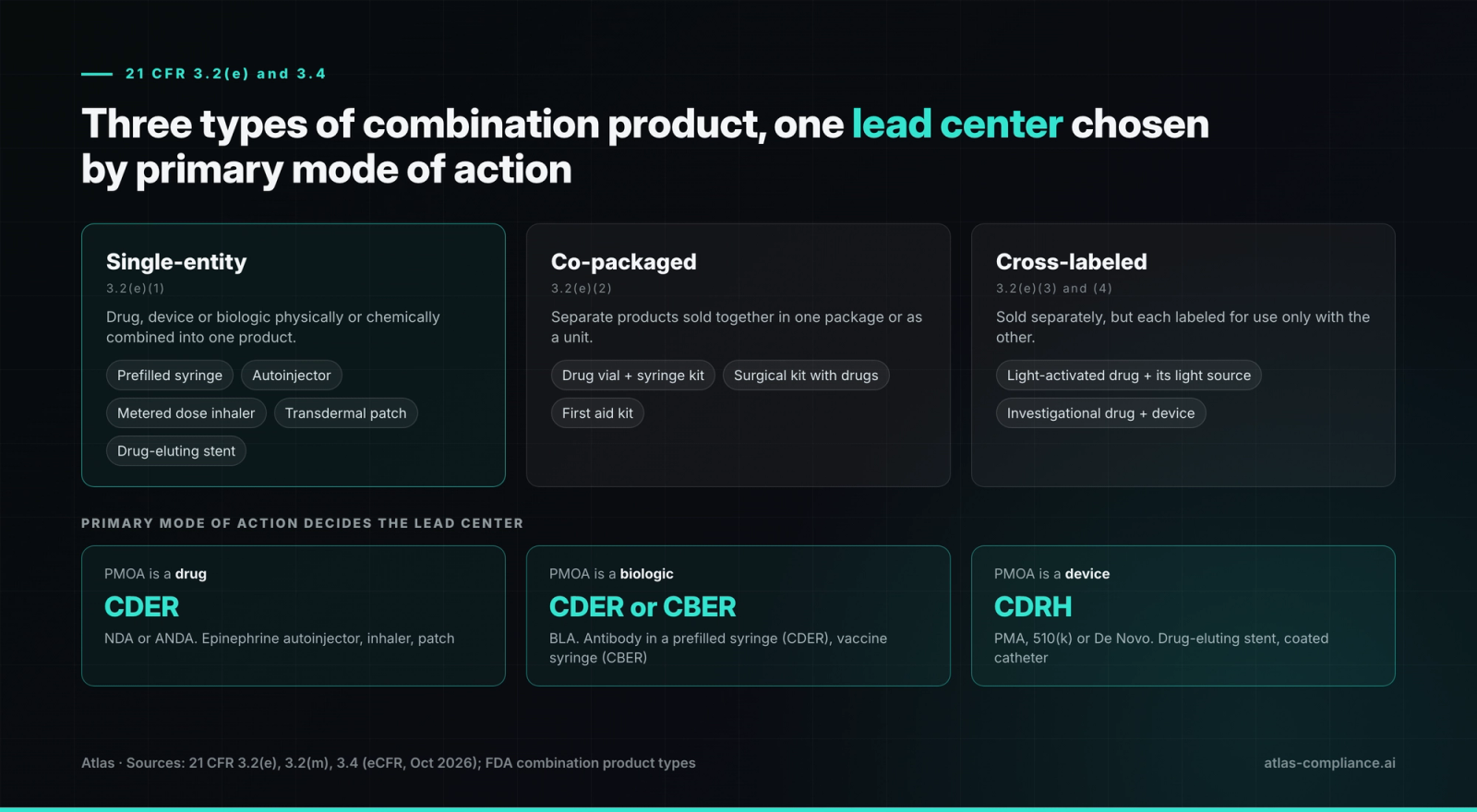
A combination product is a medical product made of two or more regulated parts of different types: a drug and a device, a biologic and a device, a drug and a biologic, or all three. FDA defines it in 21 CFR 3.2(e). The parts can be combined into one single entity, packaged together, or sold separately and cross-labeled for use together.
Prefilled syringes, autoinjectors, metered dose inhalers, transdermal patches and drug-eluting stents are all combination products. Each is regulated by one lead FDA center, chosen by its primary mode of action, and made under one quality system that has to satisfy both drug and device rules under 21 CFR Part 4.
In short:
- There are three types: single-entity, co-packaged and cross-labeled.
- The primary mode of action (PMOA) decides whether CDER, CBER or CDRH leads.
- A drug-led facility can run on Part 211 plus six named groups of device requirements; a device-led facility can run on the QMSR plus eight named Part 211 sections.
- In 193 Form 483s issued to 15 combination product makers in Atlas, none cites 21 CFR 4.4. Twelve cite both Part 211 and Part 820, and 20 cite device design controls.
What counts as a combination product under 21 CFR 3.2(e)?
The regulation lists four cases, which FDA groups into three types. Each part is called a constituent part, and each keeps its identity: the drug in a prefilled syringe is still a drug product, the syringe is still a finished device.
| Type | 3.2(e) paragraph | What it means | Examples |
|---|---|---|---|
| Single-entity | (e)(1) | Parts physically, chemically or otherwise combined and produced as one product | Prefilled syringe, autoinjector, metered dose inhaler, transdermal patch, drug-eluting stent, antibody-drug conjugate |
| Co-packaged | (e)(2) | Separate products packaged together in one package or as a unit | Drug vial packaged with a syringe or transfer device; first aid or surgical kit with drugs and devices |
| Cross-labeled | (e)(3) and (e)(4) | Products sold separately, but labeling says each is for use only with the other, and both are needed for the intended effect | Light-activated drug labeled for one specific light source; investigational drug labeled for one investigational device |
Two boundaries trip people up. A package of devices only, or of drugs only, is not a combination product; FDA says so on its combination product types page. And cross-labeling is defined by labeling and intent, not by packaging: if an approved drug's label would have to change to reflect the new device, the pair is likely a combination product.
How primary mode of action decides the lead center
Every combination product is assigned to one lead center. Under 21 CFR 3.4, FDA determines the primary mode of action: the single mode of action that provides the most important therapeutic action, meaning the one expected to make the greatest contribution to the overall intended therapeutic effect (3.2(m)).
| If the PMOA is | Lead center | Typical application | Example |
|---|---|---|---|
| Drug | CDER | NDA or ANDA | Epinephrine autoinjector, inhaler, transdermal patch, small molecule prefilled syringe |
| Biologic | The center that reviews that biologic: CDER for most therapeutic proteins, CBER for vaccines and blood products | BLA | Monoclonal antibody in a prefilled syringe or autoinjector; vaccine in a prefilled syringe |
| Device | CDRH | PMA, 510(k) or De Novo | Drug-eluting stent, antibiotic-coated catheter, contact lens coated with a drug |
When FDA cannot tell with reasonable certainty which mode contributes most, 3.4(b) sets a tiebreaker. The product goes to the center that regulates combination products raising similar safety and effectiveness questions. If none exists, it goes to the center with the most expertise in the most significant questions. Lead center does not mean sole reviewer: the other centers consult, and FDA can still require separate applications.
The Office of Combination Products, set up in 2002 under the Medical Device User Fee and Modernization Act, makes these jurisdiction decisions and writes cross-center policy.
When to file a Request for Designation
If the classification of your product or its lead center is unclear, you can ask FDA to decide formally through a Request for Designation (RFD) to the Office of Combination Products, under 21 CFR 3.7. The rules in 3.8 are specific:
- FDA reviews the RFD for completeness within 5 working days and tells you the filing date.
- Within 60 days of filing, the product jurisdiction officer issues a letter of designation naming the lead center and any consulting centers.
- If no letter arrives within 60 days, the center you recommended in your RFD becomes the designated center.
- You can ask for reconsideration within 15 days of the letter, in no more than 5 pages, with no new information.
Many sponsors first send OCP an informal pre-RFD for a non-binding view. Either way, settle jurisdiction before the main clinical study: the lead center sets the application type, the review clock and the cGMP lens your inspection will use.
Which cGMP rules apply under 21 CFR Part 4
21 CFR Part 4 subpart A starts from a simple rule in 4.3: every set of cGMP requirements that applies to a constituent part applies to the combination product. Parts 210 and 211 for a drug, Part 820 for a device, Parts 600 to 680 for a biologic, Part 1271 for an HCT/P, and Part 213 for a medical gas.
For single-entity and co-packaged products, 4.4(a) then gives two ways to comply. You can show full compliance with every applicable set of rules. Or, under 4.4(b), you can run one quality system built on either the drug or the device rules and add a named list of provisions from the other set. Most manufacturers take the second route.
| Your quality system is built on | You must also show compliance with | Source |
|---|---|---|
| Drug CGMPs (Parts 210 and 211) | ISO 13485 clauses 4.1, 5 and 6.1 plus 820.10 (management); clause 7.3 (design and development) plus documented risk management in product realization; clause 7.4 (purchasing); clauses 8.2.2, 8.4 and 8.5 plus 820.35(a) (complaints, data analysis, CAPA); clause 7.5.3 (installation); clause 7.5.4 plus 820.35(b) (servicing) | 4.4(b)(1) |
| The QMSR (Part 820) | 211.84 component testing; 211.103 yield; 211.132 tamper-evident OTC packaging; 211.137 expiration dating; 211.165 testing and release; 211.166 stability; 211.167 special testing; 211.170 reserve samples | 4.4(b)(2) |
| The QMSR, with a medical gas | 213.84, 213.94, 213.122, 213.165, 213.166, 213.204, 213.208 | 4.4(b)(3) |
| Any of the above, with a biologic or HCT/P | All Part 600 to 680 or Part 1271 requirements that would apply to that constituent part on its own | 4.4(b)(4) and (5) |
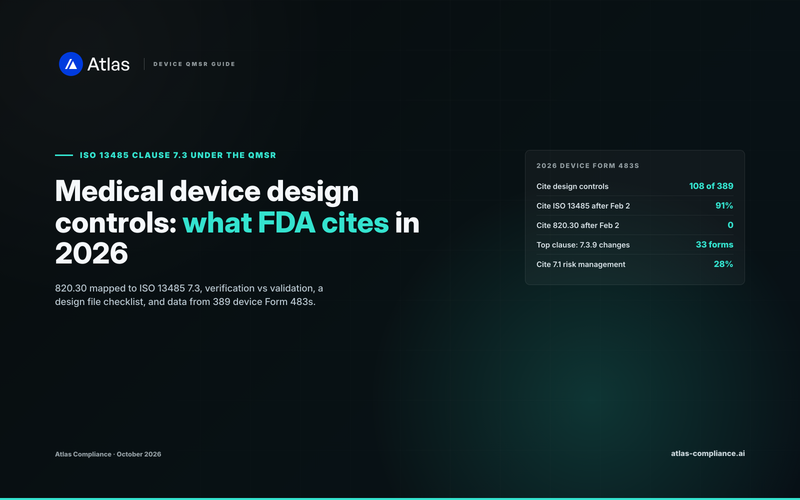
The QMSR changed the first row. Before February 2, 2026, a drug-led system had to add seven QSR sections: 820.20 management responsibility, 820.30 design controls, 820.50 purchasing controls, 820.100 corrective and preventive action, 820.170 installation, 820.198 complaint files and 820.200 servicing. FDA's QMSR rule rewrote 4.4(b)(1) to point at ISO 13485 clauses instead, with the ISO 9000 clause 3 definitions. The substance barely moved. A drug-led autoinjector maker still needs design controls, purchasing controls on device suppliers, complaint handling and CAPA to device standards. The citation numbers did. Our guide to medical device design controls under the QMSR maps each old 820.30 paragraph to its clause 7.3 successor.
Two timing rules matter for contract chains. Under 4.4(c), while a constituent part is made at a separate facility, that facility must meet the full rules for its own type of part. Under 4.4(d), the single quality system approach only begins once both types of part have arrived at the same facility. A syringe filler working for a biologics sponsor is therefore a combination product facility, and its inspection can hold up the sponsor's application.
What Form 483s at combination product makers actually cite
We looked for 21 CFR 4.4 in the Atlas directory. We pulled every Form 483 issued to 15 companies that make prefilled syringes, autoinjectors, inhalers, nasal pumps, transdermal patches or drug delivery devices: Amphastar, Antares Pharma, Aptar, Baxter Healthcare, Becton Dickinson, Bespak, Catalent, Hikma, Kindeva, Meridian Medical Technologies, Noven, Owen Mumford, SHL Medical, Vetter and West Pharmaceutical Services. That gave 193 forms across 74 facility records, issued from December 2008 to May 2026 (data release of August 15, 2026), and we read the regulation cited on every observation. Some forms cover products that are not combination products, so treat the counts as an upper bound.
| Measure | Form 483s | Share of 193 |
|---|---|---|
| Cite any 21 CFR Part 4 section, including 4.4 | 0 | 0% |
| Cite Part 211 (drug CGMP) | 129 | 67% |
| Cite Part 820 (device QSR) | 71 | 37% |
| Cite both Part 211 and Part 820 | 12 | 6% |
| Cite 820.30 design controls | 20 | 10% |
| Categorized Human Drugs and cite 820.30 | 5 | 3% |
| Issued after February 2, 2026 | 4 | 2% |
The zero is the finding. Investigators do not cite Part 4 itself; they cite the underlying drug or device section that Part 4 pulls in. A drug-led autoinjector facility with a weak design change process gets an observation under 820.30(i), or now ISO 13485 clause 7.3.9, not under 4.4(b)(1). If you search your supplier's history for "4.4", you will find nothing. Search for device sections on a drug inspection instead.
Those mixed forms are where combination product risk shows up:
- Amphastar Pharmaceuticals, Rancho Cucamonga, California, a maker of prefilled syringe and inhalation products, has 28 FDA inspections on record and 11 Form 483s. Its June 2021 human drugs form cites 211.42(c)(10)(vi) alongside 820.30(f) verification, 820.30(g) validation and 820.30(h) design transfer.
- Catalent Pharma Solutions, Morrisville, North Carolina has 18 inspections and 8 Form 483s. Its September 2020 human drugs form cites only device design sections: 820.30(b), (c), (d), (f) and (g).
- The May 2017 Form 483 at Catalent Indiana in Bloomington, a prefilled syringe filler, mixes 211.22(d) and 211.100(b) with 820.50 purchasing, 820.70(a) production controls, 820.75(a) process validation and 820.100(a) CAPA. That facility's July 2025 inspection ended in a warning letter, and its effect on a sponsor's prefilled syringe application is covered in our Regeneron Form 483 analysis.
- At Hikma's Columbus, Ohio facility, an October 2016 form cites 211.110 and 211.160(b) next to 820.30(f) and (g).
- Meridian Medical Technologies in St. Louis, an autoinjector manufacturer, has four forms from 2017 to 2024 that each cite both parts, two of them categorized as human drugs inspections.
Not every combination product maker draws device citations. Kindeva Drug Delivery in Northridge, California, an inhaler manufacturer, has 17 inspections and 6 Form 483s, and every form we read cites only Part 211, most recently 211.110(a) and 211.192 in November 2025.
 Atlas
See what the FDA knows about your next investigator.
30 minutes with the founder. No pitch deck.
Which design control gaps investigators find at drug-led sites
Within the 20 forms that cite 820.30, validation leads. 820.30(g) design validation appears on 13, 820.30(f) verification on 11, 820.30(c) design input on 6, and 820.30(d) output and 820.30(i) changes on 4 each. That fits how drug-led teams often work: they qualify the filling process thoroughly and treat the device as a purchased component, not a design with user needs and verified outputs.
Pure device makers show a different pattern. In Atlas's sample of 389 device Form 483s issued from January to July 2026, 28% cite design controls and design changes (clause 7.3.9) top the list, ahead of validation. The 10% rate here looks low, but most of the 193 forms come from drug inspections, where a design citation means the investigator went looking at the device constituent.
The post-QMSR picture is too thin to read yet. Only 4 of the 193 forms were issued after February 2, 2026, and all four cite Part 211 alone. The first drug-led form citing ISO 13485 clause 7.3 at a combination product facility will show how investigators apply the rewritten 4.4(b)(1). Until then, expect device-side coverage at drug-led sites to follow the six QMS areas of Compliance Program 7382.850, which replaced the QSIT inspection approach for devices on the same date.
What a drug-led site can check before an inspection:
- a design and development file for the device constituent, with user needs traced to verification and validation
- a risk management file that covers use errors, not only drug quality
- purchasing controls on device suppliers to ISO 13485 clause 7.4, not only drug component testing under 211.84
- complaint handling that evaluates device malfunctions and feeds CAPA
- design change records for every device change since approval
Search the FDA Form 483 database by company to see whether your contract filler or device supplier has drawn mixed 211 and 820 citations before. A Form 483 at a supplier is not a finding against you, but it shows what the next investigator will check.
Postmarketing safety reporting under Part 4 subpart B
Subpart B, in force since 2017, sets safety reporting by who holds the application. A combination product applicant reports under the rules for its application type: Parts 803 and 806 for a device application, Part 314 for an NDA or ANDA, Parts 600 and 606 for a BLA. It then adds reports tied to the other constituent parts.
| Constituent part in the product | Extra reports the combination product applicant must file |
|---|---|
| Device | Five-day reports, malfunction reports, correction or removal reports |
| Drug | Field alert reports; 15-day reports, due in 30 days if the product was authorized under a device application |
| Biologic | Biological product deviation reports; 15-day reports, due in 30 days if authorized under a device application |
So an NDA holder for an autoinjector files malfunction reports for the device, and must summarize them in its periodic safety reports. When the constituent parts sit under different applicants, 4.103 requires each to pass death, serious injury and adverse experience information to the others within 5 calendar days, and to keep records of what was sent and when. Subpart B does not apply to investigational products.
AtlasFDA Inspection Intelligence Digest
We track every 483, EIR, and warning letter the moment it happens. Get the signals before they hit the FDA website.
Frequently asked questions
Yes, when it is sold filled with a drug or biologic. The syringe is a device constituent part and the drug or biologic is the other, combined as a single-entity product under 21 CFR 3.2(e)(1). An empty syringe sold on its own is a device. Most prefilled syringes have a drug or biologic primary mode of action, so CDER usually leads.

Written by
Bhavish Agarwal
Founder, Atlas
Bhavish Agarwal is the founder of Atlas and previously worked at Google and Microsoft. He has spent the past several years building regulatory data infrastructure for the pharmaceutical industry.