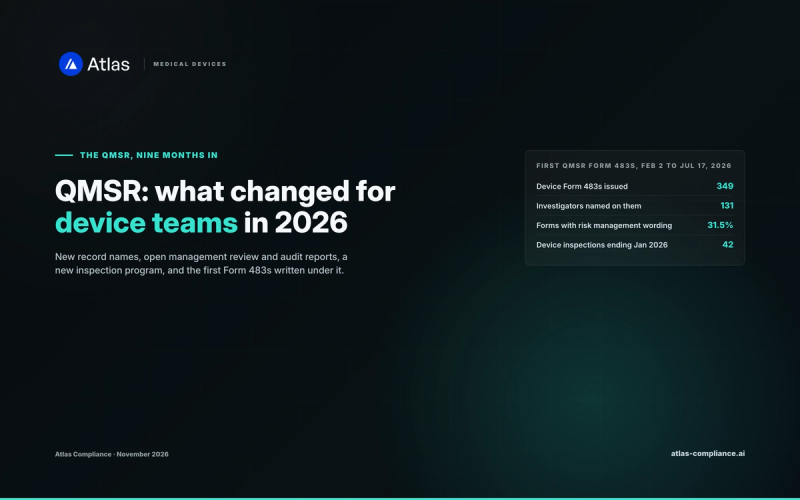

A design history file (DHF) is a compilation of records that describes the design history of a finished medical device and shows the design was developed under the approved design plan. Since February 2, 2026, the Quality Management System Regulation (QMSR) calls the same record the design and development file, under ISO 13485:2016 clause 7.3.10.
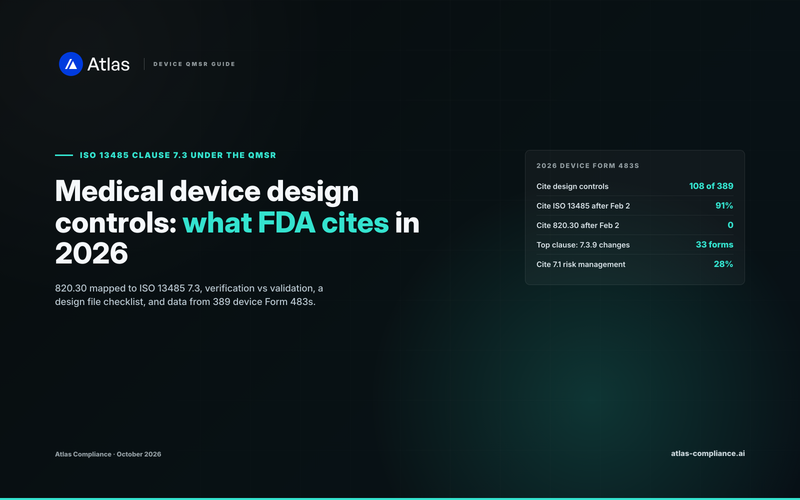
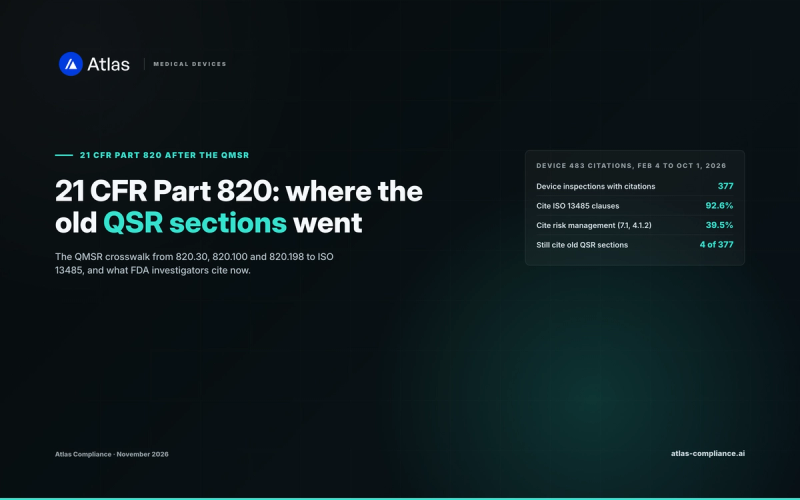
This guide covers the old definitions, the record that replaced each one, and what FDA investigators cited. The numbers come from FDA device inspection citation records tracked by Atlas (pulled October 21, 2026): 747 device inspections with citations under the old Quality System Regulation (QSR) and 377 under the QMSR.
Key facts:
- The old 21 CFR 820.30(j) required a DHF for each type of device, containing or referencing the records that show the design followed the approved design plan.
- FDA's final rule (89 FR 7496, February 2, 2024) removed the DHF, DMR and DHR terms and said their content is largely required by ISO 13485 clauses 7.3.10, 4.2.3 and 7.5.1.
- From January 8, 2025 to January 16, 2026, 117 of 747 device inspections with citations (15.7%) cited 820.30(j), 820.181 or 820.184.
- From February 4 to October 1, 2026, 20 of 377 QMSR device inspections (5.3%) cited clause 7.3.10, more than cited the device file or the batch record clauses.
- The 20 inspections that cited clause 7.3.10 averaged 5.1 citations each, against 3.0 at the other 357 QMSR device inspections.
What is a design history file?
A design history file is the set of records that proves how a device design was developed: the plan, inputs, outputs, reviews, verification, validation, transfer and changes. The old QSR at 21 CFR 820.3(e) defined the DHF as "a compilation of records which describes the design history of a finished device."
Section 820.30(j) set the rule. Each manufacturer had to establish and maintain a DHF for each type of device, and the DHF had to "contain or reference" the records needed to show the design was developed in accordance with the approved design plan and Part 820. The words "or reference" matter in practice: a DHF can be an index that points to records held in a document system, as long as your team can produce each record when an investigator asks.
Design controls produce the DHF. Our guide to medical device design controls walks through each stage that creates its records.
What happened to the DHF under the QMSR?
The DHF still exists in substance, under a new name. The QMSR, which took effect on February 2, 2026, incorporates ISO 13485:2016 by reference in 21 CFR Part 820, and the current Part 820 never uses the terms design history file, device master record or device history record.
FDA explained the change in its response to comment 31 of the final rule (89 FR 7507 to 7508). FDA wrote that ISO 13485 does not contain requirements for the QSR record types, so it removed them, because "the elements that comprise those records are largely required to be documented by ISO 13485." The response maps each record:
- Clause 7.3.10 requires the design and development file to contain or reference all records needed to show compliance with design and development requirements, including the plan and procedures. FDA calls this "consistent with the former DHF."
- Clause 4.2.3 requires the medical device file (MDF) to contain or reference the procedures and specifications current on the manufacturing floor. Content that sat in the DMR now sits in the MDF.
- Clause 7.5.1 requires a record for each medical device or batch. FDA wrote that many former DHR requirements are "largely required" in that record.
Two scope rules carried over. Section 820.10(c) applies clause 7.3 to Class II and Class III devices and to listed Class I devices, including those automated with computer software. And 21 CFR 820.35(c) adds a US requirement that the unique device identifier (UDI) be recorded for each device or batch. Our QMSR overview covers the rest of the rule.
DHF vs DMR vs DHR: what is the difference?
The DHF records how the design was developed, the DMR records how to build the device, and the DHR records how each unit or batch was built. One DHF and one DMR exist per device type; a DHR exists for every batch, lot or unit.
| Design history file (DHF) | Device master record (DMR) | Device history record (DHR) | |
|---|---|---|---|
| Old QSR section | 820.30(j) | 820.181 | 820.184 |
| QMSR home | ISO 13485 clause 7.3.10, design and development file | Clause 4.2.3, medical device file | Clause 7.5.1, record for each device or batch, plus 820.35(c) |
| Question it answers | How was the design developed? | How do we build, test, label and service it? | Was this unit or batch built to the master record? |
| How many | One per device type | One per device type | One per batch, lot or unit |
| Old required content | Records showing the design followed the approved plan | Device, production process, quality assurance, packaging and labeling specifications; installation and servicing methods | Dates of manufacture, quantity made and released, acceptance records, primary label and labeling, UDI and control numbers |
| QSR inspections citing it | 31 of 747 (4.1%) | 25 of 747 (3.3%) | 88 of 747 (11.8%) |
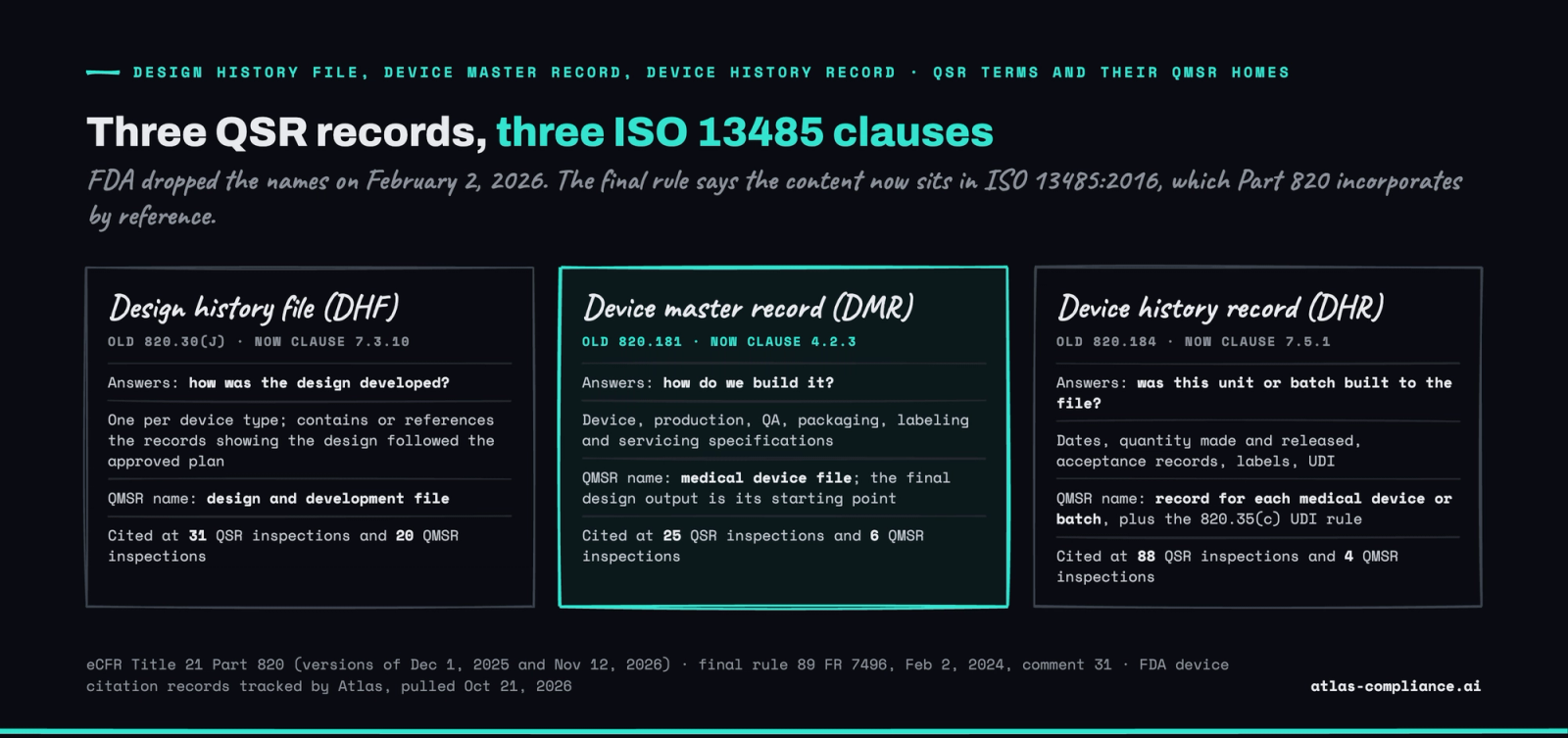
Counts come from FDA device citation records tracked by Atlas for inspections ending January 8, 2025 to January 16, 2026. Definitions come from the eCFR version of Part 820 in force on December 1, 2025.
What goes in a design history file?
A design history file should contain or reference every record that shows the design met the approved plan, from the first inputs to the last approved change. Under clause 7.3 that means the following, each traceable to the next:
- The design and development plan and the procedures it follows (clauses 7.3.1 and 7.3.2).
- Design inputs, reviewed and approved, including risk management outputs (7.3.3).
- Design outputs: drawings, specifications, software and labeling (7.3.4).
- Design review records for each planned stage (7.3.5).
- Verification plans, results and conclusions (7.3.6).
- Validation records on representative product (7.3.7).
- Design transfer records showing outputs became production specifications (7.3.8).
- Design change records, with their review, verification and approval (7.3.9).
- A traceability matrix that links each user need to its input, output and test.
The risk management file can stay separate as long as the design file references it. Our ISO 14971 guide explains what that file holds. Change records deserve extra care: FDA's citation text for clause 7.3.10 includes the wording "does not include or reference records generated to demonstrate conformity to the requirements for design and development and records for design and development changes."
How do the DHF, device file and batch record connect?
The three records form a chain. The design file holds the final design output, design transfer turns that output into production specifications, the medical device file keeps those specifications current, and each batch record shows a batch was built and accepted against them. FDA's final rule describes the final design output in the design and development file as "the basis or starting point" for the MDF.
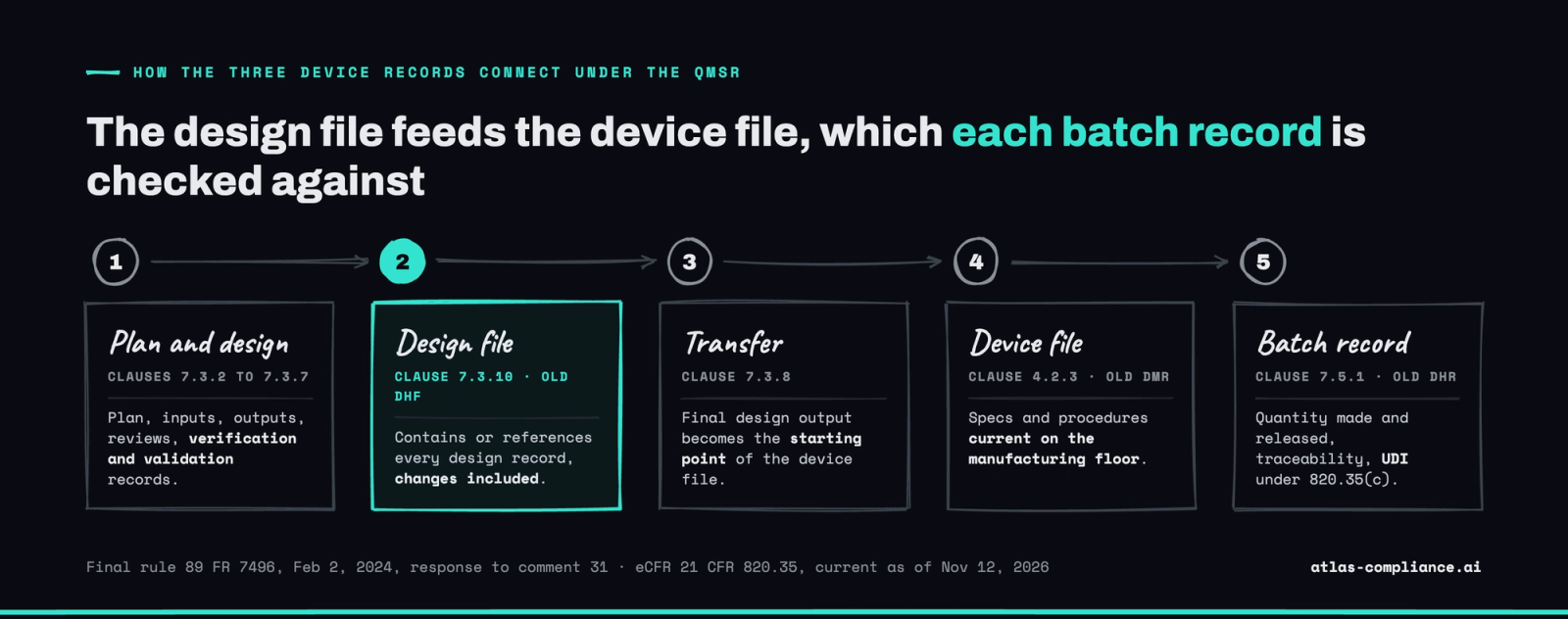
If a design change never reached the design file, the device file may carry a specification nobody verified, and your production team then builds and accepts each batch against it. Investigators tend to cite these records together: of the 20 QMSR inspections that cited clause 7.3.10, 4 also cited clause 4.2.3 and 3 cited clause 7.5.1.
The batch record is where the QMSR adds US text. Clause 7.5.1 asks for a record of each device or batch that provides traceability and identifies the amount manufactured and approved for distribution, and 21 CFR 820.35(c) requires the UDI in it. Four QMSR inspections in the Atlas data cited 820.35(c) for a missing UDI record.
How often does FDA cite design history file gaps?
FDA cited design file gaps at 5.3% of QMSR device inspections in 2026, making the design file the most cited of the three successor records. In FDA device citation records tracked by Atlas (pulled October 21, 2026), 20 of 377 inspections ending February 4 to October 1, 2026 cited clause 7.3.10, against 6 citing clause 4.2.3 and 4 citing clause 7.5.1 for device or batch records.
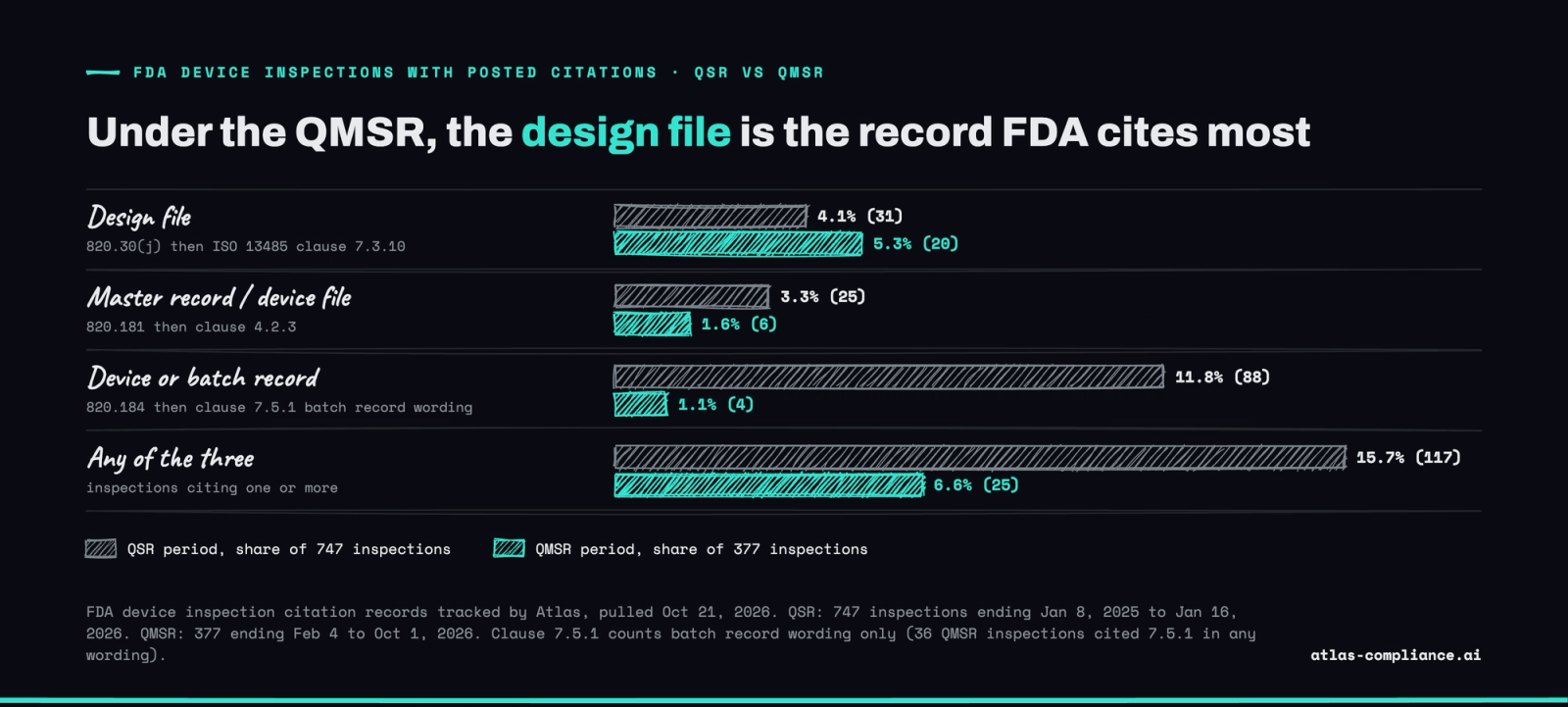
Before February 2, the order was reversed. Under the QSR, 820.184 was the most cited of the three, at 88 of 747 inspections, and its most common citation wording was "Lack of or inadequate DHR procedures" (37 citations). The share of inspections citing any of the three records fell from 15.7% (117) to 6.6% (25). The QMSR figure counts only the batch record wording; 36 QMSR inspections cited clause 7.5.1 in some form, so the production record comparison is not like for like.
Investigators who cite the design file usually cite more. The 20 inspections citing clause 7.3.10 averaged 5.1 citations, against 3.0 at the rest. Eight of the 20 also cited clause 7.1 risk management and eight cited clause 7.5.6 process validation. The most common 7.3.10 wording, on 12 citations, was "A design and development file was not maintained for each medical device type or medical device family."
These indexable records in the FDA Form 483s directory show the pattern:
| Form 483 | Issued | Record clauses cited | Other citations on the form |
|---|---|---|---|
| Nipro Renal Solutions USA, Lewisberry, US | Mar 27, 2026 | 7.3.10, 4.2.3 and 7.5.1 | 7.3.9 change procedures, 8.2.2 complaints, 8.5.2 corrective action |
| Medify Air, Boca Raton, US | Apr 23, 2026 | 7.3.10 and 4.2.3 | 4.1.1 QMS not documented, 21 CFR 803.17 MDR procedures |
| Altor Safety, Valley Cottage, US | Mar 12, 2026 | 7.3.10 and 4.2.3 | 7.5.6 process validation, 803.17 |
| Light Age, Somerset, US | May 15, 2026 | 7.5.1 device or batch records | 4.2.4 document control, 7.6 calibration |
| Medivis, New York, US | Mar 3, 2026 | 21 CFR 820.181 DMR | 7.3.7 validation on representative product |
Nipro's form is the only QMSR device inspection in the Atlas citation data that cites all three successor clauses, including the batch record wording. Medivis shows the transition in one document: a March 2026 form that cites the old DMR section next to an ISO 13485 design clause. Light Age's facility record lists its earlier inspections. Before your next inspection opens, check what your assigned investigator has cited at comparable device facilities.
 Atlas
See what the FDA knows about your next investigator.
30 minutes with the founder. No pitch deck.
How should a device team update its DHF procedures for the QMSR?
Update the procedures and templates first, then test one product file end to end. A team with a working QSR system can make the switch with these steps:
- Map each DHF, DMR and DHR procedure to clauses 7.3.10, 4.2.3 and 7.5.1, and keep the old terms as aliases so older records stay findable.
- Confirm each device type or family has one design and development file, the record gap FDA cited most often in 2026.
- Check that design change records sit in or are referenced by the design file.
- Rebuild the medical device file index from the released design outputs, and confirm it matches what production uses today.
- Add the UDI field to every device or batch record template, per 820.35(c).
- Pick your highest-risk product and retrieve every record in its design file in one sitting, as an investigator would ask.
Our 21 CFR Part 820 crosswalk lists where the other QSR sections moved. New Form 483s that cite clauses 7.3.10, 4.2.3 and 7.5.1 reach the digest below as FDA posts them.
AtlasFDA Inspection Intelligence Digest
We track every 483, EIR, and warning letter the moment it happens. Get the signals before they hit the FDA website.
Frequently asked questions
Most Class I devices do not need a design and development file. Section 820.10(c) applies clause 7.3 to Class II and Class III devices and to listed Class I devices: devices automated with computer software, tracheobronchial suction catheters, non-powdered surgeon's gloves, protective restraints, manual radionuclide applicator systems and radionuclide teletherapy sources. Check your product's classification regulation before deciding.

Written by
Bhavish Agarwal
Founder, Atlas
Bhavish Agarwal is the founder of Atlas and previously worked at Google and Microsoft. He has spent the past several years building regulatory data infrastructure for the pharmaceutical industry.