
ISO 14971 is the international standard that sets the process a medical device manufacturer uses to identify hazards, estimate and evaluate the associated risks, control those risks and monitor the controls across the whole device life cycle. The current version is ISO 14971:2019, the third edition, published in December 2019.
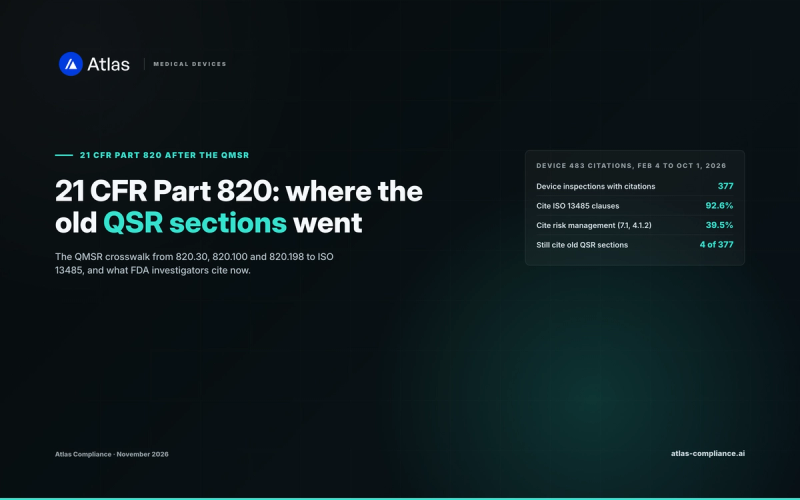
Most ISO 14971 guides stop at the clauses. This one adds what FDA investigators wrote once the QMSR took effect: risk management wording at 149 of 377 device inspections with citations that ended February 4 to October 1, 2026, from the FDA inspection citation records Atlas tracks (pulled October 21, 2026), and named examples from the Atlas Form 483 directory (release of August 15, 2026).
Key facts:
- ISO 14971:2019 is the third edition (December 2019, 36 pages, ISO/TC 210), and ISO confirmed it in 2025, so the 2019 text remains current.
- ISO/TR 24971:2020 is the 87-page companion guidance; ISO lists it as "to be revised", with ISO/AWI TS 24971-1 under development as its replacement.
- FDA's QMSR, in force since February 2, 2026, incorporates ISO 13485:2016 by reference at 21 CFR 820.7 but does not incorporate ISO 14971.
- At 377 device inspections with citations from February 4 to October 1, 2026, 149 (39.5%) cited ISO 13485 clause 7.1 or 4.1.2, the two clauses that carry risk management.
- In 2025, under the QSR, 99 of 723 device inspections with citations (13.7%) cited 820.30(g), the section that held risk analysis.
- None of the 3,679 device citations in the dataset, January 2025 to October 2026, names ISO 14971 itself.
What is ISO 14971?
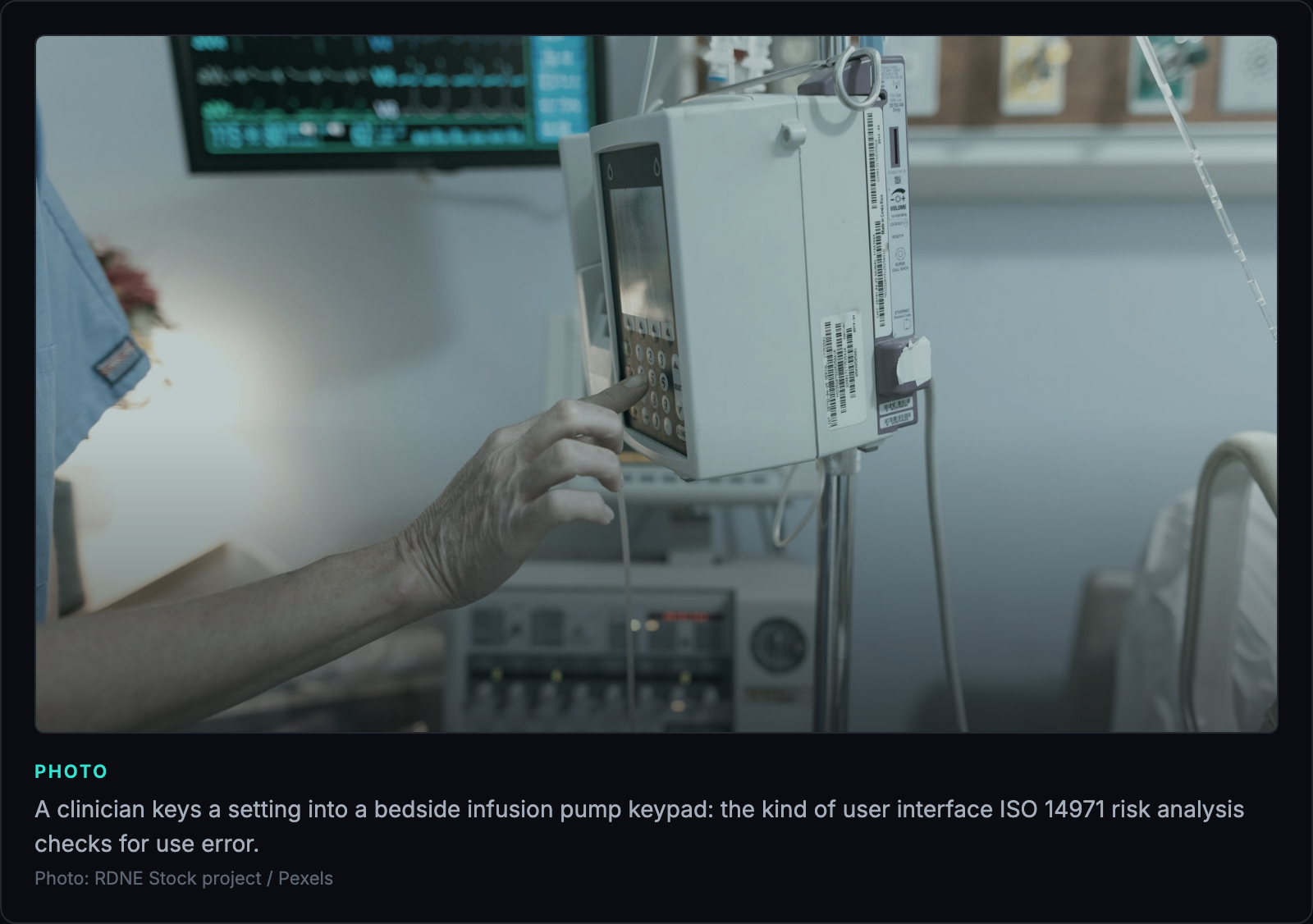
ISO 14971 is the ISO standard titled "Medical devices: Application of risk management to medical devices." ISO 14971 gives terminology, principles and a process for managing risk, and it covers software as a medical device and in vitro diagnostic devices as well as hardware. The ISO 14971:2019 catalogue entry lists biocompatibility, data and systems security, electricity, moving parts, radiation and usability among the risks in scope.
Three limits shape how you use the standard. ISO 14971 requires you to set objective criteria for risk acceptability, but it does not tell you what level of risk is acceptable. It does not require a quality management system, although most manufacturers run it inside one. It also excludes business risk and decisions about using a device in a particular clinical procedure.
The 2019 edition replaced ISO 14971:2007. ISO's summary of the change points to more weight on benefit-risk analysis and expanded requirements for production and post-production activities, the two areas FDA investigators now probe through ISO 13485.
What are the steps of the ISO 14971 risk management process?
The ISO 14971 risk management process runs in seven steps, one per clause from 4 to 10: plan the work, analyze risks, evaluate them, control them, evaluate overall residual risk, review before release, and collect production and post-production information. Clause 4 also requires a risk management file that holds the records from every step.
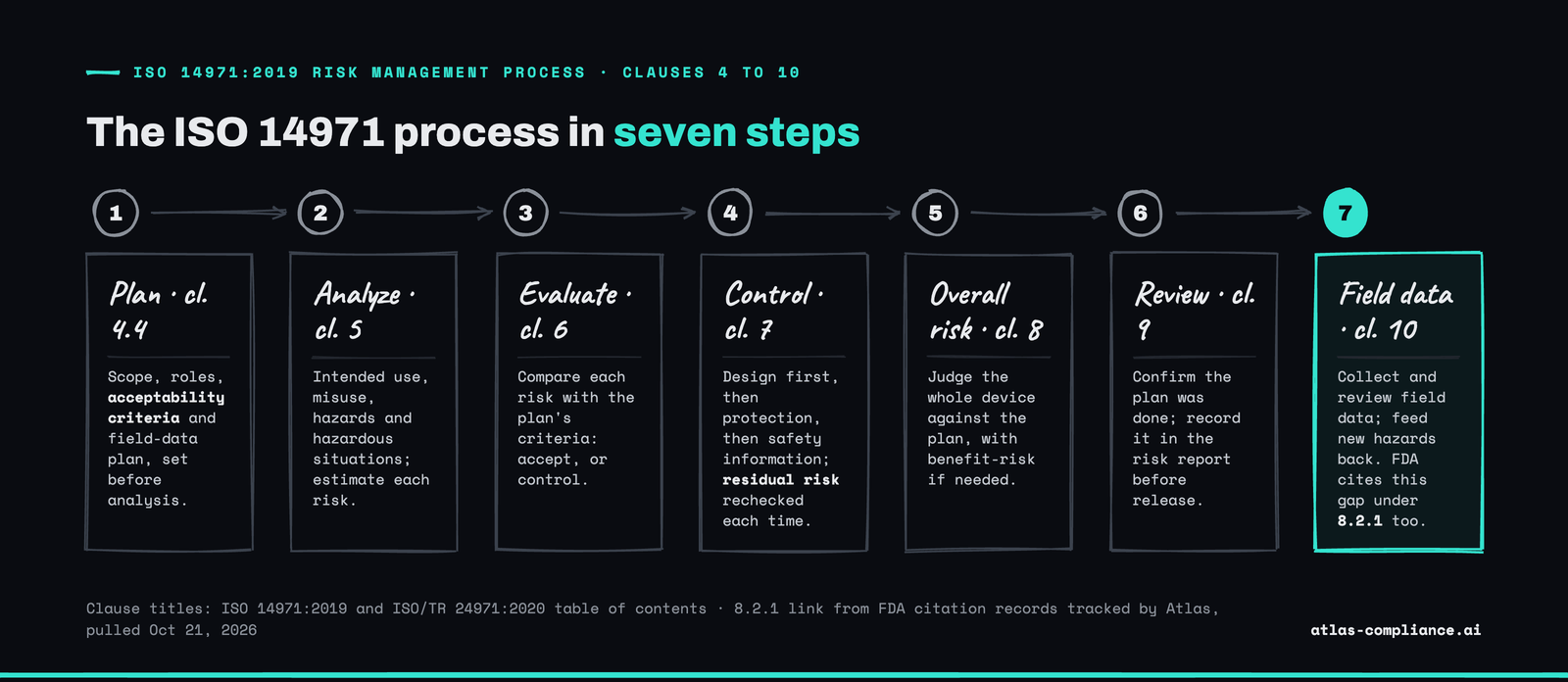
- Plan (clause 4.4). Write a risk management plan for the device that sets the scope, assigns responsibilities, defines how risk management activities get reviewed, states the criteria for risk acceptability, names the method for judging overall residual risk, lists verification activities, and says how you will collect and review production and post-production information.
- Analyze (clause 5). Document the intended use and reasonably foreseeable misuse, identify the characteristics related to safety, then list hazards and hazardous situations, including those that arise from security vulnerabilities. Estimate each risk from probability of occurrence of harm and severity.
- Evaluate (clause 6). Compare each estimated risk with the acceptability criteria in your plan and decide whether it needs reduction.
- Control (clause 7). Clause 7.1 ranks the options: inherent safety by design and manufacture first, protective measures in the device or the manufacturing process second, and information for safety, plus training where appropriate, last. Implement and verify each measure, evaluate the residual risk, run a benefit-risk analysis (clause 7.4) when a residual risk is not acceptable under your criteria, and check whether the controls created new risks.
- Evaluate overall residual risk (clause 8). Judge the device as a whole, after all controls, against the method and criteria in the plan, and decide what residual risk to disclose to users.
- Review (clause 9). Before commercial release, confirm the plan was carried out and the overall residual risk is acceptable, and record the result in the risk management report.
- Production and post-production (clause 10). Collect information from production and the field, review it for new hazards or changed risk estimates, and act on it, including updates to the risk management file.
Step 7 is where many files go quiet. Fresenius Medical Care Renal Therapies Group in Waltham received a Form 483 on June 3, 2026 citing ISO 13485 clause 8.2.1 because feedback information was not used as input into risk management, alongside clause 7.1 for risk management records not maintained.
What is ISO/TR 24971 and how does it relate to ISO 14971?
ISO/TR 24971:2020 is the ISO technical report that gives non-mandatory guidance on applying ISO 14971:2019. ISO 14971 says what you have to do; ISO/TR 24971 explains how, with worked examples. The ISO/TR 24971:2020 catalogue entry describes it as informative, and its clauses 4 to 10 follow the same numbering as ISO 14971, so a team can read the two side by side.
| ISO 14971:2019 | ISO/TR 24971:2020 | |
|---|---|---|
| Document type | International Standard, normative | Technical Report, informative |
| Edition and date | Third edition, December 2019 | Second edition, June 2020 |
| Length | 36 pages | 87 pages |
| What it gives you | Requirements for the risk management process and file | Guidance and examples for meeting those requirements |
| Notable content | Clauses 4 to 10, the process itself | Annex A hazard questions, Annex B analysis techniques (PHA, FTA, ETA, FMEA, HAZOP, HACCP), Annex F security, Annex H in vitro diagnostics |
| ISO status in November 2026 | Confirmed in 2025, current | Marked "to be revised"; ISO/AWI TS 24971-1 under development |
Annex A of the technical report is the part most teams use first. It lists 37 question groups, from implants and energy delivery to alarms and device autonomy, that help a team find characteristics related to safety before hazard analysis starts.
Does FDA require ISO 14971 under the QMSR?
FDA does not require ISO 14971 by name. The QMSR, 21 CFR Part 820 as amended by the final rule of February 2, 2024 (89 FR 7496), incorporates ISO 13485:2016 by reference, and in the preamble to that rule FDA states it does not incorporate ISO 14971 or the other standards ISO 13485 references, while acknowledging they may help in applying ISO 13485.
The requirement to manage risk is binding anyway. Under 21 CFR 820.10, a manufacturer must document a quality management system that complies with the applicable requirements of ISO 13485. In the same preamble, FDA says ISO 13485 integrates risk management throughout its clauses, citing clauses 4.1, 7.1, 7.3, 7.4, 7.5, 7.6 and 8.2, and that the QSR addressed risk management explicitly only in the former 820.30(g). For combination products, 21 CFR 4.4(b)(1)(ii) spells it out: "The organization shall document one or more processes for risk management in product realization."
When an investigator finds the risk method missing, the citation names the ISO 13485 clause, never ISO 14971.
ISO 14971 vs ISO 13485: what is the difference?
ISO 14971 is a process standard for device risk management, while ISO 13485 is a quality management system standard that requires risk management in several of its processes. ISO 13485 tells you where risk decisions have to show up; ISO 14971 gives you a recognized way to make them. Under the QMSR only ISO 13485 is incorporated by reference into US law.
| ISO 14971 output | Where FDA expects to see it in an ISO 13485 QMS | Example of FDA citation wording, 2026 |
|---|---|---|
| Risk management process and plan | Clause 7.1, planning of product realization | Product realization risk management processes not documented |
| Risk-based control of QMS processes | Clause 4.1.2 | Risk-based approach not applied to QMS processes |
| Risk management file and records | Clause 7.1 | Records of risk management activities in product realization not maintained |
| Production and post-production information | Clause 8.2.1, feedback | Feedback not used as input into risk management |
| Supplier and outsourced process risk | Clauses 4.1.5 and 7.4.1 | Controls over outsourced processes not proportionate to risk |
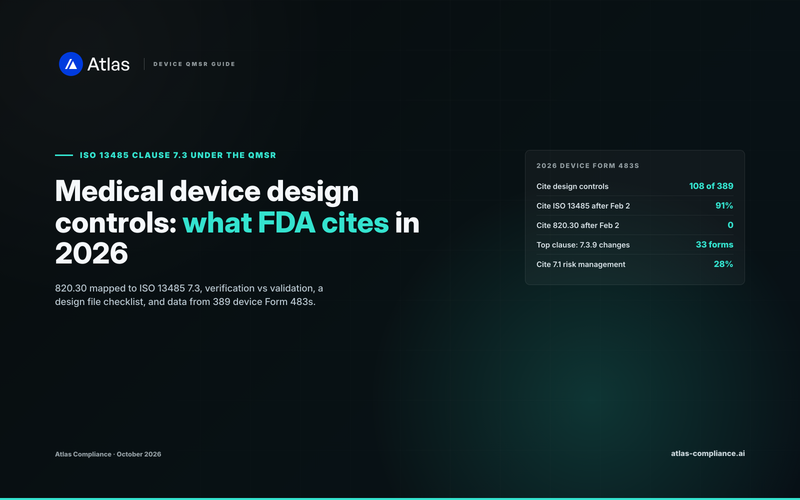
The table is an Atlas mapping from FDA citation text, not wording from either standard. Design teams can follow the same thread into clause 7.3 with our guide to medical device design controls under the QMSR.
What do FDA investigators cite on risk management under the QMSR?
FDA investigators cite missing risk management processes most often under the QMSR. At 377 device inspections with citations that ended February 4 to October 1, 2026, ISO 13485 clause 7.1 appeared at 121 (32.1%) and clause 7.1 or 4.1.2 at 149 (39.5%), from the FDA inspection citation records Atlas tracks, pulled October 21, 2026.
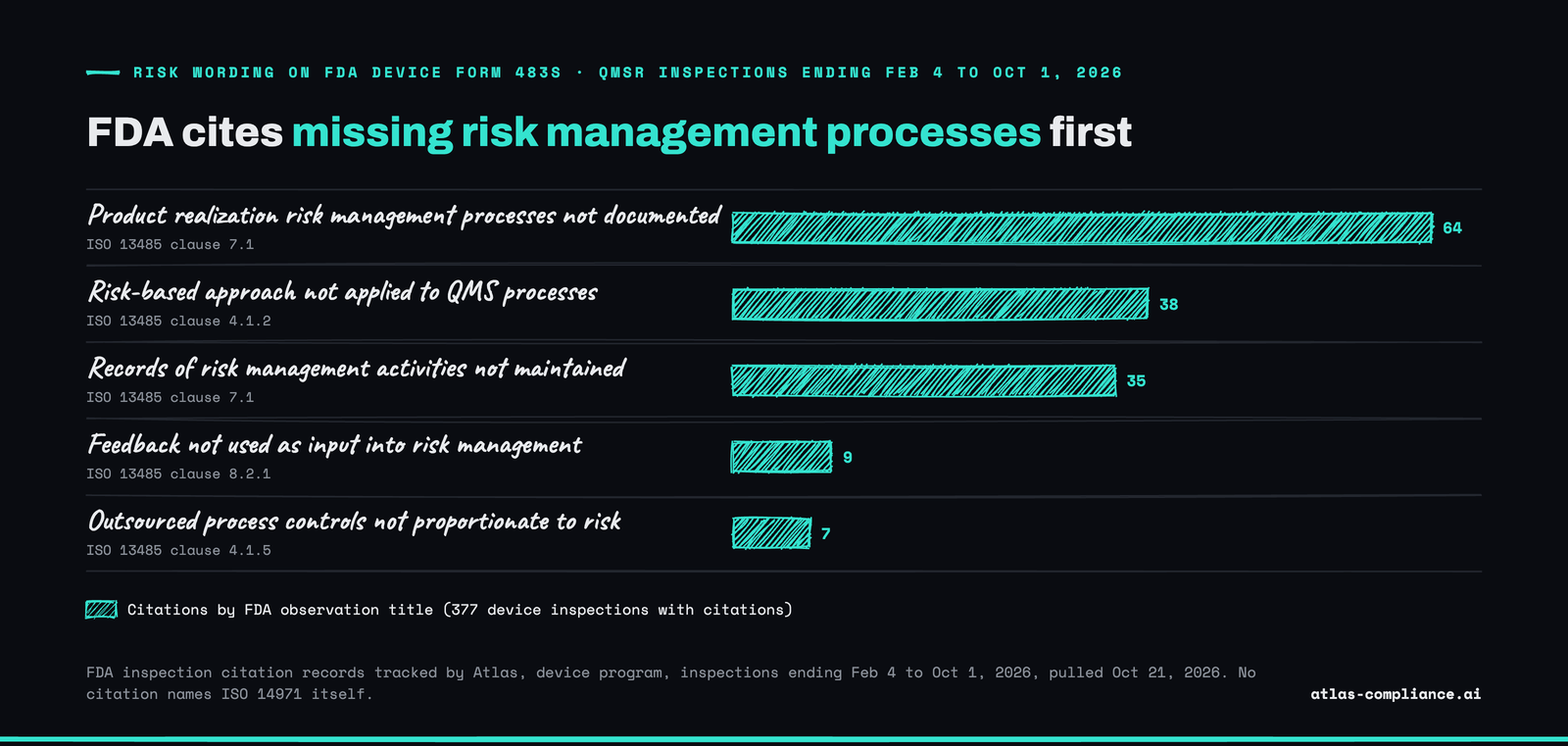
The wording tells you what the investigator could not find. "Product realization risk management processes not documented" appears on 64 citations, and "records of risk management activities in product realization not maintained" on 35. Both point to a file that either does not exist or covers only the design phase. A further 9 citations, under clause 8.2.1, say complaint and feedback information did not reach risk management, which is ISO 14971 clause 10 work.
Under the QSR the same theme was smaller. In 2025, 99 of 723 device inspections with citations (13.7%) cited 820.30(g), design validation, and 46 of those carried the title "risk analysis not performed/inadequate." The 2026 rate is nearly three times higher, though the comparison is not one to one: 820.30(g) also covered design validation, and the QMSR spreads risk across more clauses. Inspections with a risk citation also carried more findings: 3.9 citations each at the 149, against 2.6 at the other 228.
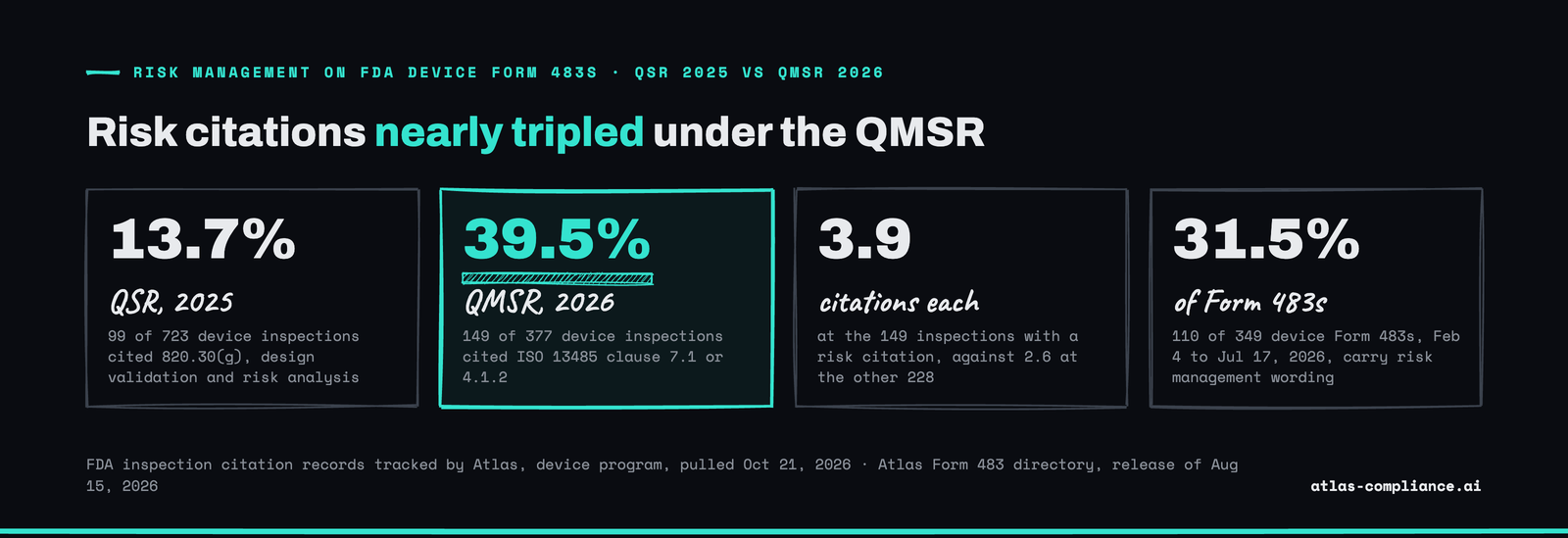
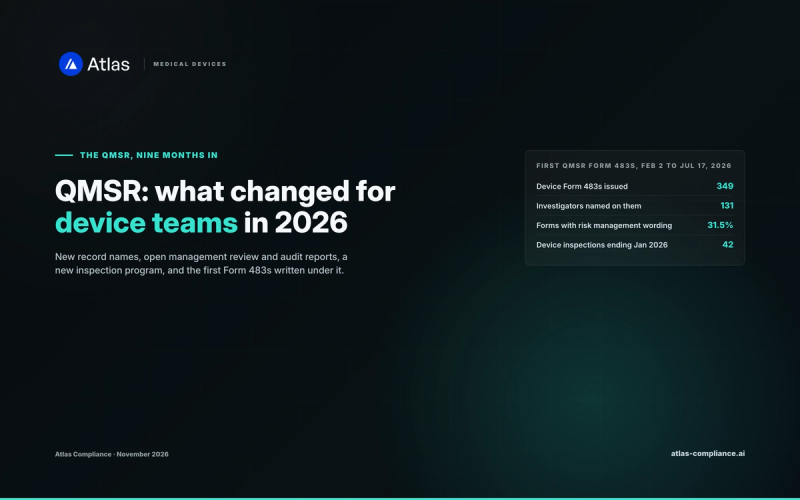
The Atlas Form 483 directory shows the same pattern on the forms themselves. Of 349 device Form 483s issued February 4 to July 17, 2026, 110 (31.5%) carry risk management wording, and 42 cite a risk-based approach not applied to QMS processes. Our QMSR guide covers the other themes on those forms, and the 21 CFR Part 820 crosswalk maps each old QSR section to its ISO 13485 clause.
Named Form 483s from the Atlas directory:
| Form 483 | Issued | Risk observation | Other observations on the form |
|---|---|---|---|
| C.R. Bard, Queensbury, US | Jun 5, 2026 | 7.1, risk management processes not documented | 8.5.2, corrective action procedures not documented |
| First Source, Rochester, US | Jun 24, 2026 | 7.1, risk management processes not documented | 7.3.9 design change procedures; 8.5.2 corrective action procedures |
| Smart World, Fremont, US | Jun 5, 2026 | 7.1, risk management processes not documented | 7.2.1, product requirements not determined |
| Surgical Theater, Beachwood, US | Jun 11, 2026 | 4.1.2, risk-based approach not applied | 4.2.4 document control; 7.3.5 design review records |
| Marlen Manufacturing, Bedford, US | May 6, 2026 | 7.1, risk management processes not documented | GUDID data submission; production controls; process validation procedures |
The two-observation forms at C.R. Bard and Smart World show how short a QMSR form can be when the risk file is the gap. If your next inspection is under the QMSR, look up the investigator's past device forms and see whether clause 7.1 shows up in them.
 Atlas
See what the FDA knows about your next investigator.
30 minutes with the founder. No pitch deck.
How do you build an ISO 14971 risk management file that holds up in an FDA inspection?
An ISO 14971 risk management file holds up in an FDA inspection when an investigator can trace it from the plan to the field: a written procedure, a plan per device, analysis and controls tied to design records, a review before release, and complaint data flowing back in.
- Write the procedure first. Clause 7.1 citations at 64 inspections read "processes not documented." A risk management procedure that names ISO 14971:2019 and assigns owners answers that text directly.
- Keep one plan per device or family. Put the acceptability criteria and the overall residual risk method in the plan before analysis starts, as ISO 14971 clause 4.4 requires.
- Tie controls to design records. Each risk control measure should trace to a design input under clause 7.3.3 and to the verification that proves it works.
- Apply risk to QMS processes as well as the product. Clause 4.1.2 citations at 38 inspections read "risk-based approach not applied to QMS processes," so record the risk rationale behind supplier, outsourcing and process decisions.
- Close the loop from complaints. Route complaint trends, service data and Part 803 reports into the risk file and record the review, which is the gap behind the clause 8.2.1 citations. Our CAPA guide covers how corrective actions should update the risk file.
- Check what peers were cited for. Search the FDA Form 483s directory for device firms like yours and read their clause 7.1 observations.
Drug and combination product teams who also run ICH Q9 can compare the two frameworks in our ICH Q9 quality risk management guide. FDA keeps adding QMSR inspections to its public citation data as it finalizes classifications, so the 2026 shares will move, and the digest tracks each new device Form 483 as it appears.
AtlasFDA Inspection Intelligence Digest
We track every 483, EIR, and warning letter the moment it happens. Get the signals before they hit the FDA website.
Frequently asked questions
ISO 14971:2019 is the latest version. ISO published this third edition in December 2019, replacing ISO 14971:2007, and confirmed it at its most recent systematic review in 2025, so the 2019 text stays current. ISO reviews each standard every five years. The companion guidance, ISO/TR 24971:2020, is the document ISO has marked for revision, with a technical specification in development.

Written by
Bhavish Agarwal
Founder, Atlas
Bhavish Agarwal is the founder of Atlas and previously worked at Google and Microsoft. He has spent the past several years building regulatory data infrastructure for the pharmaceutical industry.