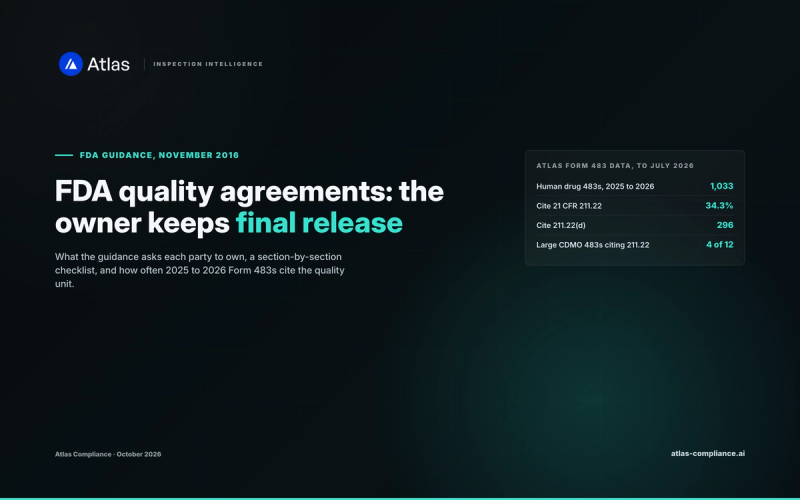

A contract manufacturing organization (CMO) is a company that manufactures, fills, packages or tests drug, biologic or device products under contract for the company that owns the product, following the owner's process and specifications. FDA's regulations call a CMO a contract facility and treat it as an extension of the owner's own facility.
This guide adds what generic definitions leave out: how FDA investigators cited owners for weak control of their contractors on 774 drug and 377 device inspections from January 2025 to October 2026, from the Atlas Form 483 citation dataset (pulled October 2026), with named Form 483s at contract facilities.
Key facts:
- 21 CFR 211.22(a) makes the owner's quality control unit responsible for approving or rejecting drug products manufactured, processed, packed or held under contract by another company.
- A CRO is defined in 21 CFR 312.3 and can take over sponsor obligations under 21 CFR 312.52, but only when the transfer is described in writing.
- Since the Quality Management System Regulation took effect on February 2, 2026, FDA cited ISO 13485 clause 7.4 (purchasing and supplier controls) at 84 of 377 device inspections (22.3%) closed through October 1, 2026.
- FDA cited 13 of those device facilities for outsourcing a process without a written quality agreement under ISO 13485 clause 4.1.5.
- On the drug side, 5 of 774 Part 211 inspections closed January 2025 to September 2026 cited the owner's quality unit for not taking responsibility for contract-made products, and 2 of the 5 ended Official Action Indicated (OAI).
What is a contract manufacturing organization?
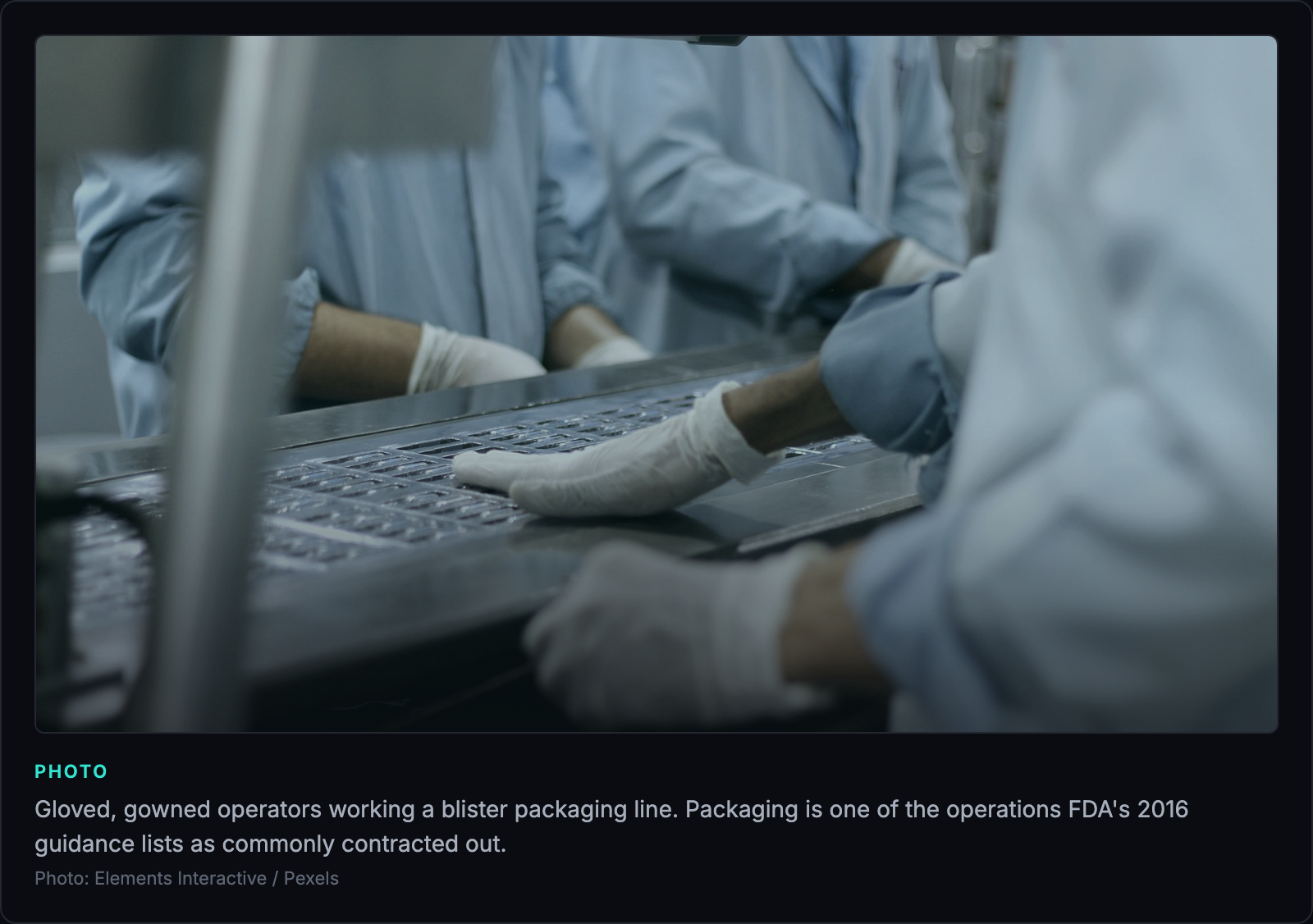
A contract manufacturing organization is an outside company that runs one or more manufacturing operations for a product owner: formulation, chemical synthesis, cell culture, fill and finish, packaging, labeling, sterilization or analytical testing. The owner holds the application or the brand. The CMO holds the equipment, the people and the batch records.
FDA does not use the word "CMO" in its regulations. 21 CFR 200.10(b) describes "extramural independent contract facilities, such as testing laboratories, contract packers or labelers, and custom grinders" and regards them "as an extension of the manufacturer's own facility." FDA's November 2016 guidance, Contract Manufacturing Arrangements for Drugs: Quality Agreements, uses two terms: the owner and the contract facility. A contract facility that uses its own subcontractor becomes an owner for that work.
Owners use CMOs for capacity, for a technology they do not run in-house (blow-fill-seal, sterile lyophilization, high-potency compounds), or because they own no manufacturing facility at all. Virtual biotechs, which own no manufacturing facility, fall in that last group.
CMO vs CDMO vs CRO: what is the difference?
A CMO manufactures to a process the owner already has. A CDMO (contract development and manufacturing organization) also develops the formulation and process before making the product. A CRO (contract research organization) runs clinical or nonclinical studies and produces data, not commercial product.
| CMO | CDMO | CRO | |
|---|---|---|---|
| What it delivers | Batches, packaged lots, test results | Development work, then batches | Study data, reports, submissions support |
| Typical stage | Clinical supply and commercial | Preclinical to commercial | Phase 1 to post-approval studies |
| Main FDA rules | 21 CFR 210, 211; 820 for devices; ICH Q7 section 16 for APIs | Same CGMP rules once it manufactures | 21 CFR 312 (GCP), 58 (GLP) |
| Can take over legal duties? | No. The owner's quality unit still approves or rejects each lot | No, same as a CMO | Yes, sponsor obligations transfer in writing under 21 CFR 312.52 |
| FDA inspection program | Drug and device quality inspections | Drug quality inspections | Bioresearch monitoring inspections |
| Agreement FDA looks for | Quality agreement | Quality agreement, plus development terms in the commercial contract | Written transfer of obligations |
The CMO and CDMO labels are marketing choices. The same company can call itself either, and FDA inspects both against Part 211. The line that matters legally runs between manufacturing contractors and CROs.
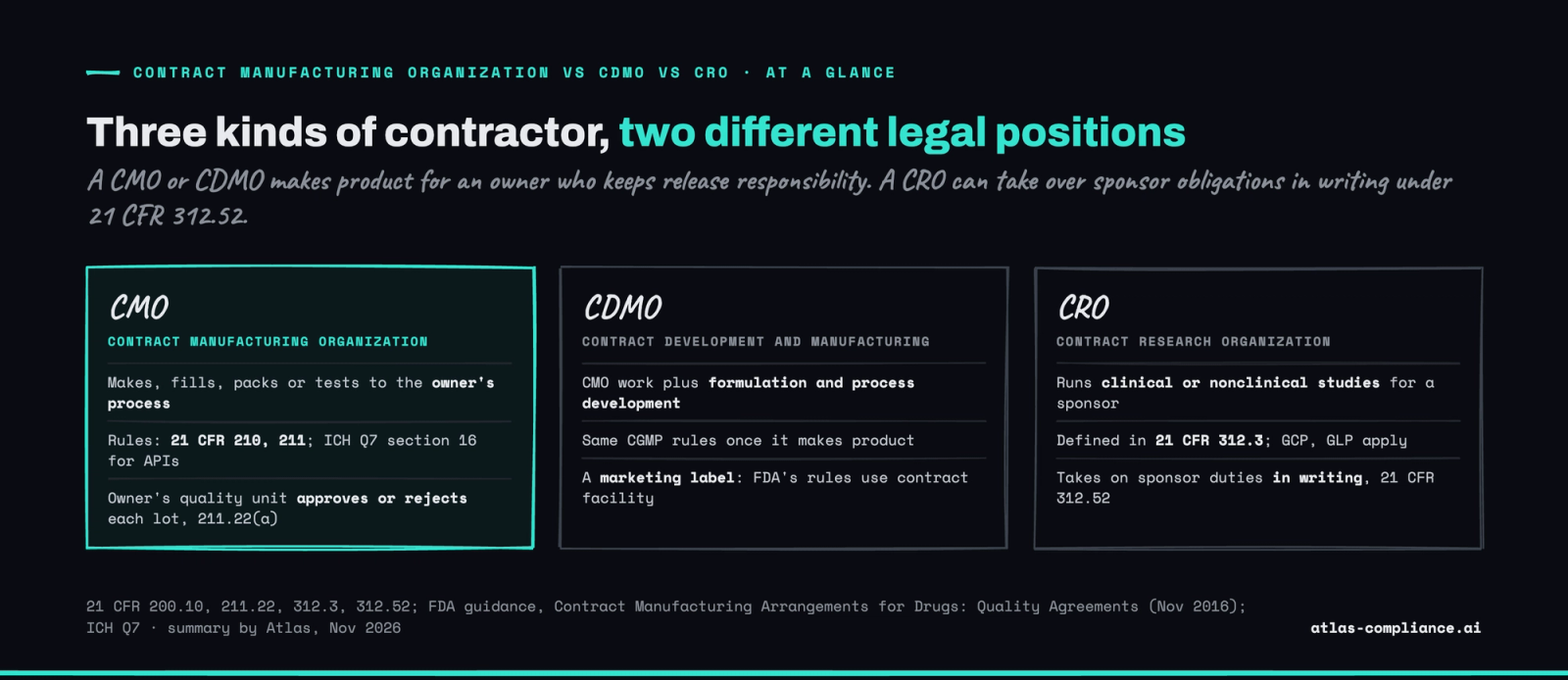
A sponsor that hands monitoring to a CRO can move that obligation, and under 21 CFR 312.52 the CRO then faces "the same regulatory action as a sponsor" if it fails. Any obligation not named in the written transfer stays with the sponsor. FDA checks that side through its bioresearch monitoring program, not through CGMP inspections.
Who is responsible for quality when you use a CMO?
The product owner stays responsible for quality when it uses a CMO, and the CMO carries its own CGMP responsibility at the same time. 21 CFR 211.22(a) says the owner's quality control unit "shall be responsible for approving or rejecting drug products manufactured, processed, packed, or held under contract by another company." The 2016 guidance adds that quality agreements cannot be used to delegate statutory or regulatory CGMP responsibilities.
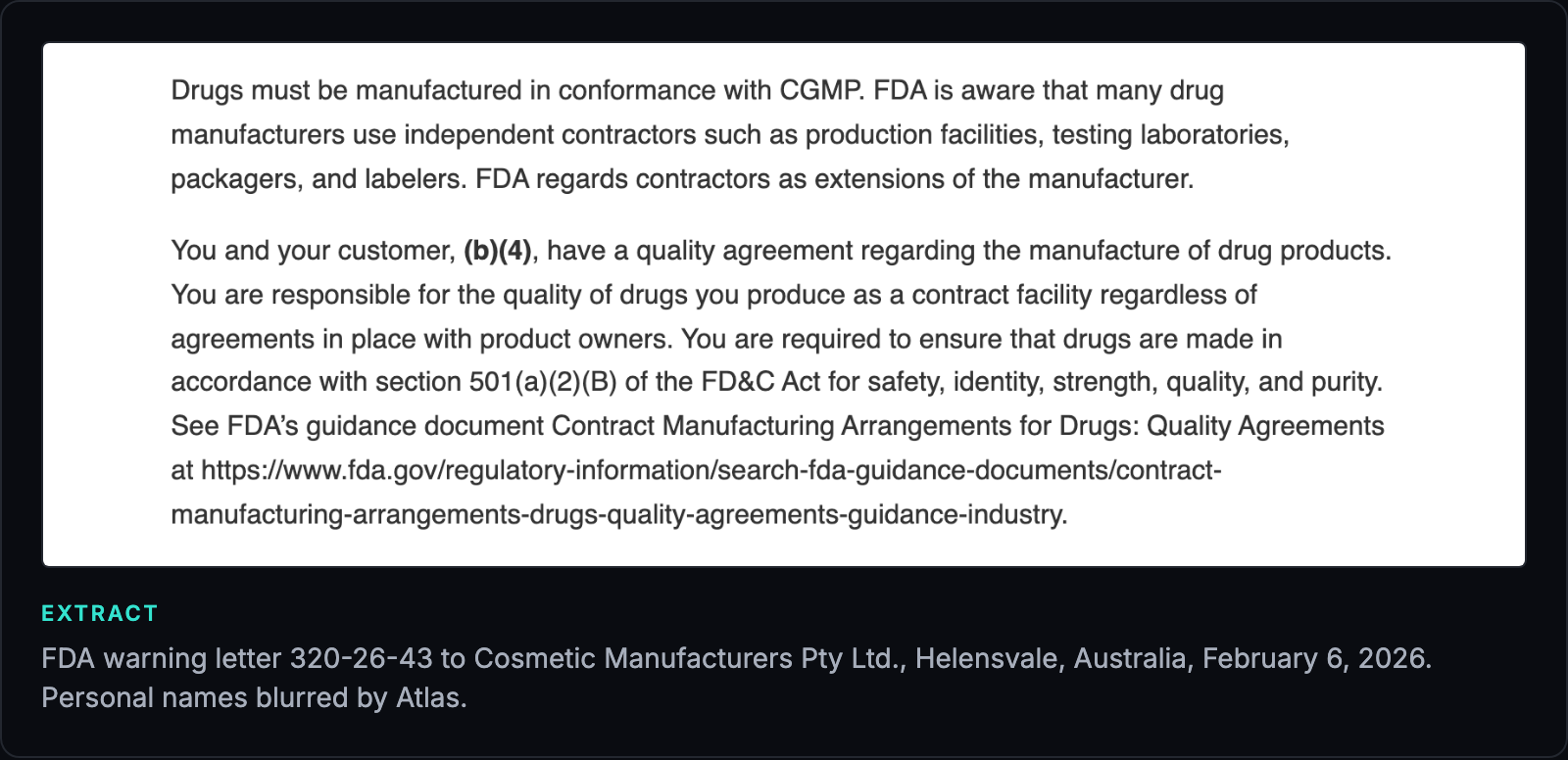
FDA holds the contract facility to the same standard from its side. Its February 6, 2026 warning letter 320-26-43 to Cosmetic Manufacturers Pty Ltd., a contract facility in Helensvale, Australia, notes that the firm and its customer had a quality agreement and still states that the contractor is responsible for the quality of the drugs it produces regardless of agreements with product owners.
Device owners have had the same duty in writing since February 2, 2026. Under the QMSR, 21 CFR 820.10 incorporates ISO 13485:2016, and clause 4.1.5 requires controls over outsourced processes, including written quality agreements. The 21 CFR Part 820 guide maps where the old purchasing controls went.
What does a quality agreement with a CMO have to cover?
A quality agreement with a CMO has to name which party performs each CGMP activity, from component testing to lot disposition, and how the two quality units communicate. FDA's 2016 guidance lists the core sections: purpose and scope, definitions, resolution of disagreements, manufacturing activities, and the life cycle of the agreement. Within manufacturing activities, it calls quality and change control the most critical pieces.
The duties a CMO agreement most often leaves unassigned:
- Release: the owner's quality unit approves or rejects every lot, and the agreement says what the CMO sends before that decision.
- Results: the CMO sends all test results, failing ones included, with access to raw data and audit trails.
- Investigations: one named party investigates each out-of-specification result and deviation, with a deadline.
- Changes: a list of changes that need the owner's prior approval (equipment, suppliers, process, site) and which need notice only.
- Inspection findings: the CMO tells the owner when FDA issues a Form 483 at the shared facility, and what it covered.
- Audits: the owner's right to audit the facility, and when it re-audits after a finding.
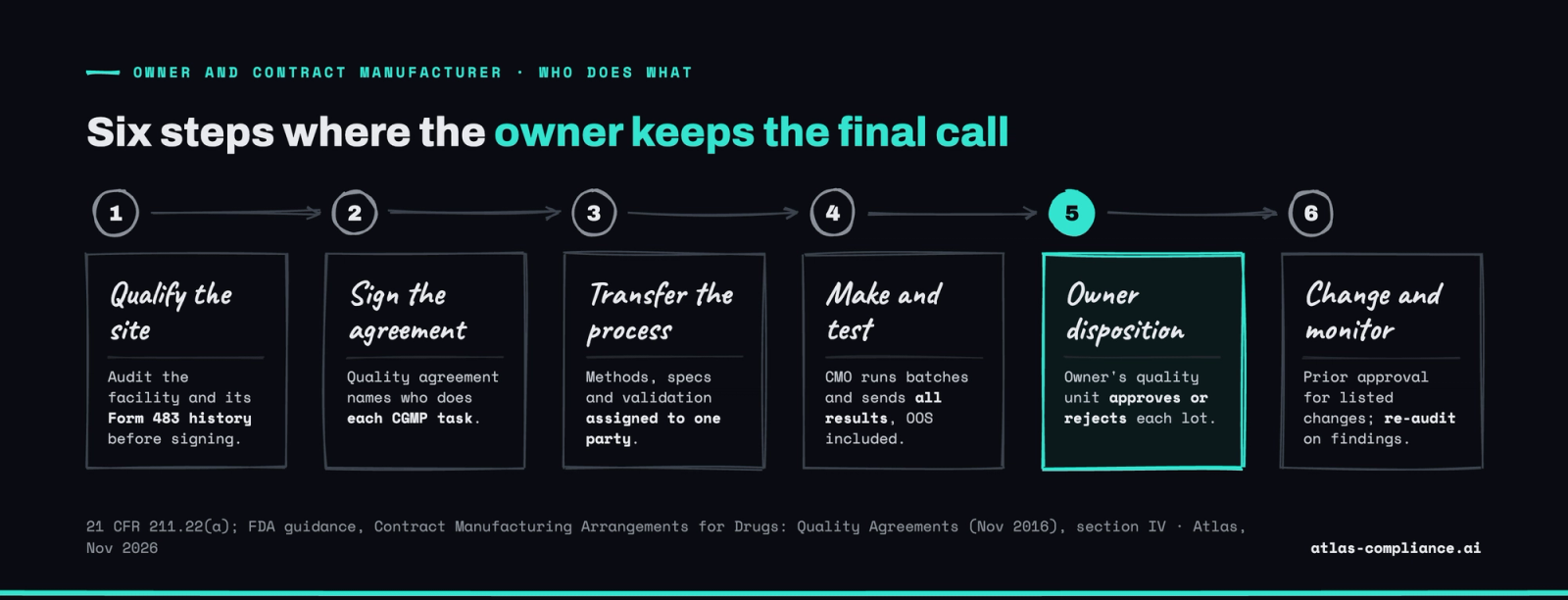
A quality agreement is separate from the supply agreement that sets price and volume. Our guide to FDA quality agreements walks through every section of the guidance with a line-by-line checklist, and supplier qualification covers the audit that comes before signing.
How often does FDA cite owners for weak contractor oversight?
FDA cites device owners for supplier and outsourcing controls far more often than drug owners for contract oversight. In the Atlas Form 483 citation dataset (pulled October 2026), ISO 13485 clause 7.4 appeared at 84 of 377 device inspections (22.3%) closed between February 4 and October 1, 2026, the first eight months under the QMSR. Clause 4.1.5 on outsourced processes appeared at 34 (9.0%), and 13 of those citations read "External party controls do not include written quality agreements."
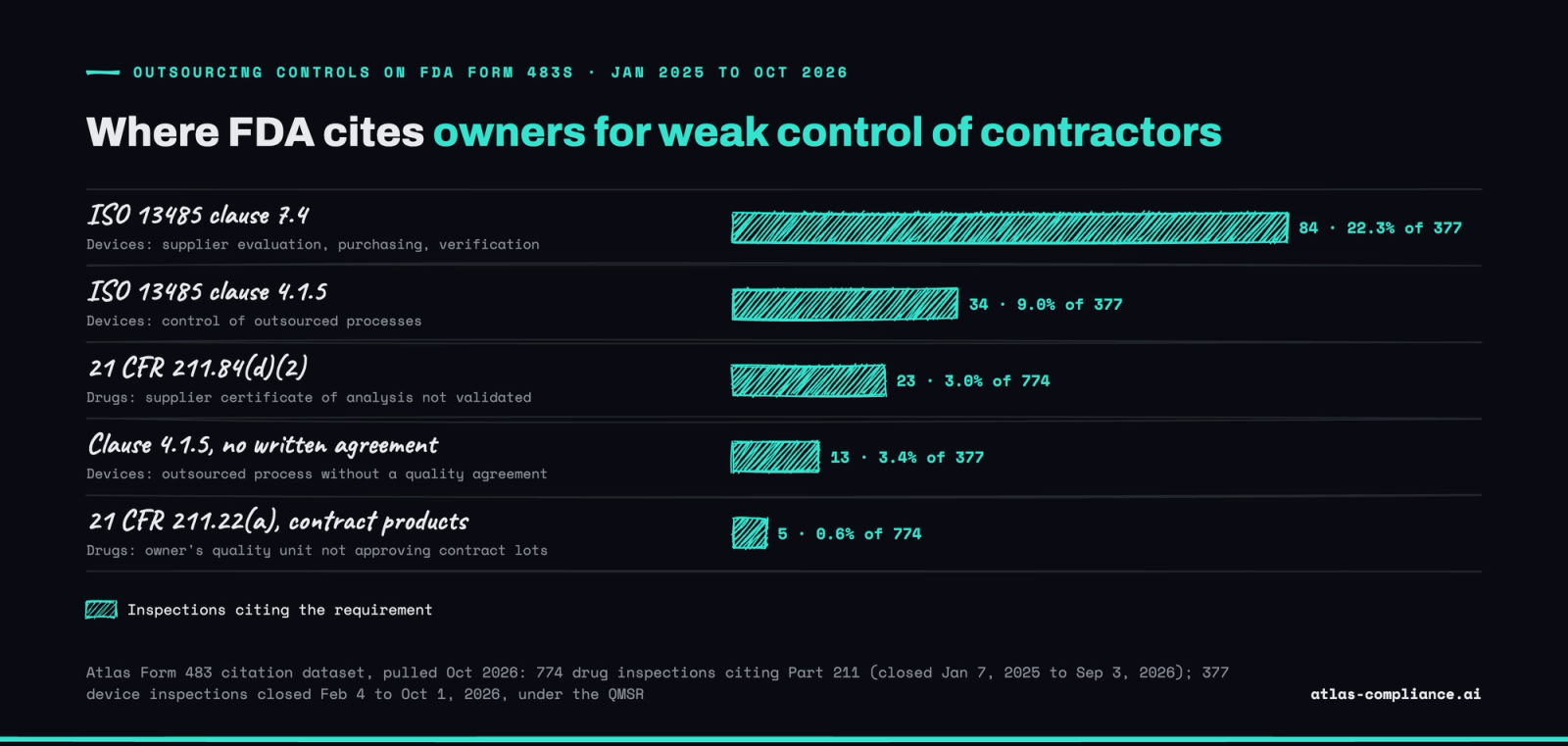
Drug owners show up in two places:
| 21 CFR citation on a drug Form 483 | Inspections, Jan 2025 to Sep 2026 | Ended OAI |
|---|---|---|
| 211.84(d)(2): reliability of the supplier's certificate of analysis not established | 23 of 774 (3.0%) | 10 (43.5%) |
| 211.22(a): quality unit lacks responsibility for products made under contract | 5 of 774 (0.6%) | 2 (40.0%) |
| All Part 211 drug inspections with citations | 774 | 212 (27.4%) |
The five 211.22(a) contract citations went to owners that outsourced production: Gussyup LLC (dba Private Label Grooming) in Henderson, Nevada (February 2025, OAI), Geri-Care Pharmaceuticals in Lakewood, New Jersey (May 2025), CosMedical Technologies in Davie, Florida (July 2025, OAI), RedPharm Drug in Eden Prairie, Minnesota (August 2025) and Talbot's Pharmaceuticals Family Products in Monroe, Louisiana (May 2026). The Talbot's Form 483 carried a single observation, written by an investigator who has 18 inspections on record since December 2024. Those five Form 483 pages are not indexed in Atlas, so they are named here without links.
Treat the drug count as a floor. FDA can also write a contractor oversight gap under 211.22(d), quality unit procedures not followed, or under 211.84 for components, and those forms never carry the contract heading.
What do FDA inspections at contract manufacturers find?
FDA inspections at contract manufacturers find the same core gaps as at owner facilities: microbiological testing, laboratory controls, investigations and quality unit procedures. Two recent Form 483s from the Atlas FDA Form 483 database show the pattern at facilities whose operators describe them as contract manufacturers on their own websites: Unither for its Rochester facility, and Silgan Unicep for its Spokane unit-dose filling business.
| Contract facility | Form 483 date | Observations | Sections cited | Outcome |
|---|---|---|---|---|
| Unither Manufacturing, Rochester, New York | May 15, 2026 | 9 | 211.113(b), 211.142(b), 211.160(b), 211.165(b) and (d), 211.166(a), 211.22(d), 211.67(b), 211.68(b) | OAI |
| Silgan Unicep Packaging, Spokane, Washington | Apr 2, 2026 | 8 | 211.192, 211.194(a)(2), 211.198(a), 211.22(d), 211.63, 211.67(a), 211.68(b), 211.84(d)(2) | Not yet in FDA's classification file, Oct 2026 |
The history behind each form matters as much as the form. Unither's Rochester facility has 12 inspections on record and 8 Form 483s, and the May 2026 team included an investigator with 52 inspections and 194 observations on record. Silgan Unicep's Spokane facility has 2 Form 483s in 4 inspections, and its 2026 form cites 211.84(d)(2), the same supplier certificate section that appears on owners' forms.
Every owner whose product runs on those lines inherits those findings. A Form 483 at a CMO can delay the owner's pending applications or interrupt supply while the CMO fixes the findings. Checking the investigator who last inspected your CMO shows which systems that person tends to examine.
 Atlas
See what the FDA knows about your next investigator.
30 minutes with the founder. No pitch deck.
How do you vet a CMO's FDA inspection history?
You vet a CMO's FDA inspection history by pulling every inspection at the exact facility, not the parent company, and reading the cited sections and classifications over at least five years. Check these before you sign or renew:
- Inspection count, Form 483 count and the last three classifications (NAI, VAI or OAI) for the facility's FEI number.
- Repeat sections: the same 21 CFR section on two consecutive Form 483s points to a corrective action that did not hold.
- Warning letters, import alerts and recalls tied to the facility.
- Whether the observations touch your dosage form or test method.
- The CMO's written response to its last Form 483, and whether its quality agreement obliges it to share the next one.
Our FDA inspection classification guide explains what each outcome means, and what FDA checks at foreign contract manufacturing sites covers CMOs outside the US. Atlas sends new Form 483s and warning letters as FDA releases them, including those at contract facilities.
AtlasFDA Inspection Intelligence Digest
We track every 483, EIR, and warning letter the moment it happens. Get the signals before they hit the FDA website.
Frequently asked questions
CMO stands for contract manufacturing organization in pharma. It is a company that manufactures, packages or tests drug products for another company that owns the product or the marketing application. In clinical development, the same letters sometimes mean chief medical officer, so check the context. FDA's own documents use the term contract facility rather than CMO.

Written by
Bhavish Agarwal
Founder, Atlas
Bhavish Agarwal is the founder of Atlas and previously worked at Google and Microsoft. He has spent the past several years building regulatory data infrastructure for the pharmaceutical industry.