
A CDMO (contract development and manufacturing organization) is a company that develops and manufactures drug products or active ingredients for other companies under contract, from formulation and process work through clinical and commercial supply. FDA inspects a CDMO like any other drug facility, and the findings land on the sponsor's application as well as on the CDMO.
This guide adds what CDMO marketing pages leave out: the FDA inspection record of 99 CDMO facilities between January 2025 and October 2026, from FDA's Data Dashboard as analyzed by Atlas in November 2026, and the Form 483 sections FDA writes at them.
Key facts:
- FDA regards a contract facility as an extension of the manufacturer's own facility, under 21 CFR 200.10(b).
- The sponsor's quality unit approves or rejects drug products made under contract by another company, under 21 CFR 211.22(a).
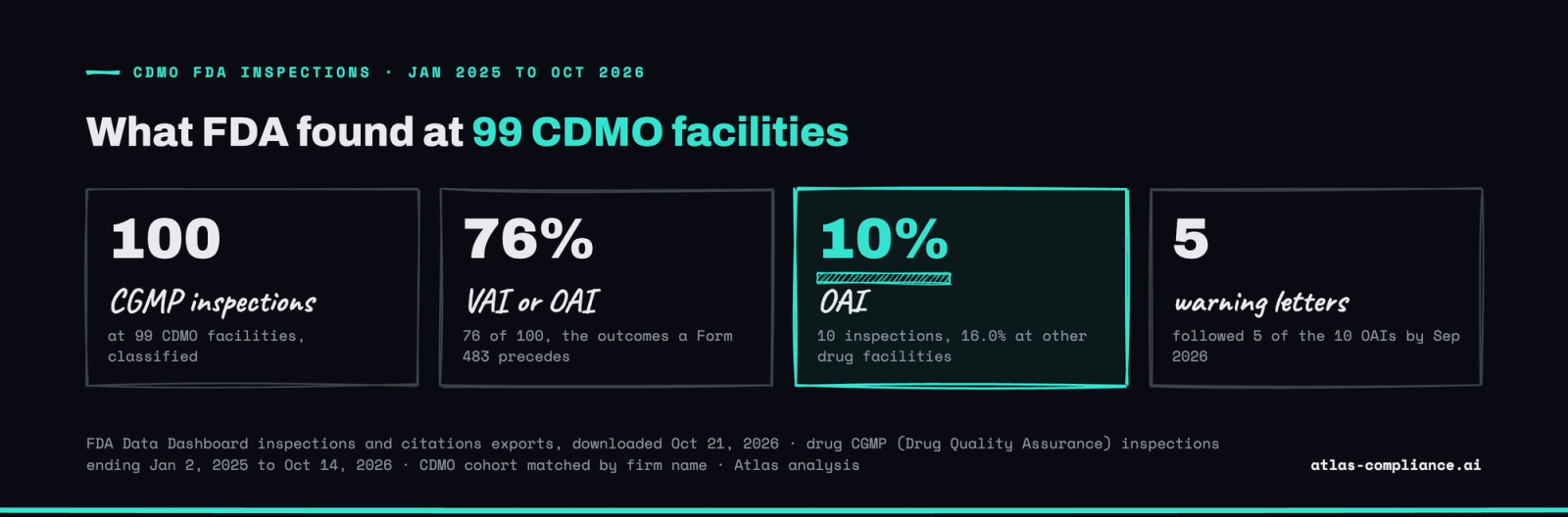
- 76 of 100 classified CGMP inspections at CDMO facilities that ended between January 2, 2025 and October 14, 2026 were classified VAI or OAI.
- 10 of those 100 inspections (10.0%) ended OAI, against 300 of 1,874 (16.0%) at other drug facilities in the same FDA program.
- 21 CFR 211.67, equipment cleaning and maintenance, appears in 17 of the 32 CDMO inspections with posted Form 483 citations (53.1%), against 29.1% across all drug CGMP inspections.
- Five of the 10 CDMO OAI inspections were followed by an FDA warning letter 129 to 225 days after the inspection ended.
What is a CDMO?
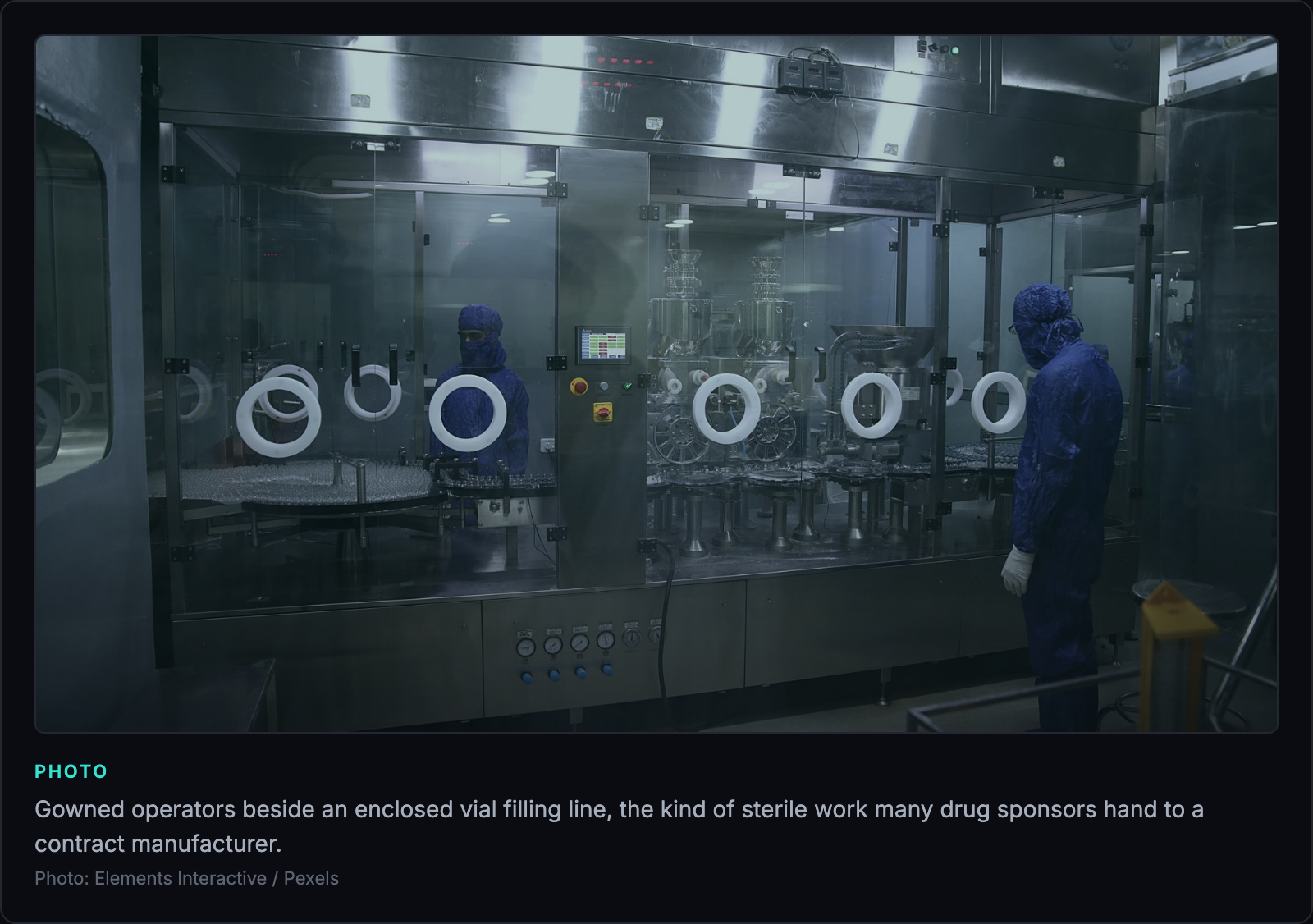
A CDMO is a contract company that does both development and manufacturing for a drug sponsor: formulation, analytical method development, process scale-up, technology transfer, then GMP production of clinical and commercial batches. A CMO, by contrast, manufactures a product whose process the sponsor already owns, and a CRO runs research and clinical work without making product.
| Provider | What it does for the sponsor | FDA rules that apply to its work | Inspected by FDA as |
|---|---|---|---|
| CDMO | Develops the formulation or process, then manufactures clinical and commercial batches | 21 CFR Parts 210 and 211 (drug products), ICH Q7 (APIs), Part 600 (biologics) | A drug establishment, under its own FEI number |
| CMO | Manufactures, fills or packages to the sponsor's established process | Same CGMP rules as the CDMO | A drug establishment, under its own FEI number |
| CRO | Runs nonclinical studies, clinical trials, data management | 21 CFR Part 58 (GLP), Part 312 (clinical investigations) | A testing facility or clinical site under bioresearch monitoring |
The labels overlap in practice. Many firms sell both services, and FDA's records do not tag a facility as a CDMO at all. What matters for supplier quality is the facility that will touch your product and its own inspection history.
How does FDA regulate a CDMO's work for a sponsor?
FDA regulates a CDMO's work as if the sponsor did it. Under 21 CFR 200.10(b), FDA regards extramural contract facilities as an extension of the manufacturer's own facility, and under 21 CFR 211.22(a) the sponsor's quality control unit is responsible for approving or rejecting drug products manufactured, processed, packed or held under contract by another company.
Three consequences follow for a sponsor:
- The CDMO's Form 483 can hold up your application. FDA's pre-approval and surveillance inspections cover the contract facility named in the filing, and an unresolved finding there can produce a complete response letter.
- FDA may tell you what it found. Section 200.10(c) reserves FDA's right to disclose to the applicant or sponsor any inspection information with a specific bearing on the compliance of its product.
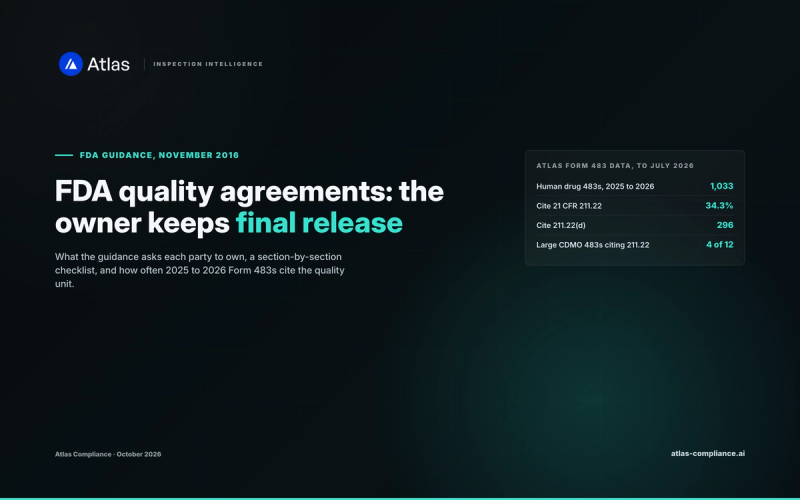
- The split of duties has to be written down. FDA's guidance Contract Manufacturing Arrangements for Drugs: Quality Agreements (November 2016) expects a written quality agreement that says who handles deviations, investigations, change control and batch release. Our post on FDA quality agreements walks through the clauses.
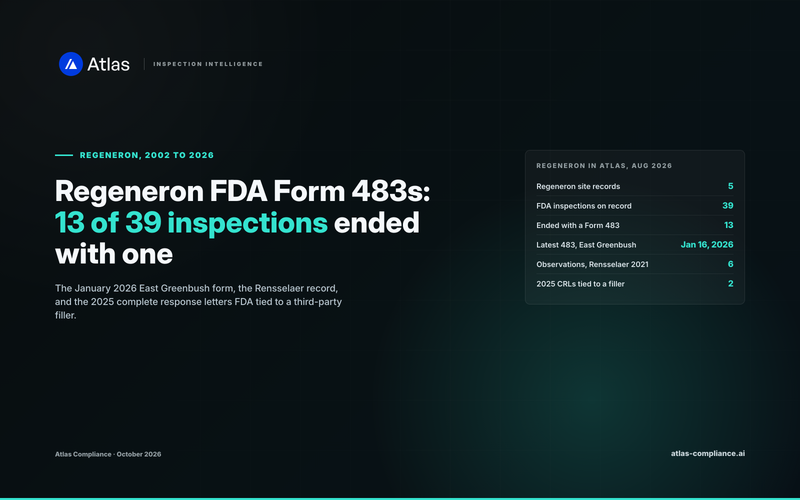
Regeneron's 2025 filings show the first point at work. Regeneron reported complete response letters for products whose sole approvability issue was unresolved inspection findings at its third-party filler, Catalent Indiana in Bloomington. The sequence is laid out in our Regeneron Form 483 and filler CRL analysis.
How often do CDMO inspections end in a Form 483 or OAI?
CDMO inspections ended VAI or OAI in 76 of 100 classified drug CGMP inspections between January 2, 2025 and October 14, 2026, and OAI in 10 of 100 (10.0%), according to an Atlas analysis of FDA Data Dashboard exports downloaded October 21, 2026. Other drug facilities in the same FDA program ended OAI in 300 of 1,874 inspections (16.0%).
| Outcome | CDMO facilities (100 inspections) | Other drug facilities (1,874 inspections) |
|---|---|---|
| NAI, no action indicated | 24 (24.0%) | 435 (23.2%) |
| VAI, voluntary action indicated | 66 (66.0%) | 1,139 (60.8%) |
| OAI, official action indicated | 10 (10.0%) | 300 (16.0%) |
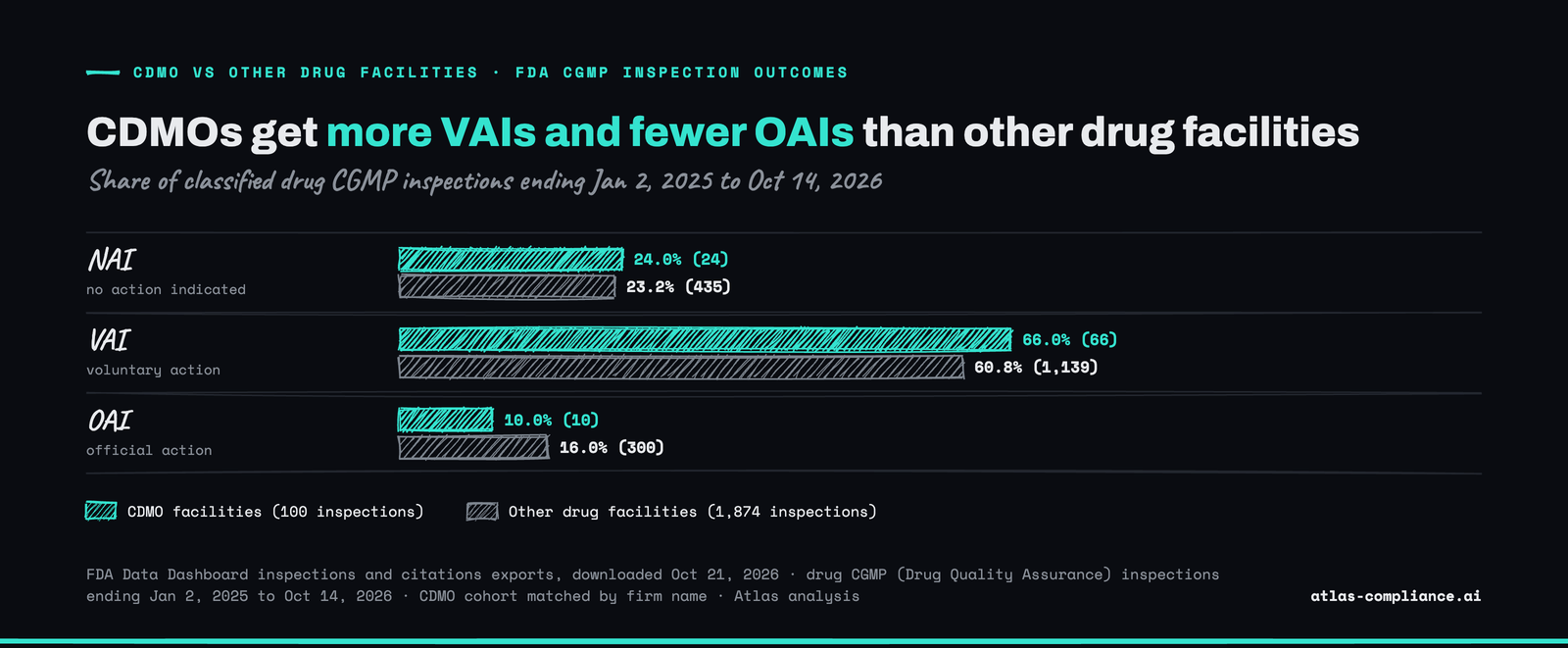
CDMO facilities receive Form 483 observations about as often as other drug manufacturers, and those observations end in official action less often. The 100 inspections covered 99 facilities, 61 in the United States and 39 abroad. US CDMO facilities ended OAI in 7 of 61 inspections (11.5%), against 222 of 1,156 (19.2%) at all US drug facilities in the program; foreign CDMO facilities ended OAI in 3 of 39 (7.7%), against 88 of 818 (10.8%) across all foreign drug facilities.
A VAI means FDA found objectionable conditions but will not take regulatory action; an OAI means it plans to. Our guide to NAI, VAI and OAI classifications explains how the decision is made after the Form 483. A lower OAI share does not make an individual CDMO safe, and the named cases below show how fast an OAI turns into a supply problem.
What does FDA cite at CDMO facilities?
FDA cites equipment cleaning and maintenance, 21 CFR 211.67, more than any other section at CDMO facilities: in 17 of the 32 CDMO inspections with posted Form 483 citations (53.1%) between January 2025 and October 2026. Across all 781 drug CGMP inspections with posted citations, the same section appears in 29.1%.
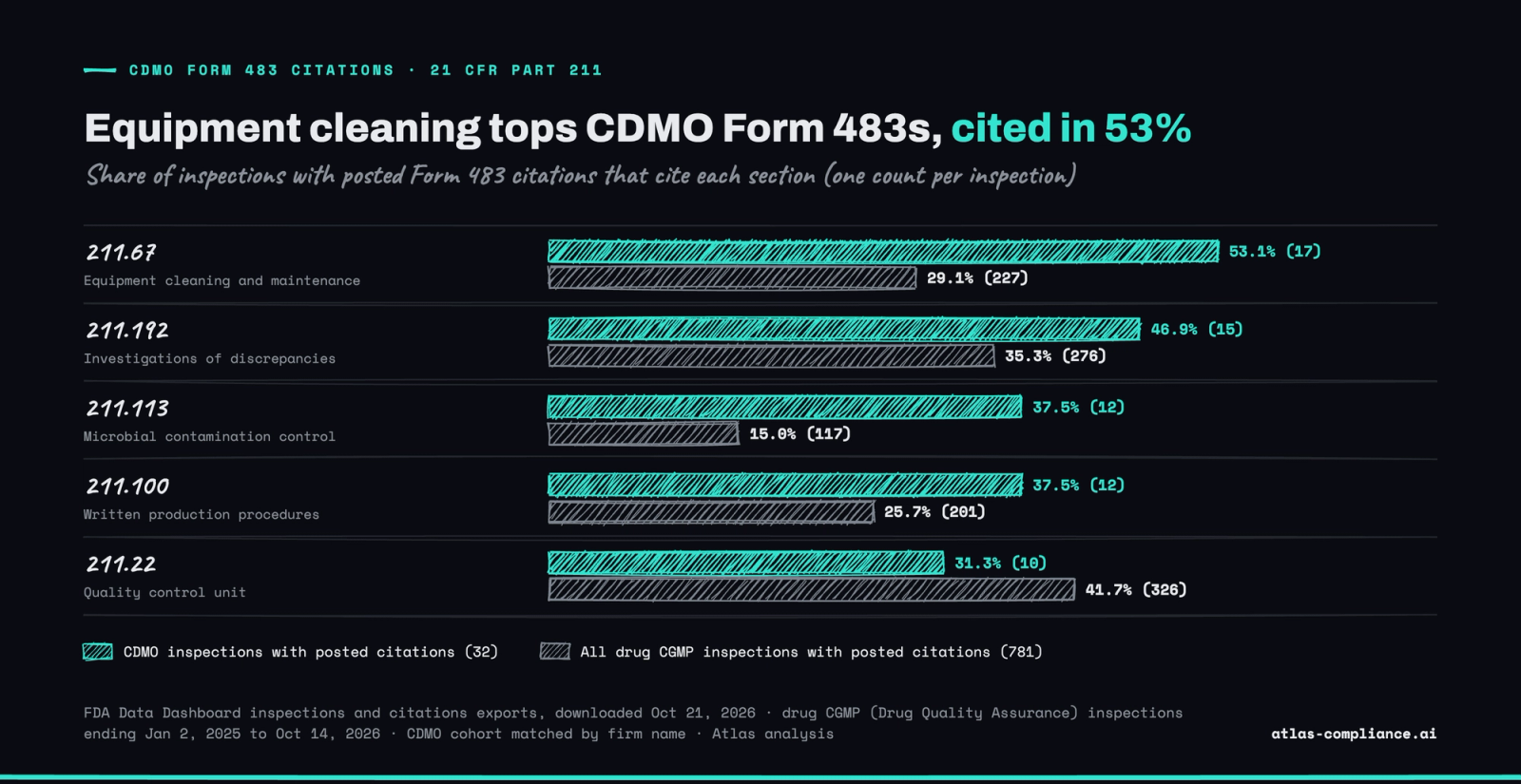
Two sections stand out against the drug average. Equipment cleaning, 211.67, fits the business model: a CDMO runs many sponsors' products through shared equipment, so cleaning validation and changeover records carry more risk than at a single-product facility. Microbial contamination control, 211.113, appears in 37.5% of CDMO inspections with citations against 15.0% overall, which reflects how much sterile fill and finish work sponsors outsource. Investigations of discrepancies, 21 CFR 211.192, sits second at 46.9%. The quality unit section, 211.22, is the one section cited less often at CDMOs (31.3%) than across all drug inspections (41.7%).
Four Form 483s at facilities in the CDMO cohort, from the Atlas directory (release of August 15, 2026), show these sections on real forms:
- The Fareva Morton Grove Form 483 of August 12, 2025 carries 7 observations, among them 211.113(a), 211.165(b), 211.166(a)(3) and 211.67(c). FDA classified the inspection OAI.
- The Oakwood Laboratories Form 483 of May 21, 2026, at the Solon, Ohio facility, carries 4 observations: two under 211.113(b), one under 211.192 and one under 211.25(a). That inspection was also classified OAI.
- The Grand River Aseptic Manufacturing Form 483 of November 4, 2025 in Grand Rapids, Michigan carries 2 observations, under 211.113(b) and 211.22(d), and the inspection ended VAI.
- The Catalent Indiana Form 483 of November 15, 2023 carries 18 observations across 211.110(a), 211.113(b), 211.160(b), 211.192, 211.22(d) and 211.67(b), two years before the facility's 2025 warning letter.
If your product runs at any of these facilities, or at one like them, the next step is to see who inspected it and what those investigators cite elsewhere.
 Atlas
See what the FDA knows about your next investigator.
30 minutes with the founder. No pitch deck.
What happens after a CDMO gets an OAI?
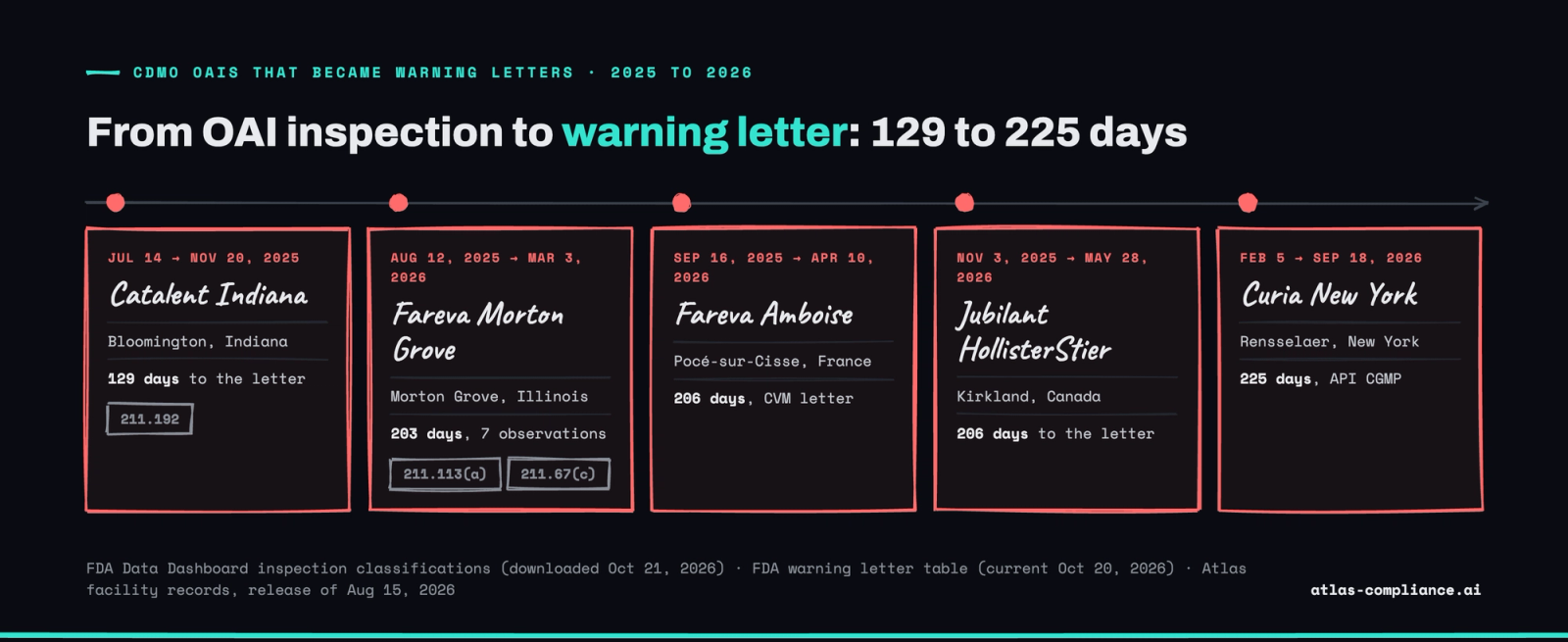
An OAI at a CDMO usually leads to a warning letter within months: five of the 10 CDMO OAI inspections in this window were followed by one, 129 to 225 days after the inspection ended, according to FDA's warning letter table as of October 20, 2026. The other five OAIs, all from inspections that ended in 2026, had no posted letter by that date.
| Facility in the CDMO cohort | Inspection ended | Warning letter | Days |
|---|---|---|---|
| Catalent Indiana, Bloomington, Indiana | July 14, 2025 | November 20, 2025 | 129 |
| Fareva Morton Grove, Illinois | August 12, 2025 | March 3, 2026 | 203 |
| Fareva Amboise, France | September 16, 2025 | April 10, 2026 (CVM) | 206 |
| Jubilant HollisterStier, Kirkland, Canada | November 3, 2025 | May 28, 2026 | 206 |
| Curia New York, Rensselaer, New York | February 5, 2026 | September 18, 2026 | 225 |
Catalent Indiana is the clearest record. Atlas holds 19 FDA inspections for the Bloomington facility, 13 of them ending with a Form 483, and FDA's data classify two of them OAI in this window: July 2025 and April 2026. The November 20, 2025 warning letter, which followed the June 23 to July 14, 2025 inspection, cites 21 CFR 211.192 first and 211.113(b) second, and describes deviations in drug products made for multiple customers. Curia New York's Rensselaer facility has 9 inspections on record and 5 Form 483s; its September 2026 letter covers active pharmaceutical ingredient CGMP. Fareva Morton Grove is in the cohort by name only: FDA's March 3, 2026 letter describes the over-the-counter drug products made there as the firm's own, the name-matching limit explained in the method section below. The five OAIs without a posted letter were at Oakwood Laboratories in Solon, Ohio, Pharmaceutics International in Cockeysville, Maryland, Unither Manufacturing in Rochester, New York, EuroAPI in Brindisi, Italy, and Catalent Indiana's April 2026 inspection.
How do you vet a CDMO's FDA inspection record?
Vetting a CDMO's FDA inspection record takes five checks on the specific facility that will make your product: pin its address and FEI number, pull every inspection for at least five years, read the Form 483 sections, check for warning letters and import alerts, then write notification duties into the quality agreement.
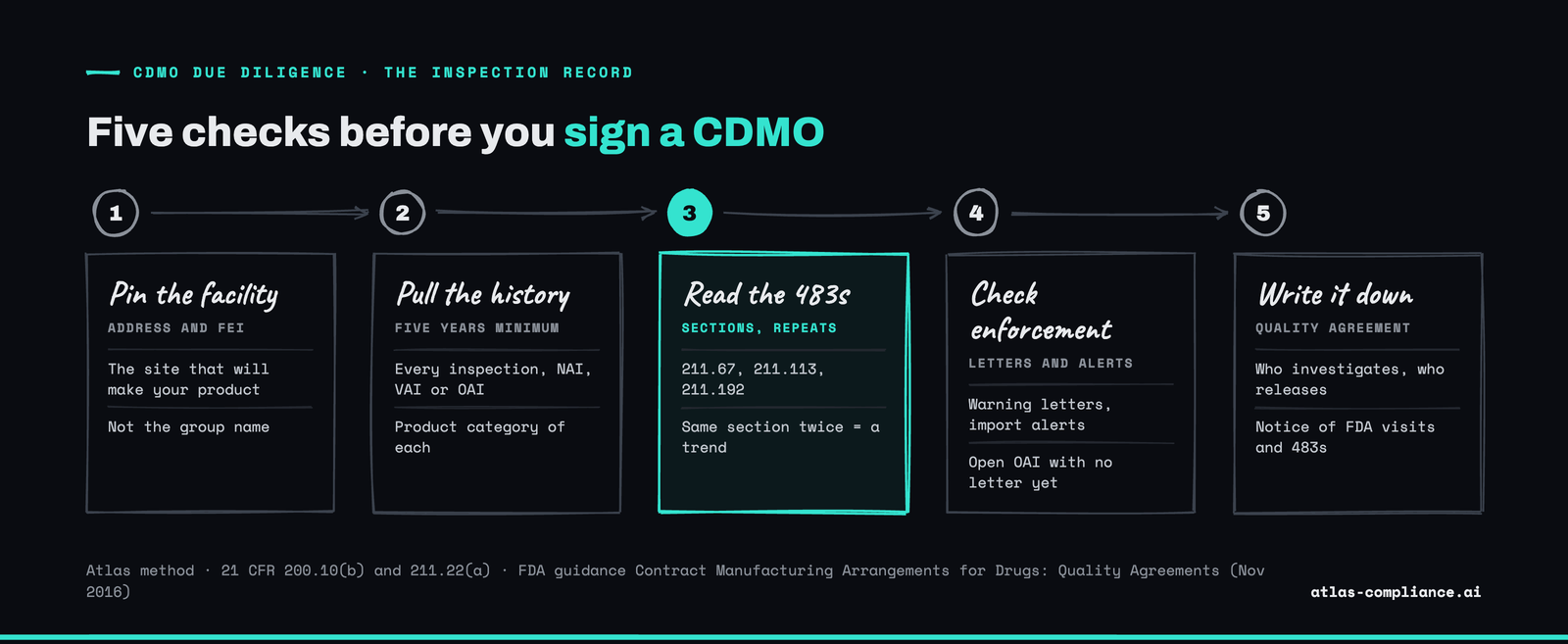
- Pin the facility. A CDMO group runs many facilities under one brand, and each carries its own FEI number. Confirm the street address in the supply agreement and look up that FEI, not the group name. The FDA registration lookup guide shows where to find it.
- Pull the history. Search the facility in the FDA-inspected sites directory and list every inspection with its outcome and product category. A biologics inspection and a human drugs inspection at the same address tell you different things.
- Read the Form 483s. Look for 211.67, 211.113 and 211.192, the sections FDA writes most at CDMOs, and for any section cited on two consecutive forms. A repeat means a CAPA that did not hold.
- Check enforcement. Look for warning letters, import alerts and recalls under the facility's name. Treat an OAI with no letter yet as an open enforcement case.
- Write it down. The quality agreement should require the CDMO to tell you within a set number of days when FDA arrives, when a Form 483 is issued and when the classification comes back, and to share its response.
Ask the CDMO for its own 483 responses during the audit. The response shows whether the facility found the root cause or rewrote a procedure.
How Atlas built the CDMO numbers
FDA does not label any facility as a CDMO, so Atlas built the cohort by firm name: facilities whose legal name matches a company on an Atlas list of firms that sell contract development and manufacturing as their main business, such as Catalent, Lonza, Patheon, Curia, Fareva and Corden Pharma. Contract testing laboratories and contract research organizations are excluded.
The base is FDA Data Dashboard inspections and citations exports downloaded October 21, 2026, limited to the Drugs product type and the Drug Quality Assurance program, for inspections ending January 2, 2025 to October 14, 2026 that FDA had classified. That gives 100 CDMO inspections at 99 facilities and 1,874 at other drug facilities. Citation shares use only inspections with posted Form 483 citations, 32 for CDMOs and 781 overall, and count each section once per inspection. Warning letters come from FDA's warning letter table as of October 20, 2026. Facility totals and Form 483 detail come from Atlas records, release of August 15, 2026.
Two limits apply. Name matching misses CDMOs that trade under other names and catches some sister facilities that make their own products. Recent inspections are still being classified, so the OAI count for 2026 will rise.
AtlasFDA Inspection Intelligence Digest
We track every 483, EIR, and warning letter the moment it happens. Get the signals before they hit the FDA website.
Frequently asked questions
CDMO stands for contract development and manufacturing organization. The term covers companies that take a drug from formulation or process development through GMP manufacturing for another company. Some firms and older sources write "contract development and manufacturing organisation" or call the same business a CDMO and a CMO interchangeably; FDA uses neither label and inspects the facility as a drug establishment.

Written by
Bhavish Agarwal
Founder, Atlas
Bhavish Agarwal is the founder of Atlas and previously worked at Google and Microsoft. He has spent the past several years building regulatory data infrastructure for the pharmaceutical industry.